
AI Actor vs Hiring a Model for Ads (Cost & Quality)
AI actor vs hiring a model for ads: a clear 2026 breakdown of cost, quality, speed, and usage rights, plus exactly when to use each for your campaigns.
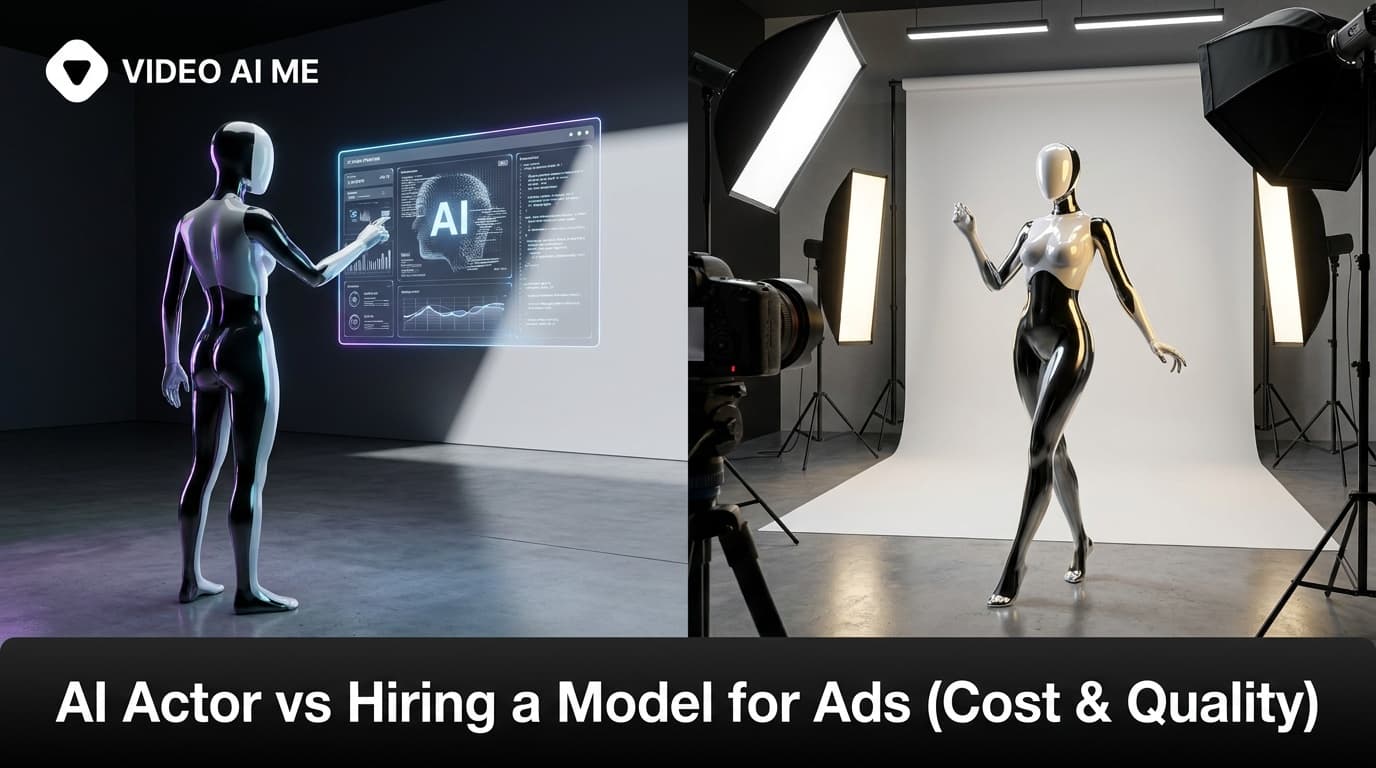
The choice between an AI actor vs hiring a model for ads now decides how many creatives you can test, how fast you can ship them, and how much of your budget survives the process. A single agency model can cost more for one shoot than a month of AI video tools, yet a human still brings something a generated face cannot fully copy. This guide breaks down cost, quality, speed, and usage rights with real numbers, then shows exactly when each option wins.
This is not a hype piece. We will name the trade-offs honestly, because picking wrong here wastes both money and weeks you do not have. By the end you will know which path fits your brand, your budget, and the volume of ads you actually need to run.
What "AI Actor vs Hiring a Model" Really Means
An AI actor is a generated or licensed digital spokesperson that delivers your script as a talking-head video. You write the words, choose the look, and the system produces a lip-synced clip in minutes. No casting, no studio, no scheduling.
Hiring a model means booking a real person through an agency or directly, then running a shoot. You pay for their time, the crew, the location, and the rights to use the footage in your ads.
Both can produce the authentic, UGC-style talking-head ads that perform on Meta and TikTok. The difference is in how you get there, what it costs, and what you are allowed to do with the result. The AI actor vs hiring a model decision is really a decision about scale, speed, and control.
Cost: AI Actor vs Hiring a Model
Cost is where the two paths separate most sharply. Real talent is priced per shoot and per usage. AI actors are priced per subscription, with effectively unlimited variations inside your plan limits.
Published 2026 rates give us solid reference points. For e-commerce and catalog work, agency models typically charge around $800 to $1,500 per day, and hero campaign talent for homepages and social ads often runs $2,000 to $5,000 per day. Hourly bookings commonly land between $50 and $250 per hour plus a roughly 20% agency fee.
Those numbers are only the talent line. A real shoot also carries crew, equipment, location, editing, and travel costs. By contrast, AI platforms that include commercial rights typically cost $10 to $50 per month, and that single fee covers the talent stand-in across every ad you generate.
Here is a side-by-side of the realistic cost picture.
| Cost factor | Hiring a model | AI actor |
|---|---|---|
| Talent fee | $800 to $5,000+ per day | Included in subscription |
| Agency fee | ~20% on top of talent | None |
| Crew and studio | Often required | None |
| Subscription | None | ~$10 to $50 per month |
| Cost per extra variation | New shoot or reshoot | Marginal, often near zero |
| Usage rights | Priced separately, can scale fast | Usually included on paid plans |
Industry analysis backs the gap. UGC fundamentals research points to roughly a 50% cost reduction with AI UGC versus human creators, and that figure does not even count the reshoot costs you avoid when you need a new hook. For a deeper line-item look, see our UGC creator vs AI UGC cost comparison.
Quality: Where Each Option Wins
Cost only matters if the output performs. So how does quality compare in the AI actor vs hiring a model contest?
Real models still hold an edge in a few places. A skilled human brings spontaneity, micro-expressions, and lived emotion that read as deeply genuine. For a flagship brand film or a high-trust hero spot, that authenticity can be worth the premium, and a creative director on set can steer storytelling in real time.
AI actors have closed much of the gap, especially platforms built on real-person likenesses, which feel more natural than older avatar tools. Where AI clearly wins is consistency and control. You get the same quality every time, you script every word, and you can adjust tone, outfit, or setting without rebooking anyone.
There is also a performance argument. UGC research shows AI-driven campaigns can reach roughly 350% higher engagement on TikTok and Meta and around 4x stronger click-through versus traditional content, largely because AI lets you test far more hooks. The winner is rarely the single most polished clip, it is the variation that resonates, and you only find it by testing many.
A few quality realities to keep in mind:
- AI handles volume and iteration better than any human shoot.
- Humans handle nuanced, unscripted emotion better than any model today.
- The best-performing ad is usually a tested hook, not the prettiest production.
- Consistency across dozens of variations is far easier with an AI actor.
For a head-to-head on output realism, our AI avatar vs real video comparison goes deeper on how the formats look on screen. If you want to see how the leading tools stack up, our roundup of the best AI UGC generators compares the platforms that produce these talking-head ads.
It is also worth being honest about where AI quality still slips. Long, complex monologues, heavy emotional range, and tightly choreographed action are harder to nail than a simple 20-second talking-head. For the UGC-style ads most growth brands run, that ceiling rarely matters, because the format is built around a single person talking straight to camera. But if your concept depends on subtle, layered performance, a real actor remains the safer bet.
Speed and Volume
Speed is the quiet reason AI actors keep winning ad budgets. A real shoot is a project: casting, scheduling, the shoot day, then editing. From brief to first asset, that is often weeks.
An AI actor compresses that to a workflow you can finish in an afternoon. You write a script, pick a face, and generate the clip. Need a different hook? Change two lines and generate again.
That speed unlocks volume, and volume is how modern paid social actually works. Serious DTC brands run 20 to 40 new UGC variations per month to keep feeding the algorithm fresh creative. Reaching that cadence with human shoots is brutally expensive. Reaching it with AI is routine.
- Human shoot: weeks per batch, high cost per variation.
- AI actor: hours per batch, near-zero cost per extra variation.
- Testing many hooks is how you find winners, and AI makes that affordable.
Usage Rights: The Hidden Cost Most People Miss
Usage rights are where hiring a model gets complicated, and where many budgets quietly blow up. A model's fee is tied to how, where, and how long you use the footage. The same image costs more on a national billboard than a local one, and more for a year-long campaign than a one-week burst.
Run the ad longer than agreed, in more markets, or across more channels, and you owe more, sometimes a lot more. That makes scaling a winning human-led ad expensive in a way that is easy to forget at signing.
AI platforms generally fold commercial use into their paid plans, so advertising and marketing usage is included with relatively straightforward licensing. You are not renegotiating every time a campaign expands.
There is a real caution on the human side worth naming. Some actors have publicly regretted licensing their likeness to AI firms after losing control of how their image gets used. If you license a real person's face for AI generation, the agreement terms matter enormously. The cleaner path for most brands is using purpose-built AI actors with clear commercial licensing.
One more rule applies to both: ads must be truthful and not deceptive. The FTC expects transparency when an AI actor delivers a testimonial or endorsement, so use AI spokespeople for product messaging rather than pretending they are real customers.
When to Use Each: A Simple Decision Guide
Neither option is universally right. The smart move is matching the tool to the job. Here is how to decide in the AI actor vs hiring a model trade-off.
Choose an AI actor when:
- You need volume, such as many ad variations to test on Meta or TikTok.
- Speed matters and you cannot wait weeks for a shoot.
- Budget is tight and you want predictable, low monthly cost.
- You operate in a regulated space and need tight script control.
- You want to scale a winning ad across markets without new usage fees.
Choose a hired model when:
- You are producing a flagship brand film where premium authenticity justifies the spend.
- The concept needs unscripted, deeply emotional human performance.
- A specific real person, such as a known founder or athlete, is the point.
- You have the budget and timeline for a full production.
For most early-stage and growth-focused brands running paid social, the answer is a hybrid. Use AI actors to test fast and find winners, then invest in a human shoot for the rare hero asset that earns it. UGC research suggests a roughly 70% AI and 30% human split balances volume with high-trust standouts.
Ready to test the AI side without booking a single shoot? Create AI UGC ads with VIDEO AI ME and generate your first batch of talking-head variations in minutes.
How to Get Started With AI Actors
If you lean toward AI, the workflow is straightforward. Follow these steps to ship your first ad.
- Write a short UGC-style script with a hook, a problem, proof, and a clear call to action.
- Pick an AI actor whose look fits your audience and brand.
- Generate the talking-head clip and review the lip-sync and tone.
- Produce several variations by swapping the hook and opening line.
- Add captions, since most viewers watch without sound.
- Launch the variations as paid social tests and scale the winners.
Keep each clip short, 15 to 30 seconds, vertical for feeds, and lead with the hook in the first three seconds. That structure is what turns a generated clip into an ad that actually converts.
A practical tip: do not chase a single perfect ad. Generate five to ten hook variations on day one, launch them all small, and let spend flow to the one or two that earn the cheapest clicks. This is the exact workflow that makes AI actors so cost-effective, because the marginal cost of the next variation is close to nothing. With a hired model, that same test would mean five to ten setups you simply cannot afford to shoot.
The Bottom Line
In the AI actor vs hiring a model debate, AI wins on cost, speed, volume, and usage simplicity, while a hired model still wins on premium, unscripted authenticity for flagship work. Most brands do not have to choose one forever. Test broadly with AI, reserve human shoots for the moments that truly need them, and let performance data decide where your budget goes.
If your goal is more sales from paid social and you are running lean, AI actors are the faster route to the volume that wins. Start there, measure, and scale what works.
Frequently Asked Questions
Share
AI Summary
Paul Grisel
Paul Grisel is the founder of VIDEOAI.ME, dedicated to empowering creators and entrepreneurs with innovative AI-powered video solutions.
@grsl_frReady to Create Professional AI Videos?
Join thousands of entrepreneurs and creators who use VIDEO AI ME to produce stunning videos in minutes, not hours.
- Create professional videos in under 5 minutes
- No video skills experience required, No camera needed
- Hyper-realistic actors that look and sound like real people
Get your first video in minutes
Related Articles
How to Turn Customer Reviews Into Video Ads (AI)
Learn how to turn reviews into video ads with AI, ethically. Pick strong reviews, script them, generate with an AI presenter, disclose, and test.
8 Best VEED Alternatives for AI Video Ads (2026)
The 8 best VEED alternatives for 2026, compared by price, category, and use case. See why an AI UGC ad generator may beat an editor for ad creative.
Revid AI Alternatives for Faceless & UGC Video (2026)
The best Revid AI alternatives for faceless content and UGC ads in 2026, compared side by side with a clear guide on which tool fits your goals.