
AI Lip Sync + Multilingual Video for SaaS (2026)
How SaaS teams localize product videos with AI lip sync and multilingual generation in 2026. Workflows, tools, languages, and real B2B examples.
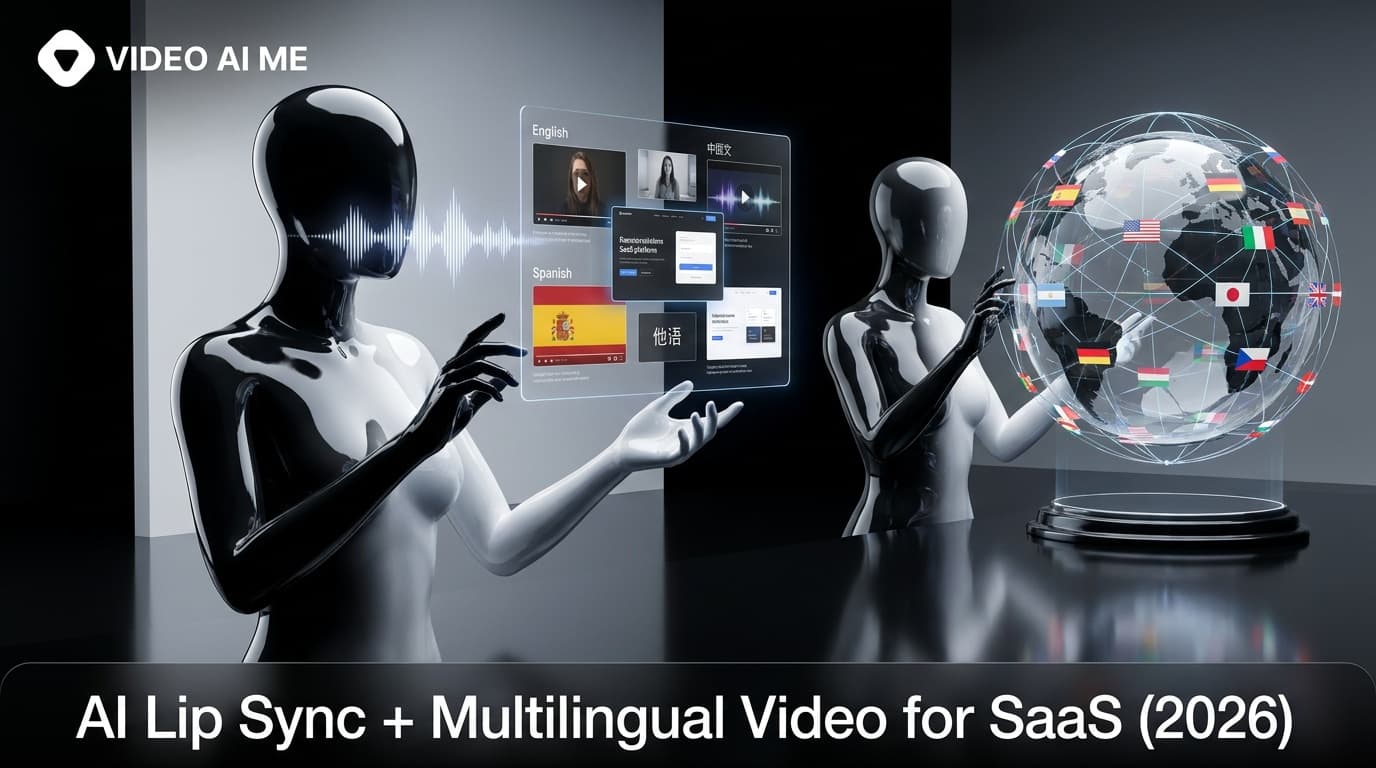
SaaS Localization Used to Be Brutal
Launching a SaaS product in a new language market used to mean rebuilding the marketing site, re-recording the demo video, re-shooting the welcome video, and re-doing the help center content. Each market added 3 to 6 months of work and tens of thousands in production cost. Most SaaS teams skipped it. They launched in English, hoped the buyers in Mexico or Germany would adapt, and watched activation drop in non-English cohorts.
AI lip sync and multilingual video generation changed that math in 2026. The same SaaS product video can ship in Spanish, German, French, Portuguese, Japanese, Italian, and 25 other languages within an hour. Same AI actor, same voice (cloned), updated mouth movement per language. Brand consistency holds across markets while the buyer hears their own language.
This guide covers how SaaS teams use AI lip sync and multilingual video inside VIDEOAI.ME in 2026. Real workflows, real use cases, and a plan to localize a SaaS marketing video library in one quarter instead of four.
Why SaaS Companies Need AI Multilingual Video Now
Four forces moved AI multilingual video from experimental to required for SaaS expansion in 2026.
First, activation rates drop sharply when SaaS onboarding is in the wrong language. A buyer in Sao Paulo starting a free trial in English activates less often than a buyer in Sao Paulo starting in Portuguese. The activation gap closes when content is localized.
Second, geographic expansion is faster than ever. SaaS companies launched in LATAM and DACH in months, not years, in 2024 and 2025. The bottleneck shifted from product readiness to marketing localization. AI video removed that bottleneck.
Third, YouTube SEO is multilingual. A "how to do X in your SaaS" video in Spanish ranks for Spanish queries the same way the English version ranks for English queries. SaaS teams that ship localized YouTube libraries capture pipeline in markets competitors are not even targeting.
Fourth, voice cloning preserves brand consistency. The same founder voice ships in five languages. Customers in Spain hear the same person Customers in Brazil hear, just in their own language.
Where SaaS teams ship AI multilingual video in 2026:
- Localized landing page hero videos
- Translated feature page deep dives
- Multilingual free trial welcome emails
- Localized in-product onboarding flows
- Translated help center video library
- YouTube SEO in target market languages
- Sales outreach in the buyer's native language
How AI Lip Sync Works for SaaS Localization
The traditional approach to multilingual video was dub audio over the existing video. The result: the mouth says English while the audio plays Spanish. Viewers in non-English markets pattern-recognized this as low-effort localization.
AI lip sync re-renders the mouth movement to match the new language's phonemes. The viewer sees the actor's mouth forming Spanish words while hearing Spanish audio. The visual mismatch disappears.
What AI Lip Sync Does
- Updates lip and tongue position frame by frame to match new audio
- Preserves facial expression, eye contact, gesture, and pace
- Works on AI-generated actors and on real recorded video
- Supports 30 plus languages on VIDEOAI.ME
What AI Lip Sync Does Not Do
- Translate scripts (you provide the translation)
- Generate audio in the new language (use voice cloning or text-to-speech for that)
- Localize cultural references (you still need to adapt jokes, currency, examples)
How to Localize a SaaS Product Video (Workflow)
The complete workflow from English source video to five localized versions in under one hour.
Step 1: Generate the English Source Video
Produce the source video in English using VIDEOAI.ME. Pick an AI actor, use voice cloning if you want the same voice across languages, layer real product UI behind. Standard SaaS product video workflow.
Step 2: Translate the Script
Use a professional translator or a quality AI translation tool for the script. Do not just plug English into Google Translate and call it done. SaaS jargon, product names, and feature descriptions need careful translation. Have a native speaker review.
Step 3: Generate Localized Audio
Three options for the localized audio:
- Same voice clone in the new language: VIDEOAI.ME supports voice cloning that holds across multiple languages with native pronunciation
- Stock text-to-speech voice in the new language: fast, no clone needed
- Native speaker recording: highest quality, slower
Step 4: Apply AI Lip Sync
Use the lip sync workflow inside VIDEOAI.ME. Upload the new language audio, point at the source video, generate. The output video has the original actor with mouth movement updated to match the new language.
Step 5: QC and Ship
Review each language render with a native speaker. Check for translation issues, cultural fit, and any lip sync artifacts on tricky phonemes. Ship.
Languages That Matter Most for SaaS Expansion
The major SaaS expansion language priorities for 2026:
Spanish
Mexico, Spain, Argentina, Colombia, Chile. One language unlocks the LATAM and Iberian markets. Spanish localization is usually the highest ROI first localization for SaaS expansion.
Portuguese
Brazil specifically. Sao Paulo has a meaningful SaaS buyer base. Portuguese is the second highest ROI language for most SaaS expansion plans into LATAM.
German
Germany, Austria, Switzerland (DACH). German enterprise SaaS buyers expect localized content as a baseline trust signal.
French
France, Belgium, Canada (Quebec). Mid-market and enterprise SaaS expanding to European markets need French.
Japanese
Japan has a large SaaS market with high willingness to pay. Cultural and language differences make localization essential, not optional.
Italian
Italy's mid-market SaaS demand is strong in 2026. Italian localization unlocks pipeline that English-only competitors miss.
Dutch
The Netherlands has unusually high SaaS adoption per capita. Dutch buyers consume English content too, but localized content lifts activation.
Prompt example: 35-second multilingual SaaS announcement for LATAM and DACH markets
Style: clean SaaS announcement, soft daylight, modern office, smartphone capture, slight bokeh, brand-consistent.
Scene: A 33 year old SaaS regional lead sits at a clean glass-top desk in a daylight-bright office. Wearing a plain white tee under a charcoal blazer. Behind: a soft gray wall with a single framed map of regional markets and a small fiddle leaf plant on a low stool. A 14 inch laptop is angled toward camera left showing the localized product UI.
Cinematography: Camera shot: medium close-up, eye-level, chest-up framing. Lens: 35mm equivalent, f2.8, shallow depth. Lighting: large window key from camera left, soft bounce from camera right, color anchors of cool white, deep charcoal, glass green, brushed metal, and pale oak. Mood: warm, confident, regionally welcoming.
Actions:
- Lead nods to the lens, then turns the laptop slightly so the localized UI shows.
- Lead taps once on the trackpad and a language switch animates on screen.
- Lead ends with a small smile and a single hand gesture toward the lens.
Dialogue:
- Lead: "Today we ship in your language. Free trial, same product, your words."
Background sound: Low room tone, soft far-off keyboard, one quiet trackpad click.
Generate the English master in VIDEOAI.ME, then run the same actor and cloned voice through multilingual video for Spanish, Portuguese, German, French, and Japanese cuts. AI lip sync updates the mouth movement per language.
Real SaaS Multilingual Use Cases
Three SaaS teams running AI multilingual video. Personas invented, workflows real.
Use Case 1: Stackmesh, a Developer Tools SaaS Expanding to DACH
Stackmesh launched in Germany. They generated their entire YouTube video library in German using AI lip sync and voice cloning. The German YouTube channel now ranks on "wie [feature] in [product]" queries that the English channel never could.
Use Case 2: Reachbase, a Sales SaaS for LATAM Markets
Reachbase launched in Mexico and Brazil. They generated their full free trial welcome flow in Spanish and Portuguese. Activation rate in those markets climbed compared to the previous English-only flow.
Use Case 3: Loopstack, a Productivity SaaS in Japan
Loopstack expanded to Japan. They generated their entire onboarding video library in Japanese with AI multilingual video. Japanese users complete onboarding at a higher rate now that the videos are in their native language.
Channels for Multilingual SaaS Video Distribution
One localized SaaS video, six placements per language:
- Localized landing page hero
- Localized free trial welcome email
- Localized in-product onboarding step
- Localized YouTube channel for SEO
- Localized help center content
- Localized paid ad creative on Meta, LinkedIn, and TikTok in that market
Generate all six placements from one master per language using VIDEOAI.ME.
Comparison Table: AI Multilingual Video vs Traditional Localization for SaaS
| Factor | AI Multilingual (VIDEOAI.ME) | Traditional Localization |
|---|---|---|
| Cost per language per video | $5 to $20 | $1,500 to $5,000 |
| Time to ship per language | 30 minutes | 2 to 4 weeks |
| Number of languages per source | 30 plus | One per shoot |
| Voice consistency across languages | Native (voice cloning) | Different voice talent per language |
| Actor consistency across languages | Same AI actor in all languages | Different actor per language usually |
| Updates when source changes | Re-render minutes | Re-shoot every language |
| Best for | Onboarding, ads, YouTube SEO | Hero brand films |
FAQ
See the FAQ above for the most common questions SaaS marketing teams ask when localizing video content for new language markets.
Next Steps
SaaS expansion is no longer gated by the cost of localizing marketing video. AI lip sync and multilingual video tools removed that gate in 2026. The teams that move first capture pipeline in markets competitors are still ignoring.
Try VIDEOAI.ME free and localize your first SaaS marketing video into a new language this afternoon. Want to see one running on your highest-traffic LATAM or DACH page? Pick the highest-impact placement (free trial welcome email, landing page hero, or onboarding step one), generate the English source, translate the script, and ship the localized version through multilingual video.
More SaaS marketing reading: AI avatars for SaaS marketing, AI product video for SaaS, and best free AI video generators for SaaS.
Frequently Asked Questions
Share
AI Summary

Paul Grisel
Paul Grisel is the founder of VIDEOAI.ME, dedicated to empowering creators and entrepreneurs with innovative AI-powered video solutions.
@grsl_frReady to Create Professional AI Videos?
Join thousands of entrepreneurs and creators who use VIDEO AI ME to produce stunning videos in minutes, not hours.
- Create professional videos in under 5 minutes
- No video skills experience required, No camera needed
- Hyper-realistic actors that look and sound like real people
Get your first video in minutes
Related Articles
MiniMax H3 for Founders Making Their Own Ads
You have no crew, no budget for one and limited patience. How to produce your own video ads without appearing on camera or learning an editing suite.
Best Vox-Style Explainer Tool for Startups
The best vox-style explainer tool for startups makes cheap, fast editorial explainers for launch, waitlist, and fundraising, with no designer and approve-before-spend.
Best Vox-Style Explainer Tool for SaaS (2026)
The best vox-style explainer tool for SaaS explains an invisible product in 30 seconds. Here are the buying criteria, a comparison table, and where VIDEO AI ME fits.