
9 AI UGC Ad Mistakes That Kill Your ROAS (2026)
The nine AI UGC ad mistakes draining your ad budget, from slow hooks to creative fatigue, plus a concrete fix for each so your next batch actually converts.
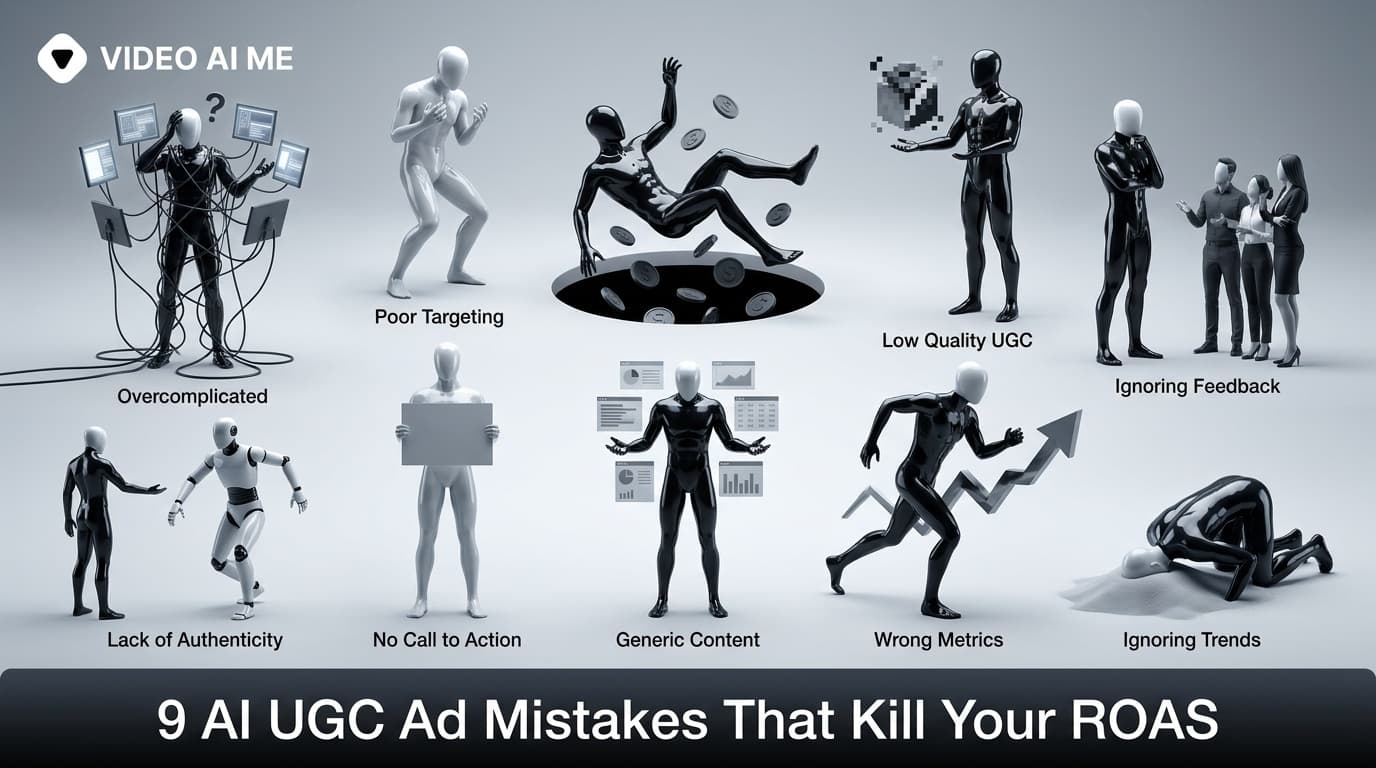
You spun up a batch of AI UGC ads, pushed spend behind them, and the dashboard came back ugly: high CPMs, a 0.6% CTR, and a ROAS that does not cover the product cost. Before you blame the tool, know this: most AI UGC ad mistakes are not about the AI at all. They are about hook, pacing, casting, and CTA decisions that would sink a human-shot ad just as fast.
This guide breaks down the nine most common AI UGC ad mistakes that kill your ROAS, with a concrete fix for each one. These are the patterns we see again and again from solo founders and small DTC and SaaS teams who generate dozens of ad variations and still cannot find a winner. Fix these and the same generation tool that gave you losers will start giving you scalable creatives.
The good news: every one of these is a controllable input. AI UGC ads are only as good as the brief, the script, and the edit you feed in. Let us go through the failures in the order that costs the most money.
Why most AI UGC ad mistakes are conversion mistakes, not "AI" mistakes
It is tempting to think a low ROAS means the avatar looked fake or the lip-sync was off. Sometimes that is true. Far more often, the ad lost the viewer in the first three seconds, never gave a reason to care, and never asked for the click.
The first two to three seconds of a paid social video decide whether anyone sees the rest. Industry creative teams routinely report that the hook drives the large majority of an ad's outcome, and Meta's own creative guidance stresses front-loading the message. That is not an AI problem. That is a creative-strategy problem that AI happens to scale, which means it also scales your mistakes.
So treat your AI UGC ad mistakes as a checklist of conversion levers. Each fix below maps to a specific stage of the ad: the hook, the script, the casting, the edit, and the offer.
The 9 AI UGC ad mistakes that kill your ROAS
Here is the short version before we go deep. These are the nine AI UGC ad mistakes draining your ad budget:
- A slow hook that buries the lead
- Scripts that sound like a press release
- Casting an avatar your customer cannot relate to
- A static frame that never changes
- No captions for sound-off viewers
- No clear call to action
- Testing too many variables at once
- Running the same two or three creatives until they fatigue
- Forcing one video onto every platform
Mistake 1: A slow hook that buries the lead
The single most expensive mistake is a weak opening. Many UGC scripts spend the first ten to fifteen seconds on a personal intro before the product ever appears. By then the viewer has scrolled.
A hook has to create a pattern interrupt: tension, curiosity, or a bold claim in the first three seconds. With AI UGC you have no excuse to ship a slow hook, because you can generate a dozen openings in minutes.
The fix: write the hook first and the body second. Open on the problem or the result, not a greeting. Then batch-generate five to ten hook variations against the same script body and let cost-per-click pick the winner. Our tested scroll-stopping hook formulas give you templates that plug straight into an AI script.
Mistake 2: Scripts that sound like a press release
AI will happily write polished, corporate copy if you let it. That is exactly what you do not want. Stiff, jargon-filled language is the fastest way to get scrolled past, because it signals "ad" to a brain that is hunting for "ad" to ignore.
UGC works because it feels like a peer talking, not a brand broadcasting. The moment your script reads like it came from a marketing department, the peer-recommendation effect that makes UGC powerful disappears.
The fix: write the way people actually talk. Short sentences. Contractions. One idea per line. Read the script out loud, and if you would never say it to a friend, cut it. Prompt your generation tool for a casual, first-person, conversational tone and explicitly ban marketing jargon.
Mistake 3: Casting an avatar your customer cannot relate to
Avatar selection is treated as an afterthought far too often. People pick whoever looks most polished or appealing to themselves, rather than the person their target customer would trust.
UGC converts on relatability and aspiration. If the face on screen does not feel like someone the viewer could be, or could become, the trust signal collapses and so does the click-through rate.
The fix: match the avatar to the buyer, not to your taste. A skincare ad for women in their 40s should not default to a 22-year-old. Generate the same script with two or three different actors and demographics, then test which one your audience actually responds to. With the right AI UGC generator, you can spin up the exact persona your customer trusts and test several at once.
Mistake 4: A static frame that never changes
A huge share of UGC ads fail because the frame is too consistent. One person, one angle, one background, for thirty seconds. The eye habituates and the thumb keeps moving.
Short-form pacing wants a visual reset every three to five seconds: a cut, a zoom, a new angle, a caption change, or a b-roll insert. Without it, even a great script feels flat.
The fix: plan the edit, not just the talking head. Cut between the spokesperson and product b-roll, change the framing, and add motion. Many AI UGC ads die in the edit, not the script, so treat the timeline as a deliberate part of the build.
Mistake 5: No captions for sound-off viewers
A large majority of people watch social video with the sound off. If your AI UGC ad has no captions, you are invisible to most of your audience the moment they tap past the volume.
This is one of the cheapest mistakes to fix and one of the most common to skip. Captions are not optional polish; they are a core part of comprehension on mute.
The fix: burn in bold, legible captions on every ad. Keep lines short, highlight the hook and the key claim, and make sure they are readable on a small phone screen. Most quality AI UGC tools generate captions automatically, so there is no reason to ship without them.
Mistake 6: No clear call to action
A polished video that never asks for anything is a brand awareness piece, not a performance ad. Plenty of AI UGC ads describe a product beautifully and then just end. The viewer enjoyed it and did nothing.
Paid social ads need a single, specific next step. Vague endings like "check us out" leave conversion intent on the table.
The fix: end with one explicit CTA tied to the offer: "Tap the link to get 20% off your first order" beats "learn more." Say it on screen and in the caption. Test CTA wording the same way you test hooks, since the close is a high-leverage variable.
Mistake 7: Testing too many variables at once
This is the AI-specific trap. Because you can generate so many variations, it is tempting to change the hook, the actor, the music, and the offer all in one batch. Now you have noise, not signal, and no idea what actually moved ROAS.
Disciplined creative teams isolate three dimensions: hook, CTA, and pacing. They change one at a time so the data is clean.
The fix: hold the body constant and swap one element per test. Start with hooks, because they are the highest-leverage lever, then move to CTA, then pacing. The 3-layer UGC creative framework for Meta lays out a structured way to test without muddying your results.
Mistake 8: Running the same two or three creatives until they fatigue
Creative fatigue is a silent ROAS killer. Running the same handful of ads for weeks pushes frequency up, CTR down, and CPMs through the roof. By the time the dashboard shows the decline, you are already losing money.
UGC creatives have a short shelf life on paid social. Without a steady pipeline of fresh variations, every winner eventually wears out and drags your account average down with it.
The fix: treat creative as a renewable input, not a one-time asset. Refresh the ad set with new variations on a regular cadence and retire creatives as frequency climbs. This is the core advantage of AI UGC: you can produce the volume needed to stay ahead of fatigue. See how to make AI UGC ads at scale without creators.
Mistake 9: Forcing one video onto every platform
A single horizontal video pushed to every channel is a guaranteed underperformer. A 60-second 16:9 ad looks wrong on vertical-first TikTok and Instagram Reels, and the pacing that works on YouTube falls flat in a feed.
Each platform has its own format, length, and tone expectations. Ignoring them wastes the creative you worked to build.
The fix: generate platform-native versions. Vertical 9:16 for TikTok and Reels, the right length for each placement, and hooks tuned to how people scroll on that surface. Because re-generating in a new aspect ratio is fast with AI, there is no reason to ship a one-size-fits-all cut.
A quick reference: mistake, symptom, and fix
| Mistake | What you see in the data | The fix |
|---|---|---|
| Slow hook | Low 3-second view rate, high CPM | Lead with problem or result; test 5-10 hooks |
| Press-release script | Low CTR, fast scroll-away | Conversational, first-person, no jargon |
| Wrong avatar | Low engagement, weak CTR | Cast to the buyer, test demographics |
| Static frame | Drop-off mid-video | Visual reset every 3-5 seconds |
| No captions | Low completion on mute | Burn in bold, short captions |
| No CTA | Clicks but no conversions | One explicit next step on screen |
| Too many variables | Noisy, unreadable tests | Change one element per test |
| Creative fatigue | Rising frequency, falling ROAS | Refresh variations on a cadence |
| One-size video | Underperforms on some placements | Generate platform-native cuts |
How to build AI UGC ads that actually convert
Put the fixes together and a repeatable workflow emerges. This is the loop that turns AI volume into ROAS instead of waste:
- Write the hook first. Generate 5 to 10 openings around the problem or result.
- Script like a human. First person, conversational, jargon-free.
- Cast to the customer. Match the avatar to who your buyer trusts.
- Edit with motion. A visual change every 3 to 5 seconds, plus burned-in captions.
- Close with one CTA. Specific, offer-led, on screen and in copy.
- Test one variable at a time. Hooks first, then CTA, then pacing.
- Refresh before fatigue. Keep a pipeline of fresh variations running.
- Localize per platform. Vertical, native length, native tone.
None of this requires a film crew or a roster of paid creators. It requires discipline and volume, which is exactly where AI UGC earns its place. UGC-style content is known to drive far higher engagement than polished brand content, and broader marketing data from HubSpot shows short-form video remains the highest-ROI format, so the authentic, fast-iterating approach is not a compromise; it is the strategy that wins.
Ready to stop guessing? Generate your next batch of conversion-focused ads with the AI UGC generator built for performance ads, then run the nine-point checklist above before you put a dollar behind any of them.
Frequently asked questions
Frequently Asked Questions
Share
AI Summary

Paul Grisel
Paul Grisel is the founder of VIDEOAI.ME, dedicated to empowering creators and entrepreneurs with innovative AI-powered video solutions.
@grsl_frReady to Create Professional AI Videos?
Join thousands of entrepreneurs and creators who use VIDEO AI ME to produce stunning videos in minutes, not hours.
- Create professional videos in under 5 minutes
- No video skills experience required, No camera needed
- Hyper-realistic actors that look and sound like real people
Get your first video in minutes
Related Articles
How to Turn Customer Reviews Into Video Ads (AI)
Learn how to turn reviews into video ads with AI, ethically. Pick strong reviews, script them, generate with an AI presenter, disclose, and test.

8 Best VEED Alternatives for AI Video Ads (2026)
The 8 best VEED alternatives for 2026, compared by price, category, and use case. See why an AI UGC ad generator may beat an editor for ad creative.
Revid AI Alternatives for Faceless & UGC Video (2026)
The best Revid AI alternatives for faceless content and UGC ads in 2026, compared side by side with a clear guide on which tool fits your goals.