
AI Video API for Fitness App Builders (2026)
How fitness app teams use AI video APIs in 2026 for programmatic workout intros, personalized trainer messages, and in-app retention videos.
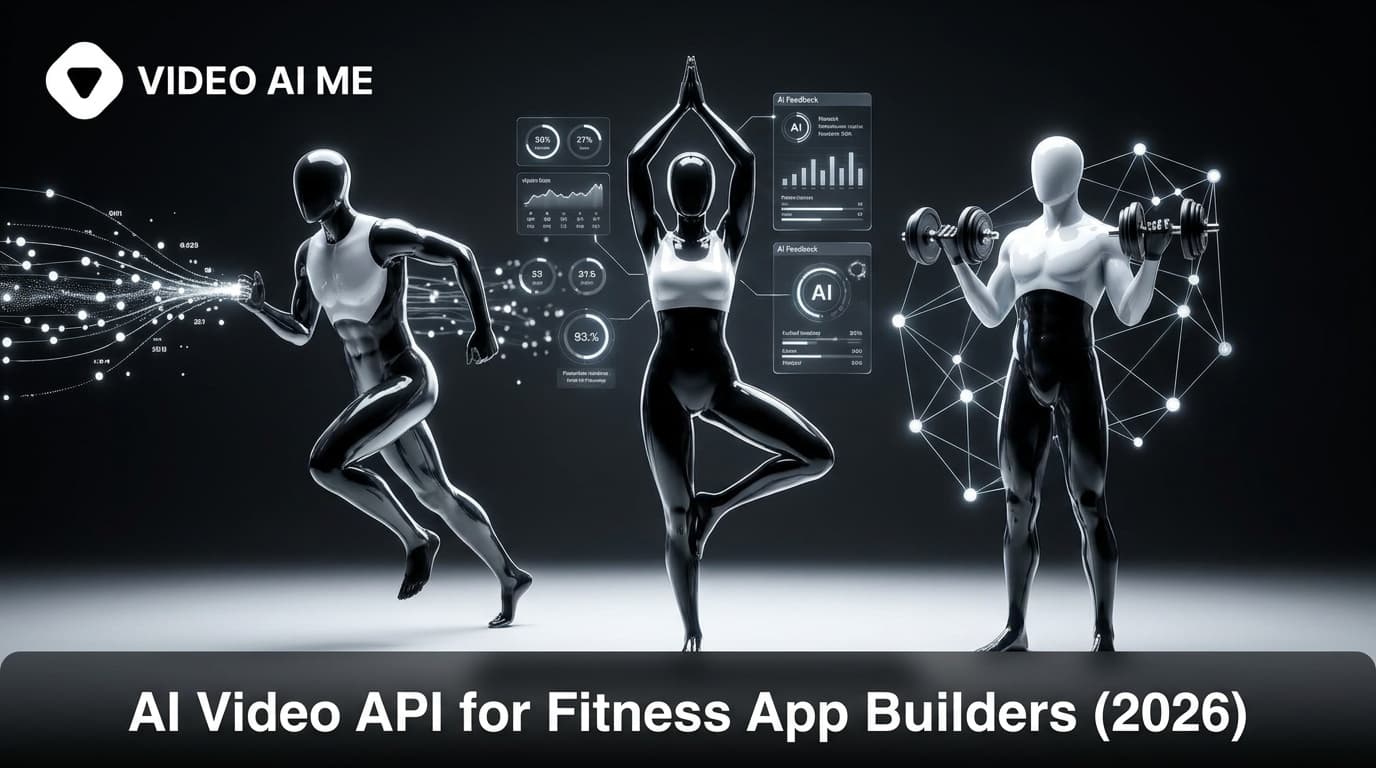
Why Fitness Apps Lose Half Their Paying Users by Week 4 and Static Workout Cards Cannot Save Them
A fitness app onboards a paying user at $14.99 a month. The user does 3 sessions that first week, 2 in week two, 1 in week three, and zero in week four. By week eight, the card has been cancelled. The team blames programming, blames push copy, blames the app store. The real problem: every user, on every session, sees the same static workout card with no human voice, no name, no acknowledgement of the program they picked. The user is paying for a trainer experience and getting a spreadsheet.
Fitness apps that win Week 4 retention in 2026 ship a personalized intro at the top of every workout. The clip is 15 to 20 seconds, addresses the user by name, references the program they picked on signup, previews today's focus, and ends on a single hype line. The user taps Start, the app plays the intro, and the workout begins. The adherence lift compounds across the program because the user shows up to a session that feels like it was made for them.
This is the workflow an AI video API unlocks. A backend worker calls the API the night before the scheduled session, renders the intro with a templated script, stores the URL on the user record, and the mobile client plays it when the user opens the app. Same pipeline, different trigger, also powers weekly recap videos, missed-week win-back clips, and personalized milestone celebrations on streak hits.
This guide is the fitness app builder playbook for AI video APIs in 2026, using VIDEOAI.ME's video API and lip sync API as the primary example. Endpoints, the integration workflow, three real personas, build versus buy economics, and pricing.
Why fitness app teams need an AI video API now
Three forces moved AI video APIs from a fun consumer toy to a fitness app primitive in 2026.
First, fitness app churn is brutal. Most consumer fitness apps lose more than half their paying users inside the first 8 weeks. Generic onboarding flows and static workout cards are not enough to keep a user logging sessions when motivation drops at Week 3. A personalized intro from a trainer who names the user and references their goal closes a meaningful percentage of that motivation gap.
Second, the user expectation shifted. People watched personalized social feeds for a decade. They no longer accept a fitness app where every user sees the same intro video. The 2026 generation of AI video APIs is fast and cheap enough to make per-user, per-session rendering a real product decision instead of a creative production cycle.
Third, the unit economics finally work. At $0.50 to $3 per 20 second clip in production, with aggressive caching at the program plus day plus locale level, a fitness subscription at $15 per month pays back the rendering spend in the first billing cycle if adherence lift holds. That is the threshold below which programmatic video stops being a luxury and becomes a default integration.
Where fitness app builder teams ship API-generated video in 2026:
- Pre-workout intros that name the user and preview today's session
- Weekly summary clips that show progress against the user's goal
- Personalized milestone videos when a user hits a 7, 30, or 90 day streak
- Missed-week re-engagement videos sent to lapsed users via push
- Localized program intros for international launches in Japan, Korea, Brazil
- In-app upsell clips inside the paywall that name the user and reference their training history
- Trainer voice swap on a stock workout intro, so a single video stocks the library in every coach voice
What you can build with an AI video API for fitness apps
Five concrete use cases the fitness app builder team can ship in a sprint or two.
Use case 1: Pre-workout personalized intro
A nightly worker iterates over users with a session scheduled for the next day. For each, it calls the render endpoint with a script that includes the user's first name, the program name, today's focus, and the target metric. The API webhook fires when the render completes and the URL gets stored on the session record. In the morning, the app reads the intro URL when the user opens the workout, plays it inline, then transitions to the workout flow. If the render is not ready (the user opened the app before the night job finished), the app plays a cached fallback intro and the personalized version queues for the next session.
Use case 2: Weekly summary recap clip
Every Sunday evening, a worker calls the video API for each active user with a recap script that mentions the user's name, the sessions completed that week, the calories burned or distance covered, and a preview of next week's plan. The clip is delivered via push notification with a deep link to the dashboard. Users who open the recap have a much higher Week 5 return rate than users who only see the static dashboard chart. The clip lives on the home screen until watched, then collapses into the weekly archive.
Use case 3: Milestone streak celebration
Product events fire on every successful session. When the streak counter hits 7, 30, or 90, a worker calls the video API with a celebration script that mentions the streak count, the user's program, and a preview of the next milestone. The clip is delivered via push and via an in-app banner. The team can also include a soft upgrade prompt for users on the free tier when the streak hits 30.
Use case 4: Missed-week win-back clip
A daily job scans for users who have not completed a session in 7 days. For each, the backend calls the video API with a re-engagement script that names the user, references their program, and offers a path back (a shorter starter session, a deload week, a fresh program suggestion). A push notification fires with a deep link to the win-back flow. Re-engagement on lapsed fitness users is one of the most expensive marketing motions in the category, and a fresh personalized clip is meaningfully cheaper than a retargeting ad.
Use case 5: Localized program intros for international launches
The backend reads device locale from the user record. On signup, the worker calls the video API with the same program intro script template but a different language code and a voice that matches the locale. The clip is generated in Spanish, Portuguese, Japanese, Korean, or any of 70 plus languages, with the trainer's mouth movement matched through the lip sync API. New international users see a program intro in their native language within minutes of signing up, narrated by what looks like the same on-screen trainer.
Prompt example: 18-second in-app workout intro for a strength training app
Style: app-native portrait capture, soft studio daylight, minimalist set, calm energy, 9:16 vertical, smartphone realism.
Scene: A 30-year-old female trainer in a black athletic top stands inside a clean concrete-wall studio, foam roller and a single dumbbell visible behind her. Her hair is in a low ponytail. She is mid-breath, like she just stepped into frame.
Cinematography: Camera shot: medium close-up, head and upper torso, slightly low angle to feel like the phone is on a desk.
Lens: 24mm equivalent, f/2.0, subject sharp with the background softly out of focus.
Lighting: large window light from camera right, gentle bounce off a white wall opposite, color anchors of bone white, warm gray, soft slate, matte black, golden skin.
Mood: encouraging, low pressure, personal.
Actions:
- She looks just off camera, smiles, and turns to address the viewer by name.
- She lifts the dumbbell briefly into frame and previews the day's focus.
- She lowers the dumbbell, breathes in, and closes on a single hype line.
Dialogue:
- Trainer: "Morning Alex. Push day, three sets, two new lifts. Let's hit it."
Background sound: A faint metal click of a dumbbell setting down, no music.
Feed this prompt into the AI video API with the user's first name, program, and focus pulled from your backend payload, then store the returned MP4 URL on the session record. The same template covers every user, every program, every locale.
How VIDEOAI.ME's AI video API and lip sync API work
The high level surface a fitness app backend team integrates against.
Authentication
Generate an API key from the dashboard on a Pro or Premium plan. Pass it in the Authorization header as a bearer token. Rotate keys on a schedule and store them in your secret manager, never in the mobile bundle.
Render video endpoint
Use case: pre-workout intro, weekly recap, milestone celebration, missed-week win-back.
Inputs: script text, actor ID (the trainer look), voice ID, language code, aspect ratio (9:16 for mobile workouts), optional background video URL (a B-roll of the exercise), optional reference image.
Outputs: job ID. The render is async. A webhook callback fires when the render completes with a signed URL to the rendered MP4.
Lip sync API endpoint
Use case: re-localize an existing program intro into a new language without re-rendering the full video, or swap a fresh weekly recap voice over a recorded trainer clip.
Inputs: source video URL, target audio URL or target script with a voice and language.
Outputs: job ID. The webhook fires with a signed URL to a video where the trainer's mouth movement matches the new audio.
Actor and voice management endpoints
Use case: list pre-built trainer actors, create custom trainer looks from an uploaded reference photo, manage voice clones for branded coaching tone.
Inputs vary by endpoint. Outputs are actor IDs, voice IDs, and custom look IDs that you store on the user, the program, or the app config.
Webhook contract
The webhook posts a JSON payload with the job ID, the status (success or failure), the rendered video URL on success, and the error message on failure. Verify the signature, then update the user or session record. Build an idempotent handler so retries do not double process.
Build vs buy: AI video API vs in-house video pipeline
| Factor | AI video API (VIDEOAI.ME) | In-house production pipeline |
|---|---|---|
| Cost per personalized clip | $0.50 to $3 | $200 to $500 |
| Time to render | 60 to 180 seconds | 1 to 3 weeks per clip |
| Per-user personalization | Native (API call per user) | Impossible at scale |
| Languages from one config | 70 plus | One per shoot |
| Trigger on session, streak, or lapse | Native | Impossible |
| Engineering effort | 1 to 2 sprints to integrate | Ongoing creative and edit cycles |
| Best for | Programmatic in-app fitness video | Hero brand films and App Store listing assets |
Most fitness app teams keep a small in-house pipeline for hero App Store assets and ship the entire programmatic surface (workout intros, weekly recaps, milestones, win-back) on the API.
Pricing and limits
VIDEOAI.ME pricing is per plan, with API access on Pro and Premium tiers.
- Starter at $29 per month. 1,000 credits, 1 actor, 1 voice clone. Best for prototyping or a single welcome flow on a small fitness app. No API access on this tier.
- Pro at $99 per month. More credits, 10 actor looks, 3 voice clones, Seedance 2.0 model. API access included. This is the entry point for most builder fitness teams shipping a real production integration.
- Premium at $199 per month. Max monthly credits, 30 actor looks, 10 voice clones. API access included. Best for fitness apps shipping workout intros plus weekly recaps plus milestones plus win-back across multiple locales.
At higher volumes, custom pricing kicks in for the rendering budget. Plan for caching where it is safe to cache (a generic program intro with the same trainer, same voice, and same script should never render twice across users on the same program). Use the user plus day plus session key for personalized renders.
Most fitness teams start on Pro, ship the workout intro flow against the production API, measure adherence lift, then expand to Premium once the math is proven.
Three integration examples with personas (no fabricated stats)
Three fitness app teams running the AI video API in production. Personas invented, the workflow real.
Persona 1: Quietreps, a strength training app
Quietreps ships a personalized workout intro at the top of every session. The script mentions the user's first name, the program they picked (push pull legs, upper lower, full body), today's focus (chest day, back day, leg day), and the target volume. Renders queue the night before via a cron job, get stored on the session record, and the app reads the URL when the user opens the workout. The team reports that session start rate (workouts opened versus workouts scheduled) felt materially better than the previous static program card, and the rendering spend pays back inside the first billing cycle on a $15 subscription.
Persona 2: Saltrise, a habit-based daily movement app
Saltrise fires a milestone video when a user hits their 7 day, 30 day, and 90 day streaks. The video celebrates the user by name, references the daily movement habit they tracked, and previews the next milestone. It is delivered via push with a deep link to the streak surface. The team also ships a 7 day missed-week win-back clip to users who broke the streak. The two video flows together are cheaper per won-back user than paid retargeting, and the open rate on a personalized video push is higher than on a text push.
Persona 3: Daokoa, a yoga and mobility app expanding to Japan and Korea
Daokoa launched in Japan and Korea. The backend reads device locale on signup and calls the video API with the appropriate language code and voice. The program intro and weekly recap clips are generated in Japanese or Korean, and the trainer's mouth movement matches via the lip sync API. New users see program intros in their native language within minutes of signing up. The team uses the same template across English, Japanese, and Korean, so adding a new locale is one config change rather than a new content production cycle. For more on this pattern, see AI Lip Sync and Multilingual Video for Fitness.
API integration patterns that work in production
Four patterns fitness backend teams use against the video API in 2026.
Pattern 1: Nightly batch render for scheduled sessions
A cron job runs at 2 AM in the user's timezone. It queries for sessions scheduled the next morning, calls the render endpoint per user, and stores the URL on the session record. By the time the user opens the app at 6 AM, the intro is ready. Caching at the program plus day plus locale level keeps the spend predictable.
Pattern 2: Event-driven milestone rendering
Product events flow through a pubsub topic. A subscriber filters for milestone events (streak hit 7, 30, 90, first PR, first 5K) and calls the render endpoint with a template that includes the milestone context. The clip is delivered via push and as an in-app banner.
Pattern 3: Locale-aware program intro
Signup payload includes device locale. The worker picks a language code and a voice ID from a locale map and passes them to the API. The clip is rendered in the user's language. The same template covers every supported locale.
Pattern 4: Trainer voice swap on a stock library
The team records a small library of generic workout intros once. The lip sync endpoint swaps the voice over the same video to fit the user's preferred coaching tone (calm, intense, friendly). One source video stocks the library in every coach voice without re-shooting.
Best practices for fitness teams shipping on a video API
- Render async, never block the workout start on a fresh render. Pre-render the night before, fall back to a cached intro if the job is not ready.
- Cache aggressively. The same program plus day plus locale should never render more than once.
- Use 9:16 aspect ratio for in-app workout intros, 1:1 for paywall and milestone thumbnails.
- Keep clips short. Workout intros 15 to 20 seconds, weekly recaps 25 to 35 seconds, milestone celebrations 10 to 15 seconds.
- Tag every render with user ID, surface (intro, recap, milestone, win-back), and program for analytics rollup.
- Cap retries on failed renders, retry once with backoff, then fall back to a static asset.
- Test the lip sync output for every new locale before rolling out at scale.
- Use a CDN in front of the rendered MP4s for fast playback on first open.
- Track session start rate, completion rate, and weekly active retention per surface and per variant.
- Stop the pre-workout intro from playing if the user has dismissed it twice in a row, fall back to a quick visual countdown.
What to skip on fitness video API builds
- Synchronous rendering inside the workout start request. Always async, always pre-render or push when ready.
- Mobile SDK calls direct to the API. Always go through the backend, never put the API key on device.
- Long clips. Fitness attention is short and the user wants to start moving. Keep intros under 20 seconds.
- Same render for every user. The whole point of the API is per-user rendering. Personalize the name, the program, the focus, the language.
- Skipping the variant analytics rollup. If you cannot tell which hook lifts adherence, you spent the rendering budget for nothing.
- Generic win-back clips. A user who lapsed for 7 days deserves a clip that names them and references the program they were doing, not a generic re-download nudge.
FAQ
See the FAQ section above for the most common questions fitness app teams ask when integrating an AI video API.
Next steps
Fitness app retention got harder in 2025 and 2026. Static workout cards and generic push copy are not enough to move adherence on a competitive app. Personalized in-app video is the next layer, and the AI video API, the lip sync API, and the multilingual video stack make it a backend integration rather than a creative production cycle.
Start with one surface. Workout intros on scheduled sessions is the easiest to ship and measure. Once the adherence lift is real, expand to weekly recaps, milestones, and missed-week win-back. By the third surface, the integration has paid for itself many times over.
Drop your app's signup payload shape into the AI video API docs and we will sketch the first render call against your real user fields. Want to see what a personalized workout intro looks like on one of your scheduled sessions? Open VIDEOAI.ME and start with the workout intro surface as integration target one.
Related reading for fitness builder teams:
- AI Product Video for Fitness Programs
- AI Lip Sync and Multilingual Video for Fitness
- AI Facebook Ads for Fitness Trainers
- AI UGC Playbook for Fitness
- AI Avatars for Fitness Marketing
External references for builders weighing video API platforms: the Twilio API documentation is a useful parallel for the developer experience pattern that strong video APIs follow, and the Stripe API reference is the gold standard for async webhook contracts that fitness backends already speak. For broader consumer fitness trends, McKinsey's wellness coverage tracks the personalization expectations that pushed AI video into the product itself, and Statista's fitness app data tracks the category growth that justifies the rendering spend.
Frequently Asked Questions
Share
AI Summary

Paul Grisel
Paul Grisel is the founder of VIDEOAI.ME, dedicated to empowering creators and entrepreneurs with innovative AI-powered video solutions.
@grsl_frReady to Create Professional AI Videos?
Join thousands of entrepreneurs and creators who use VIDEO AI ME to produce stunning videos in minutes, not hours.
- Create professional videos in under 5 minutes
- No video skills experience required, No camera needed
- Hyper-realistic actors that look and sound like real people
Get your first video in minutes
Related Articles
What Is MiniMax H3? The Video Model Explained
MiniMax H3 is a multimodal video model that turns a written brief into a short clip with synchronised sound. Here is what it does, what it does not, and who it suits.
MiniMax H3 vs Veo 3: An Honest Comparison
Veo 3 is Google's video model and it is not in the VIDEO AI ME picker. Here is how it compares to MiniMax H3 on the things that decide ad creative.
MiniMax H3 vs Sora 2: Drafting Against Polish
Sora 2 renders at higher resolution and longer. MiniMax H3 gets you many more attempts. Which one belongs in your workflow depends on the job, not the benchmark.