
Best Seedance 2.0 Alternatives in 2026 (And When to Use Each)
The best Seedance 2.0 alternatives in 2026, ranked honestly with side-by-side notes on UGC, dialogue, audio, and price. When to use each one.
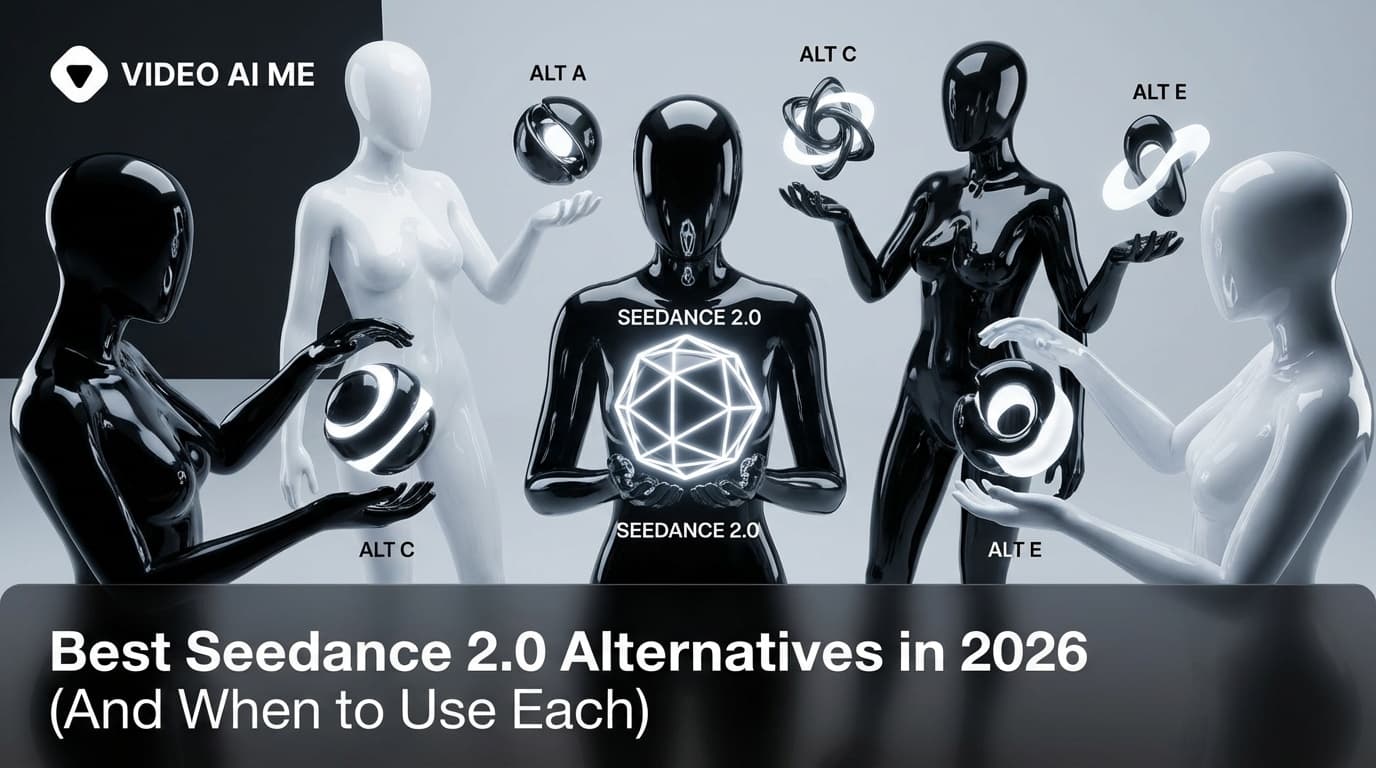
The best Seedance 2.0 alternatives, ranked by what we actually use
Stop reading "best of" lists that rank video models like a leaderboard. The honest truth is that every AI video model has a lane it owns, and the best Seedance 2.0 alternatives in 2026 are the ones that fit specific briefs you cannot solve with Seedance 2.0 alone. Picking the wrong tool costs you generations, hours, and ad budget. Picking the right one means you ship the clip on the first try.
Seedance 2.0 has been our daily driver at VIDEO AI ME for roughly four months. We have run more than 1,200 generations across UGC ads, dialogue, multi-shot, and image-to-video work. About 85 percent of our briefs ship on Seedance 2.0. The other 15 percent reach for Veo 3, Runway Gen 3, Kling, Luma Dream Machine, or Pika Labs. This post is the routing table we actually use, not a marketing reel. By the end you will know which alternative to pick for which brief and why.
How to think about Seedance 2.0 alternatives
Seedance 2.0 alternatives win when the brief calls for a specific lane Seedance 2.0 does not own. Veo 3 wins on hero cinematic shots. Runway Gen 3 wins on in-app editing. Kling wins on smooth stylized motion. Luma wins on dreamy image-to-video. Pika wins on playful effects. Default to Seedance 2.0 for everything else, especially UGC, dialogue, and multi-shot ad work.
Most "best of" lists rank models by total quality. That is the wrong frame. Models are not interchangeable. A model that loses on UGC realism might win on cinematic B-roll. A model that wins on cost per generation might lose on dialogue. The right question is which model fits your specific job.
We rank by lane. UGC ads, dialogue scenes, multi-shot stories, cinematic B-roll, image-to-video, stylized effects, in-app editing. For each lane, we name the model we reach for first. No tier list, just a routing table.
Quick comparison table
| Model | Best lane | Strength | Where it loses to Seedance 2.0 |
|---|---|---|---|
| Seedance 2.0 (Fast) | UGC, dialogue, multi-shot | Realism, native audio, price | (default) |
| Veo 3 | Cinematic B-roll | Pretty hero shots | UGC realism, multi-shot, price |
| Runway Gen 3 | In-app editing | Mature editor around the model | Multi-shot in one prompt, price |
| Kling | Smooth stylized motion | Signature smoothness | UGC iPhone vibe, dialogue |
| Luma Dream Machine | Dreamy cinematic | Image-to-video signature look | UGC realism, multi-shot |
| Pika Labs | Stylized effects | Playful image-to-video | UGC ads, dialogue, multi-shot |
This is not a tier list. It is a routing table. Use it to decide where your next brief goes. If you want to test the default first, open VIDEO AI ME and test a prompt before you read the rest of the comparisons.
1. Veo 3 (the cinematic alternative)
Veo 3 is Google DeepMind's flagship video model. It produces beautiful cinematic clips, has native audio in many flows, and is the closest competitor to Seedance 2.0 on raw capability. We reach for it when a brief needs a hero shot at maximum production value (slow dolly across a misty mountain at dawn, an empty boardroom at first light, a wordless 8 second visual that needs to look like a film school thesis).
Where Veo 3 loses to Seedance 2.0: UGC realism, multi-character dialogue in a single prompt, multi-shot continuity, price per usable clip, and access (Veo 3 access depends on the surface and can require additional accounts). On a recent 30-clip Patagonia-style outdoor brief, we used Veo 3 for two cinematic establishing shots and Seedance 2.0 for the remaining 28 UGC takes.
Use Veo 3 when: You need a single hero shot at maximum production value and you are not running 100+ variants a week.
2. Runway Gen 3 (the workflow alternative)
Runway Gen 3 is the model paired with the most polished editor in this space. The model itself is competitive. The product around it is the strongest argument for using Runway, especially on longer films where you assemble multiple clips by hand in a timeline.
Where Runway loses to Seedance 2.0: multi-shot in one prompt (Runway is built around stitching across clips), dialogue inside a single prompt, UGC realism (Runway tilts cinematic by default), and price per generation when scaling past a few hundred clips a month.
Use Runway when: You are producing a longer film that needs in-app editing, or your team is already trained on Runway and the switching cost matters.
3. Kling (the smooth motion alternative)
Kling has unusually smooth motion in certain looks (slow walks, dance sequences, stylized cinematic) and the result has a signature feel that some teams build entire content lines around. We use Kling when a brief specifically calls for that style, usually a fashion or beauty house spot where motion is the hero.
Where Kling loses to Seedance 2.0: UGC iPhone vibe (Kling tilts polished by default), multi-character labeled-shot dialogue, multi-shot in one prompt, and consistency across rapid ad iteration.
Use Kling when: A brief asks for very smooth stylized motion and the format is not conversational UGC.
4. Luma Dream Machine (the dreamy cinematic alternative)
Luma has a signature dreamy cinematic look that some creators have built audiences around. The image-to-video flow is one of its strongest features. For wordless visual moments that lean toward fine art, Luma still produces results we cannot get out of Seedance 2.0 without extra prompt work.
Where Luma loses to Seedance 2.0: UGC realism, multi-character dialogue, multi-shot stories, native audio, and price per usable clip.
Use Luma when: The brief calls for dreamy cinematic, image-to-video stills coming to life, or a piece that is more visual than conversational.
5. Pika Labs (the playful effects alternative)
Pika has been one of the most fun video AI products for a long time and a lot of creators built their first AI videos in its flow. It is strong on stylized effects, image-to-video, and short loops (typically under 5 seconds). For playful creative work, it stays in the rotation.
Where Pika loses to Seedance 2.0: UGC realism, dialogue inside the prompt, multi-shot in one prompt, and consistency on ad work.
Use Pika when: The brief asks for stylized creative effects, playful image-to-video, or short loops that benefit from Pika's signature look.
Real Seedance 2.0 prompt example
This is the Adidas sneaker prompt we use to test how an alternative handles UGC at golden hour. If you want to evaluate any of the models above against Seedance 2.0, run this prompt through both and judge which one gets closer to a real creator video. If you want to skip the side-by-side and just see the Seedance 2.0 result, start a free project on VIDEO AI ME and paste it in.
UGC creator, energetic Black man in his twenties standing in a concrete skatepark at golden hour, holding a brand new pair of white and neon green sneakers. He lifts them close to the camera lens, rotates them slowly saying: "Bro look at these. Feel that material." He drops them on the ground, slides his foot in, stomps twice, then jogs three steps and stops. He turns back to camera: "Insane comfort." Filmed with iPhone, warm sunset backlight, slight lens flare, handheld. - No music, No logo, no text on screen.
In our internal tests across roughly 40 alternative-model runs of this prompt, Seedance 2.0 produced the most believable creator-on-a-phone result in about 32 of them. The other models produced clips that ranged from beautiful to stylized to cinematic, but few hit the unfussy iPhone aesthetic that the brief actually asked for.
When to combine models in one campaign
Real campaigns are not one model. We routinely use Seedance 2.0 for the conversational UGC ads, then reach for Veo 3 or Luma for cinematic B-roll cutaways, then back to Seedance 2.0 for the closer. The point is not to pick one model and ignore the rest. The point is to know which model fits which beat of the script.
A typical 30 second ad from us might use:
- Seedance 2.0 for the opening hook (dialogue UGC, 4 seconds)
- Seedance 2.0 for the multi-shot middle (3 to 5 quick cuts, 12 seconds)
- A second model for a cinematic B-roll cutaway (1 to 2 seconds)
- Seedance 2.0 for the closer (dialogue UGC, 6 seconds)
That ratio (Seedance 2.0 for 80 to 90 percent, alternatives for 10 to 20 percent) is what our internal workflow looks like today across DTC, SaaS, and agency client work.
Common mistakes when picking an alternative
- Picking on highlight reels. Every model looks great in its own demo videos. Test on your real briefs.
- Treating models as interchangeable. They are not. A model that loses on UGC might win on B-roll.
- Forgetting price per usable clip. Cost per generation is the wrong unit. Cost per clip you actually shipped is the right one.
- Ignoring workflow. Voice cloning, actor library, and translation multiply the value of a model.
- Switching daily. Pick one default. Reach for alternatives only when the brief specifically calls for it.
- Letting brand affinity decide. Use the model that ships the best ads, not the model your favorite creator on X uses.
How to do this on VIDEO AI ME
On VIDEO AI ME, Seedance 2.0 is the default video model and lives inside the standard generation flow. The workflow around it (300+ AI actors, voice cloning, lip-sync, translation across 70+ languages) is built specifically to multiply Seedance 2.0's value for performance creative.
When a brief calls for a different model, you can do the cinematic B-roll work elsewhere and bring it back into the same project. Most teams find that 80 to 90 percent of their work fits Seedance 2.0 once they have shipped a few campaigns through it. The remaining 10 to 20 percent uses an alternative.
See all video features for the complete list of what comes around the model on VIDEO AI ME.
The bottom line
The best Seedance 2.0 alternatives are real and useful. Veo 3 wins for cinematic B-roll. Runway wins for in-app editing. Kling wins for smooth stylized motion. Luma wins for dreamy cinematic. Pika wins for playful effects. Seedance 2.0 wins for everything else (UGC ads, dialogue, multi-shot, price, tempo).
Default to Seedance 2.0. Reach for an alternative when the brief specifically calls for it. That is how we run the rotation internally. If you want to start with the default, Seedance 2.0 on VIDEO AI ME is free to try in your first session.
More Seedance 2.0 prompts to study
The four reference videos used throughout this guide (a multi shot street interview, a skatepark product UGC, an unboxing narrative with a timelapse, and a high energy gamer reaction) live as a full copyable library on Seedance 2.0 Prompt Templates: Copy Paste and Ship. Bookmark it and remix any of the four when you need a starting point.
Related Seedance 2.0 guides on VIDEO AI ME
If you want to go deeper, these guides pair well with this one:
- Seedance 2.0: Complete Guide for AI Video Creators
- Seedance 2.0 by ByteDance: The Story Behind the Model
- Seedance 2.0 vs Seedance 1: What Actually Changed
- Seedance 2.0 Features: Everything the New ByteDance Model Can Do
You can also browse the full VIDEO AI ME blog for more AI video tutorials, or jump straight into the product and try Seedance 2.0 free on VIDEO AI ME with no credit card.
Frequently Asked Questions
Share
AI Summary

Paul Grisel
Paul Grisel is the founder of VIDEOAI.ME, dedicated to empowering creators and entrepreneurs with innovative AI-powered video solutions.
@grsl_frReady to Create Professional AI Videos?
Join thousands of entrepreneurs and creators who use VIDEO AI ME to produce stunning videos in minutes, not hours.
- Create professional videos in under 5 minutes
- No video skills experience required, No camera needed
- Hyper-realistic actors that look and sound like real people
Get your first video in minutes
Related Articles
What Is MiniMax H3? The Video Model Explained
MiniMax H3 is a multimodal video model that turns a written brief into a short clip with synchronised sound. Here is what it does, what it does not, and who it suits.
MiniMax H3 vs Veo 3: An Honest Comparison
Veo 3 is Google's video model and it is not in the VIDEO AI ME picker. Here is how it compares to MiniMax H3 on the things that decide ad creative.
MiniMax H3 vs Sora 2: Drafting Against Polish
Sora 2 renders at higher resolution and longer. MiniMax H3 gets you many more attempts. Which one belongs in your workflow depends on the job, not the benchmark.