
Best Vox-Style Explainer Tool for Skincare
The best vox-style explainer tool for skincare shows how your product works in paper-collage, keeps the bottle accurate, and lets you approve every board first.
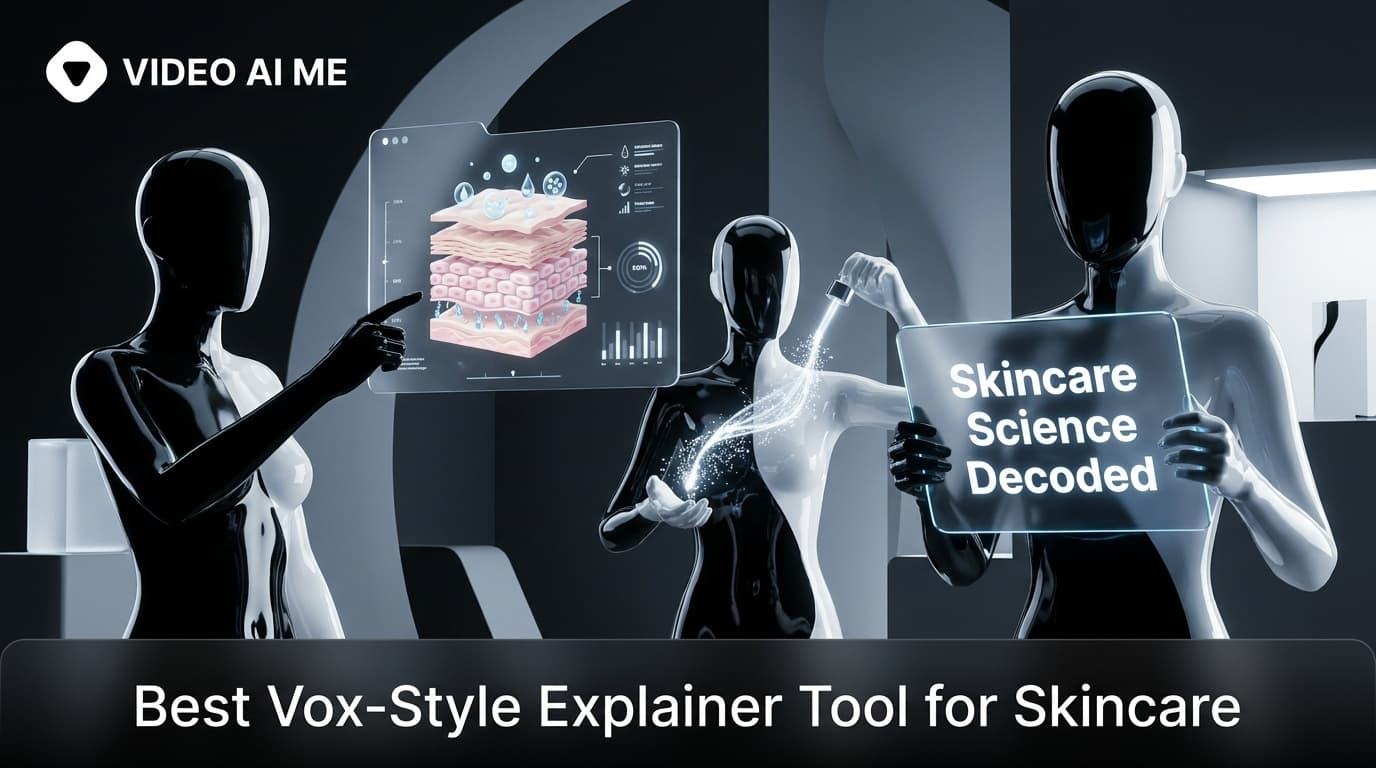
If you sell serums, cleansers, or a hero moisturizer, the hardest thing to advertise is the part customers actually care about: how the product works on their skin. A polished UGC clip can sell a vibe, but it struggles to show a mechanism. That is exactly where the editorial, paper-collage look shines, and why a good vox-style explainer tool for skincare has quietly become one of the most useful things in a beauty marketer's stack. This guide breaks down what the format does for skincare, what to look for in a tool, and the one we would reach for first.
The short version: the vox-style explainer, named after the newsroom explainer videos that made the look famous, uses torn construction-paper textures, hand-cut illustrations, cutout typography, and hand-drawn arrows over calm narration. It reads like a mini documentary, not an ad, so people actually watch it. For skincare, that editorial credibility is worth a lot, because the category is drowning in shiny, over-promising creative that buyers have learned to scroll past.
Why the vox-style format fits skincare so well
Skincare is a category of invisible mechanisms. Niacinamide, ceramides, a damaged moisture barrier, transepidermal water loss: these are ideas, not sights. A talking head can name them, but it cannot draw them. The paper-collage format can. You can literally cut out a paper "skin barrier," show the bricks cracking apart, then show your product's paper molecules slotting them back into place. That is a picture a customer remembers long after the ad ends.
The format also sidesteps the trust problem. The editorial style, borrowed from the kind of explainers Vox popularized, signals "I am here to teach you something," not "buy this now." That framing lowers a skeptical shopper's guard in a way a hard-sell demo rarely does. In beauty, where every third ad promises to erase ten years overnight, a calm explainer that treats the viewer like an adult stands out precisely because it is not shouting.
There is a practical benefit too. Because the visuals are illustrated rather than filmed, you are never bottlenecked by a photoshoot, a model's availability, or matching the lighting on a reshoot. You describe the idea, the tool draws it. That means you can explain a mechanism you could never actually film, like an ingredient penetrating the stratum corneum, without faking a lab shot.
What to look for in a vox-style explainer tool for skincare
Not every tool that claims to make cutout animation will actually help a beauty brand. Here is the checklist we use when judging a vox-style explainer tool for skincare, and why each line matters for this specific category.
| Criteria | Why it matters for a skincare brand | What good looks like |
|---|---|---|
| Product-image reference | Your bottle, pump, and label have to stay recognizable | You upload a product photo the tool keeps consistent across every scene |
| Approve before you render | Beauty visuals get re-cut endlessly; you cannot burn budget on bad drafts | You approve each paper board before any video credit is spent |
| Narration built in | Mechanism explainers live or die on the voiceover | Script and narrator voice are generated together and synced to the visuals |
| Mechanism-friendly art | You need to show barriers, layers, absorption, texture | Hand-cut illustrations and arrows, not repurposed stock footage |
| Faceless option | Not every skincare brand wants a presenter | Works with or without a paper-cutout mascot |
| Vertical and horizontal | TikTok, Reels, and YouTube each want a different frame | Native 9:16 and 16:9 export |
The two lines that matter most for skincare are product-image reference and approve-before-you-render. If a tool cannot keep your bottle looking like your bottle, you get a generic pump that could belong to any brand, which wastes the whole ad. And if it renders a full video before you have seen the visuals, you pay for mistakes. A tool that shows you every scene as a still board first lets you catch a wrong shade or an off-label claim before it costs you anything.
The best vox-style explainer tool for skincare in 2026
Our pick is the Vox-Style Explainer template inside VIDEO AI ME, and it earns the spot on that checklist above rather than on branding. You give it a short brief: the product name, what the explainer should say, an optional product photo, an optional character image, and a narrator voice. From there it writes a scene-by-scene narrated script, generates one paper-collage board per scene that you approve before any video credits are spent, then animates each approved board into a cutout clip with the narration and sound baked in, and cuts them into one finished ad.
For skincare specifically, three things stand out. First, the product-image reference keeps your actual bottle in frame, so the "here is the product" beat looks like your product, not a stand-in. Second, the approve-each-board step means you review the mechanism illustration, the claim wording, and the shade before you spend anything, which is exactly the control a regulated category needs. Third, the output is short, roughly ten to forty seconds, vertical or horizontal, with narration and sound generated automatically, so it drops straight into a paid or organic feed.
How the workflow runs for a skincare brand
- Write the brief. Name the product, the one mechanism you want to explain (for example, "restores the moisture barrier"), and upload a clean photo of the bottle.
- Let it script the scenes. The template turns your brief into a scene-by-scene narrated script, usually a hook, the problem, the mechanism, the proof, and a soft call to action.
- Approve the paper boards. You see one collage board per scene as a still. Swap wording, fix a shade, or regenerate a board here, before any video credit is used.
- Animate and narrate. Approved boards become cutout clips with the voiceover and sound already baked in.
- Export and test. Pull the vertical cut for TikTok and Reels, the horizontal for YouTube, and ship a few hook variations.
If you want to build one right now, open the Vox-Style Explainer template and start from your product photo. It is one of several guided pipelines in the Templates gallery.
Mechanism-of-action storytelling without a talking head
This is the single strongest use of the format for skincare. A mechanism-of-action story explains what your product does at the level of the skin, and the paper-collage look makes that concrete instead of abstract.
Take a barrier-repair moisturizer. The classic script is: paper "skin" with the barrier bricks drifting apart (the problem), a hand-drawn arrow pointing to the gaps (the diagnosis), your paper bottle dispensing paper ceramides that slot into the wall (the mechanism), and the barrier sealing shut with a satisfying cutout snap (the payoff). No lab, no model, no misleading macro footage, just a clear illustrated idea that a shopper can follow on mute.
Because it is illustrated, you also stay on the right side of honesty more easily. You are showing a simplified diagram of how the product is designed to work, clearly stylized as paper art, rather than implying a filmed clinical result. That said, the words in your narration are still claims, so write them the way you would for any compliant beauty ad. Our skincare video marketing guide for ecommerce beauty brands covers the safe phrasing in detail, and it applies here unchanged.
Keeping the bottle accurate with a product-image reference
A vox-style explainer that shows a generic bottle is a wasted impression. The whole point of the product beat is recognition: the viewer should see the exact thing they will find on your shelf or PDP. That is why the product-image reference is not a nice-to-have for skincare, it is the feature that makes the ad worth running.
In practice, you upload one clean, well-lit photo of the product, ideally on a plain background, and the template keeps that shape, cap, and label style consistent as it renders the paper version across scenes. If your packaging is your brand (a distinctive dropper, an amber glass bottle, a minimalist tube), this is what carries it into the collage without a designer redrawing it by hand.
Before-and-after storytelling in the paper-collage style
The other skincare workhorse is the transformation. You do not have to abandon your before-and-after just because you are working in paper. You can stage it as an illustrated arc: dull, congested paper skin at the start, the routine applied over a labeled timeline, and brighter, smoother paper skin at the reveal. It carries the same emotional payoff as a filmed transformation, with none of the reshoot logistics.
For the filmed version of this, or a hybrid where you bracket real footage with narration, our full walkthrough of before and after skincare videos with AI has the format and the compliance lines. The vox-style explainer is the illustrated cousin of that format, and many brands run both: the collage explainer to teach the mechanism, the before-and-after to prove the result.
Where vox-style fits in your skincare content mix
You do not replace your UGC with vox-style explainers, you complement them. Think of it as a division of labor. A creator-style clip earns trust through a relatable face and a real routine. A vox-style explainer earns trust by teaching. The two do different jobs, and the smartest beauty brands run both against the same audience.
| Format | What it is best at | When to reach for it |
|---|---|---|
| Creator-style UGC | Relatability, social proof, routine context | Cold traffic that responds to a real face |
| Vox-style explainer | Teaching the mechanism, editorial credibility | "How does this actually work" moments and skeptical buyers |
| Before-and-after | Proof of result | Retargeting and mid-funnel convincing |
If you are still building out the creator side, our UGC for skincare AI video guide covers that lane, and if you want the broader ecommerce view beyond beauty, the sibling breakdown of the best vox-style explainer tool for ecommerce zooms out to the whole store.
Final word
Skincare is the ideal category for the vox-style explainer because it is built on mechanisms customers cannot see and have learned to distrust when a brand simply asserts them. The paper-collage format shows the mechanism instead of claiming it, in a calm editorial voice that reads as teaching rather than selling. Add a product-image reference so the bottle stays true, and an approve-each-board step so you never pay for a bad draft, and you have a repeatable way to explain why your product works.
When you are ready, start your first skincare vox-style explainer. Bring one product photo and the single mechanism you most want customers to understand, and let the template turn it into a scene-by-scene, narrated, ready-to-post ad.
Frequently Asked Questions
Share
AI Summary

Paul Grisel
Paul Grisel is the founder of VIDEOAI.ME, dedicated to empowering creators and entrepreneurs with innovative AI-powered video solutions.
@grsl_frReady to Create Professional AI Videos?
Join thousands of entrepreneurs and creators who use VIDEO AI ME to produce stunning videos in minutes, not hours.
- Create professional videos in under 5 minutes
- No video skills experience required, No camera needed
- Hyper-realistic actors that look and sound like real people
Get your first video in minutes
Related Articles
MiniMax H3 Product Ad Prompts That Sell
Prompts for the product beats every ecommerce ad needs: the reveal, the in hand shot, the demo, the texture close up and the lifestyle frame.

MiniMax H3 for Dropshipping Ads: A Test Workflow
How to test a product with video ads before you have inventory, samples or a creator, using text to video for angles and your supplier photos for the product beats.
Seedance 2.5 Product Ad Prompts for Ecommerce
Five product shot prompt patterns for Seedance 2.5, category variants for skincare, supplements, apparel, gadgets and home, and what still does not hold up.