
Create AI Videos in Any Language 2026
Your product sells in 12 countries. Your audience speaks 8 languages. Creating video content for each market used to mean hiring local creators, managing international production, and spending months on localization.
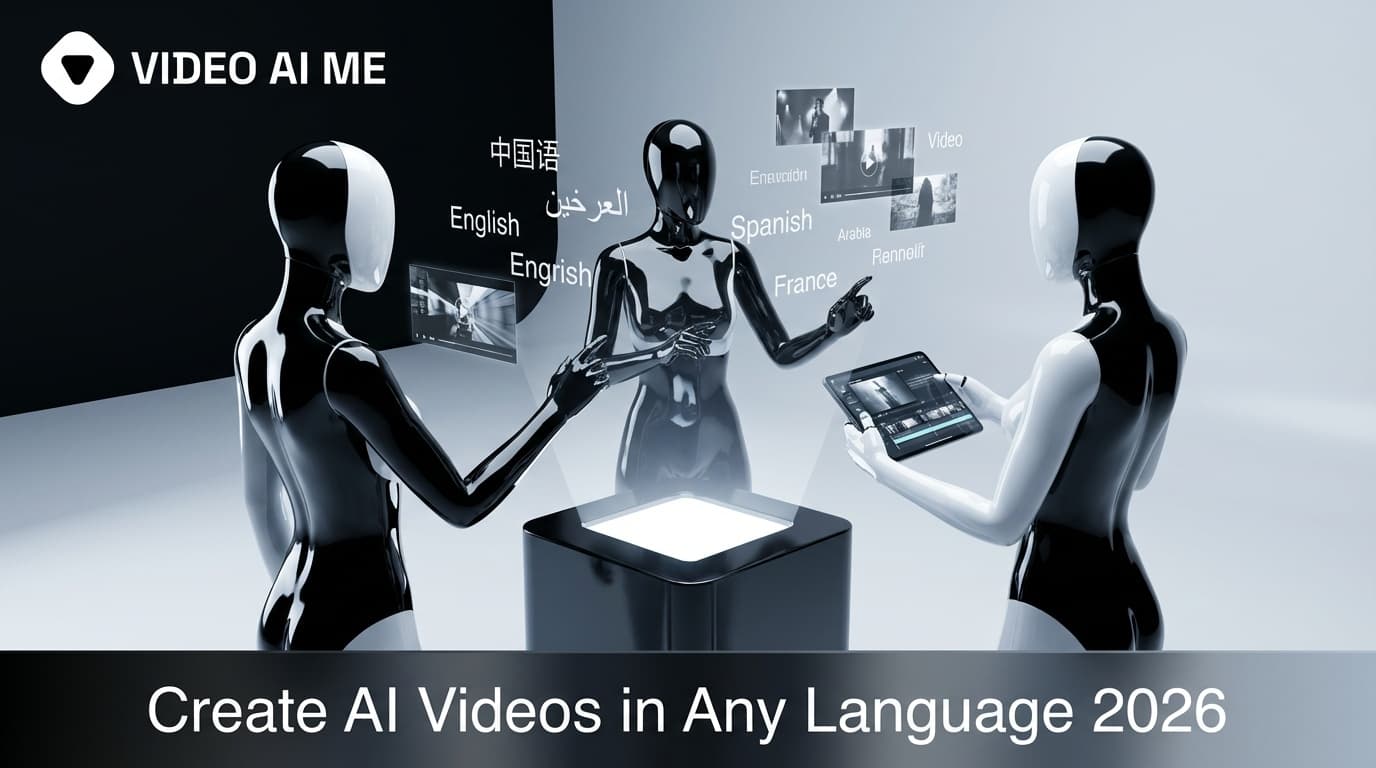
Your product sells in 12 countries. Your audience speaks 8 languages. Creating video content for each market used to mean hiring local creators, managing international production, and spending months on localization.
In 2026, you write one script and AI produces that video in every language you need. Same brand voice. Same quality. Same message. Different language.
This guide shows you exactly how to create multilingual AI video content, which tools to use for each approach, and how to ensure quality across languages.
Three Approaches to Multilingual AI Video
Approach 1: AI Avatar + AI Voice (Fastest, Most Scalable)
An AI avatar speaks your script in each target language. The avatar's lip movements sync to the translated audio. One video template becomes content for every market.
How it works:
- Write your script in your primary language
- Translate the script (AI translation or professional translator)
- Generate the video for each language using AI voice and avatar
- The avatar's lip movements automatically sync to each language
Best tool: VideoAI.ME VideoAI.ME creates complete marketing videos with AI avatars. The platform supports multiple languages with natural-sounding AI voices. Voice cloning maintains your brand voice identity across languages.
Quality advantage: Because the avatar is generated fresh for each language (not dubbed), the lip-sync is perfect in every language. This avoids the "bad dubbing" problem where mouth movements do not match the audio.
Approach 2: Voice Cloning + Translation (Most Authentic)
Clone your actual voice, then use the clone to narrate content in languages you do not speak. Your voice identity travels across languages while pronunciation stays native.
How it works:
- Record a voice sample in your native language (30 seconds to 3 minutes)
- Clone the voice using a voice cloning platform
- Generate narration in each target language using your cloned voice
- The clone speaks the new language with your vocal characteristics (timbre, pitch, rhythm) but correct pronunciation
Best tools:
- ElevenLabs: 30+ languages, excellent cross-lingual voice cloning
- Play.ht: 20+ languages, good quality
- VideoAI.ME: Integrated voice cloning within the video creation workflow
Quality result: A French listener hears your content narrated by a voice that sounds distinctly like you, speaking fluent French. The vocal identity is preserved while the language is native-quality.
Approach 3: AI Dubbing of Existing Video (For Existing Content)
Take a video you already created (in English, for example) and dub it into other languages with AI. The AI replaces the audio and optionally adjusts the lip movements.
How it works:
- Upload your existing video
- Select target languages
- AI transcribes, translates, generates new audio, and syncs lips
Best tools:
- HeyGen: Video translation feature dubs and re-syncs lips
- Rask.ai: Specialized in AI dubbing
- ElevenLabs Dubbing: High-quality audio replacement
Language-Specific Considerations
Not all AI tools handle all languages equally. Here is what to expect:
Tier 1 Languages (Excellent AI Quality)
English, Spanish, French, German, Portuguese, Italian, Japanese, Korean, Chinese (Mandarin), Hindi
These languages have extensive training data. AI voices sound natural, pronunciation is accurate, and lip-sync works well.
Tier 2 Languages (Good AI Quality)
Dutch, Polish, Turkish, Arabic, Russian, Swedish, Norwegian, Danish, Finnish, Czech, Romanian, Indonesian, Thai, Vietnamese
These languages produce good results with occasional pronunciation nuances. Professional review recommended for marketing content.
Tier 3 Languages (Acceptable AI Quality)
Less common languages with smaller training datasets. Quality is usable but may require more manual review and correction. Consider having a native speaker review the script and generated audio before publishing.
Practical Workflow: One Script, Ten Languages
Here is the step-by-step process for creating a marketing video campaign across 10 languages:
Step 1: Write the master script
Write your script in your primary language. Keep it concise and culturally neutral. Avoid idioms, slang, and cultural references that do not translate.
Good: "This product saves you 3 hours every week." Bad: "This product is a total game-changer that knocks it out of the park."
The second version has two idioms that translate poorly into most languages.
Step 2: Translate
Option A: AI translation (faster, cheaper) Use DeepL or Google Translate for Tier 1 languages. Quality is good for straightforward marketing copy.
Option B: Professional translation (higher quality) For important campaigns, use professional translators via services like Gengo, TransPerfect, or native-speaking team members. Budget: $0.10 to $0.20 per word.
Option C: Hybrid AI translate first, then have a native speaker review and correct.
Step 3: Generate videos
Using VideoAI.ME:
- Select your avatar (same avatar across all languages for brand consistency)
- Input translated script for each language
- Select the appropriate voice for each language (or use your cloned voice)
- Generate each version
With 10 languages, expect 10 video generations. Total production time: under 1 hour.
Step 4: Quality check
Have a native speaker review each video for:
- Pronunciation accuracy
- Tone appropriateness (formal vs. casual varies by culture)
- Cultural sensitivity (gestures, colors, references)
- Script accuracy (AI translation errors)
Step 5: Optimize for each market
Adjust metadata, not the video:
- Localized titles and descriptions for each platform
- Market-specific hashtags
- Posting times optimized for each time zone
- Market-specific CTAs (different landing pages for each country)
Cultural Adaptation Beyond Language
Translation is necessary but not sufficient. Effective multilingual content requires cultural adaptation:
Formality levels
Japanese: Business content requires formal speech (keigo). Casual UGC style used in English does not translate directly. Adjust the script tone.
German: Business communication is typically more formal than American English. "Hey guys, check this out!" becomes more measured.
Brazilian Portuguese: More casual and warm than European Portuguese. The same language, different cultural expectations.
Visual expectations
Middle East: Consider cultural norms for avatar appearance and gestures.
Japan: Minimalist aesthetic and detailed product information are valued.
Brazil and Latin America: Energetic, colorful, emotional presentation resonates.
Regulatory differences
EU: AI-generated content labeling requirements vary by country.
China: Specific regulations on AI-generated content in advertising.
India: Information Technology Act has specific provisions for AI content.
Cost Comparison: Traditional vs. AI Multilingual Video
Traditional approach (10 languages, 1 marketing video each)
| Cost Item | Amount |
|---|---|
| Script translation (10 languages) | $500 to $1,000 |
| 10 local voice actors | $1,500 to $3,000 |
| 10 local video producers | $3,000 to $10,000 |
| Coordination and project management | $500 to $1,000 |
| Total | $5,500 to $15,000 |
| Timeline | 2 to 4 weeks |
AI approach (10 languages, 1 marketing video each)
| Cost Item | Amount |
|---|---|
| Script translation (AI + review) | $100 to $300 |
| VideoAI.ME (10 video generations) | Platform subscription cost |
| Native speaker review (10 languages) | $200 to $500 |
| Total | $300 to $800 + subscription |
| Timeline | 1 to 2 days |
The cost reduction is 85 to 95%. The timeline reduction is even more dramatic.
Measuring Multilingual Performance
Track by market
Set up separate tracking for each language/market version. What works in English may not perform identically in Japanese or Arabic.
Compare engagement rates
Some markets engage differently with video content:
- Some markets prefer longer content
- Some markets have higher comment rates
- Some markets convert better from video ads
Iterate per market
The speed of AI generation allows market-specific optimization. If the French version underperforms, create 3 new French variations and test them. This rapid iteration across markets is only practical with AI.
Frequently Asked Questions
Can AI really speak my language naturally?
For Tier 1 languages (English, Spanish, French, German, Japanese, etc.): yes, quality is very natural. For less common languages: quality varies. Always have a native speaker review before publishing commercial content.
Does the AI avatar move its lips correctly for each language?
When generating fresh video for each language (rather than dubbing), the avatar's lip movements are generated to match the specific language. This produces more natural results than dubbing an existing video.
How do I handle right-to-left languages (Arabic, Hebrew)?
The avatar video itself is not affected by text direction. However, any text overlays, captions, and CTAs need to be right-to-left formatted. Ensure your editing tool supports RTL text.
Can I clone my voice in a language I do not speak?
Yes. Modern cross-lingual voice cloning transfers your voice identity to any supported language. You do not need to speak the language. The AI handles pronunciation; your voice provides the identity.
Which languages drive the most video ad engagement?
Based on GSC data for VideoAI.ME: India (Hindi, English), US (English), Indonesia (Indonesian), Brazil (Portuguese), France (French), and the UK (English) show the highest engagement. Prioritize these markets for initial multilingual expansion.
Frequently Asked Questions
Share
AI Summary

Paul Grisel
Paul Grisel is the founder of VIDEOAI.ME, dedicated to empowering creators and entrepreneurs with innovative AI-powered video solutions.
@grsl_frReady to Create Professional AI Videos?
Join thousands of entrepreneurs and creators who use VIDEO AI ME to produce stunning videos in minutes, not hours.
- Create professional videos in under 5 minutes
- No video skills experience required, No camera needed
- Hyper-realistic actors that look and sound like real people
Get your first video in minutes
Related Articles
What Is MiniMax H3? The Video Model Explained
MiniMax H3 is a multimodal video model that turns a written brief into a short clip with synchronised sound. Here is what it does, what it does not, and who it suits.
MiniMax H3 vs Veo 3: An Honest Comparison
Veo 3 is Google's video model and it is not in the VIDEO AI ME picker. Here is how it compares to MiniMax H3 on the things that decide ad creative.
MiniMax H3 vs Sora 2: Drafting Against Polish
Sora 2 renders at higher resolution and longer. MiniMax H3 gets you many more attempts. Which one belongs in your workflow depends on the job, not the benchmark.