
FLUX 3 Max Meta Ads: A Creative Testing Workflow
How to feed a Meta creative test with distinct FLUX 3 Max variants: credit budgets per asset, 720p drafts, 1080p winners, placement ratios and one-variable prompts.
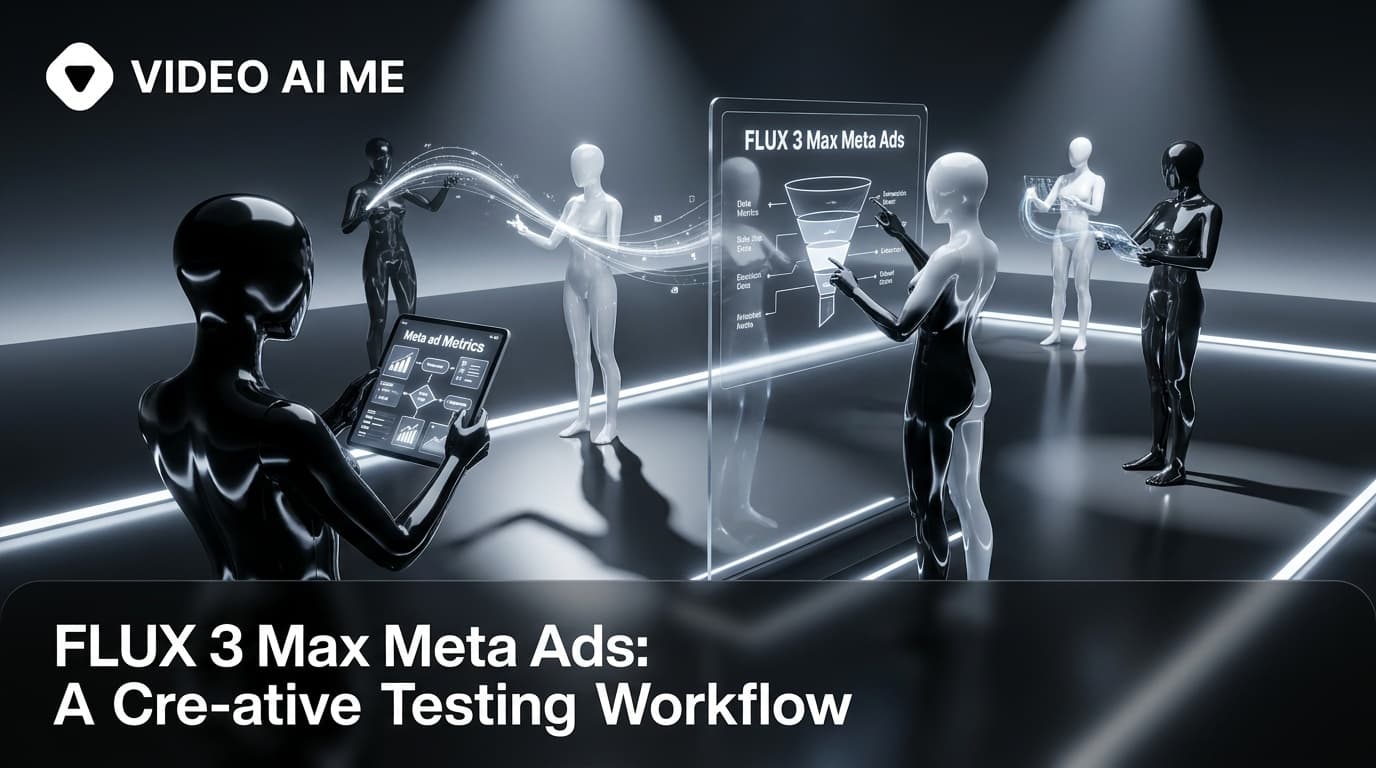
To run Meta ads creative testing with FLUX 3 Max, write five or six distinct concepts, generate each as a 10 second 9:16 draft at 720p for 170 credits, cut the weak ones in review, then render the survivors at 1080p for 290 credits each. Change one variable per variant and let Meta's test structure pick the winner.
This guide covers the production side of FLUX 3 Max Meta ads: what each variant costs in credits, which ratios to render for which placement, how to write prompts that isolate a single variable, and what to check before anything goes live. Campaign setup belongs to Meta, and its own A/B testing guidance for Facebook and Instagram ads is the reference for how to structure the test itself.
Why is creative the variable worth testing on Meta?
Meta's delivery system handles most of the targeting work. What it cannot do is invent a better idea for your ad. The creative is the lever you control directly, and Meta's own A/B testing page lists creative variables among the things worth testing: aspect ratio (a 1:1 video against a 9:16 video), audio (no sound against voiceover, music or effects) and video length (a 30 second video against a 5 second one).
The problem has always been cost. When every variant means a shoot or a creator fee, you test three and call the least bad one the winner. When a variant is a known number of credits, you can test the ideas you actually have, and the bottleneck moves back to the traffic you can send.
What does FLUX 3 Max give a Meta media buyer?
FLUX 3 Max is a video model from Black Forest Labs, the team behind the FLUX image models. It is a post-trained variant of Black Forest Labs' FLUX 3 Video, which its developers describe as tuned for stronger prompt adherence and better visual quality. For testing, adherence is the claim that matters: a variant only tests something if the clip shows the hook, the product and the line you wrote. Check that yourself on your first drafts by reading the prompt against the clip, sentence by sentence.
Here is how the specs map to Meta work:
| Spec | FLUX 3 Max on VIDEO AI ME | What it means for Meta creative |
|---|---|---|
| Durations | 5, 8, 10, 12, 15 or 20 seconds | Short hook tests through to a full 20 second single shot |
| Resolutions | 720p and 1080p | Drafts at 720p, live variants at 1080p |
| Aspect ratios | auto, 9:16, 16:9, 1:1, 4:3, 3:4, 21:9 | 9:16 for Reels and Stories, 1:1 for Feed tests |
| Audio | Generated in the same pass, always on | Voice, ambience and music arrive with the picture |
| Inputs | A prompt, or one image used as the first frame | Your product photo can open the clip |
Two limits to plan around. The editor does not offer 4:5, the ratio Meta lists for Facebook Feed video, so you choose 1:1 or 3:4 for Feed and check the Ads Manager preview. And FLUX 3 Max takes one reference image, used as the start frame, not several product angles.
How much does FLUX 3 Max Meta ads testing cost per asset?
FLUX 3 Max costs 17 credits per second at 720p and 29 credits per second at 1080p, for text to video and image to video alike. One credit is one cent of generation cost, so the numbers below translate directly into plan budget.
| Asset | Length | Resolution | Credits |
|---|---|---|---|
| Hook draft | 5 seconds | 720p | 85 |
| Concept draft | 8 seconds | 720p | 136 |
| Concept draft | 10 seconds | 720p | 170 |
| Live variant | 10 seconds | 1080p | 290 |
| Live variant | 15 seconds | 1080p | 435 |
| Full single shot | 20 seconds | 1080p | 580 |
A live 10 second variant at 1080p is 290 credits, or $2.90 of plan credit. Set that against what one creator video or a reshoot costs you.
A full test cycle with six concepts looks like this:
| Step | Clips | Credits each | Credits |
|---|---|---|---|
| Six concept drafts, 10 seconds, 9:16, 720p | 6 | 170 | 1,020 |
| Three survivors rendered at 1080p, 9:16 | 3 | 290 | 870 |
| 1:1 versions of the three for Feed, 1080p | 3 | 290 | 870 |
| Cycle total | 12 | 2,760 |
The Pro plan at 5,600 monthly credits covers two of those cycles a month. The Starter plan at 1,400 monthly credits fits a tighter loop: four 8 second drafts at 720p (544 credits) and two 8 second finals at 1080p (464 credits), 1,008 credits in all. The full breakdown of every duration and plan is in the FLUX 3 Max pricing guide, and current plans are on the pricing page.
How do you write FLUX 3 Max prompts that test one variable?
Meta's guidance is to change a single variable so the result tells you something. With generated creative, that means writing one base prompt and swapping exactly one sentence per variant. Everything else stays word for word identical.
Write each prompt as one paragraph in this order: subject and action, then camera, then light and look, then sound, with any spoken line in double quotes. Here is a base prompt for a 10 second 9:16 text to video draft:
A man in his twenties stands at a bus stop on a hot afternoon, pulls a matte green steel water bottle from his backpack, unscrews the cap and drinks. Handheld, eye level, slow push-in to a medium close-up, with the bottle kept in the middle of the frame. Harsh midday sun from behind him, warm natural grade. He looks at the camera and says, "Four hours in the sun and it's still cold." Traffic passing on the left, the cap unscrewing with a soft metal squeak, ice rattling inside, no music.
The spoken line is nine words, well inside the budget of two to three words per second that a 10 second clip allows. Use a claim your product can actually back up. Now build the variants:
| Variant | The one sentence you change | What it tests |
|---|---|---|
| A, base | The line above | Proof of the main benefit |
| B, objection | He says, "I thought steel bottles made water taste weird. Not this one." | Whether trust is the blocker |
| C, problem | He says, "I was spending a fortune on cold drinks every summer." | Whether a pain point beats a benefit |
| D, demonstration | He drops two ice cubes in, shakes it, and holds it to his cheek. (No line.) | Whether showing beats telling |
When product accuracy matters more than the scene, use image to video instead. Attach a clean product photo as the first frame, and write only motion and sound, because the image already carries the look:
A hand lifts the bottle off the counter and tilts it toward the camera as condensation runs down the steel. Slow push-in, focus locked on the bottle. The cap twists open with a soft metal squeak, ice rattles inside, quiet kitchen ambience, no music.
The model expands short prompts before it renders, so whatever you leave open gets filled in. If the colour, the line or the framing matters to the test, write it. The full method is in the FLUX 3 Max prompt guide.
Which aspect ratios should FLUX 3 Max Meta ads use per placement?
Generate natively for each shape rather than forcing one render into every slot.
| Placement | Meta's published spec | FLUX 3 Max setting |
|---|---|---|
| Instagram Reels | 9:16, per the Reels ad specs in Meta's ads guide | 9:16 |
| Facebook Feed video | 4:5, per the Facebook Feed video ad specs | 1:1, or 3:4 for a taller frame; preview before launch |
| Ratio test | Meta's A/B page uses 1:1 against 9:16 as its example | One render at each ratio |
Meta's Reels spec asks you to keep roughly the top 14 percent, the bottom 35 percent and 6 percent on each side free of text, logos and key elements. You cannot place pixels exactly in a generated clip, but you can steer it: write "the product stays in the middle of the frame" into the camera sentence, as in the base prompt above.
One honest caveat about ratio tests. A 1:1 render and a 9:16 render of the same prompt are two separate generations, so they are two takes, not one clip cropped twice. Review both and confirm they hit the same beat before you treat the result as a ratio finding.
What should you check before a variant goes live?
A variant with a production flaw drags down an angle that might have won, so ship only the clips that pass review. Watch every clip with sound on and run this list:
| Check | Why it matters |
|---|---|
| The spoken line is complete and exact | A clipped or reworded line changes what the variant tests |
| Lip sync holds through the line | Generated speech must be watched before it goes live |
| The product looks like the product | Colour, shape and cap style should match what ships |
| The sound matches the brief | Unwanted music or missing ambience changes the read |
| No garbled text or logos in frame | Small text and exact logos are unreliable on every video model |
Captions go on in the editor, and on-screen text, offers and your logo go on after export, never in the prompt. Captions also serve the viewers who watch with sound off. If you want an audio test in Meta's sense, sound against no sound, FLUX 3 Max always generates audio, so the silent variant means removing the track after export, in your own editing tool. That keeps the picture identical between the two, which is exactly what a clean test needs.
How do you read a creative test without fooling yourself?
Production discipline decides whether the test means anything:
- Hold resolution constant. Every live variant at 1080p. A 720p variant against a 1080p one measures resolution, not the idea.
- Hold length constant. Unless length is the variable, keep all variants at the same duration.
- Keep the audience clean. Meta's guidance is not to use the test audience for any other campaign running at the same time.
- Give it time. Meta recommends running A/B tests for at least two weeks and up to 30 days for the most reliable results, and waiting for its final result before acting.
Name files by product, angle, variant, ratio and resolution, for example bottle_objection_b_9x16_1080, and log the result of every variant you run. That record turns a series of tests into knowledge about your audience.
For the wider strategy behind angle selection, read the Meta ads UGC creative framework. If your concepts are creator-style talking clips, FLUX 3 Max for UGC ads covers that format in depth.
What will this workflow not fix?
Fast variants do not fix a weak offer, a slow landing page or a test with too little spend behind it. Twelve creatives split across a small budget produce twelve noisy numbers instead of one clear answer. What the workflow removes is the production ceiling: you test the six ideas you have instead of the two you could afford to shoot, and you know the bill before you write the first prompt.
Frequently Asked Questions
How many creatives should you test at once on Meta ads?
A handful of genuinely different concepts beats a long list of rewordings. With FLUX 3 Max, six 10 second drafts at 720p cost 1,020 credits, so the limit becomes the traffic you can send, not production budget.
How long should a Meta creative test run?
Meta recommends running A/B tests for at least two weeks and up to 30 days for the most reliable results, and waiting for its final result before you act. Calling a winner after a few days usually measures noise rather than the idea.
What is the best aspect ratio for Meta video ads?
It depends on the placement. Meta's ads guide lists 9:16 for Instagram Reels and 4:5 for Facebook Feed video. FLUX 3 Max offers 9:16, 1:1 and 3:4 among its ratios, but not 4:5, so preview Feed variants in Ads Manager before launch.
How much does a FLUX 3 Max Meta ad variant cost?
At the standard rate, a 10 second variant costs 170 credits at 720p and 290 credits at 1080p, the same for text to video and image to video. A 20 second single shot at 1080p is 580 credits.
Should you test Meta creative at 720p or 1080p?
Draft and review at 720p, then render every variant that goes live at 1080p. Keep all live variants at the same resolution, so the test measures the concept rather than image quality.
Can FLUX 3 Max make a no-sound version for a Meta audio test?
FLUX 3 Max always generates audio with the picture. For a silent variant, remove the track after export, in your own editing tool. That keeps the picture identical between the two versions, so the only difference Meta measures is the sound.
Frequently Asked Questions
Share
AI Summary
Paul Grisel
Paul Grisel is the founder of VIDEOAI.ME, dedicated to empowering creators and entrepreneurs with innovative AI-powered video solutions.
@grsl_frReady to Create Professional AI Videos?
Join thousands of entrepreneurs and creators who use VIDEO AI ME to produce stunning videos in minutes, not hours.
- Create professional videos in under 5 minutes
- No video skills experience required, No camera needed
- Hyper-realistic actors that look and sound like real people
Get your first video in minutes
Related Articles
FLUX 3 Max Cinematic Video: 21:9 Brand Films at 1080p
How to shoot a cinematic brand film with FLUX 3 Max: 21:9 at 1080p, 20 second single takes, camera language, sound design, copy-paste prompts and a cost table per shot.
FLUX 3 Max for Agencies: Client Volume and Cost per Ad
How agencies can price, draft and deliver client video with FLUX 3 Max: cost per deliverable, the 720p draft and 1080p final workflow, and keeping a batch on brand.
FLUX 3 Max vs Boreal: Price, Audio and Which to Use
Boreal costs far less per second, adds 2K and takes your own audio track. FLUX 3 Max rests on its developers' prompt adherence claims. Here is how to decide on your brief.