
Happy Horse vs Pika: AI Video Model Comparison 2026
Happy Horse 1.0 leads every benchmark. Pika built its name on stylized content and lip-sync. Here's what each model actually delivers in 2026.
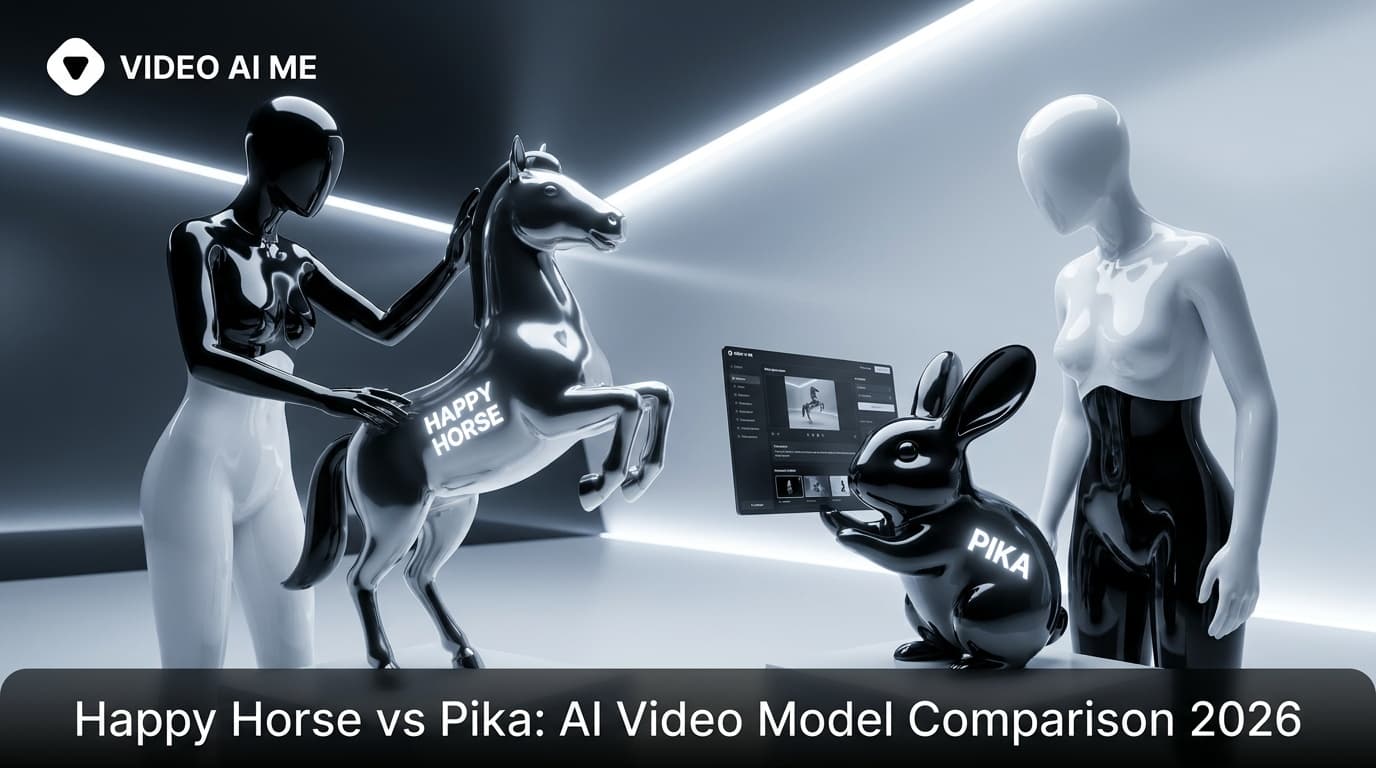
Happy Horse vs Pika: Two Very Different Models for Two Very Different Goals
Happy Horse vs Pika is a comparison that comes up often among creators and marketers who want to understand what the new benchmark leader actually beats. Pika has been a go-to tool for stylized and lip-synced video since 2023. Happy Horse 1.0 launched in April 2026 and immediately topped every major leaderboard. So where does Pika still hold ground, and where has Happy Horse moved past it?
Here is the full breakdown.
What Happy Horse 1.0 Brings to the Table
Happy Horse 1.0 is Alibaba's Token Hub flagship model. It is a 15-billion-parameter unified Transformer - one model that generates video and audio together in a single pass. That architecture is what separates it from every other model in this comparison. There is no separate audio generation step. Speech, lip movement, and body language are co-generated from the same model pass.
Benchmark position: #1 on the Artificial Analysis Video Arena with an Elo of 1333 (text-to-video) and 1392 (image-to-video). It surpasses Seedance 2.0 by 107 Elo points and sits well above the rest of the field.
Capabilities:
- 15B unified Transformer
- Joint audio + video in one pass (first model to do this)
- 1080p, 16:9 and 9:16
- Multilingual lip-sync natively built in
- Released April 26, 2026
What Pika 2.x Does Well
Pika is a US-based AI video company that built an early audience through an accessible interface, creative stylization tools, and a solid lip-sync product. Pika 2.x introduced improved motion quality and expanded aspect ratio support, cementing its position as a go-to tool for creators who want expressive, stylized output rather than strict photorealism.
Pika's niche:
- Stylized video with motion effects
- Lip-sync to uploaded audio tracks
- Short creative clips for social media
- Good product interface for non-technical users
Where Pika falls short compared to Happy Horse: it does not generate native audio, its multilingual support is limited, and its benchmark scores place it outside the top tier on the Video Arena leaderboard.
Side-by-Side Comparison Table
| Feature | Happy Horse 1.0 | Pika 2.x |
|---|---|---|
| Video Arena Elo (T2V) | 1333 (#1) | Below top tier |
| Native audio generation | Yes - single pass | No |
| Multilingual lip-sync | Yes, built-in | Limited to English-primary |
| Max resolution | 1080p | 1080p |
| Aspect ratios | 16:9 and 9:16 | 16:9, 9:16, 1:1 |
| Stylized effects | Moderate | Strong |
| Developer | Alibaba ATH | Pika Labs (US) |
| Best for | Realism, talking heads, multilingual | Stylized, creative, social clips |
| Available on VIDEO AI ME | Yes | No |
Audio and Lip-Sync: The Core Difference
Pika's lip-sync works by mapping audio you upload onto a generated face. The model was not trained to generate speech - it was trained to animate a face in response to audio input. That approach works well when you have a pre-recorded voiceover in a controlled environment. It breaks down when you need a model to produce naturalistic speech in a language other than English, or when the input audio has unusual cadence, accent, or background noise.
Happy Horse generates audio as part of the video. The transformer does not receive a text prompt and then separately produce a voice track. It produces both simultaneously, which means consonant timing, pause structure, and facial micro-expressions are all aligned from the model level. The output is more cohesive and holds up much better across languages.
For multilingual content - Spanish, Mandarin, French, Portuguese, Hindi - Happy Horse is in a different category than Pika.
Motion Quality and Realism
Happy Horse leads on photorealistic human motion. Fabric movement, hair, hand gestures, and camera behavior all score higher in human preference tests, which is what the Video Arena Elo reflects. Pika's stylized output can look excellent for expressive content where realism is not the goal, but for brand videos, talking-head ads, or anything meant to look like real footage, Happy Horse has a clear edge.
Pika still has value for:
- Music videos or content where stylization is a feature
- Rapid iteration on short clips for A/B testing creative concepts
- Teams that are deeply familiar with Pika's specific interface quirks
But for client-facing content in 2026, defaulting to Pika over Happy Horse requires a clear justification.
Custom AI Actors and Multilingual Workflow
One area where the platforms diverge significantly is workflow integration. VIDEO AI ME lets you create a custom AI actor from a short reference video and then use that actor across generations in any language - powered by Happy Horse. Pika does not offer an equivalent custom actor system at this depth.
For brands producing content across markets, or creators who need a consistent on-screen presence across multiple languages, that actor + Happy Horse combination is a meaningful workflow advantage.
For more on how Happy Horse compares to the full field of models, read Top AI Video Models 2026 Ranked.
Which One Should You Choose?
Choose Happy Horse if:
- Motion quality and photorealism are priorities
- You need multilingual lip-sync
- You are making talking-head ads, brand explainers, or UGC-style content
- You want both 16:9 and 9:16 output without switching tools
Choose Pika if:
- You specifically want stylized, expressive visual effects
- You are working with pre-recorded English-language audio and want quick lip-sync
- Your use case is highly creative rather than photorealistic
Access Happy Horse Without Switching Platforms
VIDEO AI ME is the only platform today offering both Happy Horse 1.0 and Seedance 2.0 - the current top-two-ranked models - under one subscription. You get custom AI actors in any language, 16:9 and 9:16 output, and a single workspace for all your video production.
Wondering whether Happy Horse fits your specific use case? Try it at videoai.me.
VIDEO AI ME gives you both top-2 motion models, so you don't have to bet wrong.
Frequently Asked Questions
Share
AI Summary

Paul Grisel
Paul Grisel is the founder of VIDEOAI.ME, dedicated to empowering creators and entrepreneurs with innovative AI-powered video solutions.
@grsl_frReady to Create Professional AI Videos?
Join thousands of entrepreneurs and creators who use VIDEO AI ME to produce stunning videos in minutes, not hours.
- Create professional videos in under 5 minutes
- No video skills experience required, No camera needed
- Hyper-realistic actors that look and sound like real people
Get your first video in minutes
Related Articles
MiniMax H3 UGC Prompt Templates for Ad Creative
Reusable UGC prompt templates with the variables marked, so you can produce a whole batch of creator style ads by swapping four fields.
Seedance 2.5 UGC Prompt Templates for Ads
Six fill in the blank UGC prompt templates for Seedance 2.5, each with a fully filled worked example, plus how to direct dialogue when the audio is generated.
How to Make AI UGC Videos With Seedance 2.5
A five step playbook for creator style UGC clips with Seedance 2.5: casting, prompts that carry the spoken hook, reference images for batches, and the credit math.