
Happy Horse vs Seedance 2.0: Which AI Video Wins?
Happy Horse 1.0 dethroned Seedance 2.0 at the top of the AI video leaderboard. Here's what each model does best and when to use which.
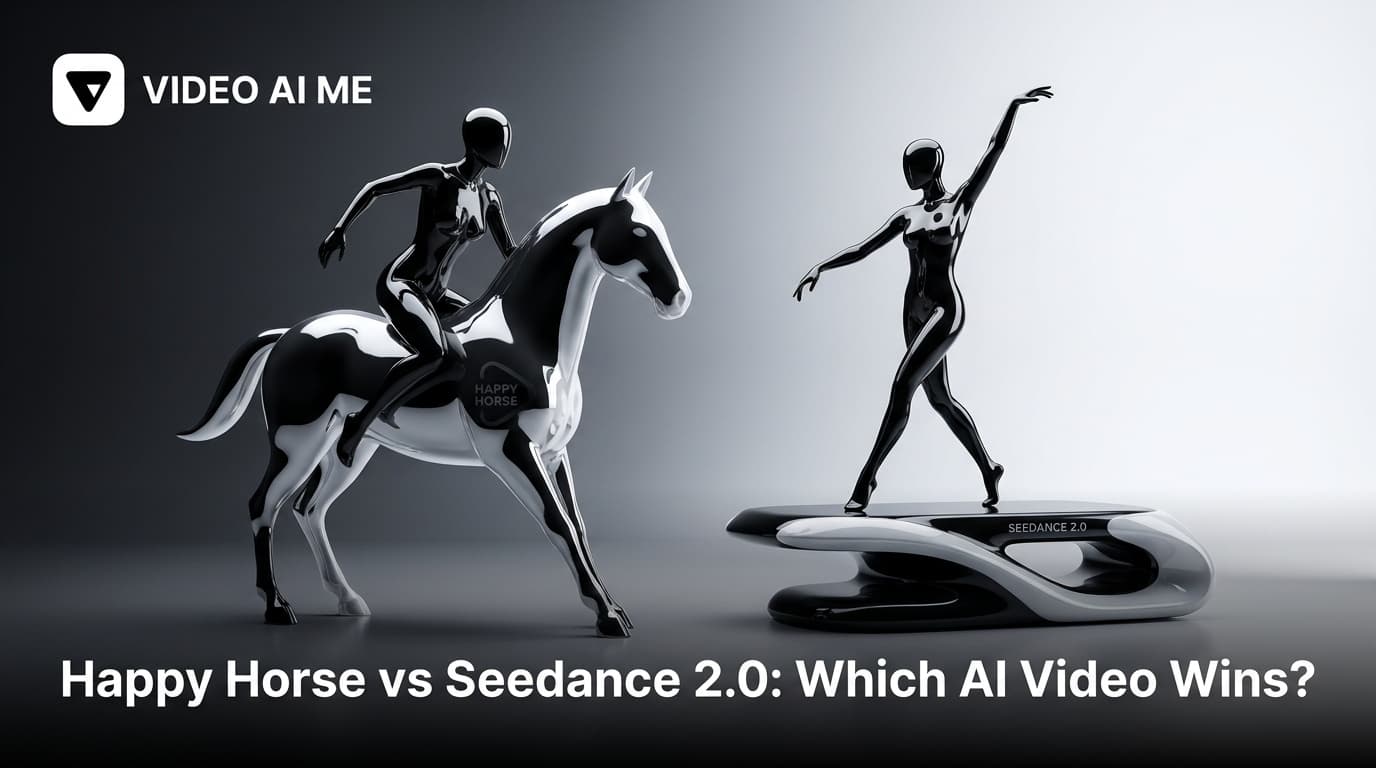
Happy Horse vs Seedance 2.0: The New #1 vs the Former Champion
For most of early 2026, Seedance 2.0 by ByteDance held the top spot on the Artificial Analysis Video Arena leaderboard. Then on April 26, 2026, Alibaba quietly released Happy Horse 1.0 - and the rankings shifted overnight. Happy Horse 1.0 now sits at Elo 1333 for text-to-video and Elo 1392 for image-to-video, a 107-point lead over Seedance 2.0. That is not a narrow gap. It is the largest margin between first and second place the leaderboard has seen.
But benchmark scores do not always translate cleanly into production decisions. This post breaks down where each model actually excels, where each falls short, and how to decide which one to use for your specific workflow.
What Makes Happy Horse 1.0 Different
Happy Horse 1.0 is a 15-billion-parameter unified Transformer built by Alibaba Token Hub (ATH). What separates it from every other video model on the market is its single-pass architecture: audio and video are generated together in one forward pass, not layered on afterward. That matters because lip-sync alignment, ambient sound timing, and speech prosody are baked into the generation process rather than stitched together in post.
The model outputs at 1080p and handles multilingual lip-sync natively. If you are producing content in Spanish, Korean, Arabic, or English, Happy Horse generates synchronized speech without a separate dubbing step. That alone makes it a meaningful upgrade for anyone running localized video campaigns.
Happy Horse was identified on benchmarks as early as April 9, 2026 (reported by Bloomberg and CNBC), before Alibaba made the official announcement on April 26. That stealth benchmark run generated early buzz in the AI video community and gave a preview of how dominant the model would be.
What Seedance 2.0 Still Does Well
Seedance 2.0 is not obsolete. ByteDance built it specifically for high-fidelity human motion, and that focus shows. Walking cycles, hand gestures, crowd scenes, and expressive body language all render with notable accuracy. If your video requires a character to move naturally through a scene without any audio component, Seedance 2.0 remains a strong option.
Seedance also has a longer production track record. It was #1 on the leaderboard for an extended period, which means there is more community knowledge, more prompt templates, and more real-world examples of what it can and cannot do. For teams that have already built workflows around Seedance, switching entirely to Happy Horse may introduce friction that is not always worth it.
Head-to-Head Comparison
| Feature | Happy Horse 1.0 | Seedance 2.0 |
|---|---|---|
| Resolution | 1080p | 1080p |
| Max clip length | Not publicly capped | Standard short clips |
| Native audio | Yes - joint generation | No |
| Motion quality | Excellent, #1 leaderboard | Excellent, especially human |
| Multilingual lip-sync | Yes | Limited |
| Pricing tier | Mid-to-high | Mid |
| Best for | Audio-synced content, localized ads | Motion-heavy silent clips |
When to Use Happy Horse 1.0
Choose Happy Horse 1.0 when your video needs synchronized audio. Product ads with voiceover, explainer videos, spokesperson content, multilingual social clips - these are all scenarios where the joint audio-video architecture produces results that no other model currently matches. The 107-Elo gap on the leaderboard reflects real-world output quality, not just abstract benchmark performance.
Happy Horse is also the right choice when you are working at scale in multiple languages. Rather than generating a video in one language and then dubbing it separately, Happy Horse generates the localized version from the start. That cuts production time significantly for global campaigns.
You can try Happy Horse 1.0 today at VIDEO AI ME - it is available alongside Seedance 2.0 under a single subscription, with no need to manage separate accounts.
When to Stick With Seedance 2.0
If your workflow is entirely motion-focused and audio is handled separately in editing, Seedance 2.0 holds its own. Scenes with complex physical interaction - sports, dance, manufacturing demonstrations - benefit from Seedance's human motion training. Teams that have already optimized their prompting style for Seedance may also find the transition to Happy Horse requires recalibration.
The practical answer for most creators is: use both. Different scenes in the same project may suit different models, and forcing every generation through a single model means leaving quality on the table.
The Case for a Dual-Model Workflow
The video production teams getting the most out of AI right now are not those who have picked the "best" model and committed to it. They are the teams that understand which model wins for which type of clip and route their work accordingly. Happy Horse for audio-synced spokesperson content. Seedance for motion sequences. The result is a production pipeline that is consistently stronger than any single-model approach.
VIDEO AI ME is currently the only platform that gives you both Happy Horse 1.0 and Seedance 2.0 in a single subscription. You also get a custom AI actor that speaks any language, and the platform outputs both 16:9 and 9:16 from one workflow - so you are not running separate processes for YouTube versus TikTok.
Don't pick one tool, pick a workflow. VIDEO AI ME gives you both top-2 motion models so you don't have to bet wrong.
Bottom Line
Happy Horse 1.0 is the best AI video model available right now by leaderboard metrics, and its joint audio-video architecture makes it a genuine leap forward for content that requires synchronized speech. Seedance 2.0 is still a top-tier model with particular strengths in human motion and an established production track record. For most teams, the smart move is not to choose between them - it is to have access to both.
If you are curious how Happy Horse compares to models outside the ByteDance-Alibaba competition, see our post on Happy Horse vs Sora 2 for a look at how the leaderboard leader stacks up against OpenAI's flagship video model.
Frequently Asked Questions
Share
AI Summary

Paul Grisel
Paul Grisel is the founder of VIDEOAI.ME, dedicated to empowering creators and entrepreneurs with innovative AI-powered video solutions.
@grsl_frReady to Create Professional AI Videos?
Join thousands of entrepreneurs and creators who use VIDEO AI ME to produce stunning videos in minutes, not hours.
- Create professional videos in under 5 minutes
- No video skills experience required, No camera needed
- Hyper-realistic actors that look and sound like real people
Get your first video in minutes
Related Articles

MiniMax H3 UGC Prompt Templates for Ad Creative
Reusable UGC prompt templates with the variables marked, so you can produce a whole batch of creator style ads by swapping four fields.
Seedance 2.5 UGC Prompt Templates for Ads
Six fill in the blank UGC prompt templates for Seedance 2.5, each with a fully filled worked example, plus how to direct dialogue when the audio is generated.
How to Make AI UGC Videos With Seedance 2.5
A five step playbook for creator style UGC clips with Seedance 2.5: casting, prompts that carry the spoken hook, reference images for batches, and the credit math.