
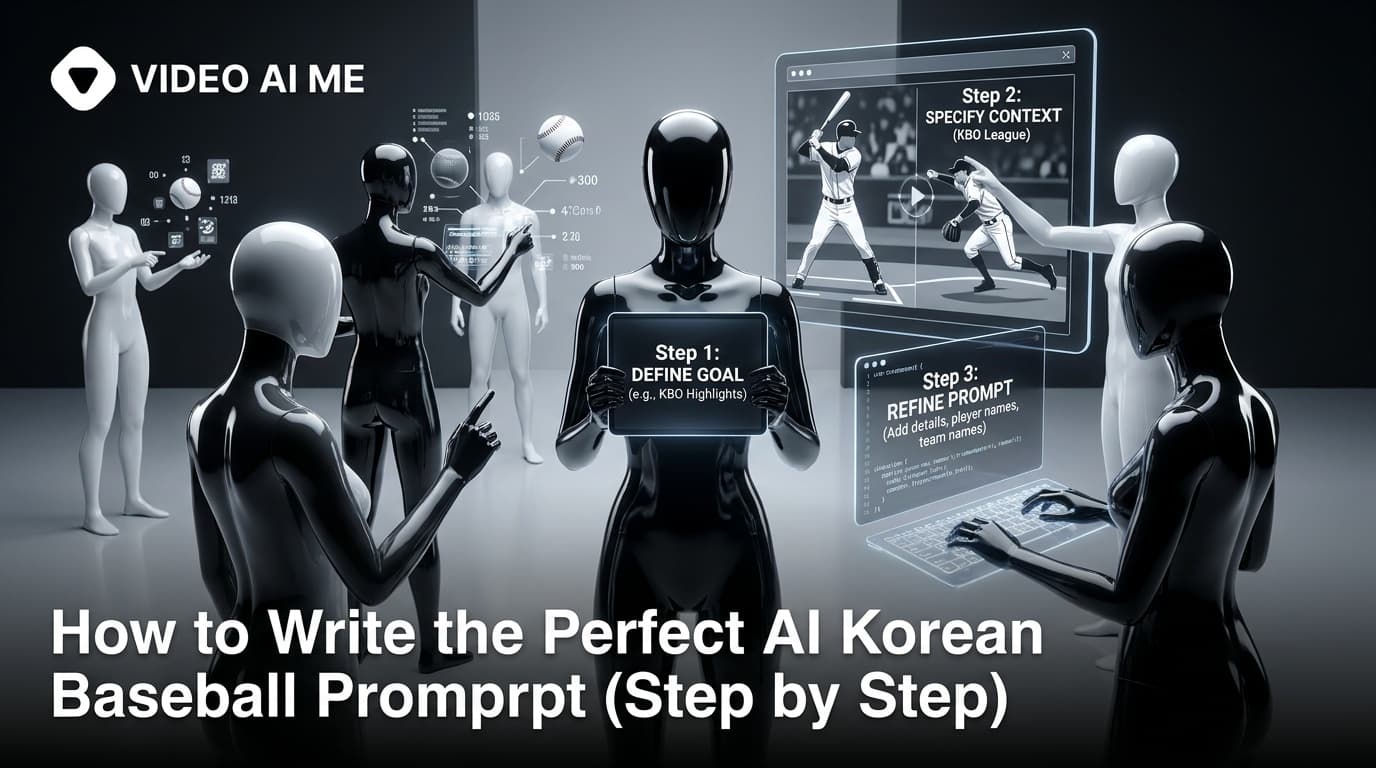
How to Write the Perfect AI Korean Baseball Prompt (Step by Step)
A full walkthrough on how to write an AI Korean baseball prompt that looks like a real KBO broadcast, with copy-paste templates and realism settings.
If you have spent any time on Instagram or TikTok in the last two weeks, you have seen the AI Korean baseball trend. A normal-looking spectator, caught for a second by the SPOTV camera, frozen on screen while the broadcast graphics tick along underneath. Stadium Goddess hit 8 million views before fans realized she was generated. The clips look real. The faces look real. The crowd looks real.
They are not. They came out of an AI Korean baseball prompt.
This guide breaks down how to write one of those prompts from scratch. Not a vague "realistic baseball fan" instruction, but a full broadcast-grade prompt with the lighting, lens, framing, wardrobe, broadcast overlay, motion cues, and anti-AI rules that separate viral clips from obvious fakes. You can paste the templates as-is, swap the variables, and ship.
The Anatomy of a Working AI Korean Baseball Prompt
Every prompt that actually fools people is built from the same six layers. Strip any one of them out and the realism collapses.
- Subject lock: the person, identity-anchored to a reference photo.
- Wardrobe and props: team jersey, hat, iced drink, cheering stick, handheld fan.
- Environment: KBO stadium, time of day, weather, crowd density.
- Camera and lens: telephoto sports broadcast, 16:9 horizontal frame, candid framing.
- Broadcast overlay: scoreboard graphics, channel watermark, lower third.
- Anti-AI rules: no beauty filter, no big eyes, no smoothed skin, no posing.
Think of it like a film slate. Subject. Costume. Set. Camera. Graphics. Don't-do list. When you write the prompt, follow that order. The model reads top-to-bottom and weights the earliest tokens most heavily, so identity should come first and aesthetic negatives should come last.
Step 1: Write the Subject Lock
This is where most beginner prompts die. They describe a generic Korean woman or man, the model invents a face, and the resulting clip has nothing to do with the creator.
The fix is identity anchoring. Use a clear reference photo with even lighting and start the prompt by referencing it.
Use the uploaded reference as the strongest identity anchor.
The subject must look identical to the source image: same
face shape, same eye spacing, same nose, same lip thickness,
same natural skin tone and proportions. Do not stylize.
If you are working off an image-only model, that paragraph alone will save you 80% of your retries.
Step 2: Build the Wardrobe and Props
This is the layer that grounds the scene in KBO culture. Generic baseball props read American. KBO props read Korean.
- Iced Americano in a clear plastic cup with a green straw
- Inflatable cheering stick (red, blue or yellow depending on team)
- Handheld plastic fan in team colors
- Lightweight jersey worn open over a fitted top
- Korean-style cap pulled low
Write it as a short, specific block:
Wardrobe: clean white Hanwha Eagles jersey worn open over a
fitted cream tank top, plain silver hoop earrings, small black
shoulder bag on the seat next to her. Props: an iced Americano
in a clear plastic cup held in the left hand, an orange inflatable
cheering stick resting against the seat, a folded handheld fan
in her lap.
Notice the level of specificity. "Wearing a jersey" produces ten different jerseys. "Clean white Hanwha Eagles jersey worn open over a fitted cream tank top" produces one.
Step 3: Set the Environment
KBO games happen at night under stadium lights. The crowd is dense, animated and slightly out of focus. The seat color and stadium architecture matter more than you'd expect because they are the cues that tell viewers "this is Korea, this is KBO."
Environment: Jamsil Baseball Stadium at night, lower bowl behind
first base, crowd of around 18,000 fans in animated motion,
stadium floodlights overhead, warm light spill on faces in the
first few rows, deep cool blue in the background sky behind
the outfield wall. Mid-game atmosphere, sixth inning energy.
Add the inning. Add the time of day. Add the section of the stadium. These cues compound into something that feels specific instead of stock.
Try VIDEO AI ME for the Full Workflow
Most guides stop at the image and tell you to push it through a separate motion tool. That is the long way around. VIDEO AI ME takes one prompt, generates a custom AI actor that holds your identity across frames, and outputs both 16:9 and 9:16 in a single pass. You skip the ChatGPT plus Kling plus editor chain entirely.
Step 4: Lock the Camera and Lens
This is the realism layer. A live KBO broadcast camera is a long-throw telephoto from across the field. It has compression. It has slight softness. It has handheld micro-shake. Write that in.
Camera: realistic KBO live broadcast capture, telephoto sports
lens at roughly 400mm equivalent, heavy lens compression,
shallow but not artificial depth of field, candid framing with
the subject slightly off-center to the right, head and upper
torso visible, micro handheld drift, faint motion blur on
moving crowd members in the background, broadcast-grade
color science, slight rolling-shutter feel.
This is the paragraph that separates real-looking results from glossy AI portraits. Telephoto compression flattens facial features in a flattering, naturalistic way. Without it, the face looks plastic.
Step 5: Add the Broadcast Overlay
This is the trust-builder. Real KBO viewers are used to the scoreboard ticker, the channel watermark, and the lower-third banner. When the AI scene has those graphics, the brain stops looking for AI tells.
Broadcast overlay: KBO-style scoreboard in the upper-left
showing Hanwha Eagles 3, Doosan Bears 2, bottom of the 6th,
1 out, count 2-1. SPOTV-style channel watermark in the
upper-right. Subtle lower-third graphic with player name
and batting average tucked into the bottom-left. All graphics
rendered as crisp vector overlays on top of the broadcast
feed, not embedded in the scene.
If the model botches the text on the scoreboard, you can mask and re-render that region. Most viewers will not zoom in on the numbers, but they will notice if the graphics are missing.
Step 6: Write the Anti-AI Rules
This is your last paragraph and it does the heavy lifting against the model's defaults. Without it, every model in 2026 will quietly add an Instagram filter to your spectator.
Realism rules: no AI beauty filter, no enlarged eyes, no jaw
slimming, no smoothed skin, no airbrush effect, no glamour
lighting. Keep visible pores, baby hairs, slight sweat sheen
on the forehead, slight broadcast compression noise, faint
crowd noise grain. The final image must read as a real
accidental broadcast capture of an ordinary spectator that
went viral online, not as a portrait shoot.
Write this in negatives. Models in 2026 still respond well to direct negative phrasing.
Putting It All Together: The Master Template
Here is the full prompt as one block. Swap the variables in square brackets for your scene.
Use the uploaded reference as the strongest identity anchor.
The subject must look identical to the source image.

Wardrobe: clean white [TEAM] jersey worn open over a fitted
[TOP COLOR] top, [EARRINGS], small bag on the seat.
Props: iced Americano in a clear plastic cup, [TEAM COLOR]
inflatable cheering stick, folded handheld fan.

Environment: [STADIUM] at night, lower bowl behind first base,
dense KBO crowd, stadium floodlights, mid-game sixth-inning
energy, deep blue sky behind the outfield.

Camera: KBO live broadcast capture, 400mm telephoto
equivalent, heavy compression, candid off-center framing,
head and upper torso, micro handheld drift, faint motion blur
on background crowd, broadcast color science.

Broadcast overlay: KBO scoreboard upper-left, channel
watermark upper-right, subtle lower-third bottom-left.

Realism rules: no AI beauty filter, no enlarged eyes, no jaw
slimming, no smoothed skin. Keep pores, baby hairs, slight
sweat sheen, broadcast compression noise. The result must
read as a real accidental broadcast capture, not a portrait.
Step 7: Add the Motion Prompt
Once the still works, the motion prompt is short. You want one micro-action, not choreography.
Motion: 5-second single continuous broadcast shot. The subject
realizes the camera, gives a small surprised smile, glances
away, then glances back. Subtle handheld broadcast camera
drift. Crowd in the background stays soft and animated. No
cuts, no zoom, no pan. 9:16 and 16:9 outputs.
Keep motion strength around 4 or 5. Higher values warp hands and hair.
Build the Engine, Not Just the Clip
One viral clip is a moment. A repeatable AI Korean baseball prompt is an engine. Once you have a template that works, you can produce a new variation every day: different team, different stadium, different inning, different wardrobe. VIDEO AI ME's repeatable AI actor workflow means your face stays consistent across every clip, so the trend becomes a series instead of a one-off. Build the system once, then run it. For the next iteration, see our 10 ready-to-copy AI Korean baseball prompts.
Try a free generation on VIDEO AI ME and see how the same prompt produces broadcast-grade 16:9 and 9:16 in one workflow.
Frequently Asked Questions
Share
AI Summary

Paul Grisel
Paul Grisel is the founder of VIDEOAI.ME, dedicated to empowering creators and entrepreneurs with innovative AI-powered video solutions.
@grsl_frReady to Create Professional AI Videos?
Join thousands of entrepreneurs and creators who use VIDEO AI ME to produce stunning videos in minutes, not hours.
- Create professional videos in under 5 minutes
- No video skills experience required, No camera needed
- Hyper-realistic actors that look and sound like real people
Get your first video in minutes
Related Articles
MiniMax H3 UGC Prompt Templates for Ad Creative
Reusable UGC prompt templates with the variables marked, so you can produce a whole batch of creator style ads by swapping four fields.
Seedance 2.5 UGC Prompt Templates for Ads
Six fill in the blank UGC prompt templates for Seedance 2.5, each with a fully filled worked example, plus how to direct dialogue when the audio is generated.
How to Make AI UGC Videos With Seedance 2.5
A five step playbook for creator style UGC clips with Seedance 2.5: casting, prompts that carry the spoken hook, reference images for batches, and the credit math.