
Kling AI for Animated Storyboards: From Static Panels to Moving Sequences in 90 Minutes
Animate static storyboard panels into multi-shot moving sequences with Kling 3.0. The director workflow, the ad agency workflow, character consistency tricks, and real time and cost data.
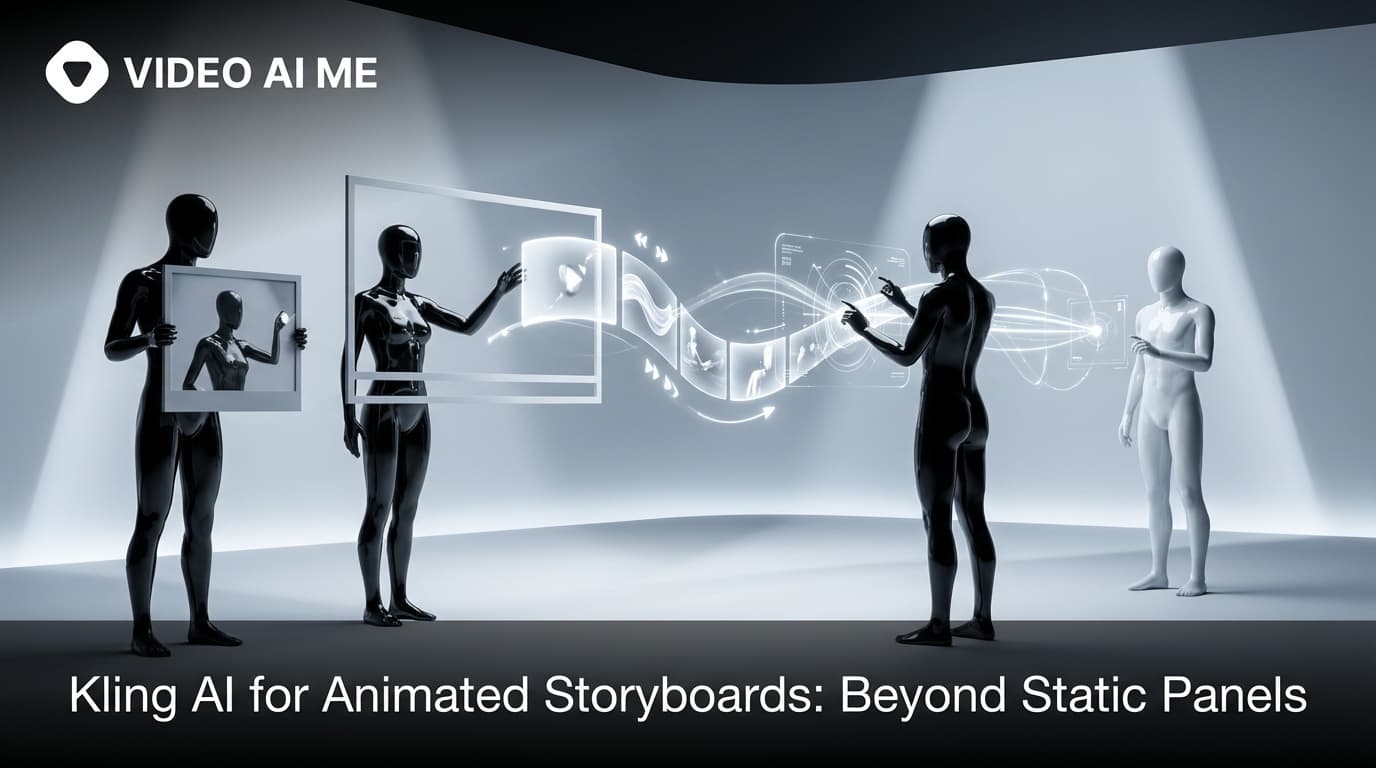
From Static Panels To Living Storyboards
For a hundred years a storyboard was a static drawing. Six panels per page, arrows for camera moves, scribbled notes for dialogue. Directors and animators would walk a client through them one frame at a time and hope the client could imagine the motion between the frames.
That imagination gap has killed more creative pitches than bad ideas ever have. A client who cannot see the motion cannot feel the pacing. A client who cannot feel the pacing cannot commit the budget.
Kling 3.0 changes the entire format. With image-to-video and native multi-shot, you can take any static storyboard panel - hand-drawn on paper, sketched on an iPad, or assembled digitally - and animate it into a moving clip that preserves your composition while adding the motion you intended.
The client no longer has to imagine. They can feel the pacing and the camera language directly.
According to Wyzowl, 96% of marketers say video has helped increase user understanding of their product. Moving storyboards eliminate the imagination gap between what the creative team sees in their head and what the client experiences in the meeting room.
Kling 3.0 is available now on VIDEOAI.ME. This post is the workflow for directors, animators and agency creatives.
What An Animated Storyboard Actually Is
An animated storyboard sits between a static board and full pre-viz on the production pipeline. Understanding where it fits helps you choose the right tool for each stage.
- Static board. A drawn panel with arrows and notes. Client must imagine all motion. Cheapest, fastest to create, but highest imagination burden on the viewer.
- Animated storyboard. The same panel animated into a 4 to 8 second moving clip with subtle motion. Client feels the timing and camera direction. Takes 90 minutes for 12 panels on Kling 3.0.
- Pre-viz. A fully generated cinematic shot from a text prompt, not based on a drawn panel. Client sees the intended visual with realistic lighting and atmosphere. Takes a full day.
The animated storyboard preserves the composition and intent you drew while adding the motion you intended. It is the lowest-friction way to upgrade your existing storyboard workflow without starting from scratch.
The Kling 3.0 Multi-Shot Storyboard Workflow
Step 1: Draw Or Source Your Panels
If you already have a storyboard, scan it at high resolution (1024px minimum on the long edge). Clean scans produce better animations. If the original is pencil on paper, increase contrast before uploading.
If you are starting from scratch, draw 12 to 20 panels by hand or in any digital tool (Procreate, Photoshop, even PowerPoint). Each panel should represent a single shot with clear framing and composition.
Do not worry about artistic quality. Kling 3.0 interprets the composition, lighting direction, and framing from your panel. Stick figures with clear spatial relationships animate just as well as polished illustrations.
Step 2: Group Panels Into Multi-Shot Sequences
Kling 3.0 multi-shot lets you animate 2 to 3 related panels in a single generation with consistent style and tone. Group panels that belong to the same scene or share similar lighting conditions.
For a 12-panel storyboard, you might have 4 to 5 multi-shot sequences of 2 to 3 panels each. This is more efficient than animating each panel individually, and the shared generation ensures visual consistency within each scene.
Example grouping for a 30-second commercial storyboard:
- Sequence 1: Panels 1-3 (establishing scene, character introduction)
- Sequence 2: Panels 4-6 (problem demonstration)
- Sequence 3: Panels 7-9 (product reveal)
- Sequence 4: Panels 10-12 (resolution and CTA)
Step 3: Write Motion Prompts For Each Sequence
Keep prompts minimal. The composition is locked by the reference panel images. The prompt only describes the motion and atmosphere you want added.
Interior dialogue scene (3 panels):
Master Prompt: Warm interior lighting, slight handheld drift. Soft natural blinks and subtle body movement. Preserve drawn composition exactly. Negative: distortion, warping face, jittery motion.
Multi shot Prompt 1: The character in the panel turns their head slowly toward camera over 4 seconds. Soft ambient motion in the room.
Multi shot Prompt 2: Reverse angle, the second character responds with a slight lean forward, 4 seconds. Subtle expression change.
Multi shot Prompt 3: Wide shot of both characters, subtle ambient movement in the background, curtains drift, 4 seconds.
Action sequence (2 panels):
Master Prompt: Cinematic feel, slow atmospheric drift. Ambient motion in environment. Negative: warping walls, jittery horizon, distortion.
Multi shot Prompt 1: Slow drift right over 4 seconds. Dust catches the sunbeam through the window, curtains move in slight breeze.
Multi shot Prompt 2: Slow push-in toward the doorway, shadow shifting across the floor, 4 seconds. Building tension.
Close-up insert sequence (2 panels):
Master Prompt: Locked-off macro feel. Subtle motion only, preserving drawn detail. Negative: distortion, melted edges, warping.
Multi shot Prompt 1: Slight focus pull from background to subject over 4 seconds. Breathing life into the still image.
Multi shot Prompt 2: Locked close-up of hands, subtle finger movement, natural tremor, 4 seconds.
Step 4: Generate on VIDEOAI.ME (45 to 60 minutes)
Upload each panel group as image-to-video references and submit the multi-shot prompts. For 5 multi-shot sequences with rerolls, the generation time is about 45 to 60 minutes. Most of that time is review and selection rather than waiting.
Step 5: Assemble The Animatic (30 minutes)
Drop the animated clips into your editor in shot order. Add temp music or scratch narration if helpful for the pitch. The animatic should show the client the complete visual flow of the piece.
Total time: about 90 minutes from scanned panels to moving animatic.
Character Consistency Across Storyboard Panels
If your storyboards feature the same character across multiple panels, Kling 3.0 multi-shot maintains consistency within each generation automatically. For consistency across separate generations, the approach depends on how your panels were drawn.
Workflow for drawn storyboards:
- Draw or generate one strong reference portrait of the main character in the style of your storyboard.
- Base every storyboard panel on that character design, keeping proportions, hair, and clothing consistent across panels.
- When animating with Kling 3.0, the model preserves the character look from the input panel.
- For panels in different lighting conditions, the character still reads as the same person because the underlying design is consistent.
Workflow for photorealistic pre-viz from storyboard panels:
- Generate one strong photorealistic portrait of the character.
- Use that portrait as an additional reference alongside each storyboard panel.
- The combination of storyboard composition plus character reference produces consistent photorealistic results.
According to Nielsen, visual consistency is one of the top factors in brand recognition and audience trust. The same principle applies to characters in a storyboard: the audience or client needs to instantly recognize the protagonist across every panel without thinking about it.
Where Animated Storyboards Win Over Static
The difference between presenting static panels and moving storyboards in a pitch is significant.
- Pitch meetings. Walk a client through a moving sequence instead of a paper deck. The win rate on pitches with animated storyboards versus static is measurably higher because the client can feel the pacing.
- Director-DP discussions. Show your DP exactly what camera language you want. No more misinterpreted arrows drawn on paper. No more "I imagined it differently" on set day.
- VFX team briefings. Communicate motion intent before any 3D or compositing work begins. A moving storyboard is worth a thousand words of technical specification.
- Festival submissions. Several animation festivals now accept animated storyboards as standalone entries in experimental and emerging technology categories.
- Crowdfunding pitches. Show backers on Kickstarter or Indiegogo a moving version of your project. Moving images generate significantly more pledges than static concept art.
- Internal alignment. Get producers, writers, and stakeholders on the same page before any budget is committed. Disagreements about pacing and tone surface immediately when people can see the storyboard move.
The Speed Advantage In Numbers
| Method | Time for 12 panels | Cost |
|---|---|---|
| Traditional hand-drawn animatic | 3 to 5 days | $1,000 to $3,000 |
| Motion graphics animatic | 2 to 4 days | $500 to $2,000 |
| Kling 3.0 on VIDEOAI.ME | 90 minutes | Under $15 (or included in plan) |
Research from HubSpot shows that video content generates 1200% more shares than text and images combined. An animated storyboard is not just a production tool - it is a shareable pitch asset that clients forward to their teams, their bosses, and their stakeholders.
Advanced Technique: Storyboard To Pre-Viz Pipeline
For directors who want to go further, the animated storyboard becomes the first step in a two-stage pipeline.
Stage 1: Animate your hand-drawn panels with Kling 3.0 image-to-video. Review the timing and pacing.
Stage 2: For panels that need more polish, rewrite those specific shots as full text-to-video pre-viz prompts on Kling 3.0. The animated storyboard showed you the timing. The pre-viz shows you the look.
This pipeline means you only spend full pre-viz effort on the shots that matter most (hero shots, emotional beats, the money shot), while the connective tissue stays at storyboard-animation level. Efficient and effective.
How VIDEOAI.ME Handles Storyboards
Inside VIDEOAI.ME the storyboard workflow lets you upload all your panels at once, group them into multi-shot sequences with drag and drop, write a single motion prompt template per group, and animate every sequence in parallel. The system tracks rerolls and lets you choose between takes per panel.
Built for directors who want to spend time on craft, not queue management.
For related workflows see Kling AI for film pre-viz, Kling AI for cinematic short films, and Kling AI image-to-video prompts.
Animate Your Next Storyboard This Afternoon
If your next pitch is still a paper deck, this is the upgrade that wins the room. 90 minutes, 12 panels, a moving animatic ready for the client meeting. Kling 3.0 multi-shot on VIDEOAI.ME.
Try VIDEOAI.ME free and animate your first storyboard today.
The Agency Storyboard Workflow: From Brief To Animated Deck In Half A Day
For agencies, the animated storyboard workflow typically starts with a client brief and ends with a moving deck ready for internal review. Here is the half-day timeline.
9:00-10:30: Brief review and panel sketching. Read the brief, develop the concept, sketch 12 to 16 panels. These do not need to be polished illustrations. Clear compositions with readable framing are enough.
10:30-11:00: Scan and organize panels. Photograph or scan each panel at high resolution. Name them in sequence.
11:00-12:00: Write motion prompts and generate on VIDEOAI.ME. Group panels into multi-shot sequences, write the motion prompts, submit the generations. While they generate, start building the deck framework.
12:00-12:30: Review takes and select. Pick the best animated version of each panel. Regenerate any that did not capture the intended motion.
12:30-1:00: Assemble the animated deck. Drop selected clips into Keynote or your presentation tool. Add titles, transitions, and a temp music bed.
By 1:00 PM you have a moving storyboard deck ready for internal creative review. The same process with traditional animatics would take 3 to 5 business days.
According to HubSpot, 54% of consumers want to see more video content from brands they support. The agency that can move from brief to moving storyboard in half a day ships more pitches, wins more clients, and scales faster than agencies still working with static panels and traditional animatic timelines.
Frequently Asked Questions
Share
AI Summary
Paul Grisel
Paul Grisel is the founder of VIDEOAI.ME, dedicated to empowering creators and entrepreneurs with innovative AI-powered video solutions.
@grsl_frReady to Create Professional AI Videos?
Join thousands of entrepreneurs and creators who use VIDEO AI ME to produce stunning videos in minutes, not hours.
- Create professional videos in under 5 minutes
- No video skills experience required, No camera needed
- Hyper-realistic actors that look and sound like real people
Get your first video in minutes
Related Articles
A Same Day Workflow for AI Video Ad Creative
A full day plan that takes an offer from brief to launched creative, built around fast drafting, one round of judgement, and finishing only what survives.
How to Draft a Video Ad in Minutes With AI
A repeatable routine for going from a product page to six testable video ad drafts in one sitting, using a fast model and single variable rewrites.

How Many Video Ad Variations Should You Test?
How many creatives a test actually needs, how different they have to be, and why the right number is set by what you can afford to produce.