
Timeline of the AI Korean Baseball Trend (May 2026)
Full day-by-day timeline of the AI Korean baseball trend, from the first Korean clips to the Stadium Goddess hoax to the global spread across Reels and TikTok.
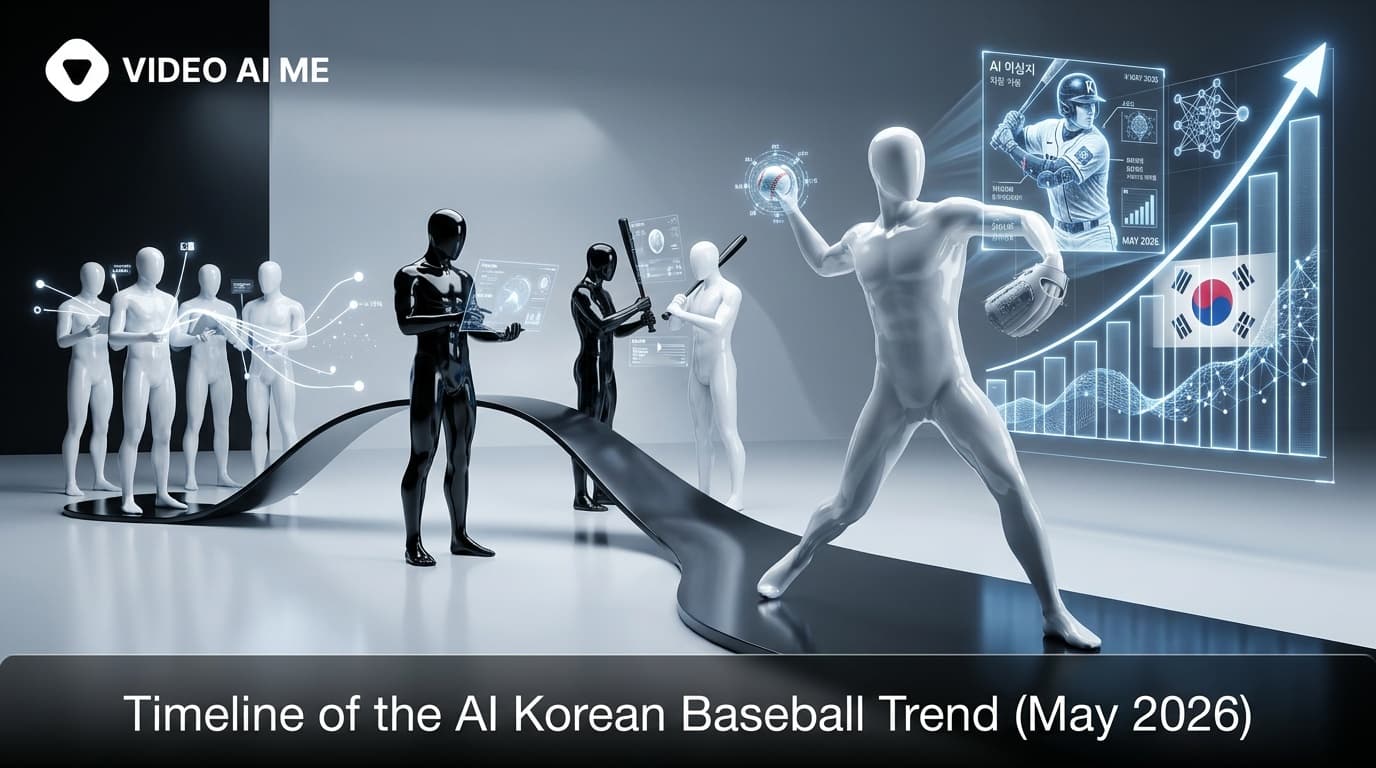
Why This Timeline Matters
The AI Korean baseball trend did not slowly accumulate. It detonated in a tight 10-day window in May 2026. Understanding the timeline matters if you create content for a living, study viral mechanics, or want to ride the next format like it instead of watching from the sidelines.
This post walks the trend day by day, names the creators who shaped it, and pulls out the lessons every working creator should take from how fast the AI Korean baseball trend went from Korean curiosity to global meme.
Early May 2026: The Korean Origin Wave
The AI Korean baseball trend started inside Korean social platforms during the first week of May 2026. The exact starting account has not been definitively identified, but the format was already circulating on Korean Twitter, Threads and Naver communities by the time international observers noticed it.
The earliest clips used a chained workflow. ChatGPT or Gemini for a still image of the creator seated in a KBO stadium. Kling AI for the motion. A few seconds of carefully prompted broadcast aesthetic, complete with scoreboard graphics, slight motion blur and compression noise designed to mimic real KBO TV feeds.
The underlying cultural energy was already there. KBO's 2026 season had opened with sellouts and a 30 percent viewership surge driven by women in their 20s, as the women audience post explains in more detail. When the meme arrived, it landed in fertile soil.
May 4 to 6, 2026: The Stadium Goddess Hits
The pivotal clip of the trend appeared on X in early May 2026 with the caption "The average Korean woman." Five seconds. A woman in a white off-shoulder top watching a Hanwha Eagles vs Doosan Bears game. Crossed legs. A short sigh.
The video cleared 8 million views across platforms and pushed close to 15 million on the original post. Comments and reshares treated it as a real broadcast moment.
On May 5 and 6, Korean baseball fans flagged the scoreboard. The graphic listed pitcher Kim Seo-hyun against batter Jo In-sung, an impossible matchup because Jo retired in 2017 and never played for Doosan. Once the anchor failure surfaced, banner text errors and warped smartphone shapes confirmed the clip was AI. Korean media broke the story on May 5 and 6, with Seoul Economic Daily and STARNEWS leading the coverage.
The full breakdown of the exposure lives in our Stadium Goddess deep dive.
May 8, 2026: The Korea Times Frames the Bigger Picture
On May 8, 2026, The Korea Times published a piece that reframed the moment from cute meme to policy issue. The argument: AI video has become so sophisticated that logical data errors, not visual flaws, are now the only reliable detection method.
Professor Lee Jae-sung of Chung-Ang University, quoted in the piece, put it bluntly. Many people still believed that if something was captured on video, it must be real. The Stadium Goddess clip proved that assumption was no longer safe.
The piece also surfaced the regulatory gap. South Korea's AI Basic Act took effect in January 2026 and requires disclosure labels on AI-generated media, but enforcement targets companies, not individual creators. That gap is exactly what the trend was exploiting.
May 10, 2026: The International Breakout
May 10 is the day the AI Korean baseball trend stopped being a Korean story.
Instagram user @somdattaaa posted an early international example of the format. The clip pulled roughly 159,000 likes within two days. The aesthetic was unmistakable: KBO broadcast framing, candid spectator composition, soft compression artifacts. The caption was English. The audience was global.
Within hours, comment sections were asking for the prompt. By that afternoon, prompt-share threads were circulating on Reddit, X and Reels itself.
May 11, 2026: The Engagement Explosion
May 11 was the loudest day of the trend.
Instagram user @thisenola posted a similar AI broadcast clip and pulled around 358,000 likes in a single day. Account @akita_hooligan published a variation featuring a dog seated in the stadium crowd, scoring roughly 237,000 likes. The format had escaped the original aesthetic of beautiful young women in white tops and was now mutating into every imaginable variation.
The NBA courtside version appeared. F1 paddock cutaways followed. K-pop concert front-row clips came next. By the end of May 11, the AI Korean baseball trend was not really about Korean baseball anymore. It was about broadcast cutaways in general.
May 12, 2026: Know Your Meme Catalogues the Format
On May 12, 2026, Know Your Meme published an entry titled KBO TV or Korean AI Courtside Trend. The cataloguing matters because it crystallized the name and locked the format into the cultural record. From that point forward, anyone searching for context could find a single canonical reference.
The same day, English-language outlets including The Tab published explainer pieces walking readers through the tool stack. The trend now had a name, a story, a toolkit and a roster of creators.
May 12 to 15, 2026: The Mutation Phase
With the format established, creators stopped imitating and started mutating. Variations multiplied.
- Family member clips: same broadcast aesthetic, different subject
- Pet clips: the @akita_hooligan dog seat genre
- Multi-sport variations: NBA, F1, NFL, Premier League, K-pop
- Comedic variations: AI-generated chaos in the crowd, fights, fan props, surprise mascot interactions
- Brand variations: small companies inserting their products into the fake broadcast frame
This mutation phase is normal for any viral format. It is also the phase where the most strategic creators stop chasing variations and start thinking about repeatable workflows.
The Lesson Buried in This Timeline
The AI Korean baseball trend went from local Korean curiosity to global meme to catalogued format in roughly eight days. That is the new tempo of viral video in 2026. If your workflow takes a day to produce one clip across one aspect ratio, you are participating too slowly.
The creators who profited most from the trend were not the most artistic. They were the most efficient. They had a workflow that could turn an idea into a finished 16:9 and 9:16 clip in under an hour. They published while the format was still hot.
VIDEO AI ME is built for exactly that tempo. Create an AI actor in any language. Generate dual-format video in one pass. Publish to TikTok, Reels, Shorts and YouTube horizontal from a single source. When the next trend lands, you will not be assembling a toolkit. You will already be posting.
What the Timeline Did Not Show
Most AI Korean baseball trend creators went viral once and then disappeared. The timeline is full of accounts that hit six-figure likes on a single clip and never replicated the result. That is not a tooling failure. It is a positioning failure.
The creators who turned this trend into a long-term gain are the ones who used it as a hook for a personal brand. Same AI actor across every future video. Recognizable voice. Consistent posting schedule. Each clip building on the last. The trend is the door. Your brand is what you build on the other side.
Do not stop at the AI Korean baseball trend. Use it to learn what your audience responds to, then apply those lessons to the next ten formats. The KBO fan cam trend will be a footnote in six months. Your AI actor can still be your audience's recognizable creator a year from now.
What Comes Next on the Timeline
Formats like the AI Korean baseball trend leave permanent residue. Three predictions for the rest of 2026.
The broadcast cutaway aesthetic becomes default. Expect every meme of the next year to include some version of fake broadcast graphics. The visual grammar is now locked in.
Regulators tighten the disclosure rules. Korean lawmakers are already moving on the gap exposed by the Stadium Goddess case. Other jurisdictions will follow.
Single-tool workflows beat tool chains. Creators who can produce dual-format AI video in one pass will outpublish creators who chain three tools. The KBO fan cam trend already showed this. The next trend will confirm it.
Try the Tempo Yourself
Try a free generation on VIDEO AI ME and see if a single-tool workflow fits your rhythm. The next trend is already loading somewhere in the feed. The question is whether you will be ready to post the same day it breaks, or three days later when the algorithm has moved on.
Frequently Asked Questions
Share
AI Summary

Paul Grisel
Paul Grisel is the founder of VIDEOAI.ME, dedicated to empowering creators and entrepreneurs with innovative AI-powered video solutions.
@grsl_frReady to Create Professional AI Videos?
Join thousands of entrepreneurs and creators who use VIDEO AI ME to produce stunning videos in minutes, not hours.
- Create professional videos in under 5 minutes
- No video skills experience required, No camera needed
- Hyper-realistic actors that look and sound like real people
Get your first video in minutes
Related Articles
MiniMax H3 UGC Prompt Templates for Ad Creative
Reusable UGC prompt templates with the variables marked, so you can produce a whole batch of creator style ads by swapping four fields.
Seedance 2.5 UGC Prompt Templates for Ads
Six fill in the blank UGC prompt templates for Seedance 2.5, each with a fully filled worked example, plus how to direct dialogue when the audio is generated.
How to Make AI UGC Videos With Seedance 2.5
A five step playbook for creator style UGC clips with Seedance 2.5: casting, prompts that carry the spoken hook, reference images for batches, and the credit math.