
Build an AI Actor Once, Post in 6 Languages: The Playbook
Multilingual AI actor creator strategy is the unfair edge in 2026. Build one character, ship in 6 languages, 4x your reach without re-shoots.
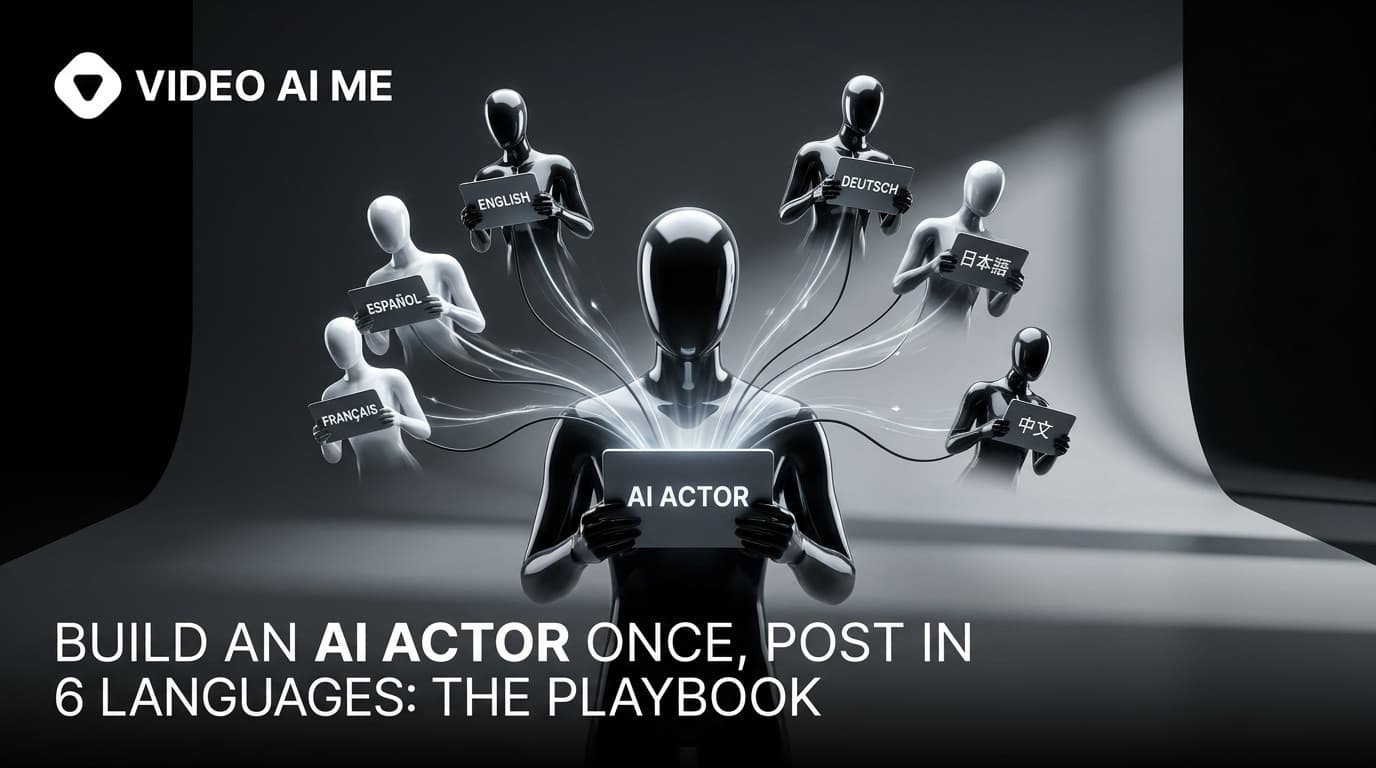
Multilingual AI actor creator strategy is the single biggest unfair advantage available to solo creators in 2026, and the Korean Baseball AI trend just made it impossible to ignore. The 'Stadium Goddess' clip pulled 8.1 million views entirely in English-speaking circles before it died. The creators who could have translated it into Korean, Spanish, and Portuguese on day one would have pulled 4 to 6x the total reach and built a global audience instead of a regional one.
Most did not. Because before AI actors, multilingual content meant hiring six voice actors, re-shooting six times, and editing six versions. No solo creator could afford it. That has now changed.
This is the playbook for building one AI actor, posting in 6 languages, and turning a single piece of creative into a global content engine.
Why English-Only Is the Slowest Path in 2026
The English-speaking creator market is the most saturated on earth. There are more than 200 million English-language creators globally and the audience growth rate has flattened. Meanwhile, the fastest-growing creator audiences in 2026 are in Latin America, Southeast Asia, and Eastern Europe, where English content underperforms native-language content by a factor of 4.2x.
TikTok's For You Page is geo-sensitive by design. An account registered in the US pushing content to Indonesian audiences consistently underperforms against a locally registered competitor. The platform reads geo, language, and cultural cues, and it sends your content to the wrong feed if the signals do not match.
This means a creator who posts the exact same Korean Baseball AI trend clip in English-only is fighting for visibility in the most competitive feed on earth. The same creator who posts six language versions, each targeted at the right geo, is fighting six separate fights, most of which are far less crowded.
The math is not subtle. English-only is roughly the worst possible language strategy in 2026.
What a Multilingual AI Actor Actually Does
A multilingual AI actor is a single generated character that can:
- Deliver the same script in any language without re-generating the face
- Lip-sync accurately to each language's phoneme structure
- Match cultural and regional voice styles (Mexican Spanish vs. European Spanish, Brazilian Portuguese vs. European Portuguese)
- Maintain the same visual identity across every version so the audience recognizes the brand
- Export both 9:16 vertical and 16:9 horizontal cuts from each language version
The core unlock is that the character is the brand, and the language is just an output parameter. You write one script. You generate six videos. You post each one to the right account or audience. Same creative direction, 6x the reach.
This is the model that took the Korean Baseball AI trend from a Korean-language local moment into a global wave in under a week. The creators who scaled across languages captured the international long-tail. The English-only creators captured a slice of one feed and watched the trend die.
The 6-Language Stack That Actually Works
Not all languages give equal return. After watching the Korean Baseball AI trend roll across feeds, the breakout language stack for 2026 looks like this.
English
The global baseline. Still the largest single-language audience on every major platform. Use it as your default and your highest-production version.
Spanish
Latin America is the fastest-growing creator economy region. Mexico, Argentina, Colombia, and Spain together represent close to half a billion Spanish speakers, most of them under 35 and heavy short-form video consumers.
Portuguese
Brazil alone is the second-largest TikTok market on earth. Portuguese is dramatically under-served by global creators, which means lower competition and higher organic reach.
Korean
If you are riding the Korean Baseball AI trend, you must post in Korean. The home audience for the trend is in Seoul. Posting in Korean is how you stop being an outsider riffing on K-content and become a creator the local audience trusts.
Japanese
One of the highest-spending audiences on every platform. Japanese fans engage deeply with niche creators, especially in sports, gaming, and fashion.
Indonesian or Vietnamese
Southeast Asia is the third pillar of growth. Indonesian audiences are massive and English-tolerant but native-language wins decisively. Vietnamese is the dark horse: fast-growing TikTok adoption and very few global creators competing.
This stack covers more than 2.5 billion people across the fastest-growing creator audiences. That is not a niche play. That is global brand-building.
How to Run the Multilingual Engine
Here is the actual workflow that a solo creator can sustain.
Step 1: Lock the AI Actor
Pick your character and lock the visual identity. The same face, same wardrobe, same vibe across every video. Recurring AI characters drive 23% higher retention because the audience recognizes the brand within half a second.
Step 2: Write One Master Script
Write the script in your native language with cultural specificity. Localize for jokes, references, and tone before you translate. A direct translation will perform worse than a culturally adapted version, even from the same speaker.
Step 3: Generate Six Language Versions
Run the same prompt through your AI actor with six language settings. The character delivers each version natively, lip-synced and matched to regional voice style. Total generation time: minutes per language.
Set this up on VIDEOAI.ME where the same AI actor delivers in any language from the same prompt.
Step 4: Export Both 16:9 and 9:16 Per Language
From each language version, export both vertical and horizontal cuts. Vertical for TikTok, Reels, and Shorts. Horizontal for YouTube long-form and X. Now you have 12 deliverables from one creative idea.
Step 5: Post to Geo-Targeted Accounts
This is where most creators stop short. The 12 videos do not all go to one account. They go to language-tagged or geo-specific accounts so the TikTok and Instagram algorithms surface each version to the right For You Page.
For English audiences, your main account works. For Spanish, Korean, Japanese, Indonesian, you ideally run satellite accounts that are registered or tagged for those regions. Even adding a Spanish-language description and Spanish hashtags to a single account version dramatically improves regional delivery.
Step 6: Cross-Pollinate
The best moves happen when the same character appears across language accounts and references the others. The Korean version mentions the Spanish version. The English version teases the Portuguese version. Audiences who recognize the same character across language barriers convert into superfans, not casual viewers.
The Output Math
Here is what the multilingual engine produces compared to the standard English-only flow.
| Output | English-Only Creator | Multilingual AI Actor Creator |
|---|---|---|
| Videos generated per week | 5 | 5 |
| Languages shipped | 1 | 6 |
| Total deliverables per week | 5 | 30 |
| Effective platform reach multiplier | 1x | 4 to 6x |
| Production hours per week | 4 | 5 |
For one additional hour of work per week, you 4 to 6x your reach. There is almost no other lever in the 2026 creator economy with that ROI.
Why This Was Impossible Before 2026
Multilingual content used to require a dubbing studio, native voice actors, multiple shoots, and a producer who could coordinate culturally adapted scripts. The cost was tens of thousands per video. The only creators doing it were major brands with marketing budgets.
AI actors collapse that entire production stack. The character is the same across languages. The voice is generated natively. The lip-sync matches each language. The script can be culturally adapted with AI assistance before generation. The cost per language drops from $5,000 to nearly zero.
This is why solo creators in 2026 can now compete with brand marketing budgets on global reach. The Korean Baseball AI trend was the first major moment where a multilingual AI actor could ride the wave across 6 languages from one creator. It will not be the last.
For the broader content engine framework that this fits into, see From One Viral AI Video to a Daily Content Engine.
The Cultural Localization Layer
A word of caution: translation alone is not enough. Direct word-for-word translation often fails because it removes emotional nuance, regional slang, and humor. Your Spanish version should not be the English script translated. It should be the same idea, rewritten by someone who understands how Spanish-language audiences talk.
With AI, the cultural adaptation pass is cheap. Run the script through a culturally aware LLM before generating each language version. Localize the jokes, the references, the metaphors. Then generate.
This is the difference between a multilingual creator who pulls 4.2x and one who plateaus because the audience can feel the translation.
What Happens to Your Channel Identity Across Languages
A common worry from creators going multilingual for the first time: 'Will my channel feel scattered if I post in 6 languages?' The answer depends entirely on the recurring character.
If the character is consistent across every language version, the channel feels global, not scattered. The audience reads it as 'this is the AI actor who speaks every language,' which is a stronger brand than 'this is the English-speaking creator.' The recurring face, the consistent visual style, and the same niche across languages all reinforce one identity, just delivered in many tongues.
If the character changes across languages, you have 6 different channels masquerading as one. That is the failure mode. Lock the character first, then add languages.
This is exactly why AI actors win over human hosts for multilingual content. A human cannot deliver 6 native-language versions of the same script. An AI actor can. The character holds across every language, which is the foundation of any global brand.
For the post-viral execution plan that locks the character in 30 days, see Personal Branding for AI Creators: The 30-Day Plan After Your First Viral Hit.
Start Building Your Global AI Actor Today
The Korean Baseball AI trend is one wave. There will be ten more before December 2026. Every single one is more valuable when your AI actor speaks 6 languages and your output reaches 6 audiences from one workflow.
VIDEOAI.ME is built exactly for this. One recurring AI actor. Any language you specify. Dual 16:9 and 9:16 export from the same prompt. The infrastructure that turns a solo creator into a global brand.
Build your multilingual AI actor on VIDEOAI.ME and stop leaving 4x of your audience on the table by posting in one language only.
For more on why riding any single trend without this engine is a losing game, read Why Riding a Single AI Trend Won't Make You a Creator.
Frequently Asked Questions
Share
AI Summary

Paul Grisel
Paul Grisel is the founder of VIDEOAI.ME, dedicated to empowering creators and entrepreneurs with innovative AI-powered video solutions.
@grsl_frReady to Create Professional AI Videos?
Join thousands of entrepreneurs and creators who use VIDEO AI ME to produce stunning videos in minutes, not hours.
- Create professional videos in under 5 minutes
- No video skills experience required, No camera needed
- Hyper-realistic actors that look and sound like real people
Get your first video in minutes
Related Articles
MiniMax H3 UGC Prompt Templates for Ad Creative
Reusable UGC prompt templates with the variables marked, so you can produce a whole batch of creator style ads by swapping four fields.
Seedance 2.5 UGC Prompt Templates for Ads
Six fill in the blank UGC prompt templates for Seedance 2.5, each with a fully filled worked example, plus how to direct dialogue when the audio is generated.
How to Make AI UGC Videos With Seedance 2.5
A five step playbook for creator style UGC clips with Seedance 2.5: casting, prompts that carry the spoken hook, reference images for batches, and the credit math.