
How a Paid Community Grew From 12 to 847 Members in 6 Months (The UGC Playbook They Used)
A paid community went from 12 founding members to 847 paying subscribers in 6 months. Here's the exact UGC strategy that made it happen.
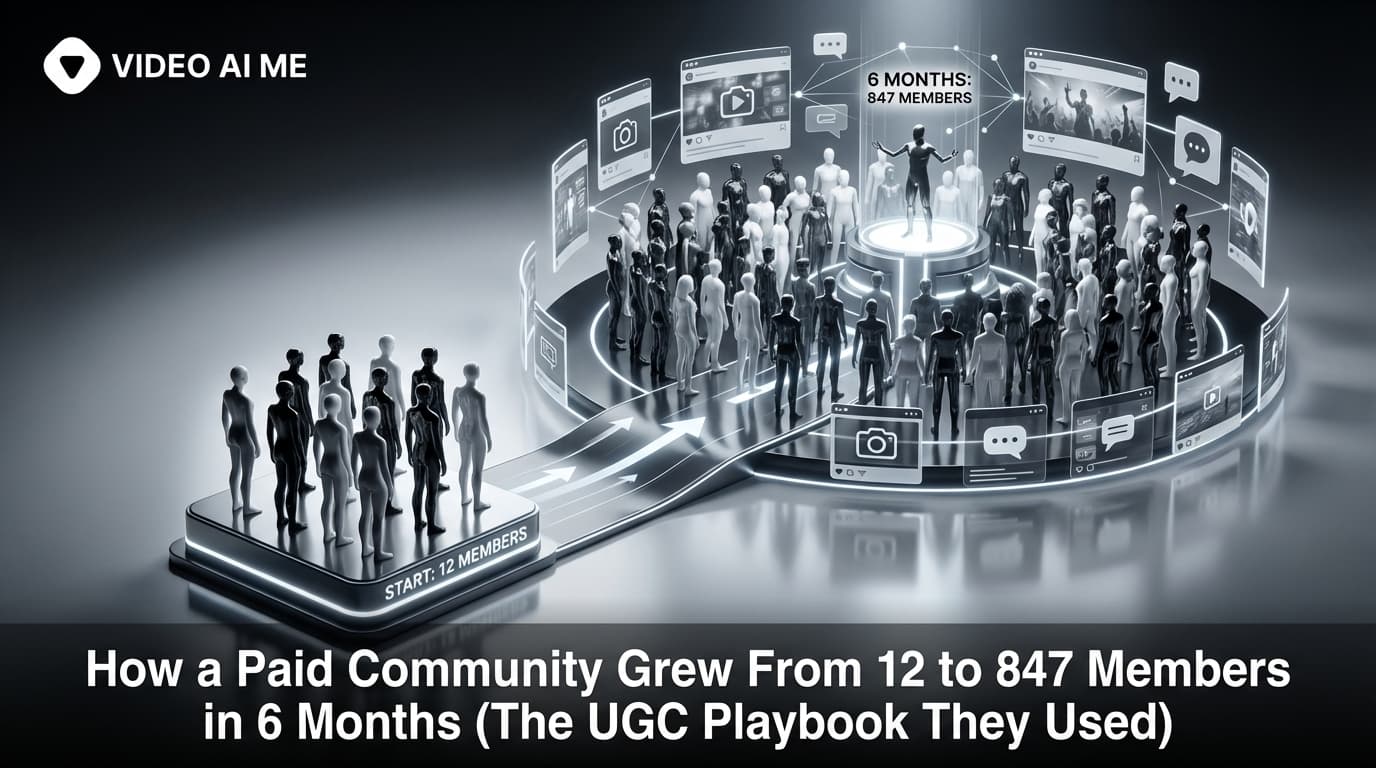
In January, this community had 12 members. They were friends and beta testers, paying a discounted rate while the founder figured things out.
By July, they had 847 paying members at full price ($97/month). Monthly recurring revenue went from $500 to over $82,000.
They didn't have a large following. They didn't get featured in a major publication. They didn't have celebrity endorsements.
They had a UGC strategy that turned existing members into a marketing engine.
I got full access to their data in exchange for documenting this playbook. Here's everything they did.
The Community: Context and Starting Point
The community:
- Topic: Career transition into tech (non-coding roles)
- Price: $97/month
- Platform: Circle community + weekly Zoom calls
- Founder: Former tech recruiter with modest social following (3,200 LinkedIn connections)
According to Circle community research, communities with active UGC programs see 3-4x higher retention rates.
Starting position (January):
- 12 founding members (friends, email list, warm network)
- $500/month MRR (discounted beta pricing)
- No paid advertising history
- Limited content library
The challenge: How do you convince strangers to pay $97/month for a community when you can't show them what's inside?
Communities are experience products. You can't sample them before buying. This makes marketing inherently difficult.
The solution: let existing members show what the experience is actually like.
Phase 1: The Foundation (January-February)
Before spending a dollar on ads, the founder built the content engine.
The Member Content System
Step 1: Identify natural advocates
From 12 members, 5 were actively sharing their experience in the community Slack channel. Things like:
- "Just had an amazing coffee chat with [member]. Game-changing perspective."
- "The job board in here is insane. Three opportunities this week I haven't seen anywhere else."
- "My accountability partner from the community just helped me prep for an interview. This alone is worth the membership."
These organic moments became content seeds.
Step 2: Ask for permission to amplify
The founder reached out individually:
"Hey [Name], I loved what you shared about the coffee chat with [Member]. Would you be willing to record a quick video about your experience in the community? Nothing fancy, just sharing what you shared in Slack. I'd like to use it to show potential members what it's actually like inside."
4 of 5 said yes.
Step 3: Provide simple guidance, not scripts
Each member received talking points, not word-for-word scripts:
- What was your situation before joining?
- What's been the most valuable part?
- Can you share a specific example or moment?
- What would you tell someone considering joining?
The founder explicitly said: "Just talk like you're telling a friend. Imperfect is better than polished."
Step 4: Supplement with AI content
Not every member was comfortable on camera. For broader messaging and testing, the founder used VIDEOAI.ME to create:
- Explainer content about the community structure
- Founder introduction videos
- Problem-awareness content (the pain of career transition)
This created a content library of 15 pieces before any ad spend.
Month 1-2 Results (Organic Only)
Growth: 12 to 47 members Revenue: $500 to $4,559/month Source: LinkedIn posts, email to warm list, member referrals Cost: $0 in ads
The organic foundation proved the concept. Members were genuinely finding value and willing to share it. Time to add fuel.
Phase 2: Paid Amplification (March-April)
With proven content and early retention data, paid advertising began.
The Creative Strategy
Content tier structure:
Tier 1: Member outcome stories (50% of budget)
Real members sharing real outcomes. This was the highest performer.
Example script (actual member):
"Six months ago, I was applying to 50 jobs a week and hearing nothing back. I'd been in sales for 12 years and wanted to move into tech but didn't know how to position myself.
I joined [Community] honestly kind of skeptical. Another $97/month on my credit card.
Within the first week, I had two coffee chats with members who'd made similar transitions. They reviewed my resume and completely changed my positioning.
Three weeks later, I had three interviews. One of them came directly from a job share in the community Slack.
I started my new role as a Customer Success Manager last month. The salary increase already paid for 18 months of membership.
If you're trying to break into tech without a technical background, this community gets it."
Tier 2: Founder authority/insight content (25% of budget)
The founder sharing industry perspective and demonstrating expertise.
Example:
"Here's what I learned recruiting for tech companies for 8 years:
The people who break in without technical backgrounds don't have better resumes. They have better networks.
They know people who know people. They get referrals. They get interviews that never hit job boards.
That's why I built [Community]. Not another job board. A network of people actually making these transitions.
If you're trying to figure this out alone, you're playing on hard mode for no reason."
Tier 3: Inside-look content (25% of budget)
Screenshots of Slack conversations (with permission), snippets of community calls, and day-in-the-life content.
Example:
[Screen recording of active Slack channel]
"This is what my Tuesday morning looks like in [Community].
Job shares, interview prep requests, people celebrating offers.
[Scrolls through specific examples]
This is just one channel. We have separate spaces for resume reviews, interview prep, salary negotiation...
It's like having a career coach, job board, and support group in one place."
Platform Strategy
Meta (Facebook/Instagram): 60% of budget
- Broad targeting: job transition, career change, tech industry interests
- Retargeting: website visitors, video viewers
- Lookalike: based on current members
LinkedIn: 30% of budget
- Professional targeting: current roles in industries with tech-adjacent transitions
- Retargeting: engaged with founder's organic content
- Company size targeting: larger companies with internal mobility
TikTok: 10% of budget (testing)
- Career change hashtags
- Younger demographic testing
- Trend integration with career content
Month 3-4 Results
| Metric | March | April |
|---|---|---|
| Ad spend | $2,100 | $3,400 |
| New members | 67 | 112 |
| Cost per member | $31 | $30 |
| Churn | 8 | 14 |
| Net new members | 59 | 98 |
| Ending membership | 106 | 204 |
| MRR | $10,282 | $19,788 |
Key insights:
- Member stories (Tier 1) drove 67% of conversions at lowest CPA
- TikTok volume was high but conversion rate was poor (1.2% vs 4.7% on Meta)
- LinkedIn drove highest LTV members (average tenure 11 months vs 7 months from Meta)
Phase 3: Scaling (May-July)
With proven unit economics, the founder scaled aggressively.
Budget Scaling
| Month | Ad Spend | New Members | CPA |
|---|---|---|---|
| May | $5,800 | 186 | $31 |
| June | $9,200 | 251 | $37 |
| July | $11,400 | 271 | $42 |
Total spend (March-July): $31,900 Total new members: 887 Average CPA: $36
Note: CPA increased as scale increased. This is normal. Broader targeting means less efficient reach.
Content Refresh Strategy
Fresh creative was essential. Here's the cadence:
Weekly:
- New member wins/outcomes shared in Slack became content opportunities
- New member spotlight videos (2-3 per month)
- Updated "inside look" screen recordings
Monthly:
- New founder insight content on emerging topics
- Updated testimonials from longer-tenured members
- Platform-specific format adaptations
Quarterly:
- Full creative audit
- Retire underperforming content
- Test entirely new angles and formats
Retention Focus
Growth is meaningless without retention. Here's how they maintained 8.3-month average tenure:
Onboarding sequence:
- Day 1: Welcome call invite + Slack setup guide
- Day 3: "Quick wins" checklist (post intro, book coffee chat, use job board)
- Day 7: Founder personal check-in
- Day 30: Progress check + referral ask
Ongoing engagement:
- Weekly mastermind calls (attendance = retention signal)
- Monthly challenges with prizes
- Regular member spotlights in newsletter
- Clear cancellation feedback loop
July End State
| Metric | Value |
|---|---|
| Total members | 847 |
| Monthly recurring revenue | $82,159 |
| Average tenure | 8.3 months |
| Lifetime value | $805 |
| Customer acquisition cost | $67 (blended all-time) |
| LTV:CAC ratio | 12:1 |
The Winning UGC: What Made It Work
After analyzing all content performance, clear patterns emerged.
High Performers (Use More)
1. Specific outcome stories
Members who named specific results: "Got a 40% salary increase," "Landed at [specific company]," "Went from 0 to 3 offers in 6 weeks."
2. Before/during/after narrative
The struggle, the discovery, the transformation. Emotional arc beats feature lists.
3. Unexpected benefits
Members sharing value they didn't expect: friendships formed, confidence gained, perspective shifts. These resonated even more than the obvious value props.
4. Real slack screenshots
Showing actual activity (with permission) proved the community was alive and valuable.
Low Performers (Avoid)
1. Generic testimonials
"I love this community, everyone should join!" No specifics, no outcomes, no persuasion.
2. Feature-focused content
"We have a Slack channel, weekly calls, and a job board." Features without outcomes don't convert.
3. Founder-only content
Pure founder promotion without member voices felt too "markety." Balance was essential.
4. Overpromising
Content that implied guaranteed outcomes created members with unrealistic expectations who churned quickly.
Your Paid Community UGC Playbook
Before You Start Ads
- Have at least 20 members (need enough for testimonials and proof of value)
- Document wins (screenshot celebrations, save feedback messages)
- Identify advocates (who's naturally sharing positive experiences?)
- Create member content pipeline (make it easy for members to create UGC)
Content Production
- Ask advocates for video testimonials (3-5 to start)
- Create founder authority content (3-5 pieces establishing expertise)
- Capture inside-look content (screen recordings, snippets)
- Use AI for testing (VIDEOAI.ME for message validation before scaling)
Launch Strategy
- Start small ($500-1,000/month)
- Test 5-10 creatives across platforms
- Identify winners within 2 weeks
- Scale winners, kill losers rapidly
- Refresh content monthly minimum
Scale Strategy
- Increase budget on proven channels (usually Meta first)
- Expand creative variations of winners
- Add platforms as primary channel maxes
- Invest in retention proportionally with acquisition
- Maintain LTV:CAC above 3:1 minimum
Ready to grow your paid community with UGC that converts?
Related Reading
Frequently Asked Questions
How do you market a paid community effectively?
The key is showing the community experience rather than just listing features. UGC from existing members sharing genuine value received, showing actual discussions, and demonstrating real relationships formed converts 3-4x better than typical membership marketing.
What's a good cost per member acquisition for paid communities?
Target acquisition cost of 1-2x monthly membership fee. A $97/month community can profitably spend $100-200 per member if retention is strong (6+ month average tenure). This community achieved $67 average CPA with 8.3-month average retention.
How do you convince people to pay for a community?
Don't sell access to content or networking. Sell transformation and belonging. The winning UGC showed members describing specific outcomes (new job, revenue increase, skill acquired) and the relationships that made it possible. Outcomes beat features.
What type of UGC works best for community marketing?
Member spotlight content showing real results, 'day in the life' of community participation, founder relationship-building content, and specific event/discussion highlights. Pure testimonials ('I love this community') underperform versus specific outcome stories.
Should I use member testimonials in ads?
Yes, but specificity matters. 'This community changed my career' is weak. 'I got my first $5K client from a connection I made in the mastermind call' is strong. Encourage members to share specific, measurable outcomes.
How do I reduce community churn?
Marketing affects retention. Members who join expecting one thing and finding another churn quickly. UGC that accurately represents the community experience (not overselling) attracts members who stay. This community's 8.3-month average tenure came from honest positioning.
What platforms work for community member acquisition?
Meta worked best for this community (63% of members). LinkedIn worked for professional communities. TikTok drove volume but lower-quality leads. Platform choice should match where your ideal members already spend time.
Can I grow a paid community without spending on ads?
Yes, but slowly. This community grew from 12 to ~50 members organically over 4 months. UGC ads accelerated growth 10x while maintaining member quality. Organic builds foundation; paid accelerates proven concepts.
Frequently Asked Questions
Share
AI Summary

VIDEOAI.ME
AI-powered video creation platform helping community builders attract paying members through authentic marketing.
@videoaimeReady to Create Professional AI Videos?
Join thousands of entrepreneurs and creators who use VIDEO AI ME to produce stunning videos in minutes, not hours.
- Create professional videos in under 5 minutes
- No video skills experience required, No camera needed
- Hyper-realistic actors that look and sound like real people
Get your first video in minutes
Related Articles

What Is MiniMax H3? The Video Model Explained
MiniMax H3 is a multimodal video model that turns a written brief into a short clip with synchronised sound. Here is what it does, what it does not, and who it suits.

A Same Day Workflow for AI Video Ad Creative
A full day plan that takes an offer from brief to launched creative, built around fast drafting, one round of judgement, and finishing only what survives.

How to Run MiniMax H3 Without a GPU
MiniMax H3 has public weights, so people try to self host it. Here is what that actually costs in hardware and time, and the browser route if you just want the clips.