
AI Podcast-Style Videos: Create Talking Head Content
Podcast-format clips are dominating TikTok, Instagram, and YouTube Shorts. Learn how solo creators use AI video to produce professional podcast-style content with virtual hosts, studio setups, and two-person conversations - no studio or co-host required.
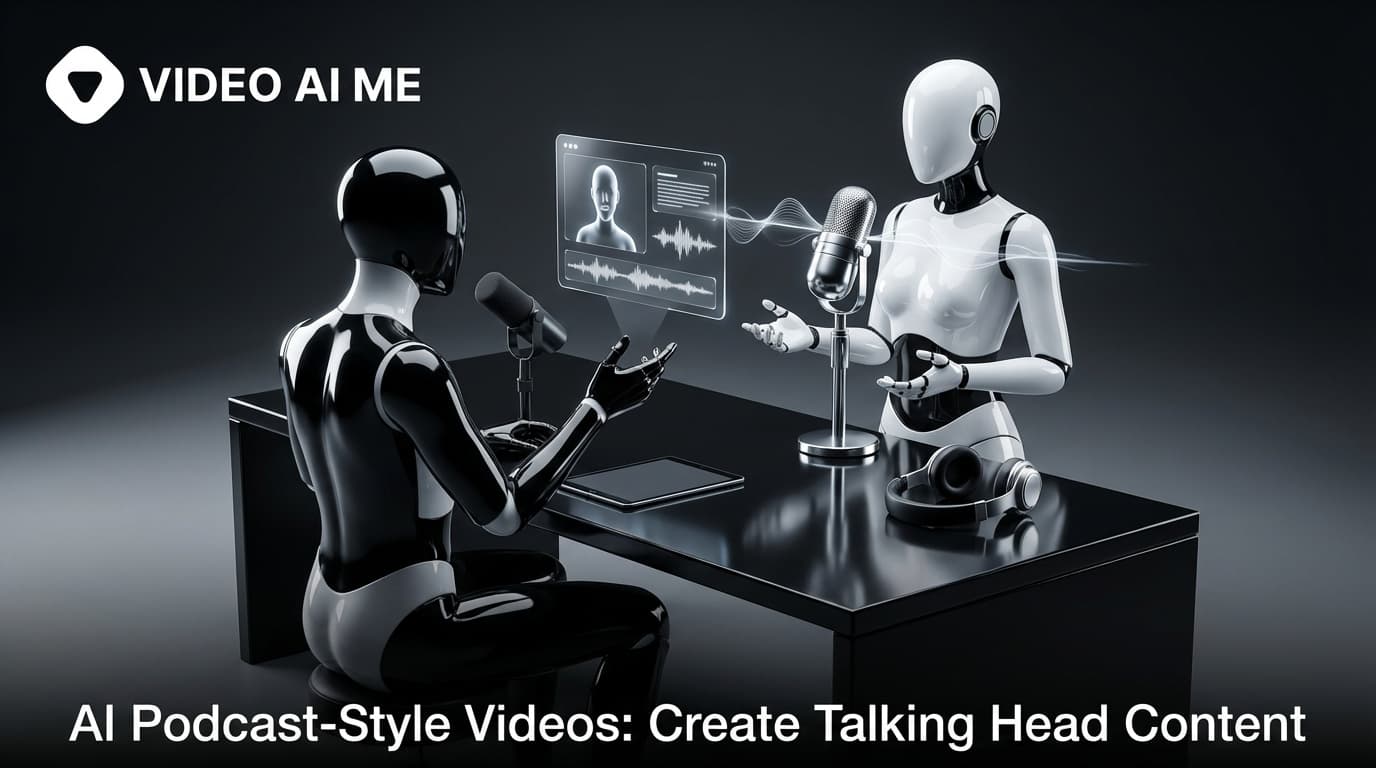
The Podcast Clip Revolution
Something happened in social media content over the past two years that nobody predicted. The podcast clip - a short, cropped excerpt of two people talking in a studio - became one of the highest-performing content formats across every major platform.
Scroll through TikTok's For You page and you will encounter them constantly. Two hosts dissecting a psychology concept. A guest revealing a surprising business insight. A heated exchange about a cultural topic. The podcast clip format has infiltrated every niche, from science education to relationship advice to tech commentary.
The numbers back it up. Podcast clips consistently outperform standard talking-head videos in watch time, shares, and comments. The format works because it taps into a fundamental aspect of human psychology: we are wired to pay attention to conversations between other people. Overhearing an interesting discussion is inherently more engaging than being lectured at by a single speaker.
But here is the problem for most content creators: producing real podcast content requires a studio (or at least a decent setup), a co-host or guest, coordinated schedules, recording equipment, and editing time. For a solo creator making educational content on psychology, neuroscience, business, or any other topic, the logistics of producing even one podcast episode per week are significant.
AI video has opened a completely different path. Solo creators are now producing podcast-style content - complete with studio environments, dual hosts, professional lighting, and natural-feeling dialogue - without ever stepping into a recording studio.
Why the Podcast Format Works on Short-Form Video
To create effective podcast-style content, it helps to understand why the format resonates so strongly.
The Conversation Effect
When a single person talks to a camera, the viewer is the audience. The dynamic is inherently one-directional: someone is teaching or telling you something. This can be effective, but it places the entire burden of engagement on the speaker's delivery.
When two people are having a conversation, the dynamic shifts. The viewer becomes an observer - someone overhearing an exchange. This activates a different type of attention. We are social creatures, and our brains are finely tuned to process interpersonal dynamics. Who agrees? Who pushes back? What surprised them? What do they disagree on?
This conversational dynamic naturally creates the engagement signals social media algorithms reward: longer watch times (people stay to hear the other person's response), comments (people want to join the conversation), and shares (people want their friends to weigh in).
The Structure Creates Natural Hooks
Podcast conversations have a built-in dramatic structure. One person makes a claim. The other person reacts. There is a moment of tension, agreement, surprise, or debate. Then a resolution or insight emerges.
This structure maps perfectly onto the hook-retention-payoff framework that performs best on TikTok and Instagram. The claim is the hook. The reaction maintains retention. The insight is the payoff. All of it happens organically within the flow of a conversation.
Perceived Authenticity
Podcast content feels less scripted and more authentic than polished single-speaker content, even when it is actually fully scripted. The conversational format creates an impression of spontaneity - two people exploring an idea together rather than delivering a rehearsed presentation. This perceived authenticity increases trust and relatability, both of which drive follower growth.
Building the Virtual Podcast Studio
Creating convincing podcast-style AI video starts with the visual environment. The studio setup is what tells the viewer, within the first half-second, that they are watching a podcast clip.
The Visual Signature of Podcast Content
Recognizable podcast studio elements include:
- Quality microphones visible in frame (condenser mics on boom arms are the standard look)
- Minimalistic background - clean, uncluttered, with intentional design elements
- Professional lighting - typically a combination of key light, fill light, and accent lighting
- Comfortable seating - chairs or a couch that suggest a relaxed, conversational atmosphere
- Subtle branding - logo or show name visible but not dominant
When prompting AI video for podcast-style content, describing these elements creates the visual context that makes the format immediately recognizable.
Lighting That Sets the Mood
Lighting is what separates a generic talking-head video from a professional podcast studio feel. The most popular podcast lighting aesthetics for social media include:
Soft neon accents: Colored LED strips or panels (commonly purple, blue, or warm amber) providing ambient background light while the hosts are lit with neutral key lights. This creates the modern, stylized podcast look that dominates platforms like TikTok.
Warm, intimate lighting: Soft, diffused warm light that creates a cozy, conversational atmosphere. This works well for topics like psychology, relationships, and personal development.
Clean and bright: High-key lighting that feels professional and authoritative. This works for business, tech, and science content where clarity and credibility matter more than mood.
Dramatic and moody: Lower light levels with strong directional key light, creating shadows and depth. This works for storytelling, true crime, cultural commentary, and topics that benefit from a more serious tone.
Describing the specific lighting in your AI video prompt is one of the most effective ways to control the overall feel of the output. For more on how cinematic lighting and visual direction affect AI video quality, see our guide on cinematic AI video techniques.
Script Structures That Perform
The visual setup gets viewers to stop scrolling. The script keeps them watching. Here are the proven script structures for podcast-style social media content.
The Myth-Buster
Structure: Host A states a common belief. Host B explains why it is wrong. Discussion explores the truth.
Example opening: "Most people think drinking eight glasses of water a day is based on science." "It is actually not. The original recommendation was misinterpreted from a 1945 paper, and here is what the research actually shows..."
This format works because it creates an immediate gap between what the viewer believes and what is actually true. The viewer stays to resolve that gap.
The Hot Take
Structure: Host A drops a controversial or surprising opinion. Host B reacts - either challenging it or asking for elaboration. Discussion unpacks the reasoning.
Example opening: "I think university degrees will be optional for most careers within five years." "That is a bold claim. What makes you say that?" "Look at what is happening in tech hiring right now..."
Hot takes generate engagement through polarization. Viewers who agree share the clip. Viewers who disagree comment their objections. Both behaviors boost the content in algorithms.
The Educational Reveal
Structure: Host A presents a question or scenario. Host B provides an expert explanation that is surprising or counterintuitive. Discussion explores implications.
Example opening: "Why do we remember embarrassing moments from years ago with perfect clarity but forget what we had for lunch yesterday?" "It is called the negativity bias, and it is actually an evolutionary survival mechanism..."
This format works exceptionally well for educational content in psychology, neuroscience, health, and science - niches where there are countless fascinating findings that most people do not know about.
The "What Would You Do" Scenario
Structure: Host A presents a dilemma or scenario. Both hosts discuss their perspectives, explore different angles, and arrive at insights.
Example opening: "Your best employee asks for a 40% raise and says they have another offer. What do you do?" "That depends on three things..."
Scenario-based discussions invite the viewer to participate mentally, which increases watch time and drives comments with personal opinions.
Solo Creators Making Dual-Host Content
The most powerful application of AI video for podcast-style content is enabling solo creators to produce conversations between two hosts. This was previously impossible without finding, scheduling, and coordinating with another person.
With AI video, the workflow looks like this:
- Write the full dialogue. Script both sides of the conversation, assigning each line to Host A or Host B. Write it naturally - include reactions, follow-up questions, and moments of genuine exchange.
- Define each host's visual appearance. Describe their look, clothing style, and positioning in the studio.
- Generate the podcast scene. Use your AI video tool to produce the content with both hosts in the studio environment.
- Review and refine. Watch the output to ensure the conversation flows naturally and the visual quality meets your standard.
This workflow allows a solo creator who specializes in, say, educational psychology content to produce daily podcast clips featuring two engaging hosts discussing neuroscience findings - all from their desk, with no studio, no co-host, and no scheduling headaches.
For creators already producing AI-generated social media content, adding the podcast format to their content mix is a natural extension that unlocks a high-performing content type.
Educational Content That Goes Viral
Podcast-style content has become one of the most effective formats for educational material on social media. Niches like psychology, neuroscience, behavioral science, philosophy, and popular science perform particularly well in the podcast clip format.
The reason is that educational content often needs more than a single voice delivering facts. It needs discussion - the back-and-forth that makes complex ideas accessible. When Host A says something technical and Host B asks "Wait, what does that actually mean in practice?" it mirrors the viewer's own thought process. The co-host becomes a proxy for the audience, asking the questions the viewer would ask.
This is why educational podcast clips frequently outperform single-speaker educational content on every engagement metric. The format makes learning feel like eavesdropping on a fascinating conversation rather than sitting through a lecture.
Topics that perform consistently well in this format include:
- Psychology: Cognitive biases, attachment styles, behavioral patterns, therapy concepts explained accessibly
- Neuroscience: Brain function, memory, decision-making, sleep science, habit formation
- Business strategy: Marketing psychology, pricing strategies, leadership frameworks, startup lessons
- Health and wellness: Nutrition science, exercise physiology, sleep optimization, stress management
- Cultural commentary: Social trends, generational differences, technology's impact on behavior
- Relationship dynamics: Communication patterns, conflict resolution, attraction psychology
For educators who want to reach broader audiences with their expertise, the podcast format combined with AI video removes both the production barrier and the co-host dependency.
Platform Strategy for Podcast-Style Content
TikTok
TikTok is where podcast clips achieve the widest organic reach. The platform's algorithm is exceptionally good at surfacing niche educational content to interested viewers.
Format: 9:16 vertical. Frame one host at a time (cutting between them) or use a split-screen layout with both hosts visible.
Length: 30-90 seconds. Each clip should contain one complete exchange - one idea introduced, discussed, and resolved.
Posting frequency: Daily if possible, minimum 4-5 times per week. Consistency is the single biggest factor in TikTok growth.
Hook strategy: The first 2 seconds should present the most surprising, controversial, or curiosity-provoking element of the clip. "Your brain is literally lying to you right now" stops more scrolls than "Today we are discussing cognitive biases."
For more detailed TikTok strategies, our guide on TikTok ad creation with AI video covers platform-specific best practices.
Instagram Reels
Instagram Reels work similarly to TikTok for podcast clips, but the audience skews slightly older and the platform rewards visual polish.
Format: 9:16 vertical, same as TikTok. Many creators publish identical content to both platforms with minor adjustments to captions and hashtags.
Length: 30-60 seconds tends to perform best on Reels. Instagram's algorithm currently favors slightly shorter content than TikTok's.
Aesthetic consideration: Instagram audiences respond well to visually polished content. The podcast studio setup with quality lighting and a clean aesthetic is especially important here.
YouTube Shorts and Long-Form
YouTube offers two opportunities for podcast-style content: Shorts (under 60 seconds, vertical) for discovery, and long-form (8-15 minutes, horizontal) for depth.
Shorts strategy: Use the same clips you produce for TikTok and Reels. YouTube Shorts has massive reach potential and feeds subscribers into your long-form content.
Long-form strategy: Produce full-length podcast-style episodes (8-15 minutes) covering topics in depth. These videos build subscriber loyalty, accumulate search traffic over time, and create a content library that compounds in value.
The combination of short clips driving discovery and long-form episodes driving loyalty is the most effective YouTube strategy for educational creators. AI video makes both formats sustainable for solo creators.
LinkedIn is an underused platform for podcast-style content, particularly for business, leadership, and professional development topics.
Format: Square (1:1) or horizontal (16:9) tends to perform better on LinkedIn than vertical.
Tone: Slightly more professional and insight-driven than TikTok content. LinkedIn audiences value practical takeaways and contrarian business perspectives.
Topics: Business strategy, leadership, hiring, career development, industry analysis. The podcast format adds credibility to business commentary because it simulates the executive conversation style LinkedIn audiences are familiar with.
Building a Content System Around the Podcast Format
Here is a weekly workflow for producing consistent podcast-style AI video content:
Monday (1 hour): Topic selection and research. Identify 5-7 topics for the week based on trending questions in your niche, audience comments, and new research or developments. For educational creators, this might mean reviewing recent studies, popular Reddit discussions, or questions from your existing audience.
Tuesday (1.5-2 hours): Script writing. Write the complete dialogue for each clip. For short-form clips (30-90 seconds), each script is 100-200 words. For longer YouTube episodes, 1,500-2,500 words. Writing all scripts in one session ensures consistency and is more efficient than writing one at a time.
Wednesday (30-45 minutes): Generation and review. Submit all scripts to your AI video tool and generate the week's content. Review each output for natural conversation flow, visual quality, and accurate content.
Thursday-Sunday (15 minutes daily): Publishing and engagement. Publish according to platform-specific schedules. Respond to comments, note popular questions for future content, and track which topics and formats perform best.
Total weekly time: approximately 4-5 hours for 5-7 pieces of content across multiple platforms. For a solo creator, this is dramatically more sustainable than the alternative of setting up a physical studio, finding a co-host, recording, and editing real podcast episodes.
The Future of Podcast-Style Social Content
The podcast clip format shows no signs of slowing down. If anything, it is evolving into new variations:
- Three-person panels: Adding a third voice for debate-style content
- Interview simulations: One host interviewing an expert on a specific topic
- Reaction content: One host watching and reacting to clips, studies, or news in real-time
- Storytelling podcasts: Narrative-driven content where hosts take turns building a story
Each of these variations benefits from AI video's ability to produce multi-person scenes without the logistics of coordinating real participants.
For creators who are building educational brands, the podcast format is particularly valuable because it positions you as both an expert and a communicator. The dual-host dynamic makes complex information more accessible, and the conversational tone builds the kind of parasocial relationship that converts followers into students, clients, or customers.
Whether you are exploring UGC-style content creation or building a niche educational brand, the podcast format is one of the most effective content types available on social media today.
Start Creating Podcast-Style Content Today
You do not need a studio. You do not need a co-host. You do not need recording equipment or editing software. You need expertise in your niche, strong scripts, and an AI video tool that can bring your podcast vision to life.
The podcast clip format is one of the highest-performing content types on social media in 2026. Every day you are not producing it, creators in your niche are. The difference between the ones growing their audiences and the ones watching from the sidelines is not talent or knowledge - it is output.
Start creating podcast-style AI videos with VIDEOAI.ME. Write the conversation. Set the scene. Let AI produce the studio-quality podcast content your audience is already searching for.
For understanding broader trends in how podcast and audio content intersects with social media, Edison Research publishes annual reports on podcast consumption habits and platform preferences that can inform your content strategy. And for exploring different AI video generators and their capabilities, our comparison guide covers the current landscape.
Frequently Asked Questions
Share
AI Summary

Paul Grisel
Paul Grisel is the founder of VIDEOAI.ME, dedicated to empowering creators and entrepreneurs with innovative AI-powered video solutions.
@grsl_frReady to Create Professional AI Videos?
Join thousands of entrepreneurs and creators who use VIDEO AI ME to produce stunning videos in minutes, not hours.
- Create professional videos in under 5 minutes
- No video skills experience required, No camera needed
- Hyper-realistic actors that look and sound like real people
Get your first video in minutes
Related Articles
MiniMax H3 UGC Prompt Templates for Ad Creative
Reusable UGC prompt templates with the variables marked, so you can produce a whole batch of creator style ads by swapping four fields.
Seedance 2.5 UGC Prompt Templates for Ads
Six fill in the blank UGC prompt templates for Seedance 2.5, each with a fully filled worked example, plus how to direct dialogue when the audio is generated.
How to Make AI UGC Videos With Seedance 2.5
A five step playbook for creator style UGC clips with Seedance 2.5: casting, prompts that carry the spoken hook, reference images for batches, and the credit math.