
Seedance 2.5 vs Veo 3 (2026): Audio-Native Models
Both generate synchronized audio with the picture. How Seedance 2.5 and Veo 3 differ on duration, audio behaviour, reference workflow, access and cost model.
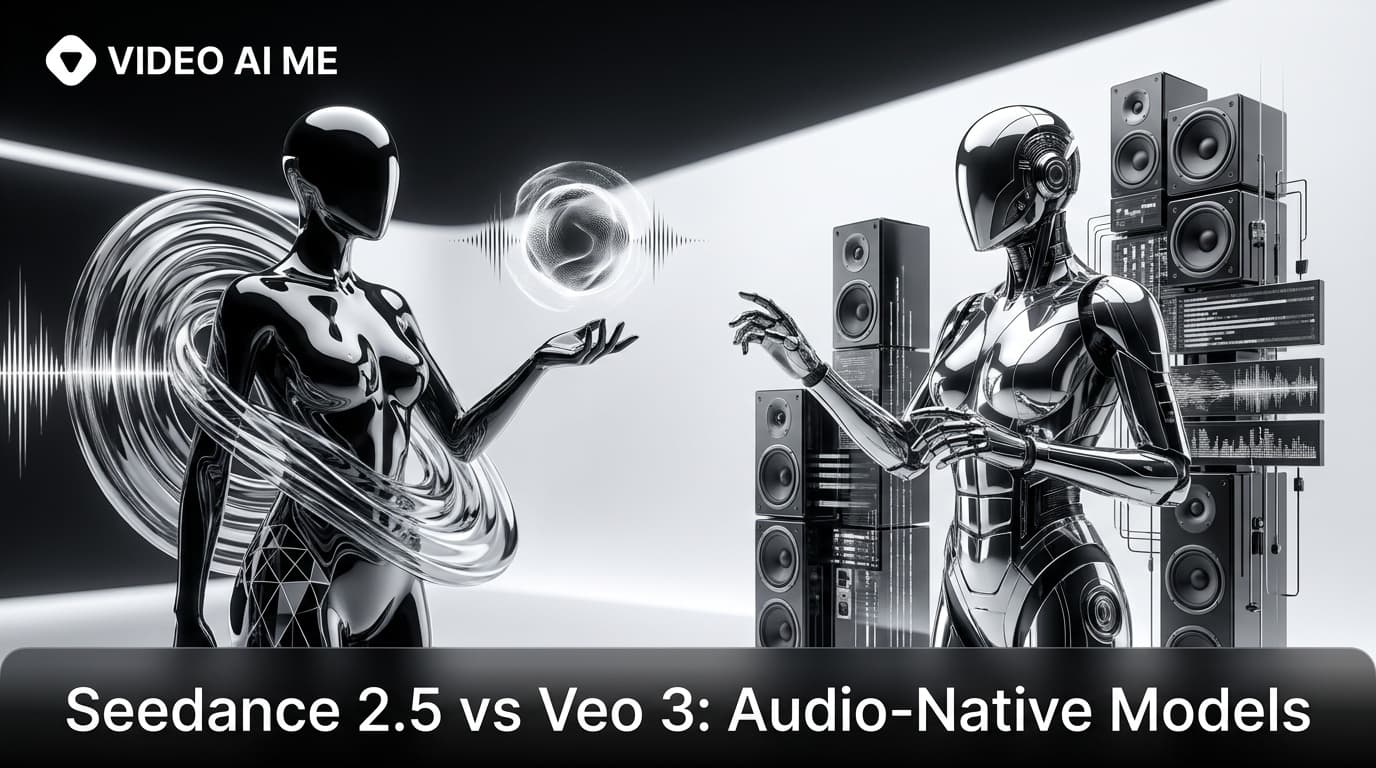
Until recently, a generated clip with sound meant two jobs: make the picture, then find the voice. Seedance 2.5 vs Veo 3 is a comparison between the two models that ended that, each in its own way. Both generate synchronized audio with the video rather than after it, and both are aimed squarely at people producing ads rather than art. They differ on length, on how you steer them, and above all on how you get to them.
The render above is Seedance 2.5 in the top panel against its own predecessor below, on the same 15 second script. We are showing it here because it is the clearest demonstration of what the newer ByteDance model does with dialogue and a scene change, which is the ground both it and Veo 3 are fighting over.
Seedance 2.5 vs Veo 3: What They Actually Share
Both models put audio inside the generation. That sounds like a feature bullet and it is really a workflow change. When a model produces the voice at the same time as the mouth, lip sync stops being a task. You write the line, the person in the frame says it, and the ambient sound of the room is already underneath. Whatever else separates these two, they belong in the same category and everything without native audio belongs in another one. Our roundup of AI video models with native audio covers the rest of that category.
They also share an audience. Google positions Veo for creators and for enterprises through its own products, and ByteDance shipped Seedance 2.5 into consumer apps with an ads shaped feature set. Neither is a research toy.
The Comparison, Honestly Scoped
We can give you verified numbers for Seedance 2.5 because it runs on VIDEO AI ME and we can read the meter. We are not going to invent Veo 3 numbers to fill in a symmetrical table. Where a Veo 3 figure is not something we can verify, the table says so, and you should treat any blog that quotes precise head to head benchmark scores for these two with suspicion.
| Seedance 2.5 | Veo 3 | |
|---|---|---|
| Maker | ByteDance Seed | Google DeepMind |
| Native audio | Yes, effects, ambient and lip synced speech, always on | Yes, synchronized audio generation |
| Length on VIDEO AI ME | 4 to 30 seconds, 30 in a single pass | Not available on VIDEO AI ME |
| Typical clip length | Long form is the headline feature | Built around shorter clips |
| Resolutions on VIDEO AI ME | 480p and 720p | Not applicable |
| Steering | Text, one start image, or 2 to 4 bound references | Text and image prompting through Google's surfaces |
| Access | English, browser, VIDEO AI ME subscription | Google's own products and cloud platform |
| Published price per second | 23 credits at 480p, 48 at 720p | Priced through Google, not comparable per second |
For the detail on the Google model specifically, we keep a standing Veo 3 review, and Google DeepMind documents the model family itself at deepmind.google.
Duration: Thirty Seconds Versus Short Form Craft
This is the cleanest difference between them.
Seedance 2.5 is built around long single takes. On VIDEO AI ME you select 4, 8, 12, 15, 20, 25 or 30 seconds, and a 30 second clip is generated in a single pass rather than stitched from shorter renders. The model is reasoning about the whole duration, so it knows at second two what has to be true at second twenty eight. That is what lets a subject leave frame, the world change, and the same face come back wearing the same clothes.
Veo 3 has been built around shorter clips, with the craft going into what happens inside them. That is not a criticism. A large share of paid social creative is six to twelve seconds long, and for a six second hook the ability to run for thirty is worth nothing.
Ask yourself what you are actually shipping. If your best performing assets are short hooks, length is not a differentiator and you should choose on look and on access. If you are producing a spot with a beginning, a middle and a turn, single pass length is the thing that removes work from your week.
Audio Behaviour in Practice
Both generate sound. The details that matter day to day:
- Seedance 2.5 audio is not optional. There is no toggle and no surcharge on VIDEO AI ME. Every generation comes back with effects, ambient and any dialogue you wrote in quotes, lip synced. If your creative is silent b-roll under a licensed track, you are paying for an engine you will mute.
- Write the sound, not just the picture. With either model, the prompt should say what is heard. Dialogue in quotes, the ambient character of the space, and explicitly no music if you do not want a bed. Leave the question open and you will usually get one.
- Language and delivery are prompt problems. Tone, pace and accent respond to description in the prompt rather than to a settings panel.
The practical test we would run before committing: generate the same line of dialogue on each model, mute the video, and listen. Then watch it muted. Sync problems are much easier to spot when you separate the two senses.
Reference Workflow: Bound Images Versus Prompted Style
Consistency across a campaign is where most ad teams lose time, so this section matters more than it looks.
On VIDEO AI ME, Seedance 2.5 chooses its mode from the number of images you attach. None means text to video. One means image to video, animating that image as the start frame. Two to four means reference to video, and in that mode you address each image in the prompt as @Image1, @Image2, @Image3 or @Image4 and bind it to a job: the creator from @Image1, the bottle from @Image2. Explicit binding is what stops the model blending a face into a product, and it is the single biggest quality lever in the whole workflow.
The Seedance 2.5 model as ByteDance describes it also accepts video references and audio references. On VIDEO AI ME today you get text to video, image to video, and reference to video with up to four images, which is what you should plan production around.
Veo 3 is steered through text and image prompting inside Google's own surfaces. If you already run a Google centric stack, that proximity is worth something in itself. We compared the older ByteDance model against it in Seedance 2.0 versus Veo 3, and much of that reasoning still holds.
Seedance 2.5 vs Veo 3 on Cost and Access
Access is the part people underestimate and it is where these two diverge most.
ByteDance launched Seedance 2.5 on 2026-07-31 inside Jimeng AI and Doubao, which in practice expect a Chinese phone number and a Chinese language interface, with API access announced as coming later through BytePlus ModelArk. The Seed team's own index sits at seed.bytedance.com. On VIDEO AI ME the same model runs in English, in a browser, on a normal subscription, which for most readers of this article is the difference between using it and reading about it.
Veo 3 is reached through Google's own products and cloud platform, with billing that follows whichever of those you are in. That is a perfectly workable route, and it is a different shape of commitment from a flat monthly creative subscription.
On cost, here is what we can state without guessing. Seedance 2.5 on VIDEO AI ME is 23 credits per second at 480p and 48 at 720p, where one credit equals one cent of generation cost. A 15 second 720p spot is 720 credits, about $7.20 of plan credit, audio included.
| Duration | 480p | 720p |
|---|---|---|
| 8 seconds | 184 credits | 384 credits |
| 15 seconds | 345 credits | 720 credits |
| 30 seconds | 690 credits | 1,440 credits |
Plans are Starter at $29 a month with 1,400 credits, Pro at $99 with 5,600 and Premium at $199 with 12,000. A 30 second 720p clip costs 1,440 credits, more than the whole Starter allowance, so that specific job starts at Pro, while Starter handles 30 second 480p clips at 690 credits. Video generation requires an active subscription. We are deliberately not putting a Veo 3 per second figure next to those, because Google's pricing is structured differently and a made up number would be worse than no number.
Which One for Which Job
Pick Seedance 2.5 when the asset is long, when it has to talk, or when a specific creator and a specific product must stay recognisable across a scene change. Also pick it when the practical question is simply how you get access in English today.
Pick Veo 3 when you are already operating inside Google's stack, when your output is short form and the look is what you are optimising, and when your billing is easier to justify through a cloud contract than a creative subscription.
Test both if the decision is worth more than a few hundred credits of experimentation, which for most media buyers it is. Generate one identical brief on each, put them side by side, and judge the faces and the audio rather than the still frames. If you want a wider field before choosing, our Veo 3 versus Sora 2 comparison covers the other audio native contender, and our hands on Seedance 2.5 review records what held up and what cost us reruns.
Frequently Asked Questions
Which is better, Seedance 2.5 or Veo 3?
Neither is better across the board. Seedance 2.5 wins on length, with up to 30 seconds generated in a single pass, and on bound reference images for character consistency. Veo 3 is the stronger fit if you already work inside Google's stack and your creative is short form.
Do both Seedance 2.5 and Veo 3 generate audio?
Yes. Both produce synchronized audio with the video rather than in a separate pass. On Seedance 2.5, audio is always generated and always included in the price, covering sound effects, ambient sound and lip synced dialogue.
Is Veo 3 available on VIDEO AI ME?
No. Seedance 2.5 runs on VIDEO AI ME alongside models including Sora 2, Kling, Seedance 2.0 Fast and Grok Imagine 1.5. Veo 3 is reached through Google's own products and cloud platform.
How long can each model generate?
Seedance 2.5 offers 4, 8, 12, 15, 20, 25 and 30 second durations on VIDEO AI ME, with 30 seconds produced in one pass. Veo 3 is built around shorter clips, which suits short form hooks but means longer pieces are assembled from several generations.
What does Seedance 2.5 cost compared with Veo 3?
Seedance 2.5 is 23 credits per second at 480p and 48 at 720p on VIDEO AI ME, one credit being one cent of generation cost. Veo 3 is billed through Google's own products, so the two are not directly comparable per second and we will not invent a figure.
Can I use one model for hooks and the other for finals?
You can, but running two billing relationships for one campaign adds admin. A simpler split is to test cheaply on a lower cost model inside the same subscription, then render the final on Seedance 2.5 at 720p with the dialogue written into the prompt.
Frequently Asked Questions
Share
AI Summary

Paul Grisel
Paul Grisel is the founder of VIDEOAI.ME, dedicated to empowering creators and entrepreneurs with innovative AI-powered video solutions.
@grsl_frReady to Create Professional AI Videos?
Join thousands of entrepreneurs and creators who use VIDEO AI ME to produce stunning videos in minutes, not hours.
- Create professional videos in under 5 minutes
- No video skills experience required, No camera needed
- Hyper-realistic actors that look and sound like real people
Get your first video in minutes
Related Articles
What Is MiniMax H3? The Video Model Explained
MiniMax H3 is a multimodal video model that turns a written brief into a short clip with synchronised sound. Here is what it does, what it does not, and who it suits.
MiniMax H3 vs Veo 3: An Honest Comparison
Veo 3 is Google's video model and it is not in the VIDEO AI ME picker. Here is how it compares to MiniMax H3 on the things that decide ad creative.
MiniMax H3 vs Sora 2: Drafting Against Polish
Sora 2 renders at higher resolution and longer. MiniMax H3 gets you many more attempts. Which one belongs in your workflow depends on the job, not the benchmark.