
Making Short Films with Sora 2: AI Filmmaking Guide
Filmmakers are using Sora 2 to create short films with cinematic visuals, consistent characters, and sequences up to 120 seconds. This guide covers storyboarding, prompting, video extension, dialogue integration, and a complete workflow for your first AI short film.
AI Filmmaking Is Here
For decades, making a short film required the same fundamental ingredients: a crew, equipment, locations, and a budget. Even a bare-bones indie short — a single actor, one location, natural light — costs $2,000-$10,000 when you factor in equipment, food, transportation, and post-production.
That equation meant most stories stayed trapped in screenwriters' heads.
Sora 2 is rewriting the rules. OpenAI's video generation model produces cinematic footage from text prompts — footage that looks like it was shot by a professional DP with proper lighting, composition, and camera movement. And with features like video extension (up to 120 seconds per sequence), character consistency (the Characters API), and dialogue generation, Sora 2 is no longer a novelty. It is a filmmaking tool.
This guide is for filmmakers — aspiring and experienced — who want to create short films with Sora 2 through VIDEOAI.ME. We will cover the complete workflow: storyboarding, cinematic prompting, building long sequences, maintaining character consistency, adding dialogue, and editing your final film.
Why Filmmakers Are Taking Sora 2 Seriously
The short film format is experiencing a renaissance. According to Statista, short-form video consumption has grown 135% since 2021, driven by platforms like YouTube, Vimeo, and social media. Film festivals received a combined 1.2 million submissions in 2024, with short films making up the majority.
But the production barrier has always limited who can participate. Sora 2 does not replace traditional filmmaking — it democratizes access to it.
Here is what makes Sora 2 viable for short film production:
- Cinematic visual quality: Sora 2 generates footage with professional-grade composition, lighting, and color
- Camera control: You can specify lens type, camera movement, framing, and depth of field in your prompts
- 120-second sequences: Video extension lets you build scenes that run two full minutes without cuts
- Character consistency: The Characters API maintains a performer's appearance across every scene
- Dialogue and audio: Built-in audio generation for spoken dialogue and ambient sound
- Multiple aspect ratios: 16:9 landscape for standard cinema, 9:16 vertical for festival social promotion
- Full HD output: Sora 2 Pro delivers 1920x1080, the minimum standard for festival projection
Step-by-Step: Making a 60-Second Short Film
Let us walk through a complete workflow for a one-minute narrative short film. This same process scales to longer projects — you just add more scenes.
Step 1: Write Your Story
Every short film starts with a story, not a prompt. Before you touch any AI tool, answer these questions:
- Who is your protagonist?
- What do they want?
- What stands in their way?
- How does it resolve (or not)?
For our example, let us create a simple story:
A woman discovers a letter on her doorstep. She reads it, and we watch her expression shift from curiosity to shock to quiet resolve. She puts on her coat and walks out into the night.
Simple. Emotional. Visual. This is the kind of story that works beautifully with Sora 2 — intimate, character-driven, and reliant on mood and atmosphere rather than complex action.
Step 2: Storyboard Your Scenes
Break your story into individual shots. Each shot will become one Sora 2 generation (or an extended sequence).
| Shot | Duration | Description | Camera |
|---|---|---|---|
| 1 | 8s | Exterior: front door at dusk, a letter sits on the doormat | Wide establishing, static |
| 2 | 12s | Close-up: woman's hand picks up the letter, turns it over | Close-up, slight push-in |
| 3 | 20s | Medium: she reads the letter, expression shifts from curiosity to shock | Medium shot, slow drift |
| 4 | 8s | Insert: her hands grip the letter tighter, paper trembling | Extreme close-up, static |
| 5 | 12s | Medium-wide: she sets the letter down, stands, puts on her coat | Medium-wide, static with subtle reframe |
| 6 | 8s | Wide: she opens the front door and walks into the night | Wide from inside, she walks toward camera then past |
Total: approximately 68 seconds of raw footage, which you will edit down to 60 seconds.
Step 3: Create Your Character Reference
Since our protagonist appears in shots 2 through 6, we need character consistency.
- Choose or record a 2-4 second reference clip of your character
- Upload it to the Characters API through VIDEOAI.ME
- Reference this character in every prompt where she appears
This step is critical. Without it, Sora 2 will generate a different-looking woman in every shot, destroying narrative continuity.
Step 4: Write Your Cinematic Prompts
Now translate your storyboard into Sora 2 prompts. Remember: you are briefing a cinematographer. Specify camera, lighting, mood, and color.
Shot 1 — Establishing (8s):
Wide establishing shot of a modest suburban front door at dusk. A white envelope sits on the welcome mat, slightly illuminated by the porch light. The rest of the frame falls into blue-hour shadow. Still air, no movement except a subtle flicker of the porch light. Melancholic, quiet atmosphere. Shot on 35mm, slightly desaturated color palette of slate blue and warm amber. Static camera.
Shot 2 — The Discovery (12s):
Close-up of a woman's hand reaching down to pick up a white envelope from a doormat. She turns it over slowly, examining the handwriting. Warm porch light from above creates soft shadows on her hand. Shallow depth of field, background is a soft blur of a doorway. Camera pushes in slowly. Intimate, curious mood. 35mm film grain, warm amber and cool blue tones.
Shot 3 — The Reading (20s):
Medium shot of a woman standing in a dimly lit hallway, reading a letter. Her expression begins neutral and curious, then shifts to surprise, then to quiet shock. The letter trembles slightly in her hands. Soft overhead lighting, shadows on the walls. Camera drifts almost imperceptibly to the right. 35mm, shallow depth of field. The color palette is muted — grey walls, warm skin tones, white paper. Emotional, intimate, building tension.
Shot 4 — The Reaction Detail (8s):
Extreme close-up of two hands gripping a white letter. The paper trembles. Knuckles tighten. Visible texture of the paper, slight creases where fingers press. Shallow depth of field, soft background blur. Warm side lighting. Static camera with subtle handheld micro-movement. Tense, visceral moment. 35mm film look.
Shot 5 — The Decision (12s):
Medium-wide shot of a woman setting a letter down on a hallway table, then standing and walking to a coat rack. She puts on a dark coat with quiet determination. The hallway is dimly lit with warm practicals. Camera holds position with a subtle reframe as she moves. Her expression is resolute. Moody, contemplative atmosphere. Desaturated warm tones. 35mm film grain.
Shot 6 — The Departure (8s):
Wide shot from inside a hallway looking toward the front door. A woman in a dark coat opens the door, and cool blue night light spills in. She steps through the doorway and walks into the darkness. The door remains open, framing the empty night. Camera is static. The contrast between warm interior and cold exterior tells the story. Cinematic, final-scene energy. 35mm, slightly underexposed for mood.
Step 5: Generate and Extend
Generate each shot at 1280x720 (standard) or 1920x1080 (Pro) for full HD quality.
For Shot 3 (the 20-second reading scene), consider using video extension to build a 40-second version. This gives you more footage to work with in editing and allows the emotional arc — curiosity to shock to resolve — more room to breathe.
Extension prompt for Shot 3:
Her expression settles into quiet resolve. She lowers the letter slowly, staring straight ahead. A deep breath. The camera continues its imperceptible drift. The moment hangs in silence.
Step 6: Edit Your Film
Import all generated clips into your editing software. Here is the editorial workflow:
- Arrange clips according to your storyboard
- Trim entrances and exits — Sora 2 clips often have 1-2 seconds of settling at the start
- Add transitions — simple cuts work best for drama; avoid flashy transitions
- Layer your audio track: ambient sound, music, and optional dialogue
- Color grade for consistency — while Sora 2 maintains style within prompts, clips may vary slightly in exposure or saturation between generations
- Export at 1080p minimum for any festival or platform submission
Cinematic Prompting Techniques for Filmmakers
The difference between amateur and professional Sora 2 output comes down to how you prompt. Here are the techniques that produce cinematic results.
Specify Lens and Format
Different lenses create different emotional responses:
- Wide angle (24mm): Establishes space, creates visual tension when close to subjects
- Standard (35-50mm): Naturalistic, documentary feel, closest to human eye perspective
- Telephoto (85-135mm): Compresses depth, isolates subjects, creates intimacy
- Anamorphic: Wide aspect ratio feel, signature lens flares, cinematic shorthand for "this is a movie"
Include these in your prompts: "Shot on 35mm," "anamorphic lens," "85mm telephoto, shallow depth of field."
Direct the Lighting
Lighting is storytelling. Name your lighting setup:
- Rembrandt lighting: Dramatic triangle of light on the shadow side of the face
- Practical lighting: Light sources visible in the frame (lamps, candles, screens)
- Motivated lighting: Light that appears to come from a logical source in the scene
- Silhouette: Subject backlit, features hidden in shadow
- Chiaroscuro: High-contrast, painterly light-and-shadow interplay
Rembrandt lighting on a man's face as he sits in a dark room. A single window to his left casts a triangle of warm light across his right cheek. The rest of the room falls into deep shadow. Dust particles float in the light beam. Intimate, psychological tension. 50mm lens, shallow depth of field.
Control Color as Emotion
Color palette is a prompting superpower that most people overlook.
- Warm amber/gold: Nostalgia, comfort, memory
- Cool blue/grey: Isolation, melancholy, tension
- Desaturated: Realism, bleakness, documentary feel
- High saturation: Energy, fantasy, heightened reality
- Complementary contrast (teal and orange): Commercial cinematic look
Always include a color direction: "Desaturated cool blue palette with warm skin tones" or "Saturated jewel tones — deep emerald, ruby, gold."
Dialogue Integration
Sora 2 supports dialogue and audio generation, which opens up narrative possibilities.
Built-in Dialogue
You can prompt for characters speaking, and Sora 2 generates corresponding audio with mouth movement. This works best for:
- Short lines of dialogue (1-2 sentences per clip)
- Emotional delivery where exact wording matters less than the feeling
- Background conversation or ambient speech
Post-Production Dialogue (Recommended for Precision)
For maximum control over performances, many filmmakers:
- Generate silent footage with Sora 2 (prompting for expressive body language and naturalistic movement)
- Record or generate dialogue separately using voice tools
- Sync in post during editing
This gives you independent control over visual and audio performance — the same approach used in much of professional filmmaking (ADR, or Automated Dialogue Replacement).
Editing Multiple Sora 2 Clips Together
Assembling AI-generated footage into a cohesive film requires the same editorial discipline as traditional filmmaking, plus a few AI-specific considerations.
Maintain Visual Continuity
- Consistent color language: Use the same palette keywords across all prompts
- Matching film stock references: If Shot 1 says "35mm film grain," every shot should reference 35mm
- Lighting continuity: Track the time of day and light direction across your storyboard
- Costume references: Mention the same wardrobe in every prompt where the character appears
Handle AI Artifacts Gracefully
Occasionally, Sora 2 generates frames with minor inconsistencies — a hand with an extra finger, a background element that shifts. In editing:
- Cut around artifacts by trimming the affected frames
- Use insert shots (close-ups of objects, hands, environments) to cover cuts
- Apply motion blur or film grain in post to mask minor issues
- Regenerate any clip that has persistent problems — it only takes minutes
Sound Design Sells the Film
Visuals get you 60% of the way. Sound design gets you to 100%. Layer these elements:
- Ambient sound: Room tone, outdoor atmosphere, city noise
- Foley: Footsteps, paper rustling, doors opening, fabric movement
- Music: Score or soundtrack that supports the emotional arc
- Dialogue: Recorded or AI-generated speech
A Sora 2 short film with thoughtful sound design is indistinguishable in impact from a traditionally shot piece.
The Future Is Already Here
We are at the very beginning of AI filmmaking. The filmmakers who learn to work with these tools now — who develop their prompting craft, who understand how to translate cinematic language into text descriptions — will have a profound creative advantage as the technology continues to improve.
You do not need a crew. You do not need a budget. You need a story, a storyboard, and the willingness to experiment.
Try VIDEOAI.ME free and generate your first short film scene today. Your story has been waiting long enough.
Frequently Asked Questions
Share
AI Summary
Paul Grisel
Paul Grisel is the founder of VIDEOAI.ME, dedicated to empowering creators and entrepreneurs with innovative AI-powered video solutions.
@grsl_frReady to Create Professional AI Videos?
Join thousands of entrepreneurs and creators who use VIDEO AI ME to produce stunning videos in minutes, not hours.
- Create professional videos in under 5 minutes
- No video skills experience required, No camera needed
- Hyper-realistic actors that look and sound like real people
Get your first video in minutes
Related Articles
A Same Day Workflow for AI Video Ad Creative
A full day plan that takes an offer from brief to launched creative, built around fast drafting, one round of judgement, and finishing only what survives.
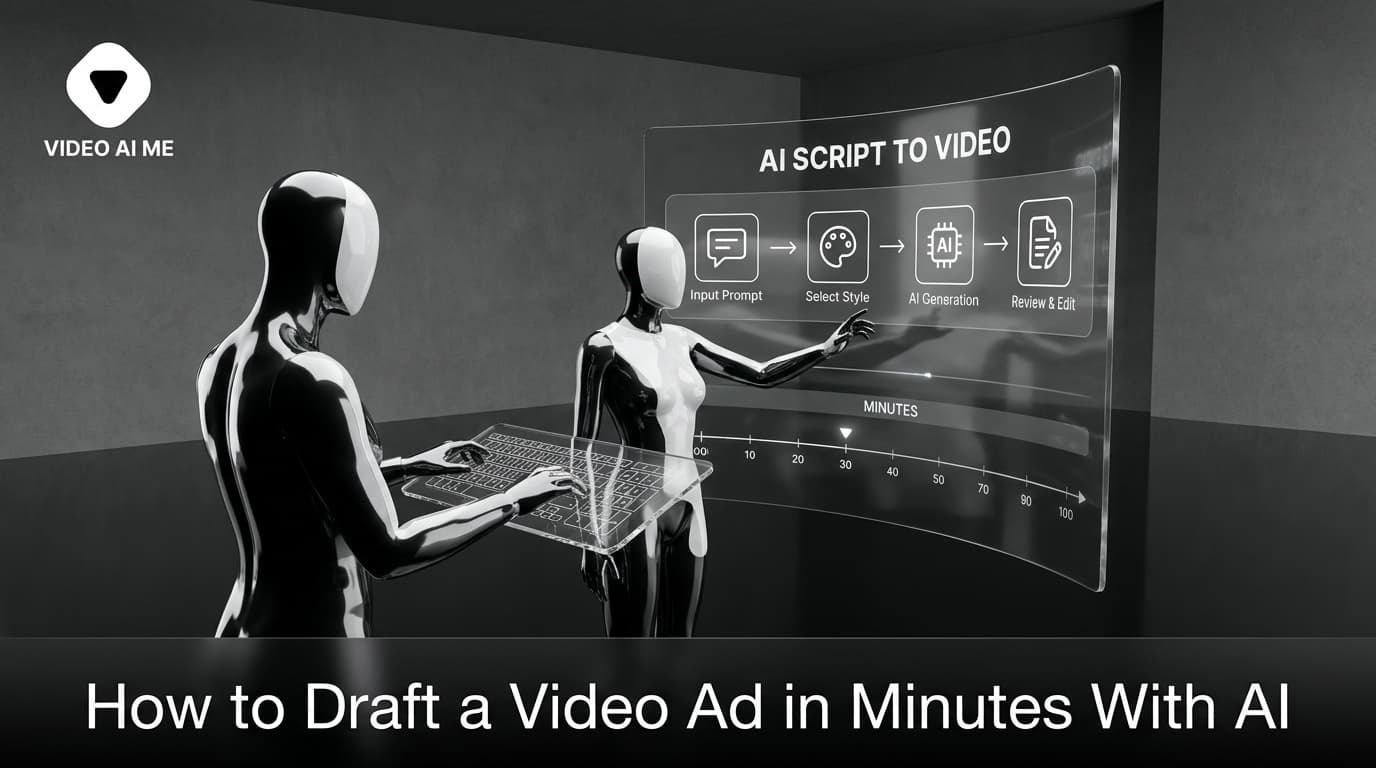
How to Draft a Video Ad in Minutes With AI
A repeatable routine for going from a product page to six testable video ad drafts in one sitting, using a fast model and single variable rewrites.
How Many Video Ad Variations Should You Test?
How many creatives a test actually needs, how different they have to be, and why the right number is set by what you can afford to produce.