
Why Happy Horse Beat Every AI Video Model in 2026
Happy Horse 1.0 didn't just score higher - it was built differently. Here's the strategic analysis of what Alibaba got right that everyone else missed.
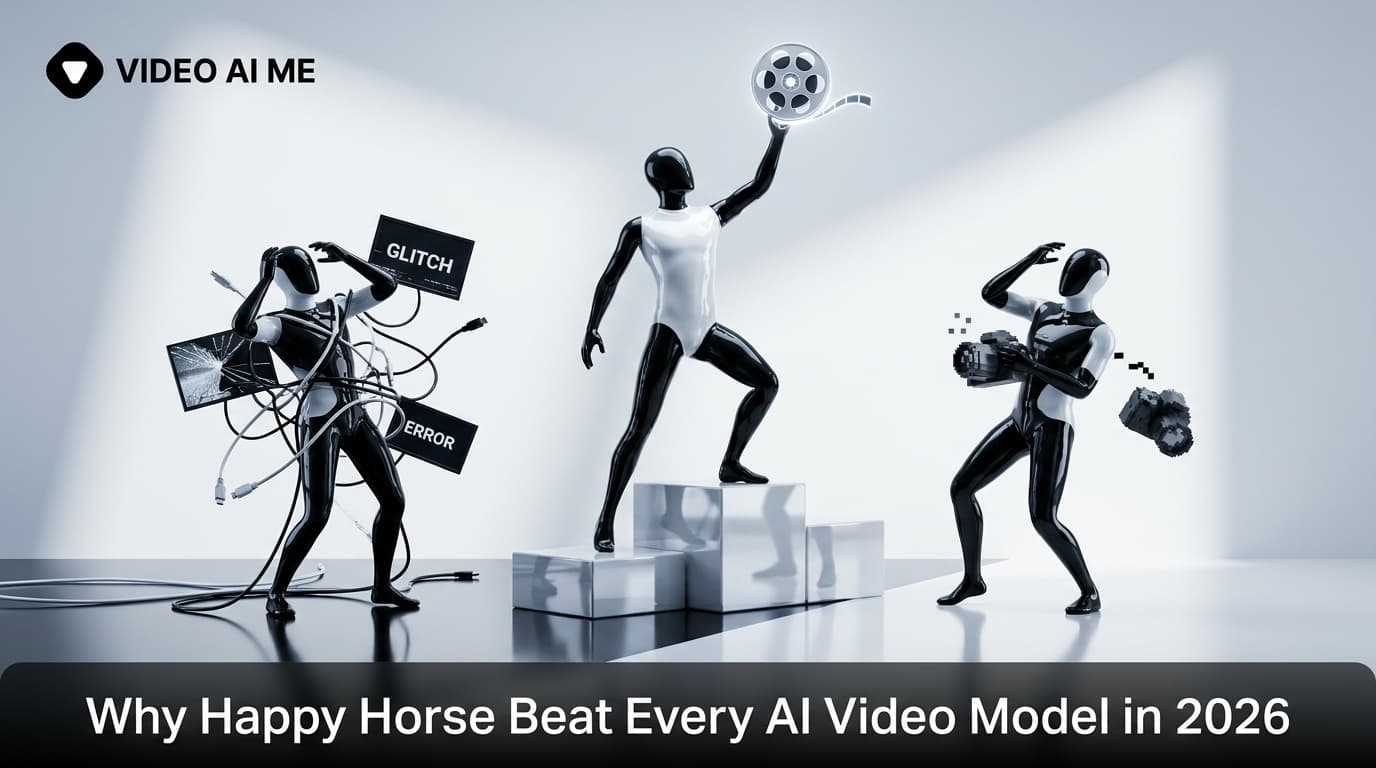
Why Happy Horse Beat Every AI Video Model in 2026
When Happy Horse 1.0 launched on April 26, 2026, it did not just nudge its way to the top of the leaderboard. It took the #1 position by a margin that made industry observers reconsider what the category ceiling actually was. Elo 1333 for text-to-video, Elo 1392 for image-to-video, 107 points ahead of the previous leader.
This is not a post about benchmark numbers. It is about why those numbers happened - the architectural choices, the scope of ambition, and the specific bets Alibaba Token Hub made that nobody else was willing to make at the same time.
The Problem Every Other Model Accepted
Before Happy Horse, here is what the AI video field looked like: every model generated video first, then handled audio separately. Even the best models - Seedance 2.0, Sora 2, Veo 3 - treated audio as a secondary problem. You generated your clip, then you layered on a voice track, then a separate lip-sync system tried to map that voice onto the generated face.
This two-step process has a fundamental ceiling. Lip-sync that is applied after video generation is always playing catch-up. The face was not generated with the intention of speaking those words. The timing of a pause, the way breath moves through a sentence, the micro-movements around the eyes during speech - none of that can be perfectly reconstructed after the fact.
The field had accepted this limitation. Some models handled it better than others, but the assumption was baked in: video and audio are separate generation problems.
Happy Horse was built to reject that assumption entirely.
The Architecture Decision That Changed Everything
Happy Horse 1.0 is a 15-billion-parameter unified Transformer. That word "unified" is doing real work. The model generates audio and video in a single forward pass. Not sequentially. Not with a coordinating layer on top. One pass, one model, one coherent output.
What this means in practice: the model's training objective included both audio and video from the start. During training, the model learned what lips look like when they produce the sound of a 'p' versus an 'm'. It learned how breath rhythm affects shoulder and chest movement. It learned that the pause before answering a difficult question looks different from the pause before a punchline.
None of that knowledge is available to a model that generates silent video and adds audio afterward. You cannot retrofit that understanding. The model that generated the face did not know it would be speaking, so it did not learn what speaking looks like at the level Happy Horse did.
This is why Happy Horse wins on realism. Not because it has more parameters than competitors (it doesn't, relative to some), but because its training objective was more complete.
Multilingual Lip-Sync as a First-Class Feature
The second strategic bet Alibaba made was treating multilingual support as an architectural requirement, not an afterthought.
Every major AI video model has approached non-English content as a post-processing problem: generate content in English, then run it through a dubbing or re-sync layer for other languages. That approach produces results that range from passable to obviously artificial. The model was not trained on Spanish phoneme-to-face mappings, Hindi breath patterns, or Mandarin tonal shifts. Applying those mappings from the outside does not recreate what a model that was trained on them from the beginning would produce.
Happy Horse's multilingual lip-sync is built in. Alibaba's training data and model design explicitly encompassed multiple languages as native outputs, not translated outputs. The difference is visible in any side-by-side test: Happy Horse Spanish sounds like someone speaking Spanish, not like an English speaker re-animated with a Spanish audio track.
For content creators and brands operating across multiple markets, this is not a convenience feature. It is the difference between content that converts and content that undermines brand trust.
Why Motion Quality Followed From the Architecture
Benchmark scores in AI video are ultimately human preference scores. People watch two clips and pick the one that looks more real, more natural, more professionally produced. When Happy Horse consistently wins those comparisons, the reason is not one single thing - it is the compound effect of getting several things right together.
Joint audio-video generation improves motion quality because the model learned motion in the context of speech and sound. Body language and vocalizations are deeply intertwined in human communication, and a model that was trained on both simultaneously develops a richer representation of human movement than one that only ever saw silent bodies.
The result is video where hand gestures feel connected to what is being said, where posture shifts match the emotional weight of the words, where blink rate and eye movement read as natural rather than procedurally generated. These are the qualities that separate Elo 1333 from the competition.
What Seedance 2.0, Sora 2, and Veo 3 Got Right (And Where They Stopped)
Being honest about the field matters. Seedance 2.0 remains one of the best models for complex human motion - the motion research ByteDance has produced is genuinely world-class. Sora 2 offers higher maximum resolution than any other model and strong character reference capabilities. Veo 3 produces cinematic quality that is hard to match for narrative content.
None of them addressed the joint audio-video problem. None of them built multilingual lip-sync as a native training objective. They were each exceptional at the problem they chose to solve. Happy Horse chose a larger problem - generating the complete human communication experience in one pass - and solved enough of it to take the top position across benchmarks.
The 107-Elo gap between Happy Horse and Seedance 2.0 is large. In the Elo system, that margin reflects not a narrow win but a consistent and substantial preference by human raters. It is not a statistical anomaly.
The Window Is Open Now, Not Permanently
Happy Horse's lead is real and substantial today. It will not stay this large indefinitely. Every major lab has access to the same architectural insight now: joint audio-video generation is better than sequential generation. Seedance 3.0, whenever it ships, will likely incorporate this. So will the next OpenAI and Google releases.
The window where Happy Horse offers a capability others cannot match is open now. The brands, creators, and agencies that build their workflows around it in the next 12 months will be ahead when the next generation of models arrives.
VIDEO AI ME is built to keep you at the frontier. Both Happy Horse 1.0 and Seedance 2.0 are available in one subscription, with custom AI actor support in any language and flexible 16:9 and 9:16 output.
For a head-to-head look at how Happy Horse performs against specific models, see Top AI Video Models 2026 Ranked.
Wondering what this means for your specific content type? Start exploring at videoai.me.
VIDEO AI ME gives you both top-2 motion models, so you don't have to bet wrong.
Frequently Asked Questions
Share
AI Summary

Paul Grisel
Paul Grisel is the founder of VIDEOAI.ME, dedicated to empowering creators and entrepreneurs with innovative AI-powered video solutions.
@grsl_frReady to Create Professional AI Videos?
Join thousands of entrepreneurs and creators who use VIDEO AI ME to produce stunning videos in minutes, not hours.
- Create professional videos in under 5 minutes
- No video skills experience required, No camera needed
- Hyper-realistic actors that look and sound like real people
Get your first video in minutes
Related Articles
MiniMax H3 UGC Prompt Templates for Ad Creative
Reusable UGC prompt templates with the variables marked, so you can produce a whole batch of creator style ads by swapping four fields.
Seedance 2.5 UGC Prompt Templates for Ads
Six fill in the blank UGC prompt templates for Seedance 2.5, each with a fully filled worked example, plus how to direct dialogue when the audio is generated.
How to Make AI UGC Videos With Seedance 2.5
A five step playbook for creator style UGC clips with Seedance 2.5: casting, prompts that carry the spoken hook, reference images for batches, and the credit math.