
AI Lip Sync and Multilingual Video for Healthcare 2026
How clinics, hospitals, and federally qualified health centers use AI lip sync and multilingual video for compliance-safe patient education in 2026.
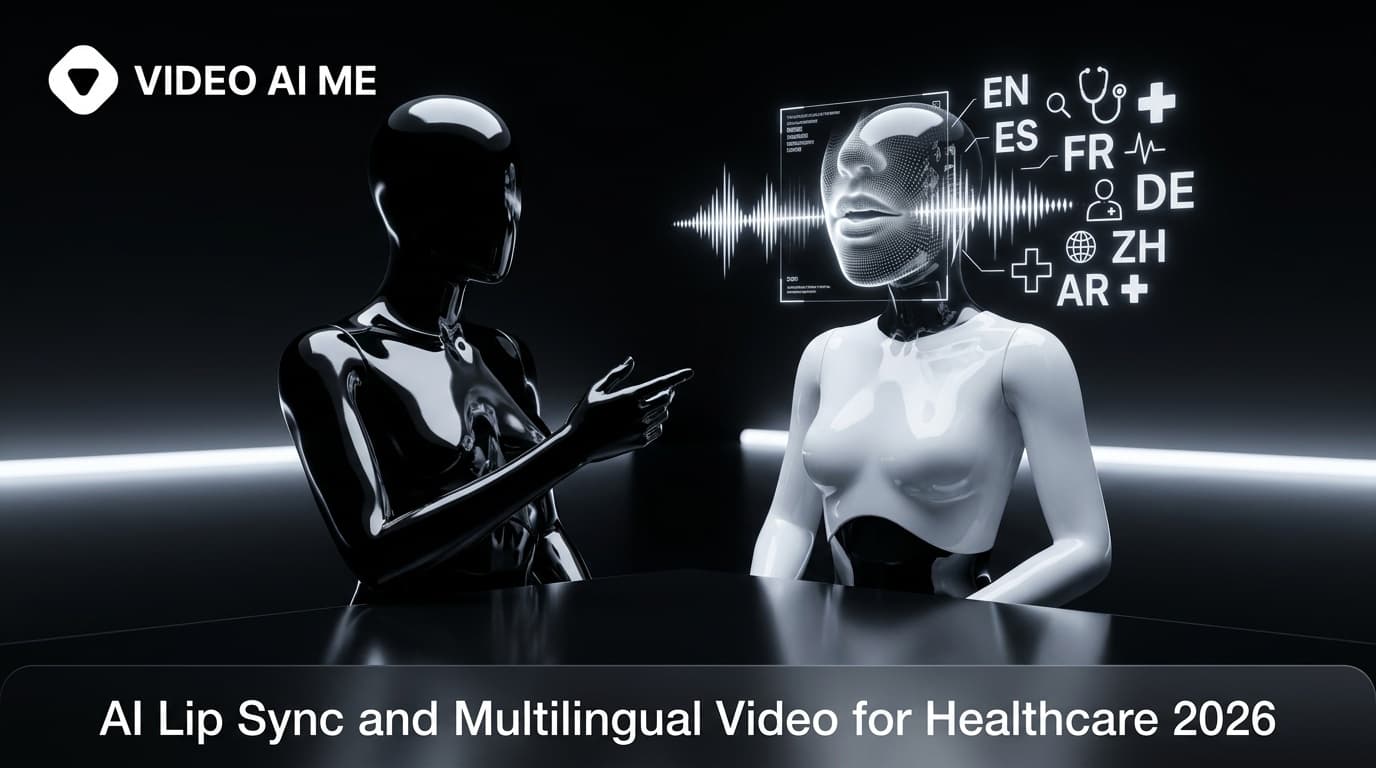
What AI lip sync and multilingual video actually do for healthcare
A federally qualified health center on the East Coast serves patients in English, Spanish, Mandarin, Vietnamese, Haitian Creole, and Arabic. Twelve years ago, the clinic produced patient-education videos in English only because every additional language meant another voiceover budget and another video edit. The clinic's marketing manager could justify one English shoot a year, not six.
The gap was not subtle. Patients who do not read English at the same level they speak it lost most of the value of the printed patient-education handouts. Patients who do not understand English video could not use the YouTube channel. The clinic shipped English content into a population where English was the home language for a minority.
AI lip sync changed the math. The same 90-second clip rendered with the clinic's medical director in English is now rendered in five additional languages from a single source recording, with mouth movements matched to each translated track. The patient sees the clinic's medical director speaking Spanish, Mandarin, or Vietnamese with accurate lip sync. The clinical content is the same. The accessibility is not.
This article covers how AI lip sync and multilingual video work for healthcare in 2026, where the technology fits across clinic types, and how to ship a multilingual patient-education program without learning a new language.
Why healthcare needs multilingual video now
The US population is increasingly multilingual at home. US Census Bureau data on home languages shows that more than 1 in 5 US residents speak a language other than English at home, with Spanish, Chinese languages, Tagalog, Vietnamese, and Arabic among the largest groups. Pew Research data on health information access consistently shows that limited English proficiency is a major driver of comprehension and outcome gaps in healthcare.
Three pressures push community-serving healthcare brands toward multilingual video:
First, regulatory requirements. Federally qualified health centers, hospitals receiving federal funds, and many state Medicaid programs require meaningful language access for patient communications. Translated PDFs at the front desk no longer count as best practice. Video has become the expected format.
Second, patient demand. Patients raised on YouTube and TikTok expect to find health information in their primary language on the formats they already use. Practices that ship English-only content lose visibility in the communities they serve.
Third, equity and outcomes. Multiple peer-reviewed studies tie language-concordant communication to better adherence, better preventive care uptake, and better patient satisfaction. Multilingual video is one of the higher-impact things a clinic can do to close those gaps.
AI lip sync and voice cloning are what make this workflow affordable for the first time.
How AI lip sync and multilingual video actually work
The production workflow has three layers:
Layer 1: Source recording or stock avatar
A real clinician records 5 to 15 minutes of well-lit footage on camera, or a stock AI avatar is selected from the platform library. The source becomes the visual presenter.
Layer 2: Voice cloning (optional)
For real clinicians who want every translated version to use their own voice, a voice clone is built from 5 to 15 minutes of clean audio. The clone can then produce audio in any supported language while sounding like the clinician.
Without voice cloning, the rendered video uses a stock voice in each target language that matches the visual presenter's tone.
Layer 3: Translation, audio render, and lip sync
The source script is translated to each target language by a translator (human, AI, or both with review). The translated audio is rendered in the selected voice. AI lip sync then matches the visual presenter's mouth movements to the new audio track.
The finished output is a video that looks and sounds like the original presenter speaking the new language. Five languages from one source script typically take a single afternoon to produce.
The five healthcare multilingual video use cases that consistently work
1. Seasonal patient outreach
Flu-shot campaigns, back-to-school readiness, Medicare open-enrollment reminders, and similar seasonal moments. One source script translates to five to fifteen languages and ships across the patient portal, social channels, and email lists segmented by primary language.
2. Service-page video on the clinic website
The service page exists in multiple language versions when the clinic serves a multilingual population. AI lip sync produces the same service explainer in each language without a separate shoot per language.
3. Condition-overview patient education
A 90-second condition explainer renders in every language the clinic serves. Patients land on the relevant version from search or from a clinician's text-message link.
4. Pre-visit and post-visit instructions
Video instructions for pre-surgical prep, post-procedure care, or medication adherence in the patient's primary language. Comprehension on procedural instructions is among the highest-impact use cases.
5. Telehealth app onboarding
The telehealth app's onboarding clip exists in every supported app language. Users land in their preferred language by default. Activation rates improve when the onboarding speaks the user's primary language.
How to ship an AI multilingual healthcare video program
- Pick the languages. Look at the language demographics of your actual patient base, not assumed demographics. Spanish is the most common addition but is not the only one for many communities.
- Pick the first content. Start with the highest-impact short clip. Visit-prep, a seasonal reminder, or a service explainer all work.
- Write the source script in English. 120 to 180 words for a 90-second clip. Plain language, no idioms that translate poorly, no jargon.
- Run the script past a clinician. Document the review.
- Render the English source. Use a stock presenter or a custom AI avatar of a named clinician.
- Translate the script. Use a human translator for medical terminology, or an AI translation reviewed by a human translator. Both work. AI-only translation without review is risky for clinical content.
- Render the translated audio. Use a stock voice or a voice clone of the source clinician.
- Run AI lip sync. Match the visual presenter to each translated audio track.
- Get clinician review on the rendered output in each language. Not just the script. The actual video. Pronunciation of medical terms matters.
- Publish each language version on the relevant channel. Patient portal segmented by primary language, language-specific social handles where applicable, language-specific email lists.
- Measure for 30 days. Patient-portal time on page by language, video completion rates, front-desk call volume on the topics covered.
Prompt example: 60-second multilingual flu-season clip for a community health center
Style: warm community-clinic interior, 16:9, daylight, soft documentary feel, natural skin tones.
Scene: A middle-aged community physician with kind eyes, wearing a sky blue scrub top with a small clinic patch, hair short and tidy. He stands in front of a softly blurred patient-education poster wall, with a counter to the side holding a small wooden box of pamphlets and a green plant on a stand.
Cinematography: Camera shot: medium shot, eye level, presenter slightly off-center to the left. Lens: 40mm equivalent, f2.4, steady tripod hold. Lighting: soft window light from camera right, gentle fill from the left, color anchors of sky blue, cream, sage green, warm honey wood, and pale grey. Mood: caring, plainspoken, neighborly.
Actions:
- He opens with a calm two-handed gesture welcoming the viewer.
- He counts off three short prep points on his fingers without rushing.
- He closes by pointing offscreen toward the appointment desk with a small reassuring nod.
Dialogue:
- Physician: "Flu season is here. Here are three quick things to know before your next visit with us."
Background sound: Quiet lobby ambience, soft pamphlet rustle, distant footsteps, no music.
Drop this prompt into AI multilingual video, render the source once, then re-render in five patient languages using AI lip sync and a voice clone built through AI voice cloning.
Three real multilingual use cases for healthcare
1. The federally qualified health center serving six language groups
A community health center marketing manager produces seasonal patient-education content for flu season, back-to-school, and Medicare enrollment. Each seasonal moment gets one source script in English and five additional language versions through AI lip sync. The full multilingual rollout takes one afternoon per seasonal moment, plus clinician review time. Patient-portal views on the seasonal content grew over the previous year, and the front desk reported fewer cold-call "when should I come in" questions in the non-English communities.
2. The aesthetic clinic in a bilingual urban market
A medical aesthetic clinic in a major US city serves a roughly even split of English-speaking and Spanish-speaking patients. The clinic owner built a custom AI avatar of herself with a custom voice clone in both English and Spanish. She now ships every service-page video, every consultation-prep clip, and every social ad in both languages from a single source script. Spanish-speaking patient bookings increased after the bilingual content launched.
3. The telehealth wellness app expanding into Latin America
A US-based telehealth wellness app expanded into Mexico and Brazil. Instead of re-shooting all onboarding and brand video, the product team rendered Mexican Spanish and Brazilian Portuguese versions of the existing English content using AI lip sync. The expansion launched in three weeks instead of the projected three months, and activation rates in the new markets approached the US baseline within the first 60 days.
These examples reflect common patterns. Specific cost and outcome numbers vary by practice type, community, and starting baseline.
AI multilingual video vs traditional translation for healthcare
| Factor | Traditional translation | AI lip sync workflow |
|---|---|---|
| Cost per finished language minute | $200 to $1,200 | $5 to $25 in credits |
| Time to ship 6 languages | 4 to 12 weeks | 1 to 3 days |
| Voice match | Different voice per language unless clinician dubs | Clinician voice clone, same voice in every language |
| Lip sync | Voiceover only, mouth movements wrong | Mouth movements match each language |
| Sustainable cadence | 1 to 2 multilingual videos per year | 1 to 2 per week |
This is the use case where AI video changes the marketing math most dramatically for healthcare. Multilingual production cost was the wall. The wall is no longer there.
Compliance notes for multilingual healthcare video
- Use a qualified medical translator or AI translation reviewed by a qualified translator. Direct AI translation without review is risky for clinical terminology.
- Get clinician review on the rendered video in each language, not just the source script. Pronunciation of medical terms matters.
- Document the review trail per language. If a regulator asks how the Spanish version was approved, you want the answer in writing.
- For US prescription products, FDA fair balance applies in each language. The disclosure has to be present in the target-language version.
- For voice cloning of real clinicians, document the clinician's consent and approved use cases per language in writing before recording.
- Disclose AI-generated content depicting real people where platform policy requires.
What to skip in the multilingual hype
- AI-only translation without human review for clinical content: medical terminology gets translated literally and incorrectly without review.
- "Universal" Spanish: Mexican Spanish, Castilian, Caribbean Spanish, and Argentine Spanish read differently. Pick the dialect that matches your patient base.
- Stock voices that do not match the presenter's apparent age or gender across languages: small mismatches read as off.
- Skipping lip sync to save time: voiceover-only with mismatched mouth movements reads as obviously dubbed. Patients notice and trust drops.
Next steps for clinic and community health center marketing teams
If your clinic serves a multilingual patient base but ships English-only content, the right first move is one seasonal patient-education clip rendered in your top non-English patient language. Watch what happens to patient-portal views and front-desk call volume in that community over the next 30 days.
If you already produce some multilingual content but it is slow and expensive, the right move is to build a custom AI voice clone of a named clinician and use AI lip sync to produce future content across all served languages from one source script.
If you are a telehealth app planning international expansion, the right move is to render your existing onboarding and brand video in the target-market languages before re-shooting anything.
Want to see one of your existing English clips rendered in your top patient language? Drop the source link on videoai.me and we will render a sample. Start with the AI multilingual video workflow, build a presenter through AI lip sync, or clone a voice through AI voice cloning. For founder-led or named-clinician content, build a talking AI avatar from real source footage.
Related reading on the blog:
Frequently Asked Questions
Share
AI Summary

Paul Grisel
Paul Grisel is the founder of VIDEOAI.ME, dedicated to empowering creators and entrepreneurs with innovative AI-powered video solutions.
@grsl_frReady to Create Professional AI Videos?
Join thousands of entrepreneurs and creators who use VIDEO AI ME to produce stunning videos in minutes, not hours.
- Create professional videos in under 5 minutes
- No video skills experience required, No camera needed
- Hyper-realistic actors that look and sound like real people
Get your first video in minutes
Related Articles
What Is MiniMax H3? The Video Model Explained
MiniMax H3 is a multimodal video model that turns a written brief into a short clip with synchronised sound. Here is what it does, what it does not, and who it suits.
MiniMax H3 vs Veo 3: An Honest Comparison
Veo 3 is Google's video model and it is not in the VIDEO AI ME picker. Here is how it compares to MiniMax H3 on the things that decide ad creative.

MiniMax H3 vs Sora 2: Drafting Against Polish
Sora 2 renders at higher resolution and longer. MiniMax H3 gets you many more attempts. Which one belongs in your workflow depends on the job, not the benchmark.