
AI Lip Sync and Multilingual Video for Law Firms 2026
How law firms use AI lip sync and multilingual video tools to reach Spanish, Mandarin, Vietnamese, and other client communities without a second video shoot.
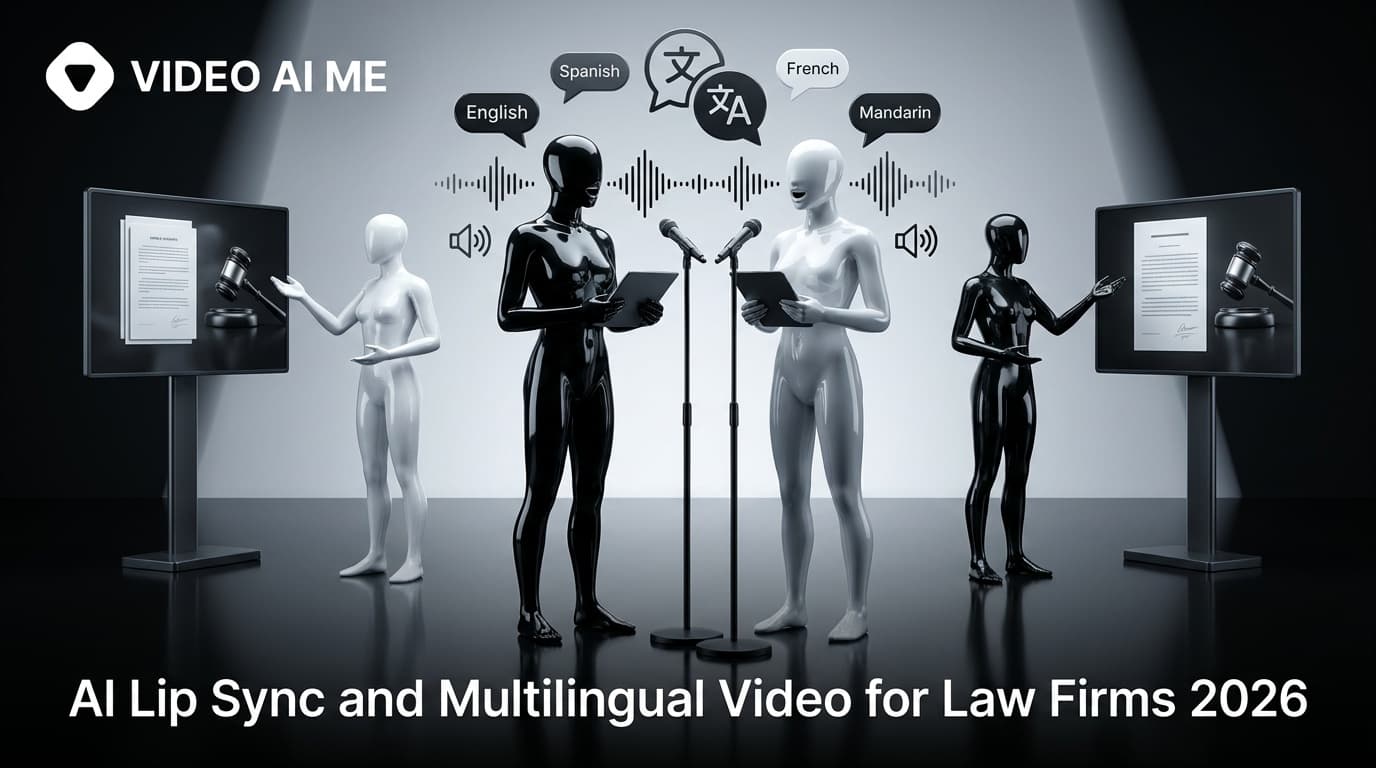
How law firms use AI lip sync and multilingual video in 2026
The US legal market has always had a multilingual access problem. A personal injury firm in Houston with a Spanish-speaking client base, an immigration firm in Los Angeles with Mandarin and Vietnamese clients, and a community law office in Atlanta with Korean and Spanish clients all face the same constraint: a single attorney video shot in English does not serve the communities the firm wants to reach. Human dubbing or re-shooting for each language costs thousands of dollars per language and weeks of scheduling. So most firms publish English only, and the language gap stays open.
AI lip sync and multilingual video close the gap. The 2026 generation of lip sync technology on platforms like VIDEOAI.ME can take an approved English video and re-render it in 30 plus languages, with the on-screen attorney appearing to speak each language in a fluent way. Cost per language is single-digit to low-double-digit dollars in credits. Time per language is 30 to 60 minutes once the master script is signed off and translated.
This guide covers how law firms use AI lip sync and multilingual video in 2026, the compliance steps that keep multilingual content inside state bar rules, the translation review workflow that keeps content accurate, and the publishing strategy that turns multilingual video into real intake calls.
Why multilingual video matters for law firms
Three factors push multilingual video up the priority list in 2026.
Demographic shifts in the US legal client base are real. According to US Census data, the Spanish-speaking population in the US has grown steadily, with significant concentrations in Texas, California, Florida, Arizona, New York, Illinois, and most major metro areas. The Clio Legal Trends Report repeatedly documents that legal clients prefer to engage with firms in their primary language when available. A firm that publishes only English content cedes those clients to the smaller number of firms that do publish in the relevant language.
Search behavior follows language. Spanish-language search for legal terms in US metro areas is significant and growing. The same is true for Mandarin in California and New York, Vietnamese in Texas and California, and other community languages in specific metro markets. A firm with no content in the target language does not appear in those searches.
Cost has been the historical barrier. The Forrester legal services CMO commentary repeatedly flags multilingual content as one of the highest-return investments most mid-size firms are not making, specifically because the production cost made the project infeasible. AI lip sync and voice cloning collapse that cost barrier. The HubSpot State of Marketing Report reinforces that video remains the highest-engagement format across service business categories.
What AI lip sync and multilingual video can do for a law firm
1. Translate an existing attorney intro
The firm's English attorney intro becomes a Spanish, Mandarin, Vietnamese, and Korean attorney intro with the same on-screen attorney. No second shoot. No new compliance review beyond verifying each translated script.
2. Build a multilingual practice-area library
Each practice-area explainer gets rendered in the relevant community languages for the firm's market. A six-page practice-area library becomes 18 to 30 video assets covering three to five languages.
3. Reach new client communities on social
Posting Spanish-language attorney content on TikTok and Facebook reaches communities that English-only firm pages do not reach. The same principle applies to Mandarin, Vietnamese, and other community languages on the platforms those communities use most.
4. Localize for paid search and paid social
Google Ads and Meta Ads support language-targeted campaigns. A multilingual video library lets the firm run paid campaigns in each target language with creative that matches the audience.
5. Support attorney-client communication after intake
Multilingual onboarding videos explaining the case process can be sent to new clients in their preferred language. This reduces intake confusion, shortens the time staff spend repeating the same information, and increases client satisfaction.
How to make a multilingual AI video for a law firm
- Start with the master script. Write the English script following your firm's standard advertising review process. Get supervising attorney sign-off on the approved English version.
- Render the English video first. Use an AI actor (or a custom likeness of an actual partner with documented consent), choose a voice that matches practice-area energy, render at the relevant aspect ratios.
- Decide on the language list. Pull census data for your service area and review your existing client base data. Common choices: Spanish (most US markets), Mandarin (California, New York, parts of Northeast), Vietnamese (Texas, California), Korean (specific metro areas), Russian (Eastern Europe-origin communities). Pick two to four languages for the first batch.
- Translate each script. Use AI translation as a first draft. Have a bilingual attorney or qualified legal translator review and adjust each translation. Confirm any state-required disclaimers translate accurately.
- Render each language. AI lip sync re-renders the original video with the new audio track. Use a native-fluent voice in each target language. Match the regional dialect to the target community (Mexican Spanish for Texas, Caribbean Spanish for South Florida, Mainland Mandarin versus Taiwanese as relevant).
- Review each render. Check lip sync at the first and last sentence. Re-render if either reads off. Have a bilingual reviewer watch each language version end to end before publishing.
- Add translated on-screen text. Disclaimers, firm name, contact details, and any required attorney advertising labels need to appear in the target language.
- Publish to language-appropriate channels. Spanish-language video belongs on the Spanish version of the firm site, the firm Spanish-language TikTok or Facebook page, Spanish-language directory listings, and Spanish-language paid campaigns.
- Save all source files. Each language version needs its own folder with the approved translated script, the renderer settings, the voice ID, the bilingual reviewer's approval, and any disclaimer files. The compliance trail per language matters.
Prompt example: 60-second Spanish-language attorney intro for an immigration practice
Style: warm community-attorney aesthetic, soft daylight in a neighborhood law office, light editorial color, faint handheld breath, smartphone-feel realism.
Scene: A mid-thirties bilingual female attorney in a fitted burgundy blazer over a cream blouse sits at the edge of a clean wooden desk in a small storefront office. A bookshelf with bilingual legal references, a small Mexican papel picado on the wall, and a tidy chair for clients sit behind her. A printed bilingual pamphlet rests on the desk.
Cinematography: Camera shot: medium chest-up, vertical 9:16 for social and 16:9 for the website hero, locked off with a subtle breath. Lens: 35mm equivalent, f3.2, soft natural separation. Lighting: large diffused key from camera-left storefront window, low warm fill from a paper lamp, gentle back-practical hair light. Color anchors: cream wall, burgundy blazer, light oak desk, papel picado pinks and yellows, brushed brass. Mood: warm, neighborly, trustworthy.
Actions:
- Attorney looks calmly into the lens, gives a small welcoming wave.
- Lifts the pamphlet, sets it down, and opens with both hands in an inclusive gesture.
- Closes with a calm nod and a small smile.
Dialogue:
- Attorney: "Hola, soy abogada de inmigración y estoy aquí para acompañarte paso a paso."
Background sound: Quiet storefront ambience, a faint distant doorbell chime, no music.
Drop the approved English master script into VIDEOAI.ME, lip-sync it into Spanish with a Mexican or Caribbean Spanish voice that matches your market, and have a bilingual paralegal verify the translated script before publish. Save each language version with its approved script and reviewer sign-off in the compliance folder.
Three law firm use cases for multilingual AI video
1. Solo immigration attorney serving a Vietnamese community
My runs a solo immigration practice in Garden Grove, California. Her primary client base is Vietnamese-speaking. She writes 12 approved English scripts covering green card processing, asylum, naturalization, family-based petitions, and DACA. She renders each as a 75 second AI explainer video, then re-renders each in Vietnamese with a native-fluent Vietnamese voice and a bilingual paralegal's translation review. The Vietnamese-language pages on her firm site become her primary intake source within six months.
2. Mid-size personal injury firm in a bilingual Texas market
Ramirez and Park is an 11 attorney personal injury firm in San Antonio. The marketing director rebuilds the firm's six core practice-area pages with both English and Spanish AI video at the top. The Spanish versions use a native Mexican Spanish voice and a translation reviewed by the firm's bilingual paralegal. Across 90 days, the firm's Spanish-language intake calls increase meaningfully, and cost per qualified consultation on Spanish-language paid search falls below the firm's English benchmark.
3. Estate planning boutique in a multilingual metro
Wilkins Estate Law is a three attorney boutique in Queens, New York. The firm's target client base includes English, Mandarin, and Korean speakers. The partners produce a 90 second attorney intro and three practice-area explainers in all three languages, distributed across the firm site, the firm Facebook page, attorney directory listings, and language-specific paid campaigns. The firm's consultation calls from Mandarin and Korean speakers become a measurable share of overall intake within four months.
These personas reflect patterns we see in legal marketing engagements. Your numbers will vary based on practice area, market demographics, and the maturity of your funnel.
AI multilingual video versus traditional human dubbing
| Factor | Human dubbing | AI multilingual |
|---|---|---|
| Cost per language | $500 to $1,500 | $5 to $50 in credits |
| Time per language | 1 to 3 weeks | 30 to 60 minutes |
| On-screen lip match | Original (no match) | Lip-synced to new language |
| Voice consistency across languages | Variable | Consistent quality |
| Translation review still required | Yes | Yes |
| Best for | Hero brand films | Practice-area libraries, social content, paid campaigns |
Compliance considerations specific to multilingual legal video
- Translated disclaimers. Any state-required disclaimer must appear in the target language on screen. A literal English disclaimer on a Spanish video creates a defective placement.
- Bilingual review of the translated script. Use a bilingual attorney, a qualified legal translator, or a paralegal with verified bilingual credentials. Do not rely on machine translation alone.
- Regional dialect match. Use Mexican Spanish for Texas and California, Caribbean Spanish for South Florida, Mainland Mandarin for most US markets except when the community is specifically Taiwanese. Mismatched dialects damage trust.
- Voice talent consent. Voice cloning requires written consent from the person whose voice is being cloned. If the firm uses a stock voice instead, the platform's licensing terms apply.
- Cultural framing. Some legal concepts translate literally but mean different things culturally. A bilingual review catches these. Example: "settlement" in English carries no shame; the literal Spanish translation can carry connotations of "giving in" that change how the offer is perceived.
- Channel-specific advertising rules. Some languages have specific advertising regulators in addition to the state bar. Run the translated content through your normal compliance review and document the approval.
What to avoid in multilingual AI video
- Machine translation without human review. Legal terminology mistranslates often enough to be unsafe without a bilingual reviewer.
- English voice reading translated text. Use a native-fluent voice in the target language. Anything else reads as inauthentic.
- Mismatched regional dialect. Mexican Spanish for a Cuban audience reads as wrong. Mainland Mandarin for a Taiwanese audience reads as wrong.
- Untranslated on-screen disclaimers. They become defective placements in the target language.
- Hard-sell framing. Cultural norms around legal services vary. The polite educational tone that works in English may need adjustment in other languages.
- Outcome guarantees in any language. ABA Model Rule 7.1 and most state equivalents apply regardless of the language of the content.
FAQ
(See the FAQ section above for People Also Ask answers.)
Next steps
A firm that has never produced multilingual video can start with one approved English attorney intro this week. Pick the most relevant second language for the firm's market. Have a bilingual reviewer translate the script. Render the second-language version with AI lip sync. Publish to the matching language-specific channel and track intake from that channel over 60 days. If the numbers move, expand to more practice areas and more languages.
Want to see one running on your firm's site in a second language? Drop a practice-area URL and your target community language and we will sketch a multilingual pilot. Start a free render via the AI lip sync feature, the AI multilingual video tool, the AI voice cloning feature, the talking AI avatar workflow, or open VIDEOAI.ME to begin.
Related reading on our blog:
Frequently Asked Questions
Share
AI Summary

Paul Grisel
Paul Grisel is the founder of VIDEOAI.ME, dedicated to empowering creators and entrepreneurs with innovative AI-powered video solutions.
@grsl_frReady to Create Professional AI Videos?
Join thousands of entrepreneurs and creators who use VIDEO AI ME to produce stunning videos in minutes, not hours.
- Create professional videos in under 5 minutes
- No video skills experience required, No camera needed
- Hyper-realistic actors that look and sound like real people
Get your first video in minutes
Related Articles
What Is MiniMax H3? The Video Model Explained
MiniMax H3 is a multimodal video model that turns a written brief into a short clip with synchronised sound. Here is what it does, what it does not, and who it suits.
MiniMax H3 vs Veo 3: An Honest Comparison
Veo 3 is Google's video model and it is not in the VIDEO AI ME picker. Here is how it compares to MiniMax H3 on the things that decide ad creative.

MiniMax H3 vs Sora 2: Drafting Against Polish
Sora 2 renders at higher resolution and longer. MiniMax H3 gets you many more attempts. Which one belongs in your workflow depends on the job, not the benchmark.