
AI Video API for Law Firm Builders 2026: A Practical Guide
How law firm tech teams and legal-tech builders integrate AI video APIs in 2026 for client intake, case-update messaging, and multilingual practice content.
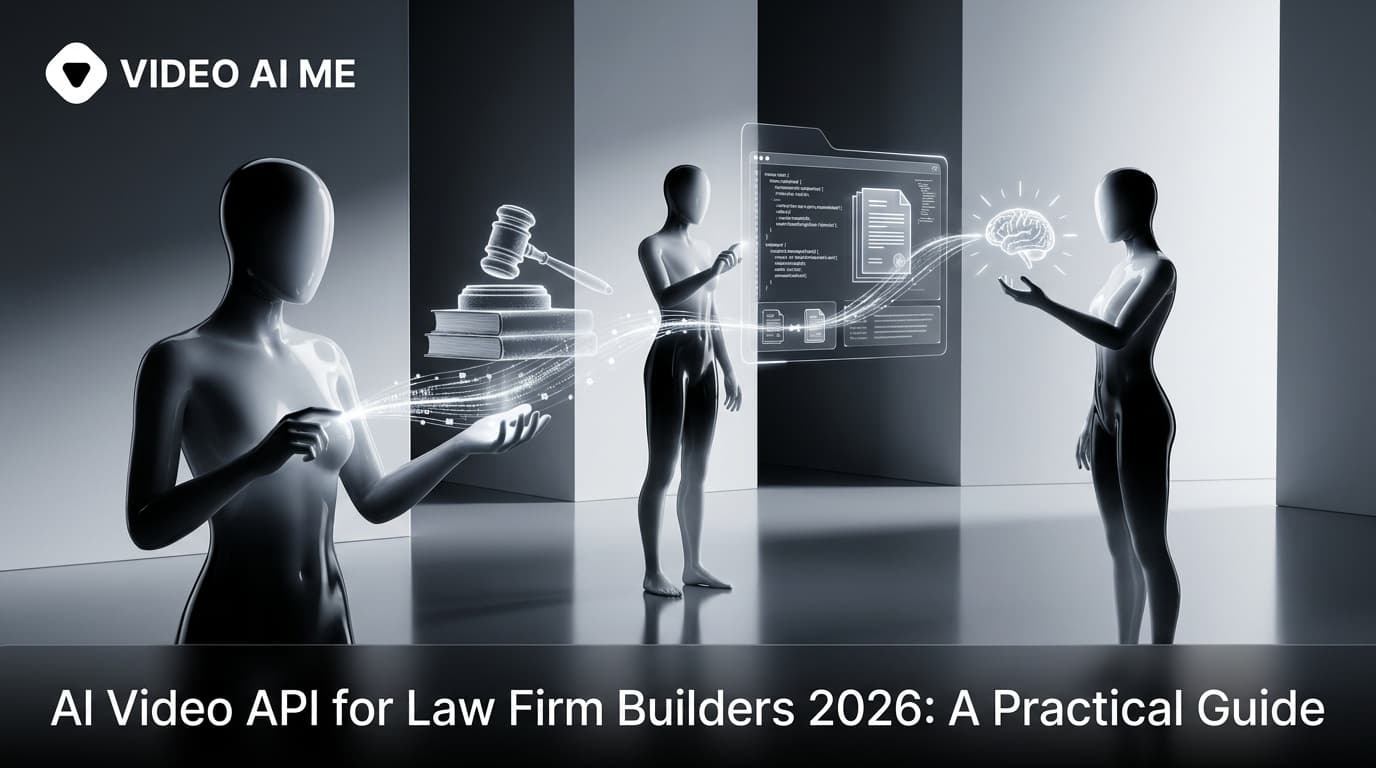
What law firm builders do with AI video APIs in 2026
An AI video API is a developer endpoint that takes a script, a chosen actor and voice, optional variables, and returns a finished video URL. For a law firm with any kind of custom tech, that opens a category of workflows the firm could not run before: a personalized intake confirmation video rendered the moment a client submits a form, a multilingual case-update video sent automatically after each court filing, a programmatic practice-area landing page that renders a new video for each city the firm serves.
Most firms will not need an API. A user interface on a Pro plan covers the marketing video library and the practice-area explainer set. But firms with a real product mindset, in-house developers, or a legal-tech vendor relationship can build workflows that move client experience and intake conversion in ways the standard product cannot.
This guide covers how law firms and legal-tech builders are using AI video APIs in 2026, the compliance considerations specific to automated rendering, the technical workflow that produces a reliable pipeline, and the use cases where the API approach actually pays for itself versus when the standard product is the better fit.
When an AI video API makes sense for a law firm
Three patterns push a firm toward the API tier.
The first is per-client personalization at scale. A 50 attorney firm with 2,000 active matters may want a personalized case-update video sent after each major filing. Producing those manually through a user interface is impossible. An API integrated with the firm's case management system renders each video automatically and emails the client. The Clio Legal Trends Report repeatedly documents that client communication is one of the top drivers of satisfaction and referral; video communications stand out compared to email-only updates.
The second is programmatic SEO. A national personal injury firm targeting 200 cities for car accident intake wants a unique practice-area landing page per city, each with a city-specific video at the top. Rendering 200 videos through a user interface is a long week of busywork. An API renders all 200 from one template with city-name variables in an hour. The HubSpot State of Marketing Report shows that page-level personalization correlates with stronger conversion across service categories.
The third is product integration. Legal-tech vendors building intake software, case management systems, or law firm CMS platforms can offer video as a native feature to their customers when an AI video API sits behind the product. The Forrester legal tech category commentary tracks growth in legal-tech tooling that bundles content creation into client-facing software.
AI video API use cases for law firms
1. Personalized intake confirmation videos
A client submits the intake form. The API renders a 30 second video that addresses the client by first name, confirms the case type they selected, and walks through what happens next. The video URL is included in the confirmation email and on the post-submission landing page. The personal touch increases the percentage of intake-form submissions that convert to booked consultations.
2. Multilingual case-update videos
The firm's case management system fires a webhook whenever a major case milestone occurs (complaint filed, deposition scheduled, motion ruling received). The API generates a short video update in the client's preferred language, with the on-screen attorney appearing to speak the language thanks to lip sync. The client receives the update via email or SMS within minutes.
3. Programmatic practice-area landing pages
The firm targets 50 cities in its state for personal injury intake. The API renders 50 unique practice-area videos, each with the city name and any city-specific intake details inserted as variables. Each landing page gets a unique video at the top, which lifts page-level conversion compared to a generic shared video.
4. Onboarding video sequences
New clients receive a five-video onboarding sequence over their first two weeks: welcome from the assigned attorney, what to expect in the first 30 days, how to communicate with the firm, what documents to gather, and what the next milestone looks like. The API renders each video from approved templates with personalization variables.
5. Bulk practice-area refresh
When the firm decides to refresh its entire practice-area library each year, the API renders all updated videos overnight from new approved scripts. Multilingual variants render in the same batch. The whole library refresh that used to take a quarter compresses to a single batch run.
6. Conditional video for paid landing pages
The firm's paid landing page renders a different video at the top depending on the visitor's search query or geographic IP. A visitor searching "truck accident lawyer Atlanta" sees a video specifically about truck accidents in Atlanta. The API renders the variant the first time someone visits with that query combination, then caches it.
Technical workflow for an AI video API in a law firm
- Define the use case and the template. Pick one workflow to build first. Intake confirmation videos and case-update videos are common starting points.
- Write and approve the underlying script template. The supervising attorney signs off on the template, including the placement of personalization variables. Lock the template in version control.
- Build the consent system. Each attorney whose likeness or voice is used signs a consent record. Store the record in the compliance system with expiration and revocation handling.
- Choose the API platform. Test a proof of concept on VIDEOAI.ME, HeyGen, and Synthesia. Compare quality, render time, language support, and pricing.
- Build the rendering pipeline. A webhook or scheduled job triggers a render. The pipeline assembles the script from the approved template plus variables, calls the API, stores the returned video URL, and updates the relevant client record.
- Add the audit log. Every render produces a log entry with the template version, the variables used, the requesting user or system, the attorney consent record version, and the timestamp. The log is the compliance trail.
- Build error handling. Renders sometimes fail. Build retry logic for transient errors and an alerting flow for repeated failures. A failed case-update video is a quality incident; the firm needs to know about it.
- Build the disclaimer layer. Required attorney advertising labels and jurisdiction-specific disclaimers should appear on every render programmatically, in the appropriate language. Do not rely on individual users to add them.
- Test in staging. Run the full pipeline against a staging environment before going live. Confirm consent enforcement, disclaimer rendering, language matching, and audit log entries.
- Go live with a small batch. Start with 10 to 20 real renders and review every one. Scale up only after the first batch passes review.
Prompt example: 30-second API-rendered client-intake confirmation video
Style: clean firm-facing communication video, soft daylight, mid-size law office, calm editorial color, very mild handheld breath.
Scene: A forty-something paralegal-style host in a light blue button-up sits at a tidy desk with a small firm logo block behind her on a clean wall. A neat desk pad, a closed legal folder, and a coffee mug with the firm's color sit in frame. A small monitor angled out of view glows softly.
Cinematography: Camera shot: medium chest-up, horizontal 16:9 for email embed, eye-level locked off. Lens: 35mm equivalent, f3.2, soft natural separation. Lighting: large diffused key from camera-left window, low fill from a paper lamp, brand-color subtle accent light on back wall. Color anchors: soft white wall, light blue shirt, walnut desk, firm-brand accent color, brushed silver. Mood: warm, organized, reassuring.
Actions:
- Host looks into the lens, gives a calm welcoming nod, taps the folder once.
- Counts off three on her fingers as she lists the next steps.
- Closes with a small open-palm gesture and a friendly smile.
Dialogue:
- Host: "Hi {{first_name}}, we received your {{case_type}} request, here is what happens next."
Background sound: Quiet office ambience, faint distant phone ring, no music.
Wire the prompt template into VIDEOAI.ME via the API, pass first name and case type as variables on each form submission, and embed the returned video URL in the confirmation email. Log every render with the template version and the consent record ID for compliance.
Three law firm use cases
1. Mid-size firm building intake-confirmation videos
Martinez and Park is a 16 attorney personal injury firm in Atlanta. Their tech team integrates an AI video API with their intake form workflow. When a visitor submits the form, a 30 second video renders with the visitor's first name and case type, and the URL is included in the confirmation email. Within 60 days, the percentage of intake submissions that convert to booked consultations increases meaningfully, and clients begin mentioning the personalized video on intro calls.
2. National immigration firm running multilingual onboarding
Reyes Immigration is a 22 attorney national immigration firm. Their tech team builds a multilingual onboarding sequence that renders five videos in the new client's preferred language over the first two weeks: welcome, what to expect, how to upload documents, common timing questions, and milestone preview. The API supports Spanish, Mandarin, Vietnamese, and Tagalog renders. New client onboarding NPS scores rise across all four language groups within the first quarter.
3. Legal-tech vendor building video into a CMS product
LawCMS is a legal-tech vendor building website management software for small firms. The product bundles AI video rendering through an API so customer firms can generate practice-area explainers and attorney intros from inside the CMS without leaving the product. Customer firms get a feature their previous CMS did not offer, and the vendor charges a premium tier that covers the API costs plus margin.
These personas reflect patterns we see in legal tech. Your specific architecture and numbers will vary based on firm size, existing case management system, and language requirements.
AI video API versus manual UI rendering
| Factor | Manual UI rendering | API integration |
|---|---|---|
| Volume ceiling | Dozens per week | Thousands per day |
| Per-render cost | Standard subscription | Per-render or per-minute pricing |
| Personalization | Manual per video | Programmatic from variables |
| Multilingual | Render each separately | Batch all languages from one call |
| Audit trail | Manual file save | Automatic log entries |
| Compliance enforcement | Human reviewer | Coded into pipeline |
| Best for | Marketing library, ad creative | Per-client video, programmatic pages, product integration |
| Engineering effort | None | 2 to 6 weeks of build time |
Most firms should start with manual UI rendering. The API tier earns its keep when monthly render volume passes a few hundred, or when per-client personalization becomes a real workflow, or when a vendor product needs video as a native feature.
Compliance considerations specific to automated AI video
- Template approval is the compliance gate. The supervising attorney approves the template, including variable placeholders. Subsequent renders inherit the approval as long as variables stay within defined types.
- Variable validation. Validate every variable before render. A typo or an unexpected case type variable can produce nonsense or misleading content. Reject renders with invalid variables and alert.
- Disclaimer logic per jurisdiction. Build a jurisdiction map that selects the right on-screen disclaimer for the relevant state. Some states require labels that others do not.
- Consent expiration. Build expiration dates into attorney consent records. The pipeline rejects renders against expired consent automatically.
- Audit log retention. Keep audit log entries for at least the period your state bar requires for advertising records, typically two to seven years. Most jurisdictions specify the period.
- Right to revoke. When an attorney leaves the firm or revokes consent, the pipeline must stop rendering videos with that attorney's likeness and voice. Build the revocation flow before launching the API integration, not after.
- Confidentiality. Never pass real client names or case details into a variable system that ends up in a public video. Use generic placeholders or first-name-only personalization in client-facing renders.
What to avoid in AI video API integrations
- Skipping the consent system. Building a render pipeline without a consent record is a malpractice and bar discipline risk.
- Hard-coded disclaimers in English only. Multilingual content needs translated disclaimers in code.
- No audit log. A render with no record is a compliance gap. The audit log is the firm's defense file if questioned.
- Unbounded variable inputs. Validate everything. Free-form user input into a video script is a data hygiene and compliance risk.
- Going live without staging review. Test 10 real renders against staging and have the supervising attorney review each before scaling.
- Mixing marketing and case-specific content in one pipeline. Build separate pipelines for marketing assets (high volume, low per-render risk) and case-specific assets (lower volume, higher per-render risk and confidentiality requirements).
FAQ
(See the FAQ section above for People Also Ask answers.)
Next steps
A firm or legal-tech builder evaluating the API tier can start with a contained proof of concept this month. Pick one use case (intake confirmation video is a good starter). Build a single-template pipeline with hard-coded variables and a manual trigger. Run 10 renders through the staging pipeline and have the supervising attorney review every one. If the quality passes, expand to a wider variable set and a production trigger.
Want to see one running on your firm's intake form? Share an example form payload and we will sketch a render-template integration. Start a free render via the AI video API docs, the lip sync API endpoint, the AI content generator, the AI ads workflow, or open VIDEOAI.ME to begin.
Related reading on our blog:
Frequently Asked Questions
Share
AI Summary

Paul Grisel
Paul Grisel is the founder of VIDEOAI.ME, dedicated to empowering creators and entrepreneurs with innovative AI-powered video solutions.
@grsl_frReady to Create Professional AI Videos?
Join thousands of entrepreneurs and creators who use VIDEO AI ME to produce stunning videos in minutes, not hours.
- Create professional videos in under 5 minutes
- No video skills experience required, No camera needed
- Hyper-realistic actors that look and sound like real people
Get your first video in minutes
Related Articles
What Is MiniMax H3? The Video Model Explained
MiniMax H3 is a multimodal video model that turns a written brief into a short clip with synchronised sound. Here is what it does, what it does not, and who it suits.

MiniMax H3 vs Veo 3: An Honest Comparison
Veo 3 is Google's video model and it is not in the VIDEO AI ME picker. Here is how it compares to MiniMax H3 on the things that decide ad creative.

MiniMax H3 vs Sora 2: Drafting Against Polish
Sora 2 renders at higher resolution and longer. MiniMax H3 gets you many more attempts. Which one belongs in your workflow depends on the job, not the benchmark.