
AI Video for Healthcare: Patient Education That Converts
Healthcare practices know they need video but have zero time to produce it. Learn how AI video solves the privacy, compliance, and time challenges of medical marketing while building patient trust across Facebook, Instagram, TikTok, and YouTube.
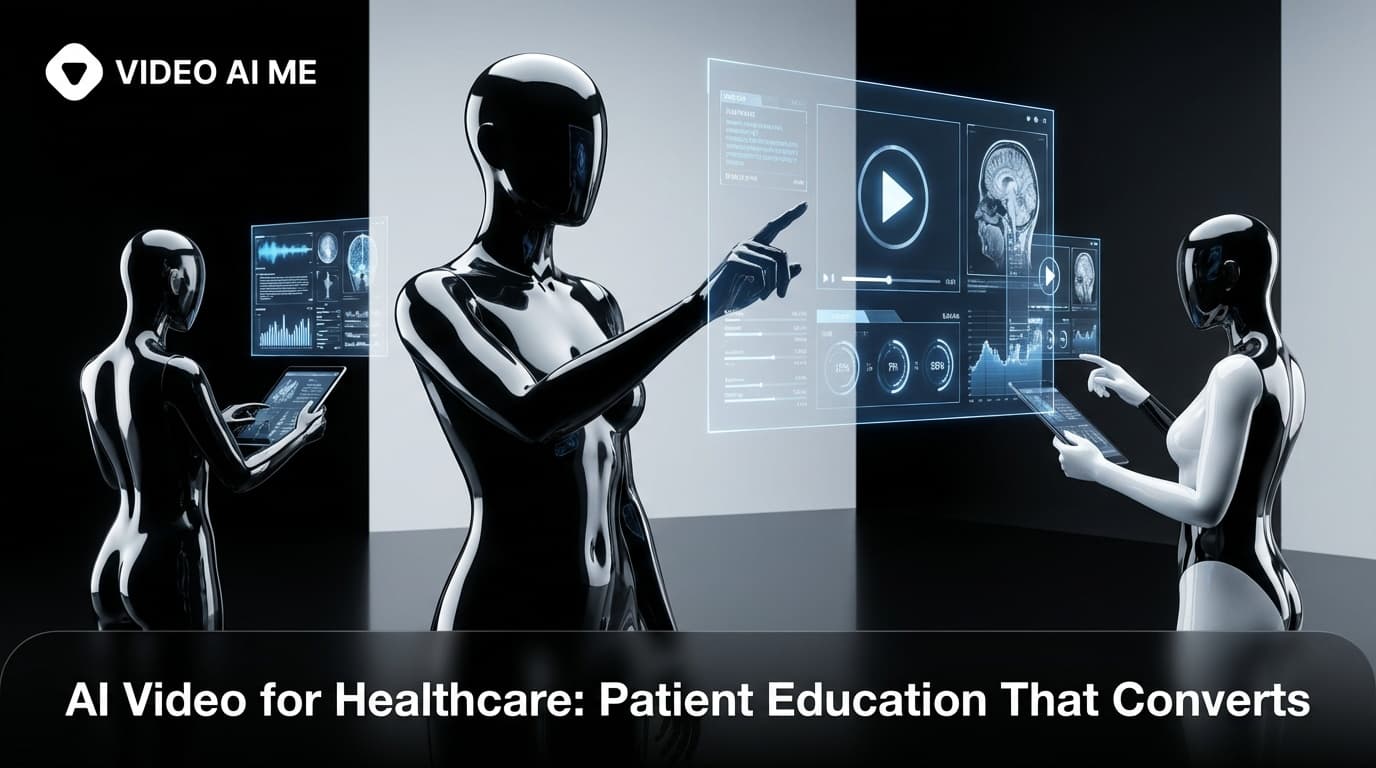
The Healthcare Video Gap
Every healthcare practitioner understands the value of patient education. Informed patients make better decisions, have more realistic expectations, ask better questions, and ultimately experience better outcomes. The data supports this - research published by the National Institutes of Health consistently links patient education to improved satisfaction and health outcomes.
Video is the most effective medium for delivering that education. It combines visual demonstration, spoken explanation, and human presence in a way that brochures, blog posts, and email newsletters simply cannot match.
And yet, most healthcare practices produce almost no video content. The reasons are consistent: no time, no equipment, no video production skills, privacy concerns about filming in clinical settings, and uncertainty about compliance rules.
This is the healthcare video gap. Practices know video works. Patients want video content. But the production barriers keep the vast majority of healthcare providers invisible on the platforms where patients are actively searching for information.
AI video closes that gap entirely.
Why Patients Trust Video Over Text
When someone receives a medical diagnosis or considers a treatment, their first instinct is to search. And increasingly, that search happens on YouTube, TikTok, or Instagram rather than Google.
The reason is deeply human. Patients want to see a person explaining their condition. They want to hear the tone of voice, read the body language, and feel the empathy that text cannot convey. A 90-second video of a knowledgeable presenter explaining "what to expect during vein treatment" does more to reduce patient anxiety than any FAQ page.
This trust dynamic is especially strong in healthcare for several reasons:
- Medical information is intimidating. Video makes it accessible and less clinical.
- Patients are anxious. A calm, reassuring presenter on screen creates emotional comfort that text lacks.
- Procedures are visual. Some things are simply easier to understand when shown rather than described.
- Trust requires a face. In healthcare, patients want to feel they are getting advice from a real person, not a faceless institution.
The practices that recognize this are building significant competitive advantages. A specialist who publishes weekly educational videos attracts patients who already trust them before the first appointment. That trust shortens the sales cycle, reduces no-shows, and increases treatment acceptance rates.
Types of Healthcare Video Content
Healthcare video content falls into several categories, each serving a different stage of the patient journey.
Condition Education
Videos that explain what a condition is, why it occurs, and what treatment options exist. These target patients at the awareness stage - they know something is wrong but do not yet understand their situation. Examples: "What causes varicose veins," "Understanding the stages of hearing loss," "Why your knee pain might not be arthritis."
Condition education videos perform exceptionally well on YouTube, where patients search for specific health information. They also work on TikTok as shorter, attention-grabbing explainers that drive followers to a profile where they can learn more.
Procedure Explainers
Step-by-step walkthroughs of what a patient can expect before, during, and after a treatment. These reduce anxiety and answer the questions patients are too embarrassed to ask during a consultation. They serve patients in the consideration stage - they know their options and are evaluating whether to proceed.
This is an area where AI video solves a real privacy problem. Filming actual procedures requires patient consent, raises HIPAA concerns, and can be uncomfortable for everyone involved. AI-generated procedure explainers use professional presenters to describe the process without any real clinical footage.
Wellness Tips and Prevention
Short, practical videos offering health advice that positions the practice as a trusted resource. A dental practice sharing "3 foods that stain your teeth" or a senior care organization explaining "how to fall-proof your home" builds audience trust over time. These videos are the top of the funnel - they attract people who may not need a procedure today but will remember the practice when they do.
For practices in the dental and healthcare space, AI video is already transforming how practices approach content.
Patient FAQ Videos
The questions your front desk answers 20 times a day deserve video answers. Insurance questions, preparation instructions, recovery timelines, parking directions - every FAQ becomes a piece of content that serves double duty: it educates prospective patients on social media and reduces the administrative burden on your staff.
Practice Introduction and Virtual Tours
A warm, welcoming introduction to your practice and team helps new patients feel comfortable before they walk through the door. AI video makes it easy to create and update these regularly, ensuring the content always reflects your current team and facilities.
Compliance and HIPAA Considerations
Healthcare marketing operates under stricter rules than most industries, and any practice creating video content needs to understand the boundaries. Here is what matters for AI-generated healthcare video.
HIPAA and Patient Privacy
AI video offers a significant compliance advantage: no real patients appear in the content. This eliminates the most common HIPAA concern in healthcare video production. There is no protected health information (PHI) being captured, stored, or transmitted.
However, you must still be careful with scripts. Never reference identifiable patient cases, even in a testimonial format. If you create a "patient story" video, ensure it is clearly a composite scenario with no details that could identify a real individual.
Medical Claims and Advertising Rules
The FTC and state medical boards regulate healthcare advertising. Key principles to follow in your video scripts:
- Do not guarantee outcomes. Phrases like "this treatment will cure" or "guaranteed results" are violations in most jurisdictions.
- Use language like "may help," "patients often experience," or "designed to address."
- Include appropriate disclaimers, especially for procedure-related content.
- If sharing success metrics, ensure they are documented and representative, not cherry-picked.
Platform-Specific Rules
Facebook and Instagram have advertising policies that restrict certain healthcare claims and targeting. TikTok similarly prohibits direct medical claims in promotional content. Organic educational content has more flexibility than paid ads, which is another reason to invest in a strong organic video strategy rather than relying solely on paid campaigns.
Disclaimer Best Practices
Every healthcare video should include, at minimum, a note that the content is for educational purposes and not a substitute for professional medical advice. This can be verbal (spoken by the presenter at the end), visual (text overlay), or both. For paid advertising content, additional disclosures may be required depending on your jurisdiction and the specific claims made.
How AI Avatars Solve the Privacy Problem
Beyond HIPAA compliance, AI video addresses several privacy challenges unique to healthcare:
No real patients on camera. You never need to ask patients to appear in marketing content - a request that many patients find uncomfortable and that creates ongoing consent management obligations.
No staff filming requirements. Doctors and practitioners are often reluctant to appear on camera, and their schedules make consistent filming nearly impossible. AI avatars deliver the same professional, trustworthy presentation without requiring anyone's time in front of a camera.
Controlled clinical environment. Filming in treatment rooms raises questions about visible equipment, patient charts, and other privacy-sensitive elements. AI video is generated in a neutral environment with no risk of accidental PHI exposure.
Consistent brand presentation. Staff turnover is real in healthcare. An AI avatar provides a consistent brand presence that does not change when a team member leaves the practice.
For an overview of how AI video compares to traditional UGC content creation methods in terms of cost and efficiency, the economics are especially compelling for healthcare practices where filming is unusually difficult.
Platform Strategy for Healthcare Practices
Different platforms reach different patient demographics, and smart healthcare practices distribute content accordingly.
Facebook: Reaching Established Patients and Older Demographics
Facebook remains the dominant platform for adults over 40 - exactly the demographic most likely to need specialist medical services. For healthcare practices, Facebook excels at:
- Local community engagement (patients searching for providers in their area)
- Sharing longer educational content that established patients appreciate
- Building referral networks through shareable health tips
- Running targeted ads to specific demographics within your service area
A vein treatment specialist, for example, finds their ideal patients predominantly on Facebook. The content that converts: condition education videos, procedure explainers, and before-and-after result discussions (without showing real patient images). For practices running Facebook and Meta ad campaigns, AI video provides the creative assets at a fraction of traditional production costs.
TikTok: Health Awareness and Younger Audiences
TikTok's health and wellness community is massive and growing. The platform is particularly effective for:
- Building awareness of conditions and treatments people might not know about
- Reaching younger patients (dental, dermatology, fitness-related services)
- Medical education content that reaches aspiring healthcare professionals
- Wellness tips and prevention content that builds practice visibility
The format that works: short, direct, educational. A 30-second video titled "3 signs you should see a vein specialist" can reach hundreds of thousands of people organically. The key is leading with the educational value, not the sales pitch.
YouTube: Long-Form Education and Search Dominance
YouTube is where patients go to research. "What happens during a colonoscopy," "how long is recovery from knee replacement," "best exercises for lower back pain" - these searches happen millions of times per month, and the practices that answer them with clear video content earn patient trust at scale.
YouTube videos also have an extraordinarily long shelf life. A well-made procedure explainer uploaded today will still attract patients three years from now. This makes YouTube the highest-ROI platform for healthcare content over time.
Instagram: Visual Results and Wellness Positioning
Instagram works best for healthcare niches with strong visual elements: cosmetic procedures, dental transformations, fitness and wellness, and dermatology. Reels format mirrors TikTok's short-form style, and the platform's slightly older demographic (compared to TikTok) often aligns well with healthcare decision-makers.
The Patient Education Funnel
Effective healthcare video content maps to the patient journey, moving viewers from awareness to appointment.
Awareness Stage: Condition Education The patient knows something is wrong but has not identified the cause or solution. Content at this stage is purely educational. "Why do my legs ache at the end of the day?" "What causes bleeding gums?" "Signs of age-related hearing loss." These videos cast a wide net and attract people who do not yet know they need your specific service.
Consideration Stage: Treatment Information The patient understands their condition and is evaluating options. Content here gets more specific. "Laser vein treatment vs. sclerotherapy - what is the difference?" "Dental implants vs. bridges - pros and cons." "In-home senior care vs. assisted living - a comparison." These videos position your practice as the knowledgeable guide.
Decision Stage: Practice-Specific Content The patient is ready to book but choosing between providers. Content at this stage is practice-specific. Virtual tours, team introductions, "what to expect at your first appointment" videos, and patient FAQ content. This is where trust converts into action.
AI video allows you to create content for every stage of this funnel without dedicating your clinical team's time to production. A practice that covers all three stages with consistent video content creates a self-sustaining patient acquisition pipeline.
Multilingual Healthcare Content
Healthcare practices in diverse communities face a communication challenge that directly impacts patient outcomes. When a patient does not fully understand their condition or treatment plan because of a language barrier, compliance drops and outcomes suffer.
AI video makes multilingual patient education scalable. A practice serving a community with significant Spanish-speaking, Vietnamese-speaking, or Mandarin-speaking populations can produce the same educational content in every relevant language. One script becomes three or four videos, each delivered naturally in the patient's preferred language.
This is not just good marketing - it is better healthcare. Patients who understand their treatment plan in their own language are more likely to follow through, attend follow-up appointments, and refer others to the practice.
For a complete guide on producing AI videos in any language, the process is straightforward and particularly impactful for healthcare applications.
Creating 30 Days of Content in One Afternoon
Here is a realistic workflow for a healthcare practice that wants to build a consistent video presence without disrupting clinical operations.
Step 1: Brainstorm 30 topics (45 minutes). Pull from your most common patient questions, conditions you treat, procedures you offer, wellness tips relevant to your specialty, and myths you regularly debunk. Every healthcare practice has at least 30 topics ready to go - you answer these questions every day in consultations.
Step 2: Write 30 scripts (2-3 hours). Each script should be 60-90 seconds of spoken content. Follow a simple structure: hook (identify the problem or question), explain (deliver the educational content), and close (brief call to action - "talk to your doctor" or "visit our website to learn more"). A practice manager or marketing coordinator can draft these with input from the clinical team.
Step 3: Generate 30 videos (1-2 hours). Using VIDEOAI.ME, generate each video from its script. Review for accuracy and tone. Regenerate any that need adjustment. The AI handles production quality, presenter delivery, and formatting.
Step 4: Schedule across platforms (30 minutes). Load the videos into your social media scheduling tool. Distribute across Facebook, Instagram, TikTok, and YouTube according to your platform strategy. Set the schedule for daily or near-daily publishing.
Total time invested: one afternoon. Content produced: an entire month of professional healthcare video across every platform. Compare that to the traditional approach - hiring a videographer, scheduling filming sessions around clinical hours, editing footage, and managing the production process over weeks.
For practices exploring the broader landscape of AI video tools for social media, the time savings are especially dramatic in healthcare where filming logistics are uniquely challenging.
The Competitive Advantage of Early Adoption
Most healthcare practices still produce zero video content. The few that do typically manage one or two videos per month - often filmed reluctantly by a practitioner squeezed between patient appointments.
This means the window for building a dominant content presence in your specialty and geographic area is wide open. A practice that starts publishing daily educational video today will have hundreds of indexed, searchable, shareable pieces of content within a year. Catching up to that library will be nearly impossible for competitors who start later.
The practices that win patient attention online in 2026 will not be the ones with the biggest advertising budgets. They will be the ones that consistently show up with helpful, trustworthy educational content on the platforms patients actually use.
AI video makes that consistency achievable for practices of any size - from a solo specialist to a multi-location healthcare network.
Create Compliant Healthcare Video with VIDEOAI.ME
Your patients are searching for health information on social media right now. They are watching videos from other practices, other providers, and - often - unreliable sources. Every day you are not publishing educational content is a day your expertise goes unheard.
AI video removes every barrier that has kept your practice off these platforms. No filming in clinical spaces. No patients on camera. No hours stolen from patient care. No expensive production crews.
Write a script that reflects your clinical expertise. Generate a professional, compliant video in minutes. Publish it where your patients are looking.
Start creating healthcare video content with VIDEOAI.ME. Your patients are already searching - make sure they find you.
Frequently Asked Questions
Share
AI Summary

Paul Grisel
Paul Grisel is the founder of VIDEOAI.ME, dedicated to empowering creators and entrepreneurs with innovative AI-powered video solutions.
@grsl_frReady to Create Professional AI Videos?
Join thousands of entrepreneurs and creators who use VIDEO AI ME to produce stunning videos in minutes, not hours.
- Create professional videos in under 5 minutes
- No video skills experience required, No camera needed
- Hyper-realistic actors that look and sound like real people
Get your first video in minutes
Related Articles
MiniMax H3 UGC Prompt Templates for Ad Creative
Reusable UGC prompt templates with the variables marked, so you can produce a whole batch of creator style ads by swapping four fields.
Seedance 2.5 UGC Prompt Templates for Ads
Six fill in the blank UGC prompt templates for Seedance 2.5, each with a fully filled worked example, plus how to direct dialogue when the audio is generated.
How to Make AI UGC Videos With Seedance 2.5
A five step playbook for creator style UGC clips with Seedance 2.5: casting, prompts that carry the spoken hook, reference images for batches, and the credit math.