
Cinematic Happy Horse Prompts: Camera Moves That Work
A practical guide to cinematic Happy Horse prompts with camera moves - steadicam, dolly, orbit, aerial - and where each one belongs in a scene.
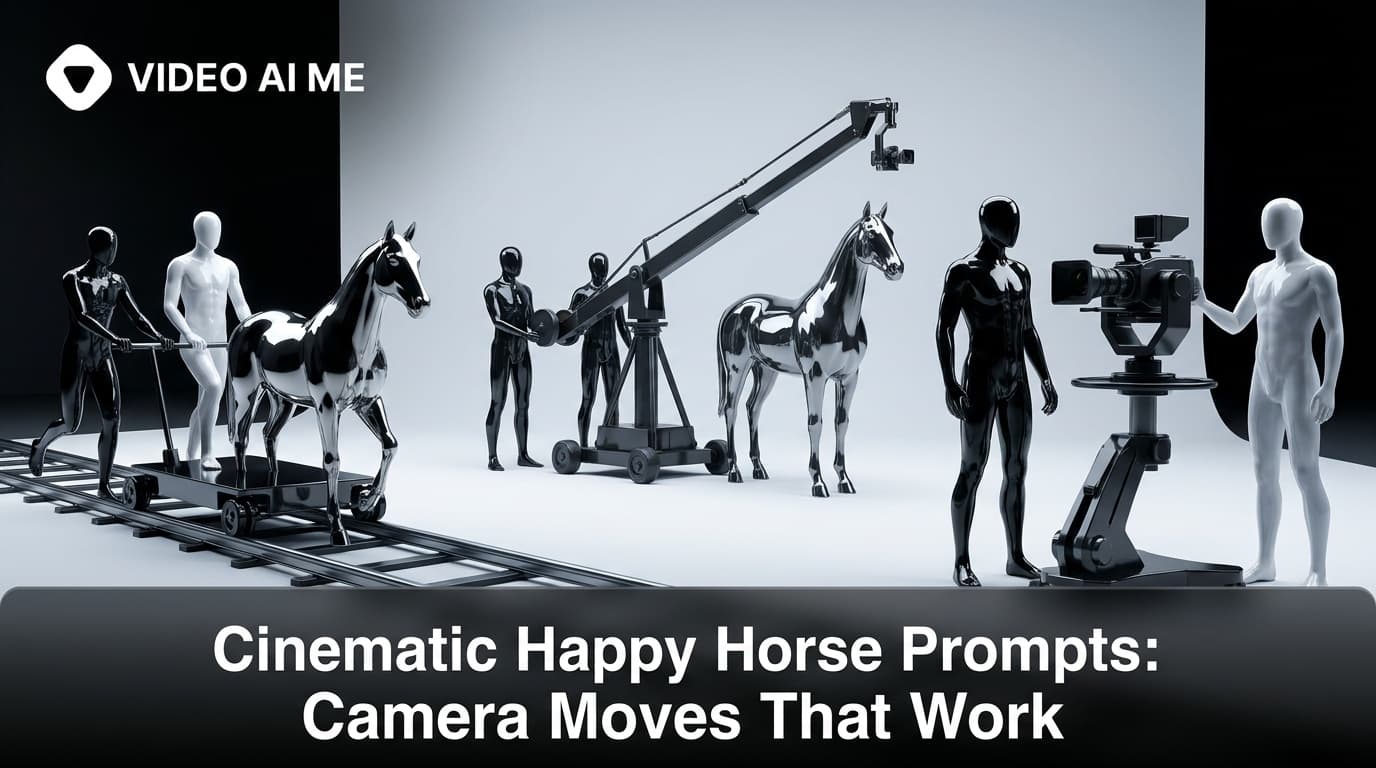
Cinematic Happy Horse Prompts: A Camera Move Guide
Happy Horse 1.0 is, at its core, a camera operator that never argues about the schedule. Tell it the right move and it executes - steadicam through a crowd, slow dolly into a face, low aerial over a coastline. Get the instruction wrong and you get drift, not motion.
This guide covers cinematic happy horse prompts with camera moves: which moves the model handles well, how to specify them correctly, and copy-ready examples across scene types.
The Golden Rule for Camera Moves
Camera cues go at the end of the prompt. Every time.
If you describe a camera move mid-sentence, Happy Horse sometimes folds it into the scene description rather than treating it as a cinematography instruction. Ending with the move makes the instruction unambiguous.
Structure: [Subject] [does action] in [setting], [lighting cue], [camera move].
Camera Moves Happy Horse 1.0 Handles Best
Steadicam
Forward-tracking follow shots with the characteristic floating stability of a Steadicam rig. Works well for subject-following sequences - a character walking through a market, down a corridor, or along a street.
A woman in a navy coat walks through a busy indoor market stall, sodium vapor lamps overhead, steadicam follow behind at shoulder height.
Dolly-In
A smooth forward move toward a static or nearly-static subject. One of Happy Horse's most reliable moves. Use it for emotional close-ups, product reveals, and scene-setting shots.
A 1965 cherry-red Mustang convertible parked on a sun-bleached desert road, mid-afternoon sun on chrome, slow dolly-in to the driver's door handle.
The "mid-afternoon sun on chrome" cue is worth memorising. Chrome and metallic surfaces are a Happy Horse strength - the model renders specular highlights accurately and the dolly reveals them progressively.
Orbit
A 360-degree (or partial arc) rotation around a central subject. Great for product shots and character reveals. Specify the arc if you want a partial orbit: "90-degree left orbit" rather than just "orbit."
A woman in a white dress stands in the centre of a sun-drenched courtyard, warm amber backlight, slow 90-degree right orbit at mid-body height.
Aerial
Happy Horse's aerial capability is one of its standout features. Low aerials that skim just above a subject and high pull-backs that establish geography both produce strong results.
A lone surfer paddles out through breaking waves at dawn, low aerial following from behind, warm amber horizon light, slight upward tilt as the horizon expands.
Shot List for a Cinematic Multi-Move Sequence
When a scene needs more than one camera move, use the shot list format with timecodes rather than describing the sequence in prose.
Shot 1 (wide aerial establishing, 0-1s): Bird's-eye view of a winding coastal highway at midday, Pacific Ocean to the left, deep blue water, hard sun.
Shot 2 (low tracking, 1-4s): A red convertible drives along the highway, steadicam at bumper height moving alongside, wind in the driver's hair, mid-afternoon sun on chrome.
Shot 3 (slow push-in close, 4-5s): The driver's hand on the steering wheel, chrome gear knob catching the light, slow dolly-in, shallow depth of field.
Each shot has one clear move. The aerial establishes, the steadicam follows, the dolly closes. Happy Horse executes each independently rather than trying to blend them.
Markdown Section Format for a Continuous Cinematic Take
For a single long take where you need precise control over every dimension, the markdown section format separates concerns clearly:
## Subject
A man in his early forties in a charcoal suit

## Action
Walks slowly through an empty underground car park, stops, turns toward camera

## Setting
Concrete pillars, oil-stained floor, low ceiling

## Camera
Steadicam follow from 45-degree front-left, closing to mid-close as subject turns

## Lighting
Single hard top-down key, deep falloff to black, sodium vapor strip lights distant

## Mood
Quiet tension, deliberate pace
Move and Lighting Pairings That Work
Certain lighting cues and camera moves reinforce each other:
slow dolly-in+single hard top-down key, deep falloff to black- theatrical close-up revealsteadicam follow+sodium vapor street lamps- gritty night-time trackinglow aerial+warm amber backlight- cinematic golden-hour sweeporbit+mid-afternoon sun on chrome- product hero shotaerial pull-back+overcast daylight- quiet, melancholy landscape
What Struggles
Extreme slow-motion. Happy Horse handles natural pacing well. Claims about 1000fps or ultra-slow-motion in prompts do not reliably produce a distinct visual effect - the model will generate smooth motion, not genuinely slowed physics.
Conflicting moves. "Handheld and also steadicam" or "orbit while following" are contradictory instructions. The model will pick one or average them awkwardly.
Micro-moves. Very subtle adjustments ("shift three degrees left") are too granular for the current model. Describe the feeling instead: "barely perceptible sway" or "nearly static with a faint breath."
Running Cinematic Prompts on VIDEO AI ME
VIDEO AI ME runs Happy Horse 1.0 alongside Seedance 2, which means you can run the same cinematic prompt on both models and compare. Some scenes render better in Happy Horse - particularly anything involving aerials, chrome, or complex lighting. Others suit Seedance 2's motion style. One subscription, both models.
The multilingual lip-sync support means that once you have a cinematic hero clip, you can localise it without a reshoot - which is particularly useful for brand films targeting multiple markets.
Build a Camera Move Library
Cinematic video production at scale is a template problem. Once you know that a particular move and lighting pair reliably produces strong output for your brand, that combination becomes a reusable block.
Five tested camera move templates - hero approach, product reveal, lifestyle follow, aerial establish, emotional close - give your content team the ability to brief an entire campaign in a morning. Each new video is a variation on a tested pattern, not a fresh experiment.
Try cinematic Happy Horse prompts on VIDEO AI ME and start building your camera move library today.
For framing guidance specific to vertical versus horizontal formats, read our guide to Happy Horse 9:16 and 16:9 prompts.
Frequently Asked Questions
Share
AI Summary
Paul Grisel
Paul Grisel is the founder of VIDEOAI.ME, dedicated to empowering creators and entrepreneurs with innovative AI-powered video solutions.
@grsl_frReady to Create Professional AI Videos?
Join thousands of entrepreneurs and creators who use VIDEO AI ME to produce stunning videos in minutes, not hours.
- Create professional videos in under 5 minutes
- No video skills experience required, No camera needed
- Hyper-realistic actors that look and sound like real people
Get your first video in minutes
Related Articles
MiniMax H3 UGC Prompt Templates for Ad Creative
Reusable UGC prompt templates with the variables marked, so you can produce a whole batch of creator style ads by swapping four fields.
Seedance 2.5 UGC Prompt Templates for Ads
Six fill in the blank UGC prompt templates for Seedance 2.5, each with a fully filled worked example, plus how to direct dialogue when the audio is generated.
How to Make AI UGC Videos With Seedance 2.5
A five step playbook for creator style UGC clips with Seedance 2.5: casting, prompts that carry the spoken hook, reference images for batches, and the credit math.