
How to Make AI Videos With Your Own Voice in 2026
A step-by-step guide to making AI videos in your own voice: record a sample, clone it, write a script, and generate a talking avatar video.
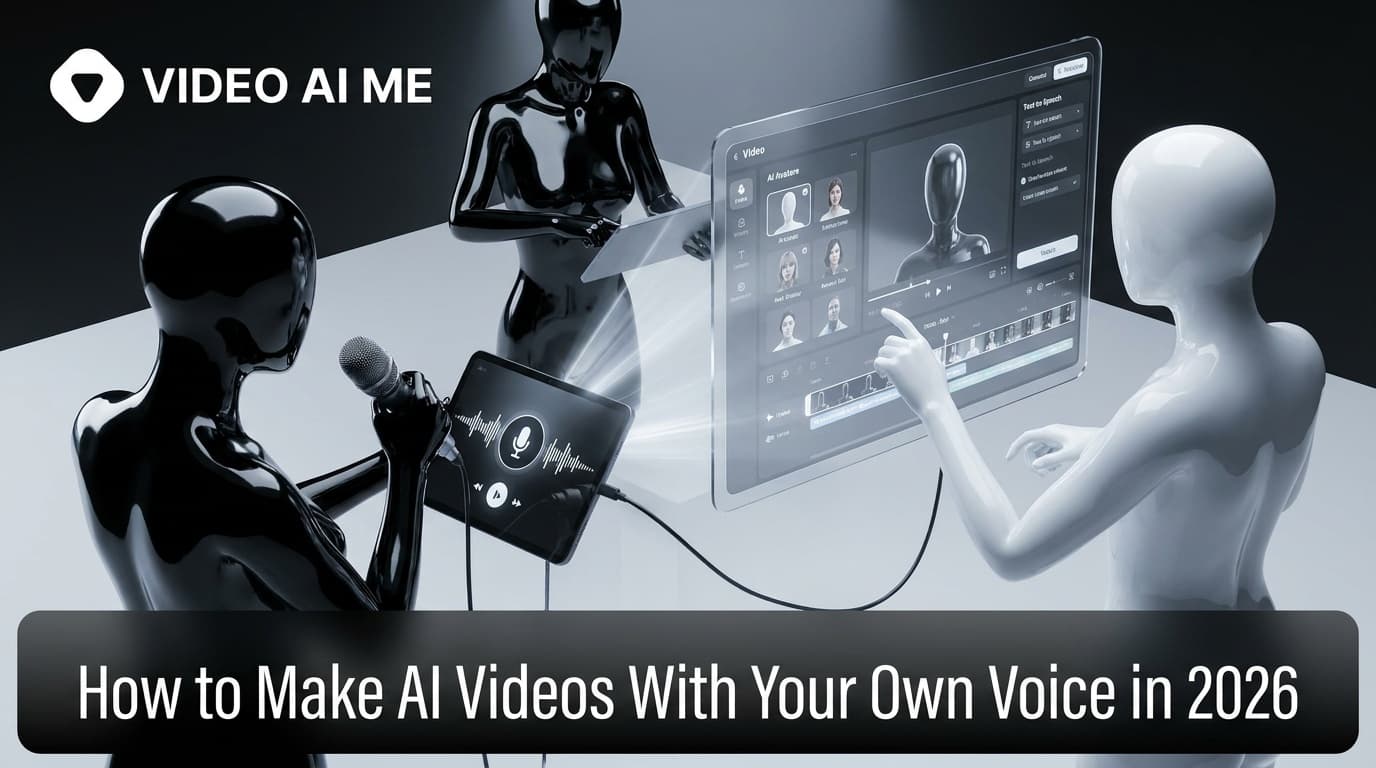
You have a script, a face, and a story to tell, but no studio, no mic setup, and no time to film fifty takes. The fastest path in 2026 is to make AI videos with your own voice: record a short sample, clone it once, then have an AI avatar speak any script you write. The result sounds like you, looks like you, and ships in minutes instead of a shoot day.
I run VIDEO AI ME, and we've tested every part of this pipeline because it's the workflow our users actually want. Not a generic robotic narrator. Their voice, on camera, saying exactly what they need this week.
This guide walks the full path step by step: recording a clean sample, cloning your voice, writing a script that performs, and generating a talking video that ties it all together. I'll be honest about where each stage gets tricky and what "good enough" really looks like.
Why Your Own Voice Matters in 2026
For two years, AI video meant stock-sounding narration that listeners tuned out in three seconds. That era is over. Three shifts make a personal-voice workflow the default in 2026:
- Clone quality crossed the believability line. Modern voice cloning needs 30 to 60 seconds of clean audio to produce speech that close friends struggle to flag as synthetic. The tells (flat affect, weird breath gaps, mangled proper nouns) are mostly gone on the top engines.
- Audiences reward authenticity, algorithms reward retention. A familiar voice keeps people watching, and watch time is what every platform's ranking system optimizes for. Your voice is a retention asset, not a vanity feature.
- The full stack finally connects. You used to clone in one app, write in a second, and animate in a third. In 2026 the photo-to-avatar, script, and voice steps live in one place, which is the difference between a fun demo and a publishing habit.
The catch: each stage has a quality floor you have to clear, and skipping the boring parts (clean recording, script timing) is where most people's videos fall apart.
Voice Cloning Workflow Tools Compared
Here's how the common pieces of the workflow stack up. "Workflow scope" is the part that matters most: a clone-only tool still leaves you stitching audio to video by hand.
| Tool / Approach | Sample Needed | Workflow Scope | Languages | Watermark | Best For |
|---|---|---|---|---|---|
| VIDEO AI ME | ~30-60s | Avatar + script + voice + video (end-to-end) | 30+ | None on paid | Complete talking videos from a photo |
| Dedicated voice cloner | ~1-3 min | Voice audio only | 20-30+ | Varies by plan | High-fidelity audiobooks, podcasts |
| Talking-photo app | n/a (uses preset voices) | Lip-sync only | Varies | Often on free | Quick novelty clips |
| Avatar platform (stock actors) | n/a | Stock-avatar video | 40+ | Plan-dependent | Corporate explainers, no personal likeness |
| General video editor + TTS plugin | Varies | Manual assembly | Varies | Editor-dependent | Editors who want full timeline control |
| DIY: record yourself | n/a (real voice) | You film + edit everything | Your languages | None | Maximum authenticity, maximum effort |
No single row is "best" for everyone. If you want a finished talking video that uses both your face and your voice without hand-assembly, an end-to-end platform wins on time. If you only need pristine narration for a podcast, a dedicated voice cloner with a longer sample may edge it on raw audio fidelity. For a deeper look at the cloning side alone, see our AI voice cloning guide.
Step 1: Record a Clean Voice Sample
Your clone is only as good as the audio you feed it. This is the single highest-leverage step, and it takes about five minutes.
How much you need: 30 to 60 seconds of continuous, natural speech is the sweet spot for most engines in 2026. More is not always better; ten minutes of inconsistent audio produces a worse clone than one clean minute.
What to record: Read something conversational, not a phone book. Use full sentences with normal punctuation so the engine learns your rhythm, pauses, and intonation. A short product pitch or a passage from an article you'd actually narrate works perfectly.
The recording checklist:
- Quiet room, soft surfaces. A bedroom with a bed and curtains beats a tiled bathroom. Hard rooms add echo the clone will faithfully reproduce.
- Phone is fine, six inches away. A modern phone mic at close range outperforms a cheap USB mic across a desk. Avoid pointing it directly at your mouth (plosives) by angling slightly off-axis.
- One steady volume, one steady pace. Don't trail off at the end of sentences. The clone learns your average energy, so give it a consistent target.
- No music, no background TV, no fan. Anything constant gets baked into the voice profile.
Quick quality test: Play your sample back with your eyes closed. If you can hear a room, a hum, or yourself getting quieter, re-record. Thirty good seconds beats two messy minutes every time.
Step 2: Clone Your Voice
With a clean sample, the clone itself is nearly instant. The work is in verifying it before you commit a full script to it.
How it works: You upload your sample, the engine builds a voice profile, and within a minute or two you can generate test speech from any text. You're not training for hours; modern systems do few-shot cloning from that short clip.
Verify before you scale. Generate three short test lines:
- A line with numbers and a date ("We launched on March 3rd with 1,200 users"). Numbers expose pacing problems.
- A line with your hardest proper noun (your brand, your name, a product). If the engine mangles it, you'll learn the workaround now instead of in a finished video.
- A line with real emotion ("Honestly, this is the part I'm most excited about"). Flat delivery here means you need a more expressive sample or a tone setting.
Common fixes when the clone sounds off:
- Robotic or flat: your sample was too monotone. Re-record with more natural variation.
- Mispronounced names: spell them phonetically in the script ("VIDEO AI ME" stays as-is, but a tricky surname might become "Gris-elle").
- Rushed pacing: add commas and periods. Punctuation is your timing control in text-to-speech.
This is also the stage to decide on language. If you plan to publish in more than one, clone once and let the engine speak your other languages. Our multilingual AI video guide covers how far that stretches and where accents still leak through.
Step 3: Write a Script That Performs Out Loud
A script that reads well on paper often sounds terrible spoken. Writing for the ear is its own skill, and it's where good clones get wasted.
Write the way you talk. Short sentences. Contractions. One idea per line. Read every draft aloud before you generate; if you stumble, the AI will too.
Front-load the hook. You have about three seconds. Open with the payoff or the problem, not "Hi everyone, in today's video." Tell viewers immediately what they get.
Control pacing with punctuation. Periods create stops. Commas create small breaths. Ellipses create suspense. The engine reads these literally, so they're your only timing dial in text.
Match length to format. A 30-second short is roughly 70 to 85 spoken words. A 60-second video is about 140 to 160. Count words, not characters, and trim ruthlessly.
Avoid spoken-word traps:
- Big numbers spelled out long-form ("one thousand two hundred forty-seven") read awkwardly. Round when you can.
- Acronyms may be read as words; spell them with spaces or periods if you want letters.
- Long parenthetical asides lose listeners. If it doesn't survive being said aloud, cut it.
If scripting is the part you dread, you can have the system draft it from a topic and then edit. Our AI video scripts guide breaks down hooks, structure, and CTA lines that convert. For brainstorming angles fast, the best AI video prompts collection is a useful idea bank even if you're not generating B-roll.
Step 4: Generate the Talking Video
Now you combine the pieces: a face, your cloned voice, and the script. This is where a connected workflow saves the most time.
Pick or create your avatar. Upload a clear, well-lit, front-facing photo and the system builds a talking AI avatar from it. Looking straight at the camera with an even expression gives the lip-sync engine the most to work with. Our create an AI avatar from a photo guide covers exactly which photos work and which to avoid.
Sync voice to face. The engine times your cloned audio to the avatar's mouth and head movement. Watch the first render at full speed and again at half speed. Check the mouth on hard consonants (b, p, m) and the end of sentences, where drift is most visible.
Set the format up front. Choose 9:16 for Shorts and Reels, 16:9 for YouTube, 1:1 for feed posts. Re-cropping a finished render rarely looks as good as generating native.
Plan around generation time honestly. A short talking clip generally renders in a few minutes; longer pieces take more. Batch your work. Write three scripts, queue three renders, and review them together rather than babysitting one at a time.
Quality-check before publishing:
- Audio: any clipping, weird pauses, or mispronounced words? Fix the script and re-render.
- Lip-sync: does the mouth match on close-ups? Slight drift is normal; obvious mismatch isn't.
- Pacing: does it feel rushed or draggy? Adjust punctuation, not the voice settings.
Where VIDEO AI ME Fits
Every step above can be done in separate apps. The friction is the handoffs: export audio here, upload there, re-time the lip-sync somewhere else, then discover your proper noun got mangled and start over.
VIDEO AI ME collapses the whole pipeline into one flow. You upload a photo and it becomes a talking AI avatar. You write a script or have the system draft one from your topic. You clone your voice from a short sample (or pick a ready voice), and it generates a complete talking-head or UGC-style marketing video, 30 seconds to several minutes, in your voice and your likeness. No watermark on paid plans, native support for 30-plus languages, and formats sized for every platform.
That's the real shift: not "a cool AI clip" but a repeatable way to publish finished videos that sound like you. If you're building a content habit, this is the difference between a one-off experiment and shipping every week. For the bigger picture on using this for growth, our AI video marketing complete guide maps where personal-voice video fits a funnel.
You can start free, clone your voice, and generate your first talking video in a single session.
Practical Tips for Better Results
A few habits that separate clips that look AI-made from ones that just look good:
- Build a script template. Hook, value, CTA. Reuse the skeleton, swap the content. Consistency compounds.
- Keep your best sample on file. Once you have a clone you love, don't re-clone on a whim. Lock it in and reuse it.
- Watch retention, not just views. Where people drop off tells you whether your hook and pacing work. Tighten the first five seconds first.
- Repurpose one script across formats. One 60-second script becomes a Short, a Reel, and a feed post. See our YouTube Shorts AI content guide for format-specific tweaks.
- Don't over-polish. Slightly imperfect, human-paced delivery often outperforms a sterile "perfect" read. Authenticity is the point.
Frequently Asked Questions
How long does it take to clone my voice?
The clone itself usually completes in a minute or two from a 30 to 60 second sample. The time you should actually budget is the five minutes spent recording a clean sample and the few minutes verifying test lines before you commit a full script.
Is voice cloning safe and ethical?
Cloning your own voice for your own content is straightforward and legitimate. The ethical line is consent: never clone someone else's voice without their permission. Reputable platforms require you to confirm the voice is yours or that you have rights to use it.
Do I need a professional microphone?
No. A modern phone in a quiet, soft-surfaced room, held about six inches away, produces a clone-quality sample. Room noise and echo hurt your result far more than microphone price, so prioritize a quiet space over gear.
Can the AI avatar and voice speak other languages?
Yes. Most 2026 engines let you clone once and generate speech in dozens of languages, with the avatar lip-syncing to the translated audio. Accent and idiom can still leak through on some language pairs, so review native-speaker output before publishing.
How long can the videos be?
VIDEO AI ME generates talking videos from about 30 seconds up to several minutes. Shorter clips render fastest and tend to perform best on social platforms, while longer pieces suit explainers and tutorials. Match length to format: roughly 70 to 85 spoken words for a 30-second short.
What if the voice mispronounces a word?
Punctuation and phonetic spelling are your fixes. Add commas to slow pacing, and spell tricky names the way they sound. Run a quick test line with your hardest proper noun before generating the full script so you catch issues early.
Start With Your Own Voice
The pipeline is no longer the hard part. Record a clean sample, clone it once, write for the ear, and generate. The skill that still matters is judgment: a sharp hook, honest pacing, and a script worth saying out loud.
If you want the whole workflow in one place, with your face and your voice, start free with VIDEO AI ME and ship your first talking video today. For where to take it next, the complete AI avatars guide goes deeper on building a consistent on-camera presence.
Frequently Asked Questions
Share
AI Summary

Paul Grisel
Paul Grisel is the founder of VIDEOAI.ME, dedicated to empowering creators and entrepreneurs with innovative AI-powered video solutions.
@grsl_frReady to Create Professional AI Videos?
Join thousands of entrepreneurs and creators who use VIDEO AI ME to produce stunning videos in minutes, not hours.
- Create professional videos in under 5 minutes
- No video skills experience required, No camera needed
- Hyper-realistic actors that look and sound like real people
Get your first video in minutes
Related Articles
How to Run MiniMax H3 Without a GPU
MiniMax H3 has public weights, so people try to self host it. Here is what that actually costs in hardware and time, and the browser route if you just want the clips.
Writing Sound and Dialogue in MiniMax H3 Prompts
Audio is generated with the picture, so it is yours to direct. How to write dialogue, ambience and silence, and how much speech actually fits in a short clip.
MiniMax H3 Prompt Guide: How to Write a Shot
The five part structure that gets usable clips out of MiniMax H3, why keyword lists fail, and how to write the sound as deliberately as the picture.