
How to Make PAS (Problem-Agitate-Solution) Video Ads With AI
Learn how to turn the problem agitate solution video ad framework into scroll-stopping short-form ads, with a script template, step-by-step AI workflow, and examples.
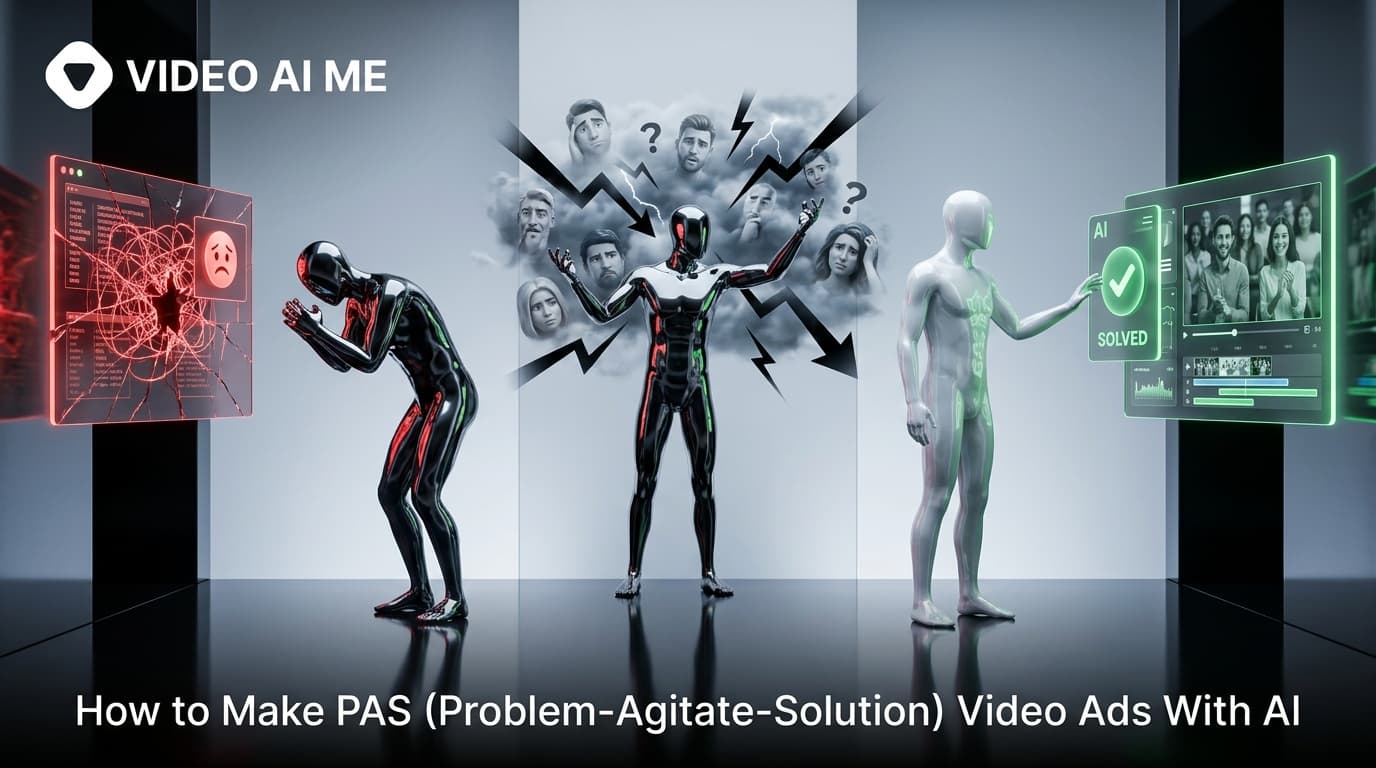
The problem agitate solution video ad is the most reliable structure in direct-response advertising, and it is also the easiest framework to mess up when you move it from a written sales page to a 20-second clip on Meta or TikTok. The written PAS formula gives you paragraphs to build tension. A scroll-stopping video ad gives you about three seconds before the viewer is gone. This guide shows you how to translate the classic problem-agitate-solution copywriting structure into a short video ad that actually holds attention, and how to produce ten variations of it in an afternoon using AI instead of a film crew.
If you have written PAS copy before, you already know the bones: name the problem, twist the knife, then hand over the relief. What changes on video is pacing, who delivers the lines, and how fast you have to earn the next second of attention. We will cover the framework, a line-by-line script template, the exact production steps, and the mistakes that flatten a good PAS angle into a forgettable ad.
What a Problem-Agitate-Solution Video Ad Actually Is
A problem agitate solution video ad is a short-form ad built on the PAS copywriting framework, where you open on a viewer pain point, amplify the emotional cost of that pain, then present your product as the obvious fix. It is one of the most widely used direct-response structures because it mirrors the viewer's own internal monologue: you validate the frustration before you sell anything.
The three classic beats are simple to state and hard to execute well:
- Problem. You name a specific, relatable pain the viewer is already feeling. Not a vague benefit, an actual frustration.
- Agitate. You sit in that pain and make the cost real. This is the emotional core, and it is the part most people skip or rush.
- Solution. You introduce your product as the resolution, then point to a clear next step.
PAS works best for pain-aware audiences and short formats under 30 seconds, which is exactly where most paid social ads live. According to copywriting breakdowns of the framework, problem-first hooks tend to earn the highest engagement because they qualify the right viewer in the opening line. The Problem-Agitate-Solution storytelling guide from StoryPrompt notes the same thing: the formula gets attention by making people feel the pain so they take action to solve it.
Why PAS Translates So Well to UGC-Style Video
User-generated content is the native habitat of the PAS framework. A real person on camera complaining about a problem, then showing what fixed it, is the most natural delivery vehicle for problem-agitate-solution there is. That is why so many UGC ads are quietly running PAS without labeling it.
The performance case for UGC-style PAS is strong. UGC achieves 6.9x higher engagement than brand-created content, and 92% of consumers trust peer recommendations over polished brand messaging. When a problem-agitate-solution video ad is delivered in that authentic, talking-to-a-friend register, the agitate step lands as empathy instead of manipulation.
The catch has always been production. Filming dozens of UGC-style PAS variations with human creators is slow and expensive, and you cannot test new angles fast enough to find a winner. That is the gap AI fills. With an AI actor you can script every word, deliver the same PAS beats in a dozen tones, and ship variations in hours instead of weeks. If you want the full background on the format itself, our guide to writing AI UGC ad scripts covers the broader hook, problem, proof, and CTA structure that PAS slots into.
The PAS Video Ad Script Template
Before you touch any tool, you need the script. A problem-agitate-solution video ad for paid social should run 15 to 30 seconds and map cleanly to a timeline. Here is the structure to fill in.
| Beat | Timing | Job | Example line |
|---|---|---|---|
| Hook / Problem | 0 to 3s | Stop the scroll by naming the pain out loud | "I wasted three hundred dollars on creators before I figured this out." |
| Agitate | 3 to 12s | Make the cost of the problem real and specific | "Every ad looked the same, took two weeks to film, and still flopped. I was burning budget and getting nothing back." |
| Solution | 12 to 22s | Introduce the product as the fix, show it | "Then I started generating UGC-style ads myself. Same actor, ten angles, done before lunch." |
| Call to action | 22 to 30s | Tell them exactly what to do next | "Link in bio, try it on your next launch." |
A few rules that separate a working PAS video from a flat one:
- The problem is the hook. In short video, the first line and the problem are the same thing. Do not spend three seconds on a logo or a slow pan. Open mid-frustration.
- Agitate with specifics, not adjectives. "It was frustrating" agitates nothing. "I refreshed the dashboard at midnight and the CPA had doubled again" agitates a real person.
- The solution is a turn, not a pitch. Show the product solving the exact problem you just agitated. One product, one fix.
- One CTA. Pick a single action. Multiple asks split attention and kill the conversion.
How to Make a PAS Video Ad With AI: Step by Step
Here is the full production workflow, from blank page to a finished problem-agitate-solution video ad you can upload to Meta or TikTok.
Step 1: Pick one pain-aware audience
PAS only works when the viewer already knows they have the problem. Choose a single, specific audience and a single pain they feel. A skincare buyer frustrated with breakouts and a founder frustrated with ad costs are different ads. Do not try to address both in one script.
Step 2: Write the problem line as a scroll-stopper
Open on the pain in plain, spoken language. Test the line by reading it out loud: if it sounds like a brochure, rewrite it until it sounds like a person venting to a friend. This single line does most of the work in the ad.
Step 3: Agitate with one concrete consequence
Pick the most painful downstream cost of the problem and describe it in detail. Time wasted, money lost, the embarrassment, the missed deadline. Stay in the agitation for a few seconds. This is the beat that earns the solution. According to PAS breakdowns, the agitate step is the emotional core, and rushing it is the most common reason the framework underperforms.
Step 4: Deliver the solution as a visible turn
Introduce your product as the resolution and show it doing the job. In UGC-style video this means the actor demonstrates or references the product naturally, not a hard cut to a feature list. Keep it to one product solving the one problem you agitated.
Step 5: Generate the video with an AI actor
This is where AI replaces the film crew. In VIDEO AI ME, you choose an AI actor, paste your PAS script, and the platform produces a lip-synced, UGC-style talking-head video in minutes. You control the tone, the wording, and the look, so the problem-agitate-solution beats land exactly as written.
Step 6: Add captions and a clear CTA
Around 80% of social video is watched without sound, so captions are not optional. Burn in captions, add a single end-card CTA, and make sure the call to action matches the one line in your script. Our tested video ad hooks guide has scroll-stopping opener formulas you can swap into the problem beat.
Step 7: Spin up variations and test
Do not ship one PAS ad and hope. Generate five to ten variations that keep the same problem and solution but change the hook line, the actor, or the agitate detail. Serious DTC brands run 20 to 40 new UGC variations per month for exactly this reason. AI handles the testing volume; you scale whatever wins.
A Worked PAS Video Ad Example
To make this concrete, here is a full problem-agitate-solution video ad script for a project management SaaS, mapped to the template.
- Problem (0 to 3s): "My team missed three deadlines last month and I had no idea until the client called."
- Agitate (3 to 12s): "Tasks were buried in Slack, half in email, half in someone's head. I was the bottleneck and I was the last to find out anything was on fire."
- Solution (12 to 22s): "We moved everything into one board. Now I see what is stuck before it slips, not after."
- CTA (22 to 30s): "Start free, link below."
Notice the agitate beat does not list features or insult the viewer. It empathizes by describing a situation the buyer recognizes. That is the difference between agitation that builds trust and agitation that feels like pressure.
You can adapt this same skeleton to almost any category. For a skincare brand, the problem might be "I tried every product and my skin still broke out before my wedding," the agitation lives in the photos you kept untagging and the events you skipped, and the solution is the routine that finally cleared it. For an ecommerce store owner, the problem is "setting up my shop took me three weekends and I still had not made a sale." The structure holds because every problem agitate solution video ad is really just one honest complaint followed by one honest fix. Swap the pain, keep the bones, and let an AI actor deliver each version so you can see which complaint your market actually responds to.
Common PAS Video Ad Mistakes to Avoid
The framework is forgiving on paper and unforgiving on video. These are the errors that quietly kill performance:
- Burying the problem. If your first three seconds are branding or a slow setup, the PAS structure never gets a chance. Lead with the pain.
- Weak agitation. Stating the problem twice is not agitating it. You have to make the cost felt with one specific, vivid consequence.
- A solution that does not match the pain. If you agitate wasted time and then sell on price, the turn breaks. Solve the exact problem you raised.
- Stacking CTAs. "Follow, comment, and click the link" is three asks. Pick one.
- Shipping a single version. PAS is a testing framework. One angle is a guess; ten variations is a strategy. The breakdown of AI UGC ad mistakes that hurt ROAS covers more of these traps in detail.
Done right, a problem agitate solution video ad does the hardest thing in paid social: it earns the viewer's attention by sounding like their own thoughts, then hands them relief at the exact moment they are looking for it. AI just lets you find the winning version faster and cheaper than ever before.
Frequently Asked Questions
Share
AI Summary

Paul Grisel
Paul Grisel is the founder of VIDEOAI.ME, dedicated to empowering creators and entrepreneurs with innovative AI-powered video solutions.
@grsl_frReady to Create Professional AI Videos?
Join thousands of entrepreneurs and creators who use VIDEO AI ME to produce stunning videos in minutes, not hours.
- Create professional videos in under 5 minutes
- No video skills experience required, No camera needed
- Hyper-realistic actors that look and sound like real people
Get your first video in minutes
Related Articles
How to Make Trending Video Ads With AI Fast (2026)
Learn how to make trending video ads with AI fast. A 7-step trend-jacking workflow to spot rising formats and ship native ads before the window closes.
How to Turn Customer Reviews Into Video Ads (AI)
Learn how to turn reviews into video ads with AI, ethically. Pick strong reviews, script them, generate with an AI presenter, disclose, and test.

8 Best VEED Alternatives for AI Video Ads (2026)
The 8 best VEED alternatives for 2026, compared by price, category, and use case. See why an AI UGC ad generator may beat an editor for ad creative.