
Kling AI for Background B-Roll Loops: The Cheapest Use Case That Replaces Stock Subscriptions
Replace stock footage subscriptions with custom Kling 3.0 b-roll loops. The 5-minute workflow, the best loop subjects, real cost comparisons, and how to make them edit invisibly.
The Cheapest Way To Use Kling AI
If you have never generated a Kling video and you want a low-risk first project, generate a b-roll loop. There is no character to keep consistent, no dialogue to sync, no brand text to render correctly. Just a short text prompt and a clip back. Time: 5 minutes.
This is the use case where every team should start. It is also the use case that quietly replaces stock footage subscriptions for thousands of teams in 2026.
According to Wyzowl, 89% of video marketers say video gives them a good return on investment. The problem has always been the cost of producing enough visual content. B-roll is the visual infrastructure behind every podcast, webinar, ad creative, and course video. With Kling 3.0 on VIDEOAI.ME, that infrastructure cost drops to nearly zero.
What B-Roll Loops Are For
B-roll loops fill the visual layer of any video where the main content is audio. You see them everywhere but rarely think about them. The most common uses:
- Podcast video. Behind subtitles or lower thirds while the host speaks.
- Webinar. As background fill during the talking head sections.
- Ad creative cutaways. 2-second visual breaks in a UGC ad that keep the viewer engaged.
- Course videos. Behind narration during concept explanations.
- Split-screen interviews. Background texture on one or both sides.
- Loading screens and waiting states. Ambient motion in apps and websites.
- Social media background content. Behind text overlays and quote cards.
In each case the loop is not the focus. It is texture. It makes the difference between content that feels produced and content that feels empty. The quality bar is lower than hero content, which is exactly why Kling 3.0 crushes this use case.
The 5-Minute Workflow With Kling 3.0
Step 1: Pick The Loop Subject
Choose something with subtle ambient motion. Subjects that loop well:
- Coffee being poured into a cup.
- Steam rising from a kettle or mug.
- Hands typing on a keyboard.
- A city skyline with slow drifting clouds.
- Dust motes in a sunbeam.
- Rain on a window pane.
- Candle flame flickering gently.
- Ocean waves at sunset.
- Pages turning in a book.
- Abstract liquid or cream swirls.
Avoid anything that requires a clear narrative arc inside 10 seconds. Loops work best when the motion is ambient and continuous, with no beginning or end.
Step 2: Write A Kling 3.0 Multi-Shot Prompt
With multi-shot, you can generate 2 to 3 related b-roll clips in one generation, all with matching lighting and color. This means each generation produces a set of coordinated clips instead of a single isolated shot.
Master Prompt: Cinematic close-up, locked-off. Soft window light from camera-left. Warm cozy kitchen environment. Palette: cream, walnut, espresso brown. Negative: warping surfaces, jittery motion, distortion.
Multi shot Prompt 1: Close-up of coffee being poured slowly into a white ceramic cup on a wooden table, gentle steam rising, 0-5s.
Multi shot Prompt 2: Macro close-up of cream swirling into the dark coffee, organic slow motion, top-down angle, 0-5s.
Multi shot Prompt 3: Wider shot of the cup on the table with a notebook beside it, steam drifting upward, soft morning light, 0-5s.
One generation, three matching clips for your library. All in the same color temperature and lighting.
Step 3: Generate on VIDEOAI.ME (3 to 5 minutes)
Submit to Kling 3.0. The multi-shot generation returns all clips with consistent color and lighting in a single batch.
Step 4: Loop In Post (1 minute)
In your editor, drop the clips in. For ping-pong loops, duplicate a clip, reverse it, and stitch the forward and reverse versions together. This creates seamless ambient loops that can run indefinitely.
Done. Total elapsed time: under 5 minutes for 3 matching b-roll clips.
The Cost Argument That Kills Stock Subscriptions
Let us compare annual costs for a team that uses 20 b-roll clips per month.
| Service | Annual cost | Clips per year | Cost per clip |
|---|---|---|---|
| Shutterstock Video (10/mo) | $1,188 | 120 | $9.90 |
| Adobe Stock Video (10/mo) | $948 | 120 | $7.90 |
| Storyblocks Unlimited | $348 | Unlimited (HD only) | Varies |
| VIDEOAI.ME Pro plan | $1,188 | Unlimited | Included |
At the same price point as Shutterstock, VIDEOAI.ME with Kling 3.0 gives you unlimited custom b-roll versus 120 generic stock clips per year. And every clip is generated in your brand palette, unique to your project.
Research from HubSpot shows that custom content drives 6.9x higher engagement than generic brand content. The same principle applies to b-roll: custom clips in your brand palette feel intentional. Stock clips feel borrowed because they are.
5 Multi-Shot B-Roll Prompt Templates You Can Use Today
1. Kitchen morning scene:
Master Prompt: Cinematic, locked-off. Warm morning kitchen light. Palette: cream, copper, oat. Negative: warping surfaces, distortion.
Multi shot Prompt 1: Coffee being poured slowly into a white ceramic cup, gentle steam rising, 0-5s.
Multi shot Prompt 2: Close-up of steam rising from a copper kettle on a stove, soft golden backlight, 0-5s.
Multi shot Prompt 3: Wide shot of the kitchen counter, morning light streaming through window, ambient dust motes floating, 0-5s.
2. Urban atmospheric:
Master Prompt: Cinematic wide, slow drift. City at dusk. Palette: cobalt, amber, slate. Negative: warping buildings, jittery clouds.
Multi shot Prompt 1: Wide city skyline at dusk, lights coming on in buildings, slow clouds moving, 0-5s.
Multi shot Prompt 2: Street-level shot of traffic lights reflecting on wet pavement, soft blur, 0-5s.
Multi shot Prompt 3: High angle of pedestrians walking as tiny silhouettes against an urban grid, amber street lights, 0-5s.
3. Office productivity:
Master Prompt: Clean editorial, soft daylight. Modern office environment. Palette: white, oat, soft blue. Negative: warping screens, jittery hands.
Multi shot Prompt 1: Top-down close-up of hands typing on a laptop keyboard, natural rhythm, 0-5s.
Multi shot Prompt 2: Over-the-shoulder of someone scrolling a bright screen, soft focus background, 0-5s.
Multi shot Prompt 3: Close-up of a notebook with a pen resting on it, slight ambient motion, soft daylight, 0-5s.
4. Nature texture:
Master Prompt: Cinematic, locked-off. Golden hour natural light. Palette: gold, deep green, amber. Negative: jittery motion, warping horizon.
Multi shot Prompt 1: Macro close-up of raindrops sitting on a green leaf, soft golden backlight catching each drop, 0-5s.
Multi shot Prompt 2: Medium shot of sunlight filtering through tree canopy, subtle leaf movement in breeze, 0-5s.
Multi shot Prompt 3: Wide shot of ocean waves rolling gently onto sand at golden hour, continuous smooth motion, 0-5s.
5. Abstract and macro:
Master Prompt: Macro top-down close-up, locked-off. Dark background. Palette: cream, espresso brown, gold. Negative: warping liquid, jittery motion.
Multi shot Prompt 1: Cream swirling slowly into black coffee, organic mesmerizing motion, top-down view, 0-5s.
Multi shot Prompt 2: Abstract ink drops expanding in water, slow and organic, deep black background, 0-5s.
Multi shot Prompt 3: Single candle flame flickering gently against pure black, warm amber tones, centered, 0-5s.
The Looping Technique For Each Subject Type
Different subjects loop differently. Here is the cheat sheet.
Ambient motion (steam, dust, flame): Ping-pong loop works perfectly. Forward then reverse, seamless.
Continuous motion (coffee pour, typing, waves): Use the longer generation (10 to 15 seconds on Kling 3.0) and find a clean loop point within it. Trim to where the motion repeats naturally.
Slow drift (skylines, clouds, bokeh): These loop well with a simple crossfade dissolve at the cut point. Dissolve the last 0.5 seconds of the clip into the first 0.5 seconds.
Static with subtle motion (desk scene, room interior): The easiest to loop. Almost any cut point works because the motion is so subtle the viewer does not notice the seam.
When To Skip Kling For B-Roll
A few cases where stock libraries still win.
- Recognizable real locations. Times Square, the Eiffel Tower, the Hollywood sign. Kling gives you a generic version that looks similar but is not the real place.
- Real people in incidental shots. Authentic crowd footage with real human diversity requires real cameras.
- Specific cultural events. Pride parades, weddings, Diwali celebrations. Stock libraries have richer, more varied options.
- Historical or documentary footage. Anything archival or period-specific.
For everything else - ambient texture, abstract motion, generic urban or domestic environments, office scenes, nature close-ups, food and beverage - Kling 3.0 is cheaper, faster, and better matched to your brand.
How VIDEOAI.ME Makes B-Roll Effortless
Inside VIDEOAI.ME the b-roll workflow is a single dropdown: pick a category (kitchen, office, nature, urban, abstract), pick a subject, click generate. The system runs the Kling 3.0 multi-shot prompt, applies a default loop, and exports ready-to-use background clips in your brand palette.
For more b-roll and stock workflows see Kling AI for stock footage and Kling AI for podcast clips. For prompt technique, see Kling 3.0 prompt guide.
Start Your B-Roll Library Today
Generate 20 multi-shot b-roll sets in your brand palette and you have a custom library of 60+ clips that lasts a year. Total time: under 90 minutes on VIDEOAI.ME.
Try VIDEOAI.ME free and generate your first b-roll loop in under 5 minutes.
Building A Year-Long B-Roll Library In 90 Minutes
The smartest approach to b-roll is not generating clips one at a time as you need them. It is building a complete library in a single session and drawing from it for months.
Here is the 90-minute session plan for a comprehensive library.
Minutes 1-15: Plan 20 multi-shot scenes. List the categories you use most often. For each category, define 3 to 4 multi-shot scenes. Each scene produces 2 to 3 clips.
Minutes 15-75: Generate all 20 scenes. Run them in parallel on VIDEOAI.ME. While one batch generates, write the next batch of prompts. A steady pipeline keeps the queue full.
Minutes 75-90: Organize and tag. Save clips with descriptive filenames. Create a simple folder structure: /broll/kitchen/, /broll/office/, /broll/nature/, /broll/urban/, /broll/abstract/. Drop a text file with each prompt into each folder for future reference.
The result: 40 to 60 clips organized by category. This library covers most b-roll needs for 6 to 12 months. When you need a clip for a podcast episode or a course video, you open the folder and pick one. No searching Shutterstock. No paying per download. No recognizing the same clip your competitor used.
According to Bazaarvoice, visual consistency across touchpoints increases consumer trust. A consistent b-roll library in your brand palette makes every piece of content you produce feel more intentional and cohesive.
The Podcast Producer's B-Roll Cheat Sheet
Podcast producers are one of the biggest users of b-roll loops. Every podcast episode that ships as video needs visual variety behind the talking heads. Here is the minimum viable b-roll library for a podcast.
Essential clips (generate these first):
- Coffee being poured or being stirred (the universal podcast visual)
- Hands typing on a keyboard (for tech and business podcasts)
- Notebook with pen, ambient light (for interview podcasts)
- City skyline with slow clouds (for news and culture podcasts)
- Abstract bokeh or light play (for any podcast, the universal fallback)
Nice-to-have clips (generate when you have time):
- Bookshelves with soft light
- Microphone close-up with subtle ambient glow
- Rain on a window
- A clock face with moving hands
- Someone walking in an urban environment
Ten essential clips and five supplementary clips give you enough variety for a weekly podcast. Rotate through them so the same clip does not appear twice in the same episode.
Frequently Asked Questions
Share
AI Summary
Paul Grisel
Paul Grisel is the founder of VIDEOAI.ME, dedicated to empowering creators and entrepreneurs with innovative AI-powered video solutions.
@grsl_frReady to Create Professional AI Videos?
Join thousands of entrepreneurs and creators who use VIDEO AI ME to produce stunning videos in minutes, not hours.
- Create professional videos in under 5 minutes
- No video skills experience required, No camera needed
- Hyper-realistic actors that look and sound like real people
Get your first video in minutes
Related Articles
A Same Day Workflow for AI Video Ad Creative
A full day plan that takes an offer from brief to launched creative, built around fast drafting, one round of judgement, and finishing only what survives.
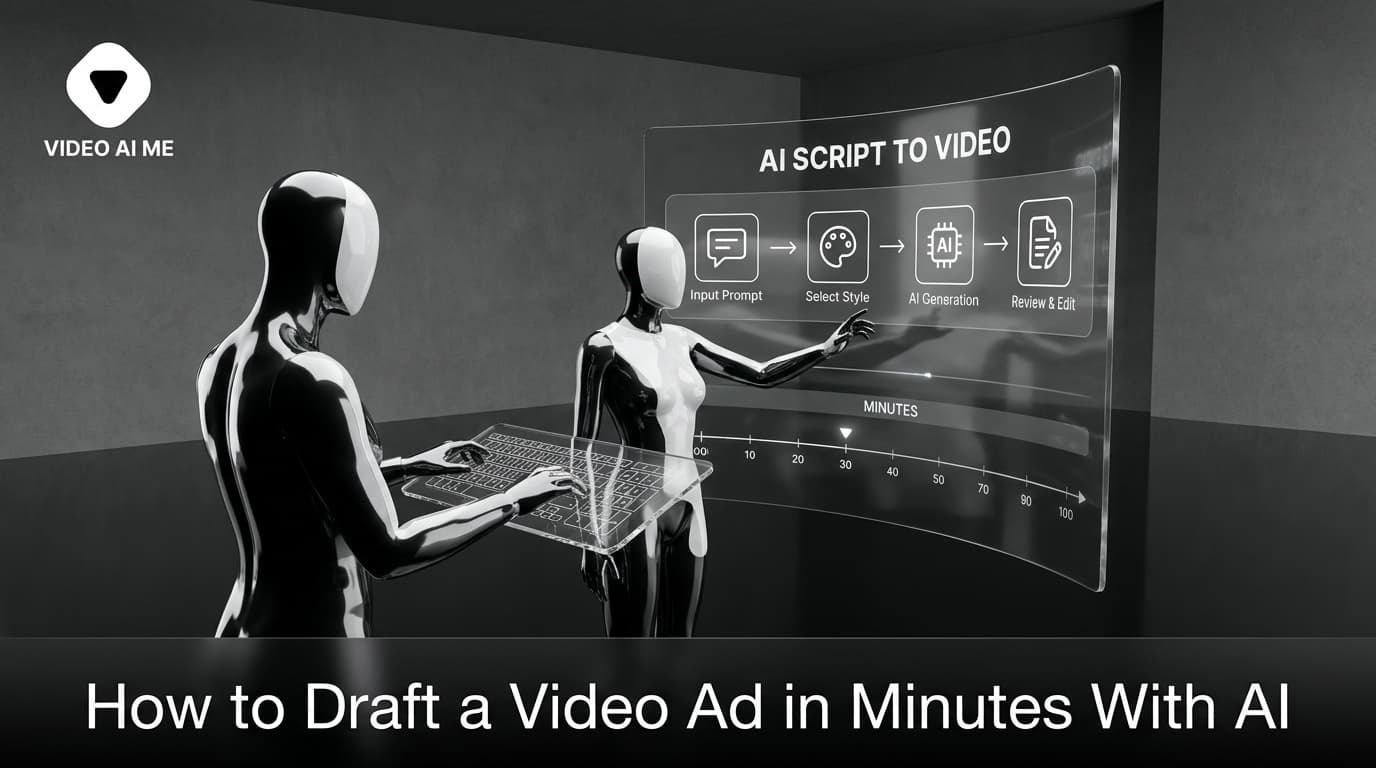
How to Draft a Video Ad in Minutes With AI
A repeatable routine for going from a product page to six testable video ad drafts in one sitting, using a fast model and single variable rewrites.
How Many Video Ad Variations Should You Test?
How many creatives a test actually needs, how different they have to be, and why the right number is set by what you can afford to produce.