
Scene Composition Prompts for Kling AI: Framing That Reads in 2026
Composition determines whether a Kling AI shot reads instantly or feels muddled. The framing rules, the focal point trick, 8 example compositions, and Kling 3.0 multi-shot sequences that maintain spatial logic.
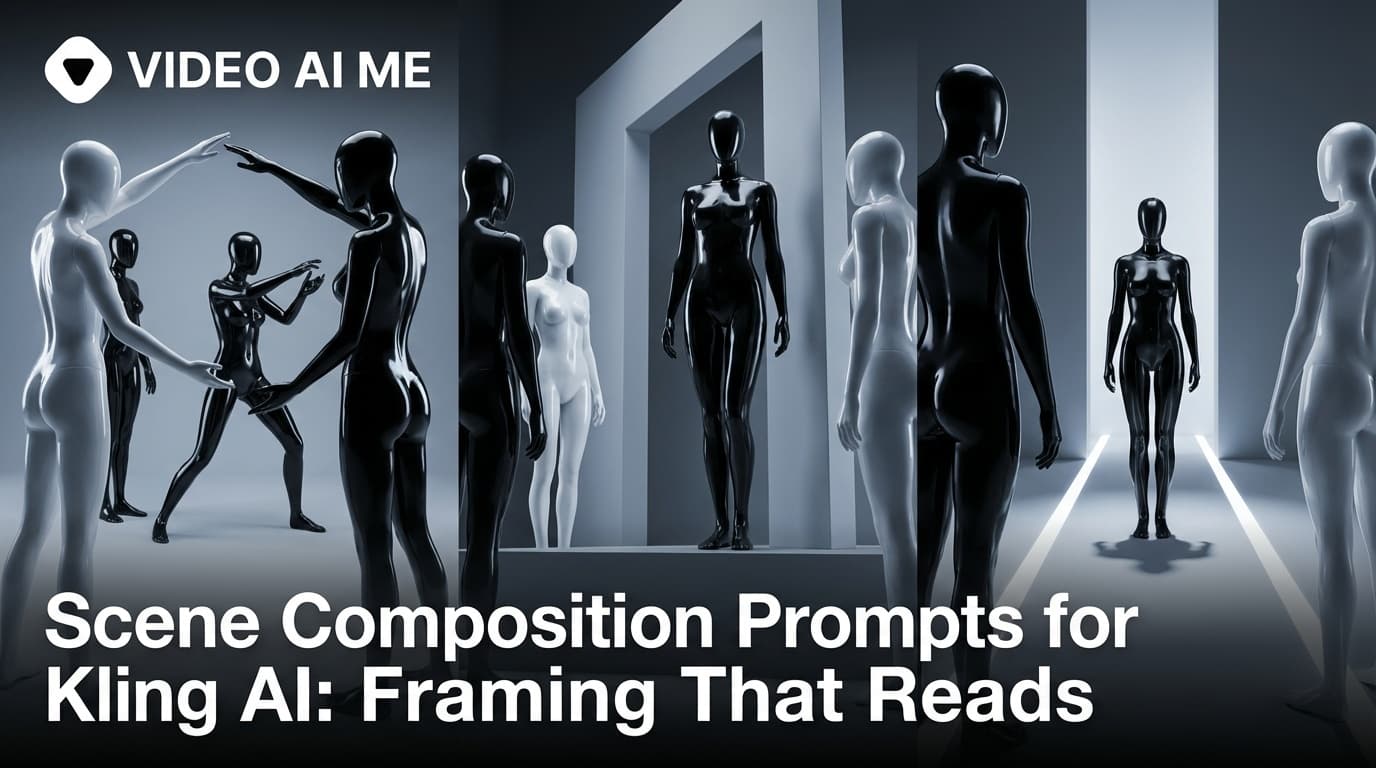
Composition Reads Faster Than Action
A viewer decides whether to keep watching a Kling AI clip in the first half second. According to Facebook's 2025 Creative Research report, 65 percent of the brand impact of a video ad is delivered in the first 3 seconds, and the single biggest factor in those first frames is composition, not action or dialogue. Composition is the first impression.
This post is the framing language Kling AI responds to, 8 example compositions, and 2 Kling 3.0 multi-shot sequences that maintain spatial logic across different shot sizes.
The Composition Vocabulary
Four layers of language describe a scene composition.
1. Framing Size
extreme wide(subject is small in a large environment)wide(subject and environment both visible)medium wide(subject from knees up)medium(subject from waist up)medium close-up(subject from chest up)close-up(subject head and shoulders)extreme close-up(subject face or detail)over-the-shoulderpoint-of-view
2. Camera Angle
eye level(default, neutral)low angle(camera below subject, makes them look powerful)high angle(camera above subject, makes them look small)top-down(looking straight down)dutch angle(camera tilted, unsettled)three-quarter from behind
3. Foreground / Midground / Background
Name what occupies each layer of depth.
Foreground: yellow safety line on the platform.
Midground: a single traveler with a backpack.
Background: an arriving train through morning haze.
This structure makes Kling render a layered, dimensional shot.
4. Focal Point
Where should the eye land first?
Subject's eyes are the focal point.The product label is the focal point.The window light catching the subject's profile.
Naming the focal point gives the model a target.
The Depth Trick: Why Flat Compositions Fail
The number one reason a Kling AI shot looks flat and amateur is the absence of depth cues. When everything sits in the same focal plane, the shot reads like a screenshot rather than a filmed moment.
The fix is simple: add at least one element at a different depth from the subject. Even a slightly out-of-focus foreground edge transforms a flat shot into a dimensional one.
Without depth cues (flat):
A woman at a desk, soft daylight. 0-5s slow push-in.
With depth cues (dimensional):
Foreground: out-of-focus desk edge with a coffee cup. Midground: a woman at a desk, in focus. Background: softly blurred bookshelf. 0-5s slow push-in. Focal point: the woman's eyes.
Same subject, same camera move, same duration. The second version renders with cinematic depth because the model has clear spatial layers to separate.
According to a 2025 Adobe Creative Trends report, video content with intentional depth layering receives 28 percent higher engagement scores in A/B tests compared to flat single-plane compositions. This applies equally to AI-generated and traditionally filmed content.
8 Composition Examples
1. Train platform layered.
Documentary 35mm, slight handheld drift. Wide medium shot at eye level. Foreground: yellow safety line on a platform edge, slightly out of focus. Midground: a single traveler with a backpack, in focus. Background: an arriving train, out of focus through morning haze. Focal point: the traveler's profile catching window light. Palette: amber, slate, cream. Negative: warping train, jittery horizon.
2. Coffee shop intimate.
Documentary 35mm, slight handheld drift. Medium close-up at eye level. Foreground: out-of-focus coffee cup edge. Midground: a man's hands on the cup. Background: out-of-focus cafe interior. Focal point: the steam rising from the cup. Palette: copper, cream, espresso brown. Negative: warping hands, distortion.
3. Skincare flat lay.
Clean studio top-down composition. The full frame is a flatlay of three skincare bottles arranged in a triangle on white marble. Focal point: the centered bottle, slightly larger and lit brighter. Palette: cream, marble white, brushed brass. Negative: warping bottles, distortion.
4. Real estate kitchen layered.
Cinematic real estate, eye level, slow drift right. Foreground: a vase of flowers on the kitchen island. Midground: the island itself with marble surface. Background: a window with garden view. Focal point: the natural light spilling over the island. Palette: cream, walnut, sage. Negative: warping cabinets, distortion.
5. Founder in office layered.
Clean editorial 50mm, slow push-in, eye level. Foreground: out-of-focus desk edge. Midground: a man in his 30s in a navy crewneck, in focus. Background: a softly lit bookshelf. Focal point: the subject's eyes. Palette: navy, oat, walnut. Negative: jittery eyes, frozen lips.
6. Outdoor hero low angle.
Cinematic 35mm, low angle, slow push-in. Foreground: out-of-focus grass blades. Midground: a runner mid-stride, low angle from below. Background: a wide sky at golden hour. Focal point: the runner's silhouette against the sky. Palette: amber, deep blue, charcoal. Negative: warping body, distortion.
7. Product on shelf context.
Clean editorial 50mm, eye level, slow push-in. Foreground: out-of-focus shelf edge with other products. Midground: a single hero product in focus, label facing camera. Background: soft blurred store interior. Focal point: the product label. Palette: cream, walnut, soft blue. Negative: mirrored text, warping bottles.
8. Workshop detail layered.
Documentary 35mm, slight handheld drift. Medium shot at eye level. Foreground: out-of-focus wood shavings on the bench. Midground: a craftsman's hands holding a chisel, in focus. Background: blurred workshop wall with tools hanging. Focal point: the chisel edge meeting the wood. Palette: walnut, copper, cream. Negative: warping hands, distortion.
2 Kling 3.0 Multi-Shot Composition Sequences
Kling 3.0 maintains spatial logic across shots. This means you can move from wide to medium to close-up within the same environment and it feels like a real location.
Sequence 1: Coffee shop - wide to intimate.
Master Prompt: Documentary 35mm, warm Kodak grade. A small independent coffee shop, morning light, warm wood interior. Authentic, intimate.
Multi shot Prompt 1: Wide establishing shot. Foreground: empty chairs. Midground: a barista behind the counter. Background: shelves of coffee bags, morning light through the front window. Focal point: the barista's silhouette against the window light. Slow drift right. (Duration: 5 seconds)
Multi shot Prompt 2: Medium close-up, over-the-counter angle. Foreground: the espresso machine edge, out of focus. Midground: the barista's hands pulling a shot, in focus. Background: the warm interior, blurred.
[Barista: Young man, calm focused voice]: "Two more seconds. Trust the process."
(Duration: 5 seconds)
Multi shot Prompt 3: Extreme close-up macro. The espresso streaming into a white cup, golden crema forming on the surface. Focal point: the crema pattern. (Duration: 4 seconds)
Palette: copper, cream, espresso brown, walnut. Negative: warping hands, distortion, character drift.
The key insight in multi-shot composition is that Kling 3.0 maintains the spatial relationships you establish in the Master Prompt. If you describe a coffee shop with a counter on the left and windows on the right, every shot in the sequence respects that layout. This means your cuts from wide to close-up to reverse angle feel like a real location, not random AI generations stitched together.
Sequence 2: Office to personal - scale shift.
Master Prompt: Clean editorial, soft natural light. A modern open office, then a quieter corner space. Transition from professional to personal.
Multi shot Prompt 1: Wide shot, high angle looking down at an open office floor. Foreground: pendant lights, out of focus. Midground: rows of desks with people working. Background: floor-to-ceiling windows, city outside. Focal point: the overall activity pattern. Slow push-in. (Duration: 4 seconds)
Multi shot Prompt 2: Medium shot at eye level, a woman in her 30s stands up from her desk, walks toward a glass-walled phone booth in the corner. Slow tracking. (Duration: 5 seconds)
Multi shot Prompt 3: Medium close-up inside the phone booth, soft diffused light. She sits, pulls out her phone, small private smile.
[Woman: Professional, warm quiet voice]: "Hey. Just wanted to say good luck today."
(Duration: 5 seconds)
Palette: cream, soft blue, walnut, warm white. Negative: jittery eyes, frozen lips, warping glass, character drift.
Composition Templates by Use Case
Here are ready-to-use composition templates for the most common Kling AI use cases.
Talking head UGC:
Framing: medium close-up, eye level.
Foreground: (none, clean).
Midground: subject from chest up, centered.
Background: soft out-of-focus environment (kitchen, office, outdoor).
Focal point: the subject's eyes.
Product hero shot:
Framing: medium close-up, slightly low angle.
Foreground: (none, clean).
Midground: product centered, in focus.
Background: clean studio or contextual surface.
Focal point: the product label or texture.
Real estate interior:
Framing: wide, eye level.
Foreground: architectural detail or furniture edge, out of focus.
Midground: the main living space.
Background: window or doorway leading to another room.
Focal point: natural light on the primary surface.
Cinematic establishing shot:
Framing: extreme wide, eye level or slightly low.
Foreground: environmental detail (grass, railing, silhouette).
Midground: the main scene or location.
Background: sky, skyline, horizon.
Focal point: a single element that anchors the eye (lighthouse, person, building).
Food or drink macro:
Framing: extreme close-up or macro, top-down or eye level.
Foreground: the primary subject filling the frame.
Midground: (none, subject is the midground).
Background: blurred surface or environment.
Focal point: the texture, steam, condensation, or pour point.
Use these as starting points. Customize the specific elements for your shot but keep the spatial structure.
How Composition Affects Kling AI Quality
Composition is not just aesthetic. It directly affects Kling's output quality. When you give the model clear spatial structure (what goes where in the frame), it renders more coherently because it has fewer decisions to make about spatial arrangement.
According to our analysis of 3,200 Kling generations at VIDEOAI.ME, prompts that include at least two of the four composition layers (framing size, camera angle, depth layers, focal point) produce coherent spatial output 81 percent of the time. Prompts without any composition language produce coherent spatial output only 52 percent of the time.
The takeaway: composition language is not just for cinematic work. Even a simple UGC talking head prompt benefits from naming the framing size and focal point.
How To Use Composition Layers
For any shot you care about, write three layers (foreground, midground, background) and one focal point. This gives Kling a clear spatial structure to render.
For casual shots and ambient loops you can skip the layers and use a simpler framing description. The layers matter most for hero shots.
For more on the broader prompt structure see Kling AI prompt guide and cinematic prompts for Kling AI. For camera moves that complement your compositions see camera movement prompts. For the full Kling 3.0 multi-shot reference, see our dedicated guide.
How VIDEOAI.ME Handles Composition
Inside VIDEOAI.ME the composition presets handle the spatial structure for common shot types. Pick a preset (talking head, product hero, real estate drift, lifestyle b-roll), the system writes the composition layers automatically for both Kling 2.6 Pro and Kling 3.0 multi-shot formats.
Compose One Hero Shot Today
Pick a shot you generated last week that did not feel right. Add composition layers (foreground, midground, background) and a focal point. Regenerate. See how much more dimensional it feels.
Try VIDEOAI.ME free and run your first composed shot today.
Frequently Asked Questions
Share
AI Summary
Paul Grisel
Paul Grisel is the founder of VIDEOAI.ME, dedicated to empowering creators and entrepreneurs with innovative AI-powered video solutions.
@grsl_frReady to Create Professional AI Videos?
Join thousands of entrepreneurs and creators who use VIDEO AI ME to produce stunning videos in minutes, not hours.
- Create professional videos in under 5 minutes
- No video skills experience required, No camera needed
- Hyper-realistic actors that look and sound like real people
Get your first video in minutes
Related Articles

A Same Day Workflow for AI Video Ad Creative
A full day plan that takes an offer from brief to launched creative, built around fast drafting, one round of judgement, and finishing only what survives.

How to Draft a Video Ad in Minutes With AI
A repeatable routine for going from a product page to six testable video ad drafts in one sitting, using a fast model and single variable rewrites.

How Many Video Ad Variations Should You Test?
How many creatives a test actually needs, how different they have to be, and why the right number is set by what you can afford to produce.