
The Ethics of the Korean Baseball AI Fan Cam Trend
The Korean baseball AI ethics debate covers consent, deepfakes, beauty standards and disclosure law. Where the trend stops being fun and starts harming people.
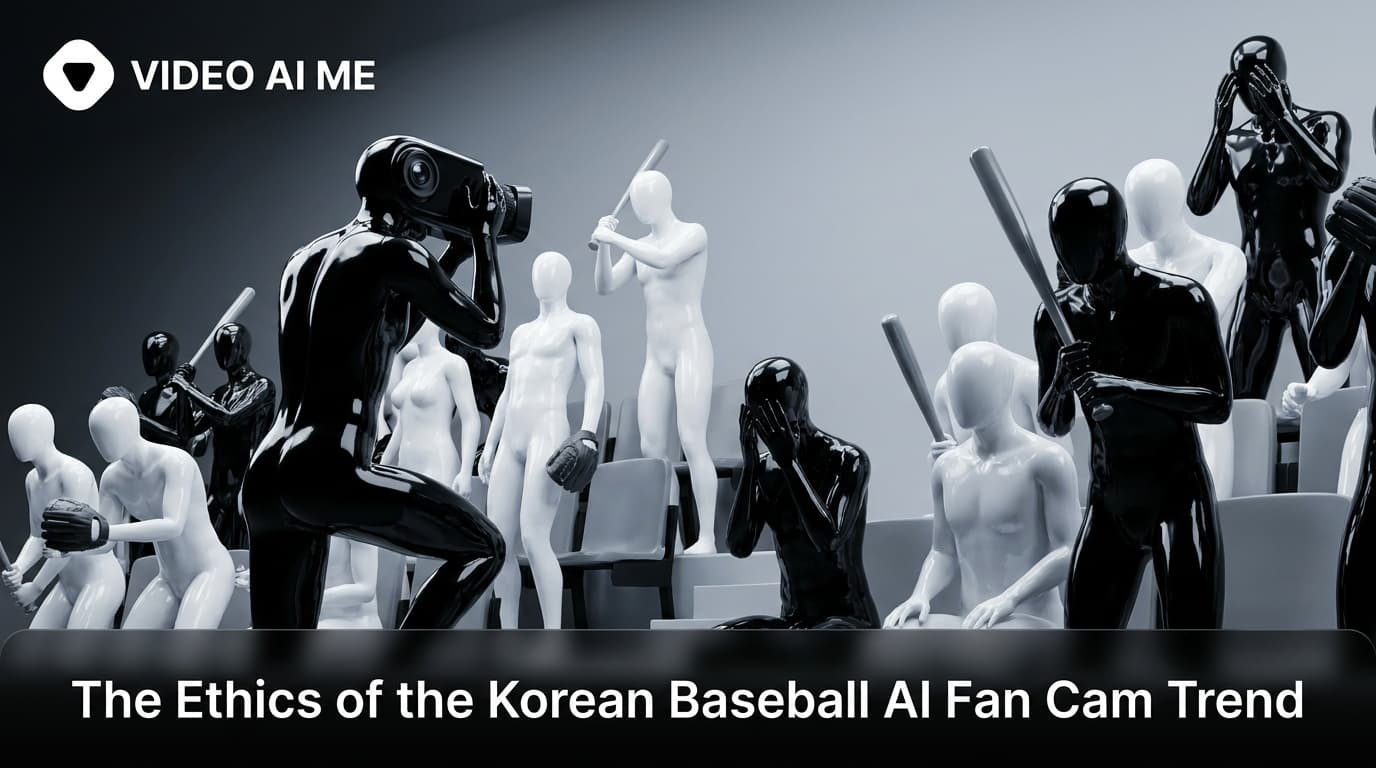
Where the Trend Stops Being Harmless
The AI Korean baseball trend is fun for most of its participants. A clip of yourself fake-spotlighted at a KBO game is closer to a creative selfie filter than to anything criminal. That is the version of the trend most people see.
Underneath that surface sits a serious ethical conversation about consent, deepfakes, beauty standards and the legal status of synthetic media. The Stadium Goddess hoax cracked the surface open. Korean media has been writing about the implications ever since. This post lays out the ethics in plain terms and offers a practical framework creators can use to stay on the right side of the line.
The Consent Problem
The simplest ethical question is consent. Whose face is in the clip?
When creators use their own face, the consent question is settled. They have agreed to be in the video they made.
When creators use a fully AI-generated face that does not correspond to any real person, the consent question is mostly settled. There is no real subject whose rights are being overridden, though there are still secondary questions about whose training data shaped the model.
When creators use a real person's face without that person's permission, the consent question is not settled. It is violated. This is the legal and ethical gray zone that has drawn most of the criticism.
Documented cases already exist. Korean media reported on a fake clip of celebrity Maeng Seung-ji depicting unsportsmanlike behavior at a baseball stadium she had not visited. The clip was AI, but it briefly damaged her reputation before being identified. The harm was real even when the footage was not.
The Deepfake Definition
The word deepfake gets used loosely. For this trend, a useful working definition: a deepfake is any synthetic clip designed to depict a real person doing or saying something they did not do, often in a way that could mislead viewers about real events.
Under that definition, most AI Korean baseball trend clips are not deepfakes. They feature the creator's own face or an obviously fictional AI face, and they do not claim to document real events. They are synthetic media but not deceptive synthetic media.
A minority of clips do meet the deepfake threshold. The Maeng Seung-ji clip is one example. Any clip that places a real person in a real situation they were not part of, without disclosure, also qualifies. These are the clips that have driven calls for stronger regulation.
We walk through how to spot the difference in the real vs AI fan cam guide.
The Disclosure Question
South Korea's AI Basic Act, in force since January 2026, requires synthetic media to carry disclosure labels. The intent is sound. AI-generated content should be marked so viewers can calibrate trust.
The enforcement is uneven. The law primarily targets companies that build AI models, not individual users. A creator who runs a Kling or Sora workflow on a personal laptop and uploads to Instagram operates outside the law's main enforcement path. The Stadium Goddess clip, for example, would arguably have required disclosure under a stricter reading of the law, but the clip's uploader faced no direct legal consequence.
The gap matters because disclosure is the single cheapest way to keep the trend ethical. A caption that says "AI generated" or a watermark that says the same costs the creator nothing and changes how the clip lands with viewers. We recommend disclosure as a default, not as an afterthought.
The Beauty Standards Question
Korean broadcast culture has long featured the beauty cut tradition, in which camera operators deliberately favor conventionally attractive young women for spectator cutaway shots. The practice has been criticized by Korean commentators for reinforcing narrow beauty standards.
The AI Korean baseball trend largely inherits that pattern. Most viral clips feature young women in similar outfits, similar poses and similar aesthetic frameworks. The format imitates the underlying broadcast tradition with unsettling fidelity, beauty norms included.
There are two reactions to this. The first is to say the trend is just reflecting an existing cultural template and is not creating new harm. The second is to say the trend amplifies an existing harm because anyone can now generate beauty-cut content at scale without the friction of real broadcasts. Both positions have merit.
What creators can control is their own output. The trend includes plenty of room for variations that push against the dominant aesthetic. Older subjects. Diverse body types. Different styles. Different sports. The format does not have to reinforce narrow norms unless creators choose to keep doing so. For more on the audience side of this, see the women audience analysis.
The Verification Crisis
The Stadium Goddess clip exposed a bigger problem than the trend itself.
Professor Lee Jae-sung of Chung-Ang University, quoted in The Korea Times, made the point bluntly. Many people still believed that if something was captured on video, it must be real. AI video has now ended that assumption.
The practical consequence is that fact-checking now has to extend to sports cutaways, casual social posts, and any clip that looks broadcast-real. The Korea Times argued that logical data errors, like impossible player matchups on a fake scoreboard, are now the most reliable detection method, because visual artifacts can no longer be trusted.
That shift is significant. It changes how journalists work, how courts treat video evidence, and how viewers should approach every clip in their feeds. The KBO fan cam trend was the format that made the shift visible to the general public.
A Practical Ethical Framework for Creators
If you want to participate in the AI Korean baseball trend without contributing to the harms, the framework is short.
Rule one: only use your own face or a clearly fictional AI face. Do not generate clips of real people who have not consented. This single rule eliminates most of the documented harm cases.
Rule two: disclose that the clip is AI. Use a caption, a watermark, or an on-screen text overlay. Disclosure costs nothing and helps your audience calibrate trust.
Rule three: do not imply real events. Avoid using real player names, real team matchups, real stadium signage or real broadcaster logos in ways that suggest the clip is a real broadcast. The trend works as obviously playful synthetic media. It does not need to pretend to be real to land.
Rule four: avoid reinforcing narrow beauty norms when you can. Feature diverse subjects, ages, body types and styles. The format has more range than the dominant output suggests.
Following these rules keeps the trend on the playful side of the line.
Building Ethically and Building Long-Term
This is where the ethics conversation converges with the personal branding conversation. The creators who will have the strongest long-term audiences out of this trend are the ones who treat ethics as a feature, not a constraint.
Disclosure builds trust. Trust compounds. Audiences that know your clips are AI but trust your editorial voice will follow you across formats. Audiences that catch you in an undisclosed fake will not.
Do not stop at this trend. Use it as a chance to set the tone for everything you publish over the next year. A consistent AI actor, a recognizable voice, a transparent labeling practice and a publishing rhythm that respects your audience. That combination outperforms any one viral clip.
How VIDEO AI ME Fits Into Ethical AI Video Work
VIDEO AI ME is built around the AI actor model, which sits naturally inside the ethical framework above. You create a fictional AI actor once, control its appearance and voice, and use it across every future video. There is no need to pull in real people's likenesses without consent because the actor is yours.
Dual-format output in 16:9 and 9:16 from a single generation means you can publish to TikTok, Reels, Shorts and YouTube horizontal without re-rendering. The actor can speak any language, which expands your reach without expanding your ethical exposure.
For creators thinking past the AI Korean baseball trend toward a longer-term content business, that is the workflow that holds up under scrutiny.
What Happens Next
Expect regulatory tightening. The Korean AI Basic Act will likely be amended to address the individual-creator gap. Other jurisdictions will pass similar measures. Platforms will roll out their own disclosure requirements.
Expect detection tools to improve. The visual-artifact era of detection is closing. The logical-error era is currently working. The next era will likely involve cryptographic provenance signatures embedded at generation time. Creators who get ahead of disclosure norms now will not be caught off guard.
Expect the cultural conversation to mature. The KBO fan cam trend will not be the last format that raises consent and beauty standards questions at the same time. Creators who think through both early will be better positioned for the next format.
Try It on a Workflow Built for Ethical Use
Try a free generation on VIDEO AI ME and see whether an AI-actor workflow fits how you want to work. The trend is hot. The ethical line is real. The creators who handle both well are the ones whose audiences will still be there in 2027.
Frequently Asked Questions
Share
AI Summary

Paul Grisel
Paul Grisel is the founder of VIDEOAI.ME, dedicated to empowering creators and entrepreneurs with innovative AI-powered video solutions.
@grsl_frReady to Create Professional AI Videos?
Join thousands of entrepreneurs and creators who use VIDEO AI ME to produce stunning videos in minutes, not hours.
- Create professional videos in under 5 minutes
- No video skills experience required, No camera needed
- Hyper-realistic actors that look and sound like real people
Get your first video in minutes
Related Articles
MiniMax H3 UGC Prompt Templates for Ad Creative
Reusable UGC prompt templates with the variables marked, so you can produce a whole batch of creator style ads by swapping four fields.
Seedance 2.5 UGC Prompt Templates for Ads
Six fill in the blank UGC prompt templates for Seedance 2.5, each with a fully filled worked example, plus how to direct dialogue when the audio is generated.
How to Make AI UGC Videos With Seedance 2.5
A five step playbook for creator style UGC clips with Seedance 2.5: casting, prompts that carry the spoken hook, reference images for batches, and the credit math.