
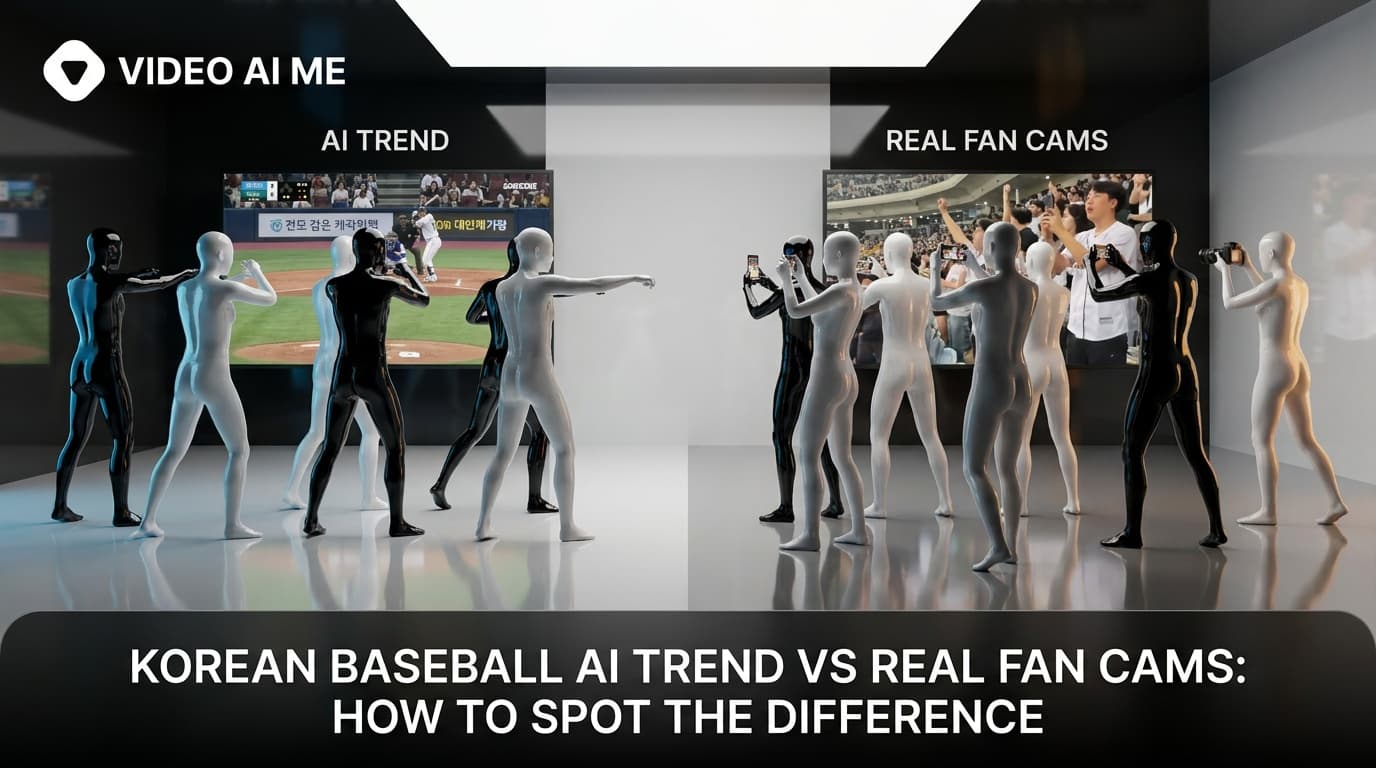
Korean Baseball AI Trend vs Real Fan Cams: How to Spot the Difference
Real vs AI Korean baseball fan cam: a practical detection checklist covering scoreboard tells, banner text, smartphone shapes, lighting and audio cues.
Why This Guide Matters
The Stadium Goddess clip cleared 8 million views before anyone realized it was AI. The detection moment did not come from a forensic tool. It came from a baseball fan who noticed the scoreboard listed a retired player. That single observation changed how the internet processes the AI Korean baseball trend.
This guide walks through how to tell real KBO fan cams from AI-generated ones, in order from easiest to hardest. Whether you are a journalist, a working creator, or just trying not to get fooled in your feed, the checklist below covers what works in May 2026.
The First Question: Why Are You Watching This?
Before any technical check, ask the editorial question. Why is this clip in your feed?
Real KBO fan cam moments rarely go viral outside Korea. The biggest broadcast cutaways usually reach 100,000 to 500,000 views across Korean social platforms and stay there. If you are seeing a Korean baseball fan cam pushed by the algorithm in a country that does not regularly engage with KBO, the clip is most likely AI-generated content built for international virality.
This is not a guarantee. Some real fan cam clips do reach global audiences through K-pop adjacent crossover communities. But the editorial check is the cheapest first screen.
The Scoreboard Test
The single highest-yield AI detection technique for the KBO fan cam trend is the scoreboard test.
Real KBO broadcasts display accurate scoreboards with correct team names, real player names, valid pitcher-batter matchups, plausible scores, and a current date. AI-generated clips often fail at one or more of these.
The Stadium Goddess clip listed pitcher Kim Seo-hyun against batter Jo In-sung. Jo retired in 2017 and never played for Doosan. That single impossibility was enough to detonate the entire hoax.
If you suspect a clip is AI, pause and zoom on the scoreboard graphic. Look for:
- Player names that combine wrongly across teams
- Players who have retired or never played
- Dates that do not match the supposed game
- Stats that are mathematically impossible
- Fonts that vary across the same graphic
- Korean text that contains nonsense characters
Any one of these is suspicious. Two together is conclusive. This is the gold standard detection method in 2026.
The Banner Text Test
AI image and video models continue to struggle with text rendering. Real broadcasts feature sharp banner text, brand logos, sponsor graphics and team mascot designs. AI versions often produce subtly warped letters, inconsistent line weights or invented words.
Look at the boundary edges of the frame. The ad boards behind the seats. The signage above the dugout. The mascot logos on caps and shirts. If anything looks slightly off, lean into the suspicion. Compare against real KBO broadcast screenshots on the league's official social accounts if you want a ground truth.
The Smartphone Test
This is the favorite detection tool of working AI investigators in 2026.
Generative video models render small handheld objects with subtle geometric warping. Phones in particular are a frequent failure mode. Cases look slightly wrong. Screens display nonsense. Hands grip the phones at angles that do not quite work. The Stadium Goddess clip had warped smartphone shapes that several Korean media outlets pointed out as a confirming tell.
In a real stadium clip, half a dozen people in any cutaway are usually holding phones. Check several of them. If multiple phones in the same frame look slightly off, you are almost certainly looking at AI.
The Skin and Hair Test
Real broadcast cameras produce compression noise, slight motion blur and uneven skin texture under stadium lighting. AI clips often produce skin that looks too smooth and hair that flows too uniformly, especially in the central subject.
This test is less reliable than it used to be. AI models have improved at adding noise back into the output deliberately. But it still catches a meaningful fraction of clips. Compare the central subject against the background crowd. If the central subject's skin looks softer and cleaner than the people sitting next to them, that asymmetry is a tell.
The Lighting Test
Real stadium lighting is messy. Light comes from overhead floods, side-lit ad boards, jumbotron screens and other sources. Shadows on faces and clothes reflect that messiness.
AI clips often render lighting that is too uniform. The central subject's face is lit cleanly, while background figures share less coherent shadows. Look for shadow direction consistency. If the central subject's shadow points one way while every nearby person's shadow points another way, suspect AI.
The Audio Test
Mute the clip. Then unmute it.
Real KBO broadcasts have layered audio. Stadium crowd noise with discrete cheers, slight reverb off concrete surfaces, a Korean commentator voice over the broadcast feed, and incidental noise from nearby vendors or fans. AI clips often use generic crowd loops with no specific cheers, no commentator audio, and no stadium reverb.
If the audio feels generic, detached or oddly clean, that is a signal. Real broadcasts are messy. Clean audio over a stadium clip is suspicious.
The Motion Test
Real broadcast cameras have a specific motion signature. Slight handshake from operator movement, occasional zoom adjustments, slight focus pulls. AI clips often produce motion that is too smooth.
Watch the clip frame by frame if you can. If the camera move feels unnaturally steady, or if the subject's motion has a slight floating quality, that is a tell. Real broadcast motion is more chaotic than AI motion. For now.
The Date and Context Cross-Reference
If the clip claims to be from a real recent game, cross-reference. Check the KBO schedule for the supposed date. Check the supposed team matchup. Check the broadcasters covering that game. Korean media is fast and thorough. A real viral moment will usually have multiple sources confirming the same details within hours.
A clip with no corroborating coverage from any Korean outlet, no real player names that match the broadcast schedule, and no plausible event context is almost certainly AI.
For the full trend context, see our timeline of the AI Korean baseball trend.
A Practical Detection Checklist
Here is the working checklist condensed into something you can run in under a minute.
- Editorial check. Why is this in my feed? Does the path make sense?
- Scoreboard. Players, scores, dates and fonts all plausible?
- Banner text. Sharp letters, real sponsors, no warped logos?
- Smartphones. Phones in the frame look normal?
- Skin and hair. Central subject matches the texture of the background crowd?
- Lighting. Shadow directions consistent across the frame?
- Audio. Crowd noise layered, reverb present, commentator audible?
- Motion. Camera motion feels operator-driven rather than uniform?
- Date cross-reference. Real KBO schedule confirms the supposed game?
If the clip fails three or more checks, treat it as AI. If it fails one or two, verify before resharing. If it passes all nine, you are probably looking at a real broadcast moment, though even that is not guaranteed forever.
What This Means If You Make AI Content
The detection checklist above is also a creator checklist in reverse. If you want your AI Korean baseball trend clip to land cleanly without misleading anyone, the opposite advice applies. Disclose openly. Do not use real player names. Do not depict real game dates. Do not mimic real broadcaster logos. The format works perfectly well as obviously synthetic media that does not pretend to be a real moment.
For more on the ethical framing, see the ethics breakdown.
The Workflow That Stays on the Right Side
If you are building AI video as a personal brand engine, the cleanest setup uses an AI actor that is clearly fictional, ships in 16:9 and 9:16 from a single generation, and is paired with consistent disclosure. That combination keeps your work ethical, keeps you in your audience's trust, and gives you a reusable asset for future formats.
VIDEO AI ME is built for that kind of workflow. The AI actor model means you are not piggybacking on real people's likenesses. Dual-format output means you can publish across TikTok, Reels, Shorts and YouTube horizontal from the same source. Any language voice gives you reach without compromising consent.
Beyond Spotting Fakes
This trend is the first time most viewers have had to seriously consider whether the video in front of them is real. It will not be the last. The skill of running a fast detection checklist on suspect content is going to matter more every year.
The same skill applies in reverse. Creators who understand what makes AI clips detectable can build cleaner, more transparent work that earns audience trust. Both sides of the line benefit from the same education.
Do not stop at this trend. Use it as a training ground for the next ten formats. Build the detection muscle if you are a viewer. Build the consistent AI actor and disclosure habit if you are a creator. Either way, the lessons compound.
Try the Creator Side Yourself
Try a free generation on VIDEO AI ME and build an AI actor that is clearly yours, openly synthetic and dual-format ready. The Stadium Goddess clip fooled millions for two days. With the right workflow, your AI actor can earn audience trust for years.
Frequently Asked Questions
Share
AI Summary

Paul Grisel
Paul Grisel is the founder of VIDEOAI.ME, dedicated to empowering creators and entrepreneurs with innovative AI-powered video solutions.
@grsl_frReady to Create Professional AI Videos?
Join thousands of entrepreneurs and creators who use VIDEO AI ME to produce stunning videos in minutes, not hours.
- Create professional videos in under 5 minutes
- No video skills experience required, No camera needed
- Hyper-realistic actors that look and sound like real people
Get your first video in minutes
Related Articles
MiniMax H3 UGC Prompt Templates for Ad Creative
Reusable UGC prompt templates with the variables marked, so you can produce a whole batch of creator style ads by swapping four fields.
Seedance 2.5 UGC Prompt Templates for Ads
Six fill in the blank UGC prompt templates for Seedance 2.5, each with a fully filled worked example, plus how to direct dialogue when the audio is generated.
How to Make AI UGC Videos With Seedance 2.5
A five step playbook for creator style UGC clips with Seedance 2.5: casting, prompts that carry the spoken hook, reference images for batches, and the credit math.