
Multilingual KBO Prompts: Make Your AI Actor Speak Korean, English, Spanish or Japanese
How to write a multilingual AI Korean baseball prompt that makes your AI actor speak Korean, English, Spanish or Japanese without losing identity.
The AI Korean baseball trend started silent. Stadium Goddess didn't say anything, she just sat there looking at the field. That worked for the first wave because the visual was strong enough to carry the clip on its own.
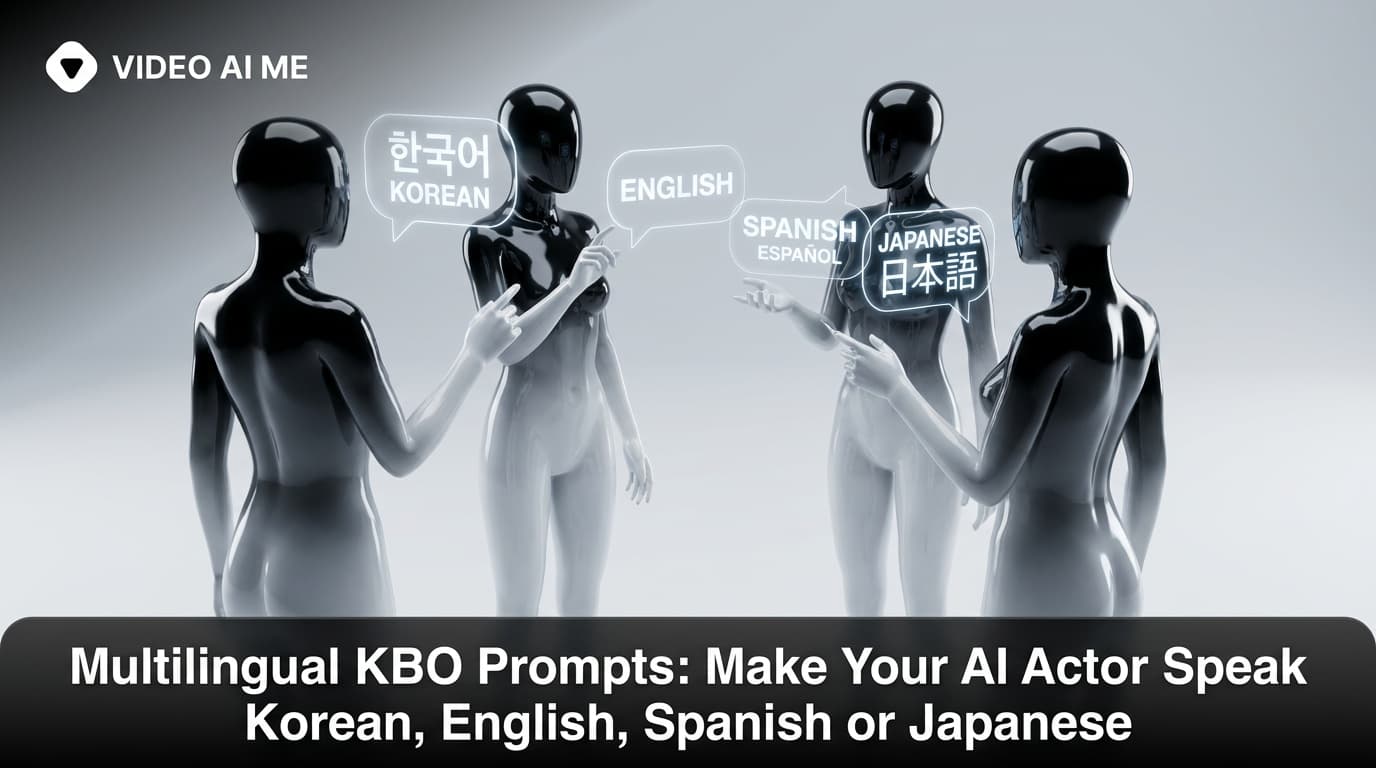
The second wave is different. The clips that are pulling the biggest numbers now have the spectator speaking - a one-line reaction, a whispered comment, a half-laugh into the camera. And the smart creators are recording those one-liners in multiple languages so the same clip can ship to Korea, the US, Latin America, and Japan in the same week.
This is exactly where VIDEO AI ME's custom AI actor changes the math. You write the prompt once, swap the language parameter, and ship four versions of the same clip with one workflow.
Why Multilingual AI Korean Baseball Prompts Matter Now
KBO is a Korean league, but the AI fan-cam trend went global immediately. Stadium Goddess hit 8 million views and the comments were in 15 languages. The Maeng Seung-ji clip that sparked the AI verification debate trended in Spanish and Japanese before Korean media even covered it.
That global reach is a once-in-a-trend opportunity. Creators who lean into multilingual content right now grab audience share in markets that have not yet saturated. By the time English-only creators catch on, the Spanish and Japanese feeds are already locked up.
Four languages cover roughly 80% of the global fan base for this trend:
- Korean: home market, native authenticity.
- English: US, UK, Australia, global default.
- Spanish: Latin America, Spain, US Hispanic market.
- Japanese: Japan, where KBO is already followed and the cultural overlap is high.
Now let's write the prompt that ships all four.
The Master Multilingual AI Korean Baseball Prompt
This is the canonical template. The image and motion blocks are identical across languages. Only the dialogue block changes. Swap the variables in square brackets.
Aspect ratio: 16:9 and 9:16 dual output.
Language parameter: [LANGUAGE = Korean / English / Spanish / Japanese].

Identity anchor: use the uploaded reference photo. The subject
must look identical to the source image across all language
versions. Voice characteristics (timbre, age, pitch) must remain
consistent across languages.

Wardrobe: clean white [TEAM] jersey worn open over a fitted
cream tank top, simple silver hoop earrings.

Props: iced Americano in a clear plastic cup, orange cheering
stick.

Environment: [STADIUM] at night, lower bowl behind first base,
dense KBO crowd, stadium floodlights, sixth-inning energy.

Camera: KBO live broadcast capture, 400mm telephoto, off-center
right-third framing, head-to-chest, micro handheld drift,
faint motion blur on background crowd.

Broadcast overlay: KBO scoreboard upper-left, SPOTV watermark
upper-right, lower-third graphic with player name and stat.

Dialogue (sound-on): [DIALOGUE IN LANGUAGE], one to two short
sentences, conversational tone, slight whisper as if commenting
to a friend, lip movement matched to the chosen language.

Subtitle overlay: [LANGUAGE] subtitle pinned to the lower-third,
white text with a thin black stroke, 32pt equivalent, max two
lines.

Realism rules: no AI beauty filter, no enlarged eyes, no
smoothed skin, visible pores, slight sweat sheen, broadcast
compression noise.
Variables: LANGUAGE, TEAM, STADIUM, DIALOGUE.
Dialogue Blocks by Language
Keep it short. One to two sentences. The shorter the line, the more believable the lip sync.
Korean dialogue example:
Dialogue: "어, 카메라 잡혔어? 진짜?" (Oh, the camera caught me?
Really?), spoken in a casual conversational tone, slight
surprise, half-laugh at the end.
English dialogue example:
Dialogue: "Oh wait, am I on the camera right now?", spoken
in a casual conversational tone, slight surprise, half-laugh
at the end.
Spanish dialogue example:
Dialogue: "Espera, me esta grabando la camara?" (Wait, the
camera is recording me?), spoken in a casual conversational
tone, slight surprise, half-laugh at the end.
Japanese dialogue example:
Dialogue: "えっ、カメラに映ってる?" (Eh, am I on camera?),
spoken in a casual conversational tone, slight surprise,
half-laugh at the end.
The lip-sync stays believable because all four lines are short and the mouth shapes converge on the same surprise-then-laugh sequence.
Why One Workflow, Four Languages Beats Four Workflows
Most creators try to do this with four separate generations across two or three tools. Generate the image in one place. Voiceover in another. Sync in a third. Render. Repeat for each language.
That is four rounds of identity drift. Your face changes a little each generation. Your voice changes a lot. By the time you have four language versions, they look and sound like four different people pretending to be the same person.
VIDEO AI ME collapses that into one workflow. The custom AI actor locks face and voice across all four language renders, so the Korean version, the English version, the Spanish version, and the Japanese version all look and sound like the same person. The only thing that changes is the dialogue and the subtitle.
Template 1: The Surprised-On-Camera Reaction (Four Languages)
The simplest one-line moment. Works in all four languages with the same motion.
16:9 and 9:16 dual output.
Language: [Korean / English / Spanish / Japanese].

Identity anchor: source photo.

Wardrobe: clean white Hanwha Eagles jersey, cream tank, hoops.

Props: iced Americano, orange cheering stick.

Environment: Jamsil at night, lower bowl, dense crowd.

Camera: KBO broadcast capture, 400mm telephoto, right-third.

Broadcast overlay: scoreboard upper-left, SPOTV upper-right.

Dialogue: short one-line surprise reaction in [LANGUAGE].

Subtitle: matching language pinned to lower-third.

Realism rules: pores, sweat sheen, compression noise, no
beauty filter.
Motion: notices the camera, mouth opens slightly, says the line, half-laughs.
Template 2: The Quiet Whisper to a Friend
Low energy, intimate. Great for the algorithm because viewers lean in.
16:9 and 9:16 dual output.
Language: [Korean / English / Spanish / Japanese].

Identity anchor: source photo.

Wardrobe: oversized navy LG Twins jersey over a black tee.

Props: paper cup of beer in both hands.

Environment: Jamsil premium seats, pitching change, soft
warm light.

Camera: KBO broadcast capture, 600mm telephoto, very shallow
depth of field, left-third placement.

Broadcast overlay: pitching change graphic, scoreboard upper-
left.

Dialogue: a whispered comment in [LANGUAGE], not directed at
the camera, like a side remark to a friend off-frame.

Subtitle: matching language, lower-third.

Realism rules: catchlight in the eyes, soft skin texture, no
smoothing.
Motion: leans toward the off-frame friend, whispers the line, glances back at the field.
Template 3: The Hype Cheer in Local Language
High energy, cheering, language-specific.
16:9 and 9:16 dual output.
Language: [Korean / English / Spanish / Japanese].

Identity anchor: source photo.

Wardrobe: red Lotte Giants jersey, red headband.

Props: two cheering sticks held overhead.

Environment: Sajik outfield bleachers, cheer section, wave
cresting.

Camera: KBO broadcast capture, 200mm wider telephoto, central
framing, head-to-waist.

Broadcast overlay: home-run banner across the bottom, KBO
logo upper-right.

Dialogue: a short cheer or hype line in [LANGUAGE].

Subtitle: matching language, lower-third.

Realism rules: motion blur on the sticks, real sweat, slight
squint, no glamour.
Motion: mid-chant, sticks crash overhead, shouts the line, sticks back up, half-laugh.
Try the Multilingual Workflow on VIDEO AI ME
If you want to test all four language versions with one face, one voice, one wardrobe, VIDEO AI ME is the only tool that runs the whole stack in one workflow. Custom AI actor locks identity. Voice cloning carries across languages. Dual 16:9 and 9:16 output ships to YouTube and TikTok in the same generation. One run, four markets.
Voice Casting Notes
A few small things matter across languages:
- Pitch consistency: keep the same vocal range across all four languages. Don't let the Korean version be high-pitched and the English version drop into a lower register. That kills the same-person illusion.
- Cadence: Korean and Japanese cadence is faster than Spanish and English in casual speech. Match the cadence to the language so the delivery sounds native.
- Emotional register: surprise reads differently across languages. Korean surprise is often softer and shorter. Spanish surprise is more exclaimed. English is somewhere in the middle. Japanese is closest to Korean. Calibrate the dialogue accordingly.
- Subtitle timing: subtitles should appear half a beat before the dialogue starts and disappear half a beat after it ends. That matches the viewer's reading cadence on sound-off platforms.
How to Roll Out Four Languages Strategically
Don't post all four versions at once. Stagger them by 24-48 hours and post each to the geographically appropriate feed at peak hours for that market.
- Korean version: post first, between 9-11 PM KST. Native audience, highest authenticity premium.
- English version: 24 hours later, 8-10 PM EST. US, UK, Australia simultaneously.
- Spanish version: 48 hours later, 9-11 PM CET or 8-10 PM Mexico City. Spain and Latin America.
- Japanese version: 72 hours later, 8-10 PM JST. Japan only, lowest competition for the trend.
This pattern gives each version 24-48 hours of clean algorithmic exposure before the next version starts cross-pollinating.
Build the Multilingual Engine, Not the Single Clip
A single language version is a clip. A four-language coordinated drop is a content engine. Run all three templates above in all four languages and you have a 12-clip drop from one identity anchor and one prompt structure. That is two weeks of content from one afternoon of work.
For more on the prompt mechanics, see our step-by-step prompt-writing guide.
Try a free generation on VIDEO AI ME and ship your first multilingual KBO clip today.
Frequently Asked Questions
Share
AI Summary

Paul Grisel
Paul Grisel is the founder of VIDEOAI.ME, dedicated to empowering creators and entrepreneurs with innovative AI-powered video solutions.
@grsl_frReady to Create Professional AI Videos?
Join thousands of entrepreneurs and creators who use VIDEO AI ME to produce stunning videos in minutes, not hours.
- Create professional videos in under 5 minutes
- No video skills experience required, No camera needed
- Hyper-realistic actors that look and sound like real people
Get your first video in minutes
Related Articles
MiniMax H3 UGC Prompt Templates for Ad Creative
Reusable UGC prompt templates with the variables marked, so you can produce a whole batch of creator style ads by swapping four fields.
Seedance 2.5 UGC Prompt Templates for Ads
Six fill in the blank UGC prompt templates for Seedance 2.5, each with a fully filled worked example, plus how to direct dialogue when the audio is generated.
How to Make AI UGC Videos With Seedance 2.5
A five step playbook for creator style UGC clips with Seedance 2.5: casting, prompts that carry the spoken hook, reference images for batches, and the credit math.