
Music Artist Ads: UGC Creatives That Turn $500 Into 100K Monthly Streams
Independent artists are buying fake streams while smart musicians use UGC ads that build real fanbases. Here's the framework for organic growth through paid promotion.
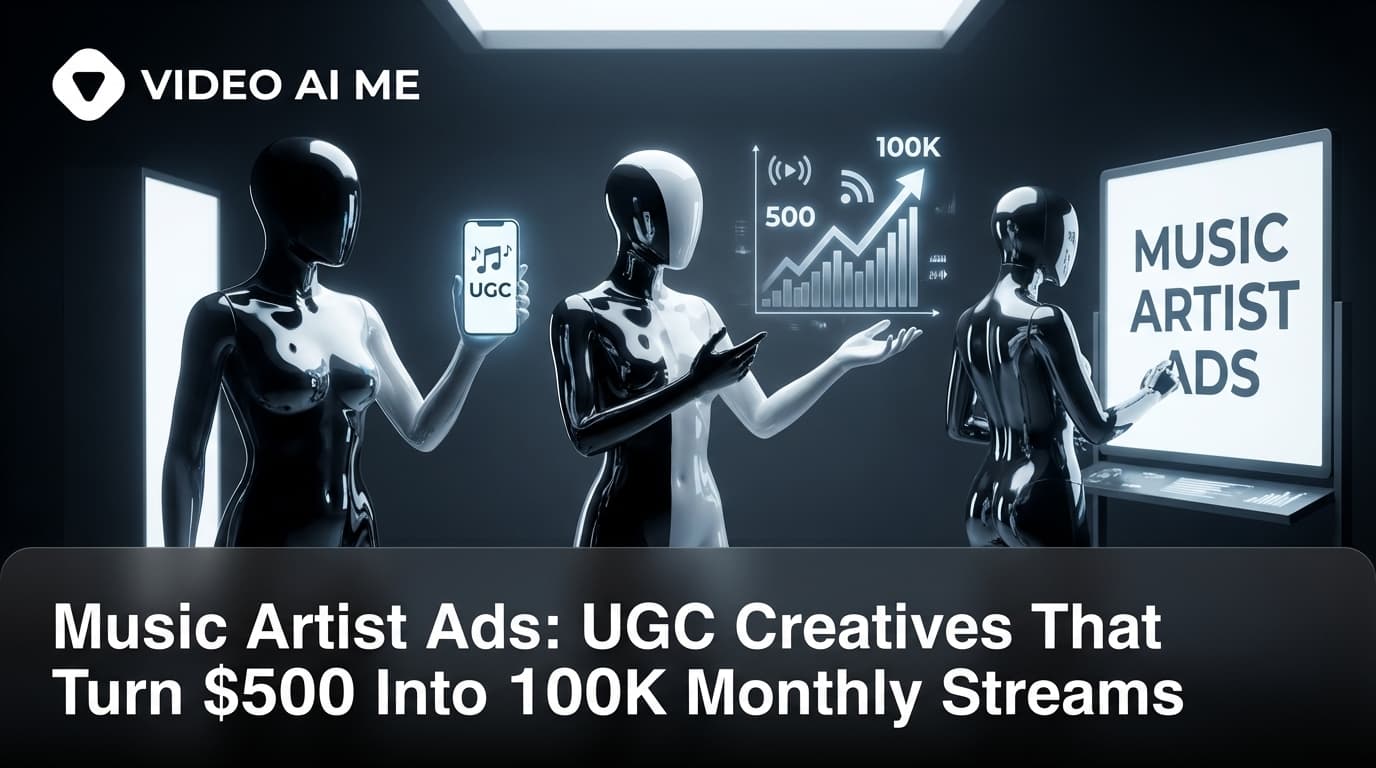
Every day, 100,000 tracks get uploaded to Spotify. Most disappear into the void with 47 streams from the artist's family. The standard advice? "Just keep posting on TikTok!" But you've been posting for months with nothing to show for it.
Meanwhile, independent artists with half your talent are hitting 100K monthly listeners because they cracked the promotion code. Not through playlist pitching. Not through buying fake streams. Through strategic UGC advertising that builds real fans who save, share, and return.
This framework shows how independent artists are turning $500 ad budgets into sustainable streaming growth.
Why Traditional Music Promotion Fails
The music industry gives artists terrible promotion advice:
What artists are told to do:
- Post consistently on TikTok (algorithm lottery)
- Pitch to playlist curators (gatekeepers with inbox overload)
- Submit to blogs (nobody reads music blogs anymore)
- Buy playlist placements (fake streams, algorithm penalties)
- Spam Instagram stories (annoying your existing followers)
The results:
- Hours of content creation with zero listener growth
- Rejection from curators who don't care about unknown artists
- Money wasted on fake streams that hurt algorithmic standing
- Burning out your small existing fanbase with constant self-promotion
According to Spotify's 2024 creator data, over 10 million artists are on the platform. Fewer than 1% earn meaningful income. The artists breaking through aren't working harder on the same broken playbook. They're running a different play entirely.
The UGC advertising shift:
| Traditional Promotion | UGC Advertising |
|---|---|
| Hope for viral TikTok | Control reach with ad budget |
| Beg playlist curators | Build direct fan relationships |
| Spam existing followers | Reach new audiences |
| Passive waiting | Proactive fan acquisition |
| Unpredictable results | Measurable growth metrics |
The Music Artist UGC Framework
This framework treats fan acquisition like e-commerce customer acquisition: targeted content, paid amplification, measurable results.
The Content Types That Convert Listeners to Fans
Type 1: Discovery Moment Content
This content mimics the experience of a friend sharing a song they just found. It's the most powerful format because it triggers the "social discovery" instinct.
Script Template: "The 2AM Discovery"
[0-2 sec] "Okay but this song has no business being this good..."
[2-8 sec] [Song clip plays with visible emotion/reaction]
[8-15 sec] "I found this at 2am and haven't stopped listening. It's by [Artist Name] and it's called [Song Name]."
[15-22 sec] "The way the [specific element: lyrics/beat/vocals/production] hits... [specific lyric or moment reference]"
[22-28 sec] "They only have [number] monthly listeners which is criminal. Go save this."
[28-32 sec] [Song continues as audio]
What makes this work:
- Feels like organic recommendation, not promotion
- Specificity about what makes the song good
- Social proof element (low listener count = undiscovered gem)
- Clear call to action (save)
Type 2: Emotional Context Content
This type creates an emotional scenario where the song fits perfectly, helping listeners imagine themselves connecting with the music.
Script Template: "The Perfect Moment Song"
[0-3 sec] "When you need a song for [specific emotional moment]..."
[3-10 sec] [Song clip plays]
[10-18 sec] "This is [Song Name] by [Artist]. I've had it on repeat for [timeframe]."
[18-25 sec] "It's perfect for [2-3 specific scenarios/moods]. The [specific element] just [emotional description]."
[25-30 sec] "Link in bio to save it."
Example scenarios to build content around:
- "When you're driving at night and need to feel something"
- "When you're getting ready to go out but haven't left the sad era yet"
- "When the main character energy hits"
- "When you need to cry but the tears won't come"
Type 3: Lyric/Moment Highlight Content
Focus on a specific lyric or moment that creates an emotional hook.
Script Template: "This Lyric Though"
[0-2 sec] "Wait for this lyric..."
[2-10 sec] [Song builds to the specific lyric]
[10-15 sec] [React to the lyric landing]
[15-22 sec] "That line gets me every time. '[Repeat the lyric]'"
[22-28 sec] "[Artist Name] really said [brief interpretation]. Go listen to the whole thing."
[28-32 sec] [Song continues]
Creating Music UGC at Scale
The challenge: you need constant content to maintain ad performance, but you can't film reaction videos 24/7.
The Content Stack Strategy
Layer 1: Artist-Created Content (20%)
Raw, authentic content from the artist:
- Behind-the-scenes creation clips
- Personal stories about the song's meaning
- Acoustic/stripped performances
- Direct address to new listeners
This content builds personal connection and should anchor your promotion.
Layer 2: Fan-Style UGC (60%)
Content that feels like fan reactions:
- Discovery moment reactions
- Emotional context scenarios
- Lyric highlights
- "POV" style content
Use VIDEOAI.ME to create AI presenters who deliver fan-reaction style scripts. This lets you test unlimited angles without coordinating with creators.
Layer 3: Trend-Adjacent Content (20%)
Content that ties into current TikTok trends using your music:
- Trending sounds adaptations
- Format mashups
- Challenge-style content
- Meme templates with your track
This content has viral potential but shorter shelf life.
Production Process
For a single release:
- Week before release: Create 5-10 UGC pieces using varied hooks
- Release day: Launch ads with all variations
- Days 1-3: Identify top performers (best hook rate + save rate)
- Days 4-14: Scale winners, cut losers, create new variations of winning angles
- Days 15-28: Maintain steady promotion, add retargeting
- Ongoing: Use proven formats for future releases
Platform Strategy for Music UGC
TikTok
TikTok is the discovery platform. It's where new fans find you.
TikTok Creative Specs:
- 9:16 vertical only
- 15-30 seconds optimal
- Hook in first 1-2 seconds mandatory
- Music starts within first 3 seconds
- Native TikTok captions
TikTok Targeting:
Interest-based:
- Similar artists' fan pages
- Music genre interests
- Music discovery behaviors
Lookalike:
- Based on Spotify followers (if you can pixel your profile link)
- Based on past ad engagers
Campaign Structure:
- Objective: Video views or profile visits
- Start with $20-50/day
- Let it run 3-5 days before making changes
- Scale winners to $100+/day
TikTok Success Metrics:
- Hook rate: 50%+ (3-second views)
- View rate: 15%+ (full video)
- Profile visits: High indicates interest
- Sound uses: Organic amplification
Meta (Facebook/Instagram)
Meta is for retargeting and reaching demographics that aren't on TikTok.
Meta Creative Specs:
- 9:16 for Stories/Reels
- 1:1 for Feed (shows album art better)
- Captions always
- Link to Spotify/Apple Music landing page
Meta Targeting:
Cold:
- Music interests matching your genre
- Similar artist fans
- Concert-goers in your genre
- Age demographics matching your sound
Retargeting:
- TikTok profile visitors (if pixel set up)
- Website visitors
- Instagram engagers
- Video viewers from previous ads
Budget Split:
- 60% TikTok for discovery
- 40% Meta for retargeting and conversion
YouTube
YouTube works for longer-form content and reaching older demographics.
YouTube Content Types:
- Music video ads
- Lyric video snippets
- Commentary/story videos
- Live performance clips
YouTube is slower growth but builds deeper fan relationships. Secondary priority to TikTok/Meta.
Measuring Music UGC Performance
Streams are a vanity metric. Real fans take actions that matter more.
The Metrics Hierarchy
Tier 1: Fan Actions (Most Important)
- Saves (indicates intention to re-listen)
- Playlist adds (integrating into their life)
- Follows (wanting future releases)
Tier 2: Engagement Metrics
- Listen time (full song vs. skip)
- Profile visits (curiosity about the artist)
- Monthly listener retention
Tier 3: Reach Metrics
- Total streams
- Unique listeners
- Impressions/views
Target Benchmarks:
| Metric | Good | Great | Exceptional |
|---|---|---|---|
| Cost per save | Under $1 | Under $0.50 | Under $0.25 |
| Save rate | 10%+ | 20%+ | 30%+ |
| Ad hook rate | 40%+ | 55%+ | 70%+ |
| Week 2 retention | 30%+ | 50%+ | 70%+ |
Avoiding Vanity Metrics
Streams without saves = wrong audience
If you're getting cheap streams but no saves, the ad is reaching people who listen once and forget. Adjust targeting or creative to find listeners who connect deeply rather than skip after 30 seconds.
High view rate + low profile visits = weak hook for the artist
People like the content but aren't curious about the artist. Make the artist more present in the content or clearer about who they are.
Common Music Promotion Mistakes
Mistake 1: Buying Playlist Placements
The problem: Paid playlist placements often use bot listeners or disinterested audiences.
Why it fails: Spotify's algorithm detects fake streams. Low save rates and skip rates signal low quality. Your song gets pushed down, not up.
The fix: Build real fans through UGC ads who save, add to personal playlists, and listen repeatedly.
Mistake 2: Generic "New Music" Ads
The problem: "Check out my new single [Song Name]! Link in bio."
Why it fails: Zero emotional hook. No reason for a stranger to care. Feels like every other artist's desperate plea.
The fix: Create content that provides value or emotional connection first, with the song as the payoff.
Mistake 3: Promoting Too Many Songs
The problem: Spreading $500 across 10 tracks hoping one hits.
Why it fails: No single track gets enough push to trigger algorithmic momentum. All promotion is wasted.
The fix: Focus budget on 1-2 tracks with highest potential. Let those build audience for your whole catalog.
Mistake 4: Ignoring Retargeting
The problem: All budget on cold traffic, no follow-up with interested listeners.
Why it fails: Someone who watched your video once might need 3-4 touches to actually save your song.
The fix: Allocate 30-40% budget to retargeting video viewers and profile visitors with different content angles.
Mistake 5: Expecting Overnight Success
The problem: Running ads for one week, seeing no viral moment, giving up.
Why it fails: Fan building is cumulative. Consistent promotion over months creates compound growth.
The fix: Plan for 3-6 month campaigns. Track incremental growth, not viral moments. Celebrate 1,000 real fans over 100,000 bot streams.
Your Music UGC Action Plan
Week 1: Pre-Release
- Choose your lead single (strongest hook, broadest appeal)
- Write 5 UGC scripts using the templates above
- Create variations with VIDEOAI.ME and self-recorded content
- Set up conversion tracking (Spotify artist link, profile visits)
Week 2: Release
- Launch TikTok ads with all variations ($30-50/day)
- Launch Meta retargeting campaign ($20/day)
- Monitor metrics daily
- Document top-performing hooks
Week 3-4: Optimize
- Kill underperforming ads (below benchmarks)
- Scale winners (increase budget 20-30%)
- Create new variations of winning angles
- Expand targeting if audience performs well
Month 2-3: Scale
- Maintain promotion at sustainable budget
- Test new content formats
- Build email list from engaged followers
- Prepare next release using learned insights
Ready to build a real fanbase for your music?
Related Reading
Frequently Asked Questions
Do UGC ads actually work for music promotion?
Yes, UGC ads outperform traditional music ads because they feel like organic recommendations rather than promotional content. The key is creating content that sounds like a fan sharing a discovery, not an artist promoting themselves. Authentic UGC generates real saves and playlist adds, not just streams.
How much should independent artists spend on ads?
Start with $300-500 per single release. Scale to $1,000-2,000 for songs gaining traction. Focus budget on the first 2-4 weeks after release when algorithmic momentum matters most. Better to spend heavily on one track than spread thin across many.
What platform is best for music UGC ads?
TikTok for discovery and virality, Meta for retargeting and older demographics. Run both. TikTok drives initial discovery; Meta converts interested listeners into followers and repeat streamers. YouTube works for longer-form content but slower growth.
Should artists show their face in promotional content?
Yes, but not in every piece. Mix artist-facing content with fan-reaction style UGC. AI presenters can represent the 'fan sharing a discovery' angle, letting you test hooks without filming yourself constantly. The artist's personality should shine through in some content.
How do I measure if music ads are working?
Track saves (not just streams), follower growth, and playlist adds. Saves indicate real fan interest. If you're getting streams but no saves, the ad is reaching the wrong audience. Cost per save under $1 is the target. Monthly listener retention week-over-week shows true growth.
What type of UGC works best for music?
Reaction-style content ('found this song at 2am'), story-driven content ('this song describes exactly how I felt'), and trend-adjacent content using your track. Pure 'check out my song' doesn't work. The content needs to create emotional context for why someone should care.
Can I promote music without showing the artist?
Yes, AI presenters and voiceover content work well for music promotion. Create 'fan reaction' style UGC using AI presenters who share the song as a discovery. This lets you test multiple angles without constantly filming yourself or coordinating with creators.
How long until I see results from music UGC ads?
Initial data within 3-5 days (hook rates, save rates). Meaningful growth within 2-4 weeks if content is working. Algorithmic momentum (Spotify editorial, TikTok viral) takes longer and isn't guaranteed. Consistent quality promotion over 3-6 months builds sustainable fanbase.
Frequently Asked Questions
Share
AI Summary

VIDEOAI.ME
AI-powered video creation platform helping independent artists create promotional content that builds real fanbases.
@videoaimeReady to Create Professional AI Videos?
Join thousands of entrepreneurs and creators who use VIDEO AI ME to produce stunning videos in minutes, not hours.
- Create professional videos in under 5 minutes
- No video skills experience required, No camera needed
- Hyper-realistic actors that look and sound like real people
Get your first video in minutes
Related Articles
What Is MiniMax H3? The Video Model Explained
MiniMax H3 is a multimodal video model that turns a written brief into a short clip with synchronised sound. Here is what it does, what it does not, and who it suits.
A Same Day Workflow for AI Video Ad Creative
A full day plan that takes an offer from brief to launched creative, built around fast drafting, one round of judgement, and finishing only what survives.
How to Run MiniMax H3 Without a GPU
MiniMax H3 has public weights, so people try to self host it. Here is what that actually costs in hardware and time, and the browser route if you just want the clips.