
Event Ads: UGC Creatives That Sell Conference Tickets Before Early Bird Ends
Empty seats at your event? Learn the UGC ad framework that fills conferences and workshops by turning FOMO into ticket sales.
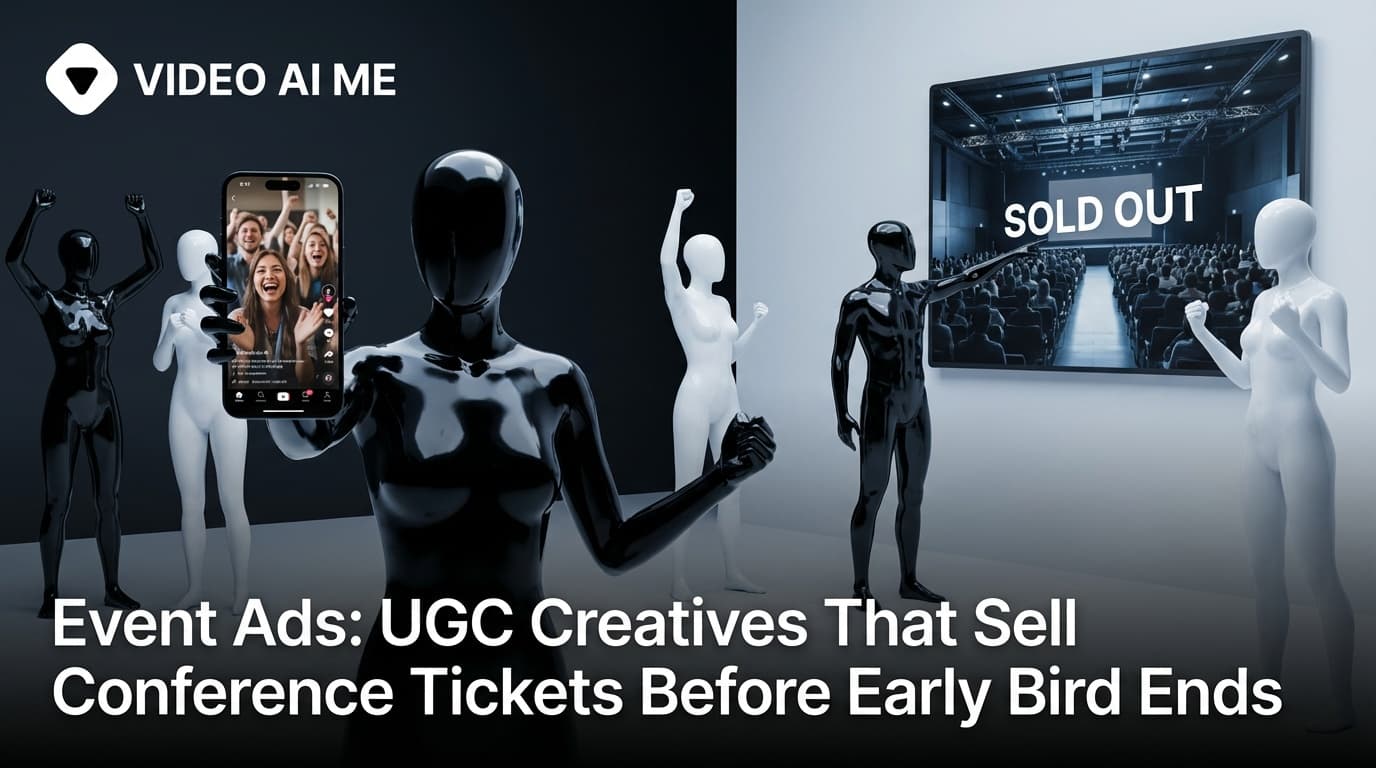
Your conference is in 10 weeks. You've sold 47 tickets. The venue holds 500. The math is terrifying.
You've posted about it constantly on social media. You've sent emails until your list started ignoring you. Speakers are promoting to their audiences with minimal results. Early bird pricing ends in two weeks, and panic is setting in.
Here's what's really happening: people want to attend. They're just not convinced yet. They need to see that others are going, that the experience will be worth their time and money, and that waiting might mean missing out.
The events selling out use UGC ads that create genuine FOMO and social proof. Here's the framework that fills seats.
Why Traditional Event Marketing Fails
The standard event promotion playbook doesn't work anymore:
What event organizers do:
- Post speaker announcements on social media
- Send email blasts to their list
- Create fancy promotional videos
- Rely on speakers to promote
- Offer increasingly desperate discounts
The results:
- Same people see repeated posts
- Email opens decline with each send
- Polished videos feel like ads
- Speakers post once and forget
- Discounts train audience to wait
According to Eventbrite's 2024 Event Trends Report, 67% of ticket sales happen in the final two weeks before an event. This creates cash flow nightmares and planning chaos. The events with healthy early sales share a common factor: social proof marketing through UGC.
The social proof difference:
| Traditional Event Marketing | UGC Event Marketing |
|---|---|
| "Register now for our conference" | "I just got my ticket, here's why I'm excited" |
| Speaker headshots and bios | Attendees sharing why they're going |
| Professional promo video | Raw testimonials from past events |
| Generic venue photos | Energy and community captured on video |
| Discount urgency | Real scarcity and FOMO |
The Event UGC Framework
This framework creates the social proof and urgency that drives ticket sales at every stage of promotion.
The Timeline-Based Content Strategy
Events have distinct promotional phases, each requiring different UGC approaches.
Phase 1: Awareness (12-16 Weeks Out)
Goal: Introduce the event and plant seeds of interest
Content Type: "Announcement Excitement"
[0-3 sec] "Just announced: [Event Name] is happening [Date/Location]!"
[3-12 sec] "This is the event for [specific audience]. [Notable speaker or feature] is keynoting. Plus [second compelling element]."
[12-20 sec] "I've been waiting for something like this. Finally an event that [specific value proposition]."
[20-26 sec] "Early bird tickets are available now. I already grabbed mine."
[26-30 sec] "Link in bio. See you there?"
Phase 2: Early Bird Push (8-12 Weeks Out)
Goal: Drive early bird sales with urgency and social proof
Content Type: "Already Registered" Social Proof
[0-3 sec] "Okay, I officially have my ticket to [Event Name]..."
[3-12 sec] "Here's why I'm going: [Specific reason 1], [specific reason 2], and honestly, [specific reason 3] alone is worth the ticket price."
[12-20 sec] "Early bird ends [date]. The difference is [price difference]. If you're thinking about it, don't wait."
[20-26 sec] "I've already connected with [number] others who are going. The networking starts before the event."
[26-30 sec] "Link in bio. We should meet up."
Phase 3: Momentum Building (4-8 Weeks Out)
Goal: Show momentum and community forming
Content Type: "Who Else Is Going" Community
[0-3 sec] "The [Event Name] attendee list is getting insane..."
[3-12 sec] "[Notable attendee type/company] just announced they're coming. Add that to [previous notable names] and [category of attendees]."
[12-20 sec] "This is turning into the can't-miss event for [industry/niche]. The conversations happening are going to be [benefit]."
[20-26 sec] "Tickets are [percentage] sold. If you're on the fence, now's the time."
[26-30 sec] "See you in [location]?"
Phase 4: Final Push (1-4 Weeks Out)
Goal: Create urgency and capture late deciders
Content Type: "Last Chance" Urgency
[0-3 sec] "[Number] tickets left for [Event Name]. That's it."
[3-10 sec] "I've been to a lot of events in [industry]. This lineup is different. [Specific compelling element]."
[10-18 sec] "If you're still deciding, here's what you're weighing: [cost] versus [specific value you'll receive]."
[18-26 sec] "The people attending are [description of attendees]. The room is going to be [energy description]."
[26-30 sec] "Link in bio. See you in [days] days."
The Three Content Types for Event UGC
Beyond the timeline approach, these content categories fill your ad rotation:
Type 1: Past Attendee Testimonials
The most powerful content for returning events. Real attendees sharing real experiences.
Script Template: "What I Got From Last Year"
[0-3 sec] "I went to [Event Name] last year, and honestly..."
[3-12 sec] "[Specific positive experience]. I met [outcome or connection made]. I learned [specific takeaway]."
[12-20 sec] "The part that surprised me: [unexpected benefit]. I wasn't expecting [specific element]."
[20-26 sec] "I already have my ticket for this year. If you're in [industry/niche], this is the one to go to."
[26-30 sec] "Link in bio."
Type 2: Speaker/Agenda Highlights
Content that showcases the value of specific sessions or speakers.
Script Template: "Why I'm Excited About [Speaker]"
[0-3 sec] "[Speaker Name] is speaking at [Event]. This is huge."
[3-12 sec] "If you don't know them: [brief credibility statement]. They [notable accomplishment or insight]."
[12-20 sec] "They're talking about [session topic]. This is exactly what [audience type] needs to hear right now because [relevance statement]."
[20-26 sec] "This session alone is worth the ticket. Plus everything else on the agenda."
[26-30 sec] "See you there?"
Type 3: Behind-the-Scenes Anticipation
Content that builds excitement through exclusivity and insider access.
Script Template: "Just Saw the Venue/Agenda/Plan"
[0-3 sec] "Just got a look at [behind-the-scenes element] for [Event Name]..."
[3-12 sec] "[Exciting detail]. They're also [second exciting detail]. This is not going to be a typical [event type]."
[12-20 sec] "The attention to detail on [specific element] shows they actually care about [attendee experience aspect]."
[20-26 sec] "I've been to enough disappointing events. This isn't going to be one of them."
[26-30 sec] "Tickets: link in bio."
Creating Event UGC at Scale
Events have promotional windows that require consistent content. Here's how to maintain output.
For New Events (No Past Footage)
Use AI presenters and anticipation content:
Content sources:
- AI presenters sharing speaker highlights
- AI presenters expressing excitement about topics
- Behind-the-scenes peeks (venue tours, planning process)
- Organizer-facing content sharing vision
VIDEOAI.ME applications:
- Generate multiple presenters with different demographics
- Test different hooks for same event value prop
- Create platform-specific variations
- Scale ticket-deadline urgency messages
For Returning Events
Leverage past event content plus new material:
Content sources:
- Actual attendee testimonials (video from event)
- Highlights from past event
- Comparison content (this year even better because...)
- Updated attendee/speaker announcements
Production Schedule
Monthly (ongoing):
- Fresh content featuring new speakers/announcements
- AI variations of core messaging
- Platform-specific adaptations
Weekly (4-8 weeks out):
- Social proof updates
- Urgency milestone content
- New testimonials or reactions
Daily (final 2 weeks):
- Countdown content
- Final scarcity messages
- Last-chance urgency
Platform Strategy for Event Ads
Meta (Facebook/Instagram)
Meta offers powerful event-specific features and broad reach.
Meta Targeting:
Interest-based:
- Similar events and conferences
- Industry interests and publications
- Speaker fans
- Geographic (if local event)
Behavioral:
- Frequent event attendees
- Business travelers
- Professional development investors
Custom/Lookalike:
- Past attendees (email list)
- Website visitors
- Video viewers from earlier promotion
Creative Specs:
- 9:16 for Stories/Reels
- 1:1 for Feed
- Event dates visible in first 3 seconds
- Captions mandatory
LinkedIn is ideal for professional conferences and B2B events.
LinkedIn Strengths:
- Job title targeting
- Industry filtering
- Professional context
- Event features native to platform
LinkedIn Targeting:
- Job functions matching your audience
- Seniority levels appropriate for your event
- Industry categories
- Company size segments
TikTok
TikTok works for reaching younger audiences and creating viral FOMO.
TikTok Considerations:
- More casual, energetic content required
- Works best for lifestyle and creator events
- Can drive awareness that converts elsewhere
TikTok-Specific Hook:
"POV: You just realized [Event Name] is [weeks] away and you don't have a ticket yet..."
Measuring Event Ad Performance
Track metrics that connect to ticket revenue.
Primary Metrics
| Metric | Target | What It Tells You |
|---|---|---|
| Cost per ticket sale | 5-15% of ticket price | Acquisition efficiency |
| ROAS | 3x+ | Direct profitability |
| Click to purchase rate | 3-8% | Landing page effectiveness |
| Hook rate | 50%+ | Creative quality |
Funnel Metrics
| Metric | Target | What It Tells You |
|---|---|---|
| Landing page conversion | 15-30% | Page effectiveness |
| Cart abandonment | Under 60% | Checkout friction |
| Retargeting conversion | 2x cold | Warm audience value |
Advanced Tracking
Attribution considerations:
- Multi-touch attribution for long consideration cycles
- Track assists, not just last-click
- Early exposure often influences late purchase
Lifetime value factors:
- Upsell purchases (VIP, workshops)
- Sponsor introductions from attendee data
- Repeat attendance in future years
Common Event Marketing Mistakes
Mistake 1: Waiting Too Long to Advertise
The problem: Starting ads 4 weeks before the event.
Why it fails: Not enough time to build awareness and consideration. Competing against established FOMO.
The fix: Start 12-16 weeks out. Early bird pricing should be a real incentive, not a panic response.
Mistake 2: Only Promoting Speakers
The problem: All content features speaker headshots and credentials.
Why it fails: Misses the full value proposition. Most attendees come for networking and overall experience.
The fix: Balance speaker content with community, networking, and experience content. The people attending matter as much as the people speaking.
Mistake 3: Generic Targeting
The problem: Targeting broad interests like "business" or "marketing."
Why it fails: Reaches people with vague interest but no intent to attend events.
The fix: Target people who attend similar events, follow relevant industry voices, and match the demographic of your ideal attendee.
Mistake 4: No Retargeting
The problem: All budget on cold traffic, no follow-up.
Why it fails: Event purchases are considered decisions. Multiple exposures drive conversions.
The fix: Allocate 30-40% to retargeting. Show different content to warm audiences who've engaged but not purchased.
Mistake 5: Fake Urgency
The problem: "Only 50 tickets left!" when you've sold 47.
Why it fails: Sophisticated audiences sense desperation. Damages trust.
The fix: Use real deadlines (early bird ends, hotel block expires, venue capacity). Real scarcity is compelling; manufactured scarcity backfires.
Your Event UGC Action Plan
12 Weeks Out:
- Create speaker and agenda highlight content
- Launch awareness campaigns ($30-50/day)
- Build anticipation through behind-the-scenes content
- Set up tracking for full-funnel attribution
8 Weeks Out:
- Push early bird messaging hard
- Create "already registered" social proof content
- Scale winning awareness content
- Add retargeting for site visitors
4 Weeks Out:
- Create momentum and attendee list content
- Increase budget as urgency grows
- Launch attendee testimonials (if returning event)
- Add final-deadline countdown content
Final 2 Weeks:
- Daily content updates
- Maximum budget on proven content
- Strong retargeting with urgency
- Last-chance messaging
Ready to fill your event with engaged attendees?
Related Reading
Frequently Asked Questions
Do UGC ads work for event promotion?
Yes, UGC is exceptionally effective for events because ticket purchases are highly influenced by social proof. Seeing real people excited about attending or sharing past experiences creates FOMO that drives purchases. Events are inherently social, and UGC captures that energy.
When should I start running event ads?
Start 12-16 weeks before the event with awareness content. Push hard 8-12 weeks out for early bird sales. Intensify 4-6 weeks out as urgency builds. Final push 1-2 weeks before with scarcity messaging. Different content for each phase.
What's a good cost per ticket sale for events?
Target 5-15% of ticket price as acquisition cost. A $500 conference can afford $50-75 per ticket acquisition. Higher-margin events (sponsorship revenue, upsells) can justify higher acquisition costs. Track full-funnel ROI including sponsorship and upsell value.
How do I create event UGC before my first event?
Use AI presenters to share what attendees will experience. Create anticipation content about speakers, topics, and networking opportunities. For subsequent events, capture testimonials and footage during the event for future promotion.
Should I promote speakers or the overall experience?
Both, strategically. Speaker-focused content attracts people specifically interested in that expert. Experience-focused content (networking, venue, community) attracts people seeking the overall event value. Test which angle resonates with your audience.
What platforms work best for event ads?
Meta (Facebook/Instagram) for broad reach and event targeting features. LinkedIn for professional conferences and B2B events. TikTok for younger audiences and lifestyle events. Use event-specific targeting (similar events, industry interests) on each platform.
How do I create urgency without being pushy?
Use real deadlines (early bird ends, limited seats, hotel block expiring) rather than fake scarcity. Show social proof of tickets selling. Highlight what they'll miss by waiting. Real urgency feels helpful, fake urgency feels manipulative.
Can I use AI presenters for event promotion?
Absolutely. AI presenters can share event details, express excitement about speakers and topics, and deliver testimonial-style content about anticipated value. Post-event, real testimonials from attendees work best, but AI can supplement for scale and testing.
Frequently Asked Questions
Share
AI Summary

VIDEOAI.ME
AI-powered video creation platform helping event organizers fill venues through authentic promotional content.
@videoaimeReady to Create Professional AI Videos?
Join thousands of entrepreneurs and creators who use VIDEO AI ME to produce stunning videos in minutes, not hours.
- Create professional videos in under 5 minutes
- No video skills experience required, No camera needed
- Hyper-realistic actors that look and sound like real people
Get your first video in minutes
Related Articles
What Is MiniMax H3? The Video Model Explained
MiniMax H3 is a multimodal video model that turns a written brief into a short clip with synchronised sound. Here is what it does, what it does not, and who it suits.
A Same Day Workflow for AI Video Ad Creative
A full day plan that takes an offer from brief to launched creative, built around fast drafting, one round of judgement, and finishing only what survives.
How to Run MiniMax H3 Without a GPU
MiniMax H3 has public weights, so people try to self host it. Here is what that actually costs in hardware and time, and the browser route if you just want the clips.