
Vox-Style vs UGC Ads: Which Converts in 2026?
Vox-style vs UGC ads: the editorial paper-collage explainer wins the how-it-works job, talking-head UGC wins trust. Here is when to use each, and how to test both.
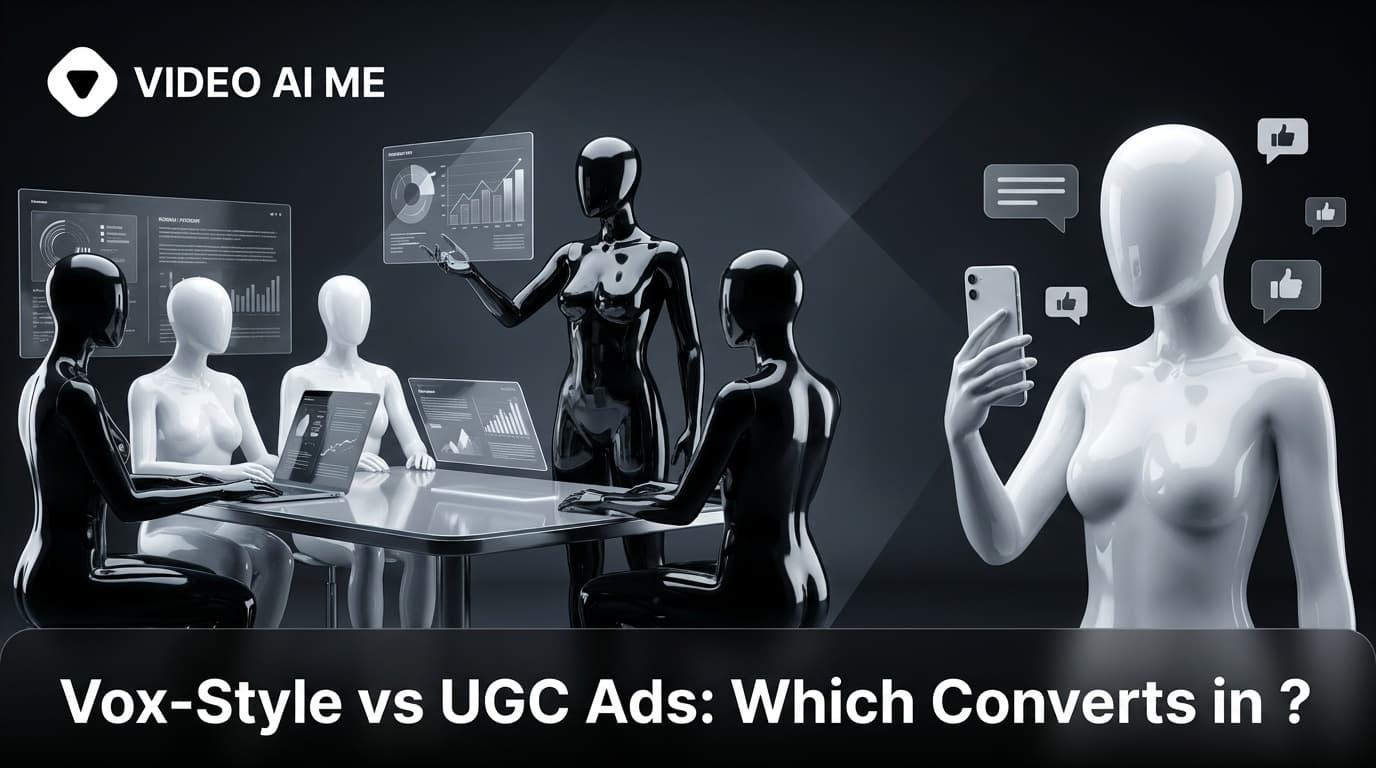
Vox-style vs UGC ads is the creative question of 2026. On one side, the editorial paper-collage explainer that reads as content. On the other, the talking-head UGC ad that reads as a recommendation. Both work. They just do different jobs, and knowing which to reach for saves budget.
Vox-style vs UGC ads: the core difference
A vox-style ad explains. It uses torn paper, cutout labels, arrows, and narration to teach the viewer how something works, with no person on camera. A UGC ad testifies. A creator or avatar looks into the lens and tells you why they like the product.
That difference in intent, explain versus testify, is the whole decision. Match the format to the job and both convert. Mismatch it and even a great production underperforms.
When vox-style wins
The paper-collage explainer has a structural edge in three situations.
- The product needs explaining. If a viewer cannot buy until they understand the mechanism, arrows and cutout diagrams do what a talking head cannot.
- The brand is faceless. No spokesperson, no creator budget, no camera-shy founder problem. The format is faceless by design.
- You want editorial reach. The look earns organic watch time and reads as content in a paid feed, which can lower distribution costs.
That is why the format sits comfortably beside the best AI UGC ad examples rather than replacing them, and why we cover it in depth in the vox-style explainer playbook.
When UGC wins
Talking-head UGC still owns a big chunk of the funnel.
- Testimonials and reviews. A believable person saying this worked for me is hard to beat for trust.
- Social proof. Seeing someone like the viewer use the product lowers perceived risk.
- Relatability plays. Lifestyle, before-and-after with a face, and creator-led hooks lean on human connection.
If your bottleneck is trust rather than understanding, UGC is usually the faster lever. Our guide to the best AI UGC generators covers that side of the house.
Vox-style vs UGC ads, side by side
| Dimension | Vox-style explainer | Talking-head UGC |
|---|---|---|
| Main job | Explain the mechanism | Build trust and proof |
| On-camera person | None, faceless | Creator or avatar |
| Reads as | Editorial content | A recommendation |
| Best funnel stage | Awareness and consideration | Consideration and conversion |
| Iteration speed | Very fast, from a brief | Fast with AI avatars |
| Weakness | Not a personal endorsement | Flagged as an ad sooner |
The real answer: test both
Treating this as a rivalry is the mistake. The accounts that win run a portfolio. They ship a vox-style explainer for the how-it-works angle and a talking-head UGC ad for the testimonial angle, then let cost-per-acquisition decide the split.
The good news is that both are now cheap to produce. You can generate a talking-head UGC ad from a script and a vox-style explainer from a brief, which means the experiment costs a fraction of what a shoot used to. The discipline that matters is changing one variable at a time, hook first, then call to action, so the data stays clean.
How to make the vox-style contender
To put a paper-collage explainer into your next test, open VIDEO AI ME's Vox-Style Explainer template. Give it a two-line brief, and it writes the scene script, generates a collage board per scene for you to approve, and animates them into a narrated ad with sound. You approve the visuals before any video credits are spent, so adding the format to your test costs almost nothing to try.
A simple decision framework
If you are unsure which format to reach for, one question settles most cases: is my bottleneck understanding or trust? If viewers do not yet grasp what your product does or how it works, the bottleneck is understanding, and a vox-style explainer is the right tool. If viewers understand the product but hesitate to believe it works for them, the bottleneck is trust, and a talking-head UGC ad usually wins.
A second question helps at the edges: do I have a credible face to put on camera? If yes and the message is a recommendation, UGC is natural. If no, or the brand is deliberately faceless, the vox format removes the obstacle entirely. Most brands discover they have both bottlenecks at different funnel stages, which is why the strongest accounts run both formats rather than betting on one.
How to run the test
Testing the two formats fairly means changing only the format, not the message. Take the same core claim and produce it two ways: a vox-style explainer and a talking-head UGC ad. Run them to the same audience with the same budget and the same call to action, and compare cost-per-result over a clean window.
Watch more than the surface metrics. A vox-style explainer often wins on watch time and cheap reach, while a UGC ad may win on conversion rate from a smaller, warmer audience. Read the full funnel before you crown a winner, and remember that the answer can differ by product and by stage. The point of the test is not to retire a format, but to learn where each one earns its place in your account.
Bottom line
Vox-style vs UGC ads is not a winner-take-all fight. Vox-style explains, UGC testifies, and most products need both. Start by adding a vox-style explainer to an account that only runs talking heads, or a talking head to an account that only runs explainers, and let the data show you the gap. Make your first collage explainer in the Vox-Style Explainer template and run it head to head this week.
Frequently Asked Questions
Share
AI Summary

Paul Grisel
Paul Grisel is the founder of VIDEOAI.ME, dedicated to empowering creators and entrepreneurs with innovative AI-powered video solutions.
@grsl_frReady to Create Professional AI Videos?
Join thousands of entrepreneurs and creators who use VIDEO AI ME to produce stunning videos in minutes, not hours.
- Create professional videos in under 5 minutes
- No video skills experience required, No camera needed
- Hyper-realistic actors that look and sound like real people
Get your first video in minutes
Related Articles

A Same Day Workflow for AI Video Ad Creative
A full day plan that takes an offer from brief to launched creative, built around fast drafting, one round of judgement, and finishing only what survives.

How to Draft a Video Ad in Minutes With AI
A repeatable routine for going from a product page to six testable video ad drafts in one sitting, using a fast model and single variable rewrites.

How Many Video Ad Variations Should You Test?
How many creatives a test actually needs, how different they have to be, and why the right number is set by what you can afford to produce.