
How to Draft a Video Ad in Minutes With AI
A repeatable routine for going from a product page to six testable video ad drafts in one sitting, using a fast model and single variable rewrites.
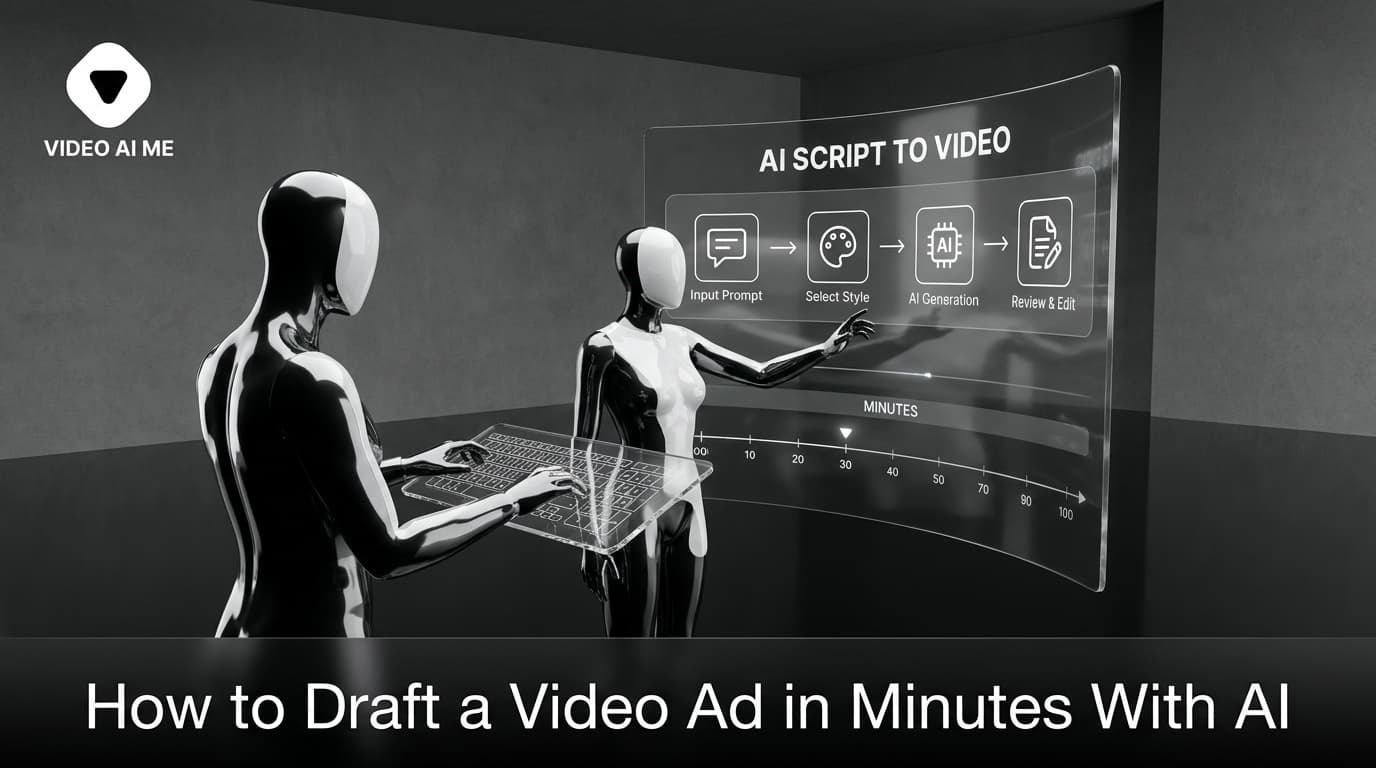
To draft a video ad in minutes, write six short hooks first, generate all of them at five seconds and 480p in your shipping aspect ratio, then judge them on a phone with the sound off. Rerun the two that survive at higher resolution and finish them with captions. The generating is the fast part.
Here is the routine in full.
Step 1: Pull your angles before you open the editor
Open the product page and write down what it actually promises. Not the feature list, the reason someone would stop scrolling.
For most products you will find three or four real angles. A price angle, a time saved angle, a problem avoided angle, a status angle. Write each as a single sentence someone would say out loud, because that sentence is going to become the spoken line in your clip.
Bad: "Our serum contains 2 percent encapsulated retinal." Nobody says that.
Better: "Nobody warned me about the purge week." That is a real sentence from a real person, and it earns three seconds of attention.
Write six of these. Six, not one, because you are about to test them against each other and you cannot pick the winner from your chair. Our guide to writing AI UGC ad scripts goes deeper on finding these lines.
Step 2: Turn each hook into a complete shot brief
A fast model still needs a proper brief. The five parts are who is in frame, what they do, how the camera behaves, how it is lit, and what you hear.
A woman in her late twenties sits cross legged on a bed in a sunlit bedroom, holding a small pink skincare tube. She looks straight into the camera and says, "Nobody warned me about the purge week." Handheld medium close up with a small amount of natural sway, soft window light from the left, clean natural colour. Room tone only, no music. Vertical framing.
Now build the other five by changing only the spoken line and, where it makes sense, the setting. Keep the camera, the lighting and the framing identical across all six. That is the whole point: you are testing hooks, so the hook must be the only variable.
Two rules that save renders. One subject, one action, one camera move, because stacking motion is the most common way to waste a generation. And put dialogue in quotation marks, because sound is generated with the picture and a quoted line gets spoken rather than described.
Step 3: Generate all six before you watch any
Open the editor, select MiniMax H3, and set five seconds, 480p and your shipping aspect ratio. In the model picker it is listed as MiniMax H3 Max.
Generate all six back to back without stopping to evaluate. This matters more than it sounds. Writing prompts and judging clips use different kinds of attention, and switching between them constantly makes both worse and slower. Write in a block, generate in a block, judge in a block.
Why five seconds and 480p: you are deciding whether a line earns attention, and that judgement does not need extra length or extra pixels. Spending on those before you know which idea survives is spending on the five you are going to throw away.
Why your real aspect ratio: cropping a horizontal clip to vertical discards the composition the model built for you and forces a second pass. Generate in the shape you will ship.
Step 4: Judge them the way your audience will
Put the six on a phone. Watch them muted, at arm's length, in the order they came out.
Muted first, because most social video is watched without sound at first contact and your hook has to survive that. If the clip only works with audio, it needs captions before it needs anything else, which our guide to adding captions covers.
Judge on one question only: did the first second make you want the second one? Not whether the lighting is nice, not whether the hands are perfect. Attention is the only thing being tested here.
Expect roughly two of six to survive. That ratio is normal and it is the reason you generated six.
Step 5: Rerun the survivors properly and ship both
Take the two that worked and rerun the exact same prompts at 768p, extending to eight or ten seconds if the idea needs room to land. Then finish them: trim the soft first and last frames, add captions, add your end card and offer. Do not ask the model to render text on screen, because lettering is unreliable across every model in this class.
Then put both live. Do not pick one. You have two hooks that beat four others, and the ad platform will sort out which of the two wins far more reliably than you will by staring at them. Our note on how many variations to test covers what a sensible test size looks like.
What makes this routine work?
Three things, and none of them are the model on its own.
Single variable testing. Because only the hook changes across your six, the result tells you something true about your audience. If you had changed the hook and the setting and the camera, a win would tell you nothing you could reuse.
Cheap drafts. Short and low resolution while deciding means you can afford to be wrong four times out of six, which is what makes honest testing possible rather than a thing you say you do.
No handoffs. Generating, cropping, captioning and publishing in one place is what keeps this to a sitting. Every export and re-upload adds minutes and an opportunity to end up with the wrong aspect ratio.
How do you keep the routine from decaying?
The method is simple and that is exactly why it erodes. Three habits keep it honest.
Write the six hooks before you open the editor. Once you are generating, the temptation is to write the next prompt based on what the last clip looked like, which quietly turns a test of six ideas into six refinements of the first one.
Keep a record of what lost. A note of the four hooks that failed is worth as much as the two that worked, because it stops you re-testing the same dead angle next quarter. One line each is enough.
Do not skip the muted phone watch. Judging on your desktop, with sound, in a quiet room, is judging under conditions no customer will ever experience. This is the step people drop first and it is the one that catches the most mistakes.
If the routine starts producing clips that all feel the same, the usual cause is that the hooks stopped being genuinely different. Go back to the product page and find a promise you have not tested rather than another way of phrasing the one you have. Meta's advertising guidance is also worth periodically re-reading, since placement specs and creative recommendations change more often than most people check.
What if none of the six work?
Then you learned something cheaply, which is the point.
Usually it means the angle is wrong rather than the execution. Go back to the product page, find a different promise, and write six more hooks against that. It is far more common for a whole angle to be dead than for six executions of a live angle to all fail.
If they were close but flat, change only the delivery line and rerun. Reading the same words with different energy often moves a clip from unusable to fine. If they were visually wrong, change only the shot size or the lighting sentence.
Frequently Asked Questions
How long does it really take to draft a video ad this way?
One sitting for six drafts, including writing the hooks. The generating is the quick part. Deciding what to test is what takes the thought.
Should I write the script or the visual first?
The hook first, always. The first line decides whether anyone sees the rest, so build the visual around a line that earns attention rather than the other way round.
Why generate six versions instead of perfecting one?
Because you cannot reliably predict which hook works, and neither can anyone else. Six cheap drafts give you an answer. One careful draft gives you an opinion.
What settings should I draft at?
Five seconds, 480p, in the aspect ratio you will actually ship. Short and low while you are deciding, then rerun the winner longer and higher.
Do I need product photos to start?
No, but they help. With no image you get text to video. With one image the model animates that exact frame, which is the reliable way to keep real packaging looking right.
What do I do after the drafts are generated?
Watch them muted on a phone, pick the two that survive, rerun those at 768p, add captions and an end card, then put both live rather than choosing between them.
Ready to run it?
Everything above happens in the editor on any paid plan, with credits included from 1,400 a month upward. The pricing page has the detail. If you want the prompt writing side in more depth first, the MiniMax H3 prompt guide breaks a brief down line by line, and Meta's advertising guidance is worth checking for current placement specs before you render.
Frequently Asked Questions
Share
AI Summary
Paul Grisel
Paul Grisel is the founder of VIDEOAI.ME, dedicated to empowering creators and entrepreneurs with innovative AI-powered video solutions.
@grsl_frReady to Create Professional AI Videos?
Join thousands of entrepreneurs and creators who use VIDEO AI ME to produce stunning videos in minutes, not hours.
- Create professional videos in under 5 minutes
- No video skills experience required, No camera needed
- Hyper-realistic actors that look and sound like real people
Get your first video in minutes
Related Articles
FLUX 3 Max Cinematic Video: 21:9 Brand Films at 1080p
How to shoot a cinematic brand film with FLUX 3 Max: 21:9 at 1080p, 20 second single takes, camera language, sound design, copy-paste prompts and a cost table per shot.
FLUX 3 Max Meta Ads: A Creative Testing Workflow
How to feed a Meta creative test with distinct FLUX 3 Max variants: credit budgets per asset, 720p drafts, 1080p winners, placement ratios and one-variable prompts.

FLUX 3 Max for Agencies: Client Volume and Cost per Ad
How agencies can price, draft and deliver client video with FLUX 3 Max: cost per deliverable, the 720p draft and 1080p final workflow, and keeping a batch on brand.