
AI Lip Sync + Multilingual Video for E-Commerce 2026
How DTC brands use AI lip sync and voice cloning to ship the same product video in 30 languages from one shoot. Workflows, costs, and platform tips.
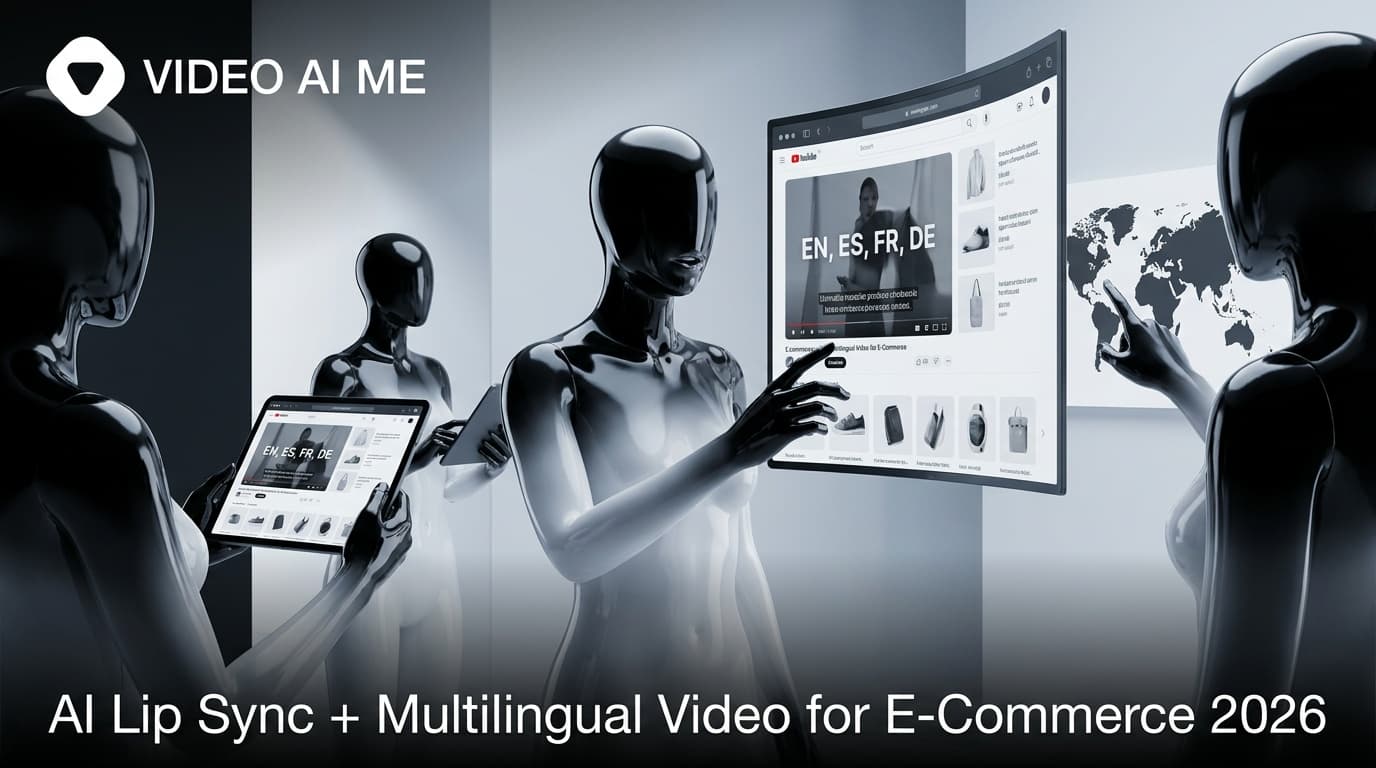
AI lip sync and multilingual video are how DTC brands ship cross-border without a 5x cost
You are ready to launch in Germany, France, Spain, Italy, and the Netherlands. The product is ready. Shipping is set up. Then your agency quotes $24,000 for 5 local creator shoots, 6 week delivery, and one ad per market. Your CFO closes the proposal in the Slack thread and the launch slides 3 months. This is why most US DTC brands die domestic.
A US brand launching in 5 EU markets used to need 5 separate UGC shoots with 5 local creators. Each shoot ran $400 plus, took a week, and produced one ad per market. International growth quietly cost 5 to 10x what domestic growth did, even before media spend.
AI lip sync and voice cloning rewrote the math. One English shoot becomes 5 localized ads in an hour. Same actor, same founder voice, lips matched to each new language. This guide is how DTC brands actually run multilingual AI video in 2026, what works, what breaks, and where to start without lighting $20k on local production.
Why multilingual AI video matters for DTC in 2026
Statista reports cross-border e-commerce grew faster than domestic e-commerce in every major region in 2024. eMarketer shows international DTC sales as the fastest growing segment for US-based DTC brands.
The blockers used to be:
- Creative cost: 5 markets meant 5 shoots
- Time to launch: weeks per market for ad assets
- Voice mismatch: dubbed audio without lip sync looks fake
- Local creator coordination: managing 5 to 10 creators in 5 countries
AI lip sync and voice cloning removed all four.
What AI lip sync actually does
Lip sync adjusts the mouth and lower face of an actor to match a new audio track. The technology shipped in 2025 became good enough that casual viewers stopped detecting it. By 2026 the best tools render lip sync that matches phonemes specific to each target language, not just generic mouth motion.
VIDEOAI.ME, HeyGen, and Synthesia all ship strong lip sync. Quality differences in 2026 are small at short ad lengths.
What voice cloning adds
Voice cloning trains a model on a sample of your founder or spokesperson voice, then renders new audio in target languages while keeping the original tone, pace, and accent. The result is a founder who appears to speak fluent German, French, Spanish in their own voice.
This is the unlock for international DTC. Customers respond better to founder-led ads. Voice cloning lets the founder appear in every market without speaking those languages.
How to ship multilingual AI video for an international DTC launch
Step 1: Pick the markets first
List your top 3 to 5 launch markets. Confirm payment processing, shipping, and customer support are ready. Multilingual video is the last step, not the first.
Step 2: Hire native copywriters for scripts
The biggest failure mode for multilingual ads is bad translation. Hire a native speaker to write each script. Do not use a single English script translated by AI. Localize hooks, idioms, and CTAs.
Step 3: Train the founder voice clone
1 to 3 minutes of clean audio is enough. Use the AI voice cloning tool. Train once, use forever.
Step 4: Render in each language
Pick the actor that matches the buyer in that market. For some markets, swap actors. For others, keep the same founder actor with cloned voice.
Step 5: Quality check lip sync
Review first and last sentence of each render. Re-render if mouth motion misses on a syllable.
Step 6: Test in market with paid traffic
Run $50 per market to validate hook rate and CTR before scaling.
Prompt example: 18-second multilingual unboxing UGC for a Shopify supplement brand expanding to EU
Style: modern UGC handheld, kitchen daylight, smartphone capture, lived-in, slight bokeh
Scene: A woman in her early 30s in a soft camel cardigan sits at a small kitchen table. A glass of water, a folded newspaper, and a kraft mailer sit in front of her. A plain amber supplement bottle is half pulled out of the mailer. A potted herb plant is just out of focus on the windowsill behind.
Cinematography: Camera shot: chest-up handheld phone shot, slight high angle from across the table, subject square to lens Lens: 28mm equivalent smartphone, f/1.8, soft bokeh on plant and windowsill Lighting: window light from camera-right, warm morning balance, colors anchored in camel, amber, sage green, off-white linen, warm skin Mood: calm, sincere, mid-week-morning energy
Actions:
- She lifts the supplement bottle out of the mailer and turns the label toward the lens
- She taps two capsules into her palm and shows them in close-up
- She glances back at the lens with a small relieved smile
Dialogue:
- Woman: "Three weeks in. Energy is back, sleep is back. That is the entire reason I am posting this."
Background sound: Quiet kitchen ambience, soft cap click on the bottle, faint clink of the water glass
Drop this into the AI multilingual video flow, clone your founder voice in the AI voice cloning tool, and render the same scene in German, French, Spanish, Italian, and Dutch in a single batch session.
Real e-commerce use cases
1. Personalized goods brand launching in 5 EU markets
Deejo, the French personalized knife brand, shipped AI UGC across multiple markets with lip sync and voice cloning. The brand reported a 2x return on ad spend lift and roughly 50 percent faster production turnaround. See the Deejo AI UGC case study.
2. Beauty brand running US, UK, Canada, Australia
A beauty brand cloned the founder voice and rendered the same ad in US, UK, Canada, and Australian English accents. Per-market CTR improved 22 percent over running US accent everywhere.
3. Supplement brand expanding into LATAM
A supplement brand launching in Mexico, Argentina, and Brazil rendered the same ad in three Spanish dialects plus Brazilian Portuguese. Per-market cost dropped from $1,800 to under $50.
Personas based on common DTC patterns. Test against your own funnel.
The best tools for multilingual AI video in 2026
1. VIDEOAI.ME
Strongest end-to-end DTC fit. UGC actors, voice cloning, AI lip sync, AI multilingual video. 30 plus languages.
- Paid: Starter $29 (1 voice clone), Pro $99 (3 clones), Premium $199 (10 clones)
2. HeyGen
Industry-leading lip sync quality. Translation feature for cross-border.
- Paid: Creator $29, Team $89
3. Synthesia
Strong on enterprise multilingual content. Less UGC native.
- Paid: Starter $29, Creator $89
4. ElevenLabs (for voice cloning only)
Best in class voice cloning. Pair with another tool for video.
- Paid: Creator $22
5. Captions AI
Mobile-first multilingual workflow.
Multilingual AI video vs hiring local creators
| Factor | Local Creator Hire | AI Multilingual |
|---|---|---|
| Cost per market | $200 to $500 per ad | $1 to $5 in credits |
| Time to first ad | 1 to 3 weeks per market | 1 to 2 hours |
| Voice consistency | varies per creator | identical founder voice |
| Founder presence in market | impossible | default |
| Variants per market | 1 | 5 plus |
| Coordination overhead | high | none |
What kills multilingual AI video quality
- Translated scripts: hire native copywriters
- Wrong actor for market: swap actor to match local buyer
- Same accent in every region: clone accent variants for English markets
- Long monologues: hold to 60 to 90 word scripts
- Skipping in-market testing: $50 per market before scaling
What scales multilingual AI video
- Founder voice clone as a default for every market
- Native copywriter brief template you reuse
- Per-market actor mapping documented
- Quarterly re-render as products and angles refresh
- Local hashtag and caption pack built per market and stored with the script
Localization economics: real cost per market launch
The cost difference at scale is what drives DTC teams to adopt multilingual AI. Approximate costs for a 5-market launch of one hero SKU:
- Traditional production. 5 local creators at $400 = $2,000. 5 native copywriters at $80 = $400. Per-market shoot day fees and project management at $300 each = $1,500. Subtotal: $3,900 per ad. For 5 ad variants per market: $19,500 before media spend.
- AI multilingual production. 1 voice clone (one-time setup). 5 native copywriters at $80 = $400. AI render credits at $5 per render times 25 renders = $125. Subtotal: $525 for the full 25-ad library across 5 markets. Roughly 97 percent cheaper than traditional and shipped in a day instead of 6 weeks.
That delta is why cross-border DTC growth no longer requires venture money. A bootstrapped brand can launch into 5 markets for the cost of one previous shoot.
Where AI multilingual still falls short
Be honest about the limits. There are still scenarios where human production beats AI:
- Hero brand films above 60 seconds. AI talent drifts on long cuts. Use human production for the 1 or 2 hero brand films per year.
- Sensitive categories. Health claims, weight-loss, and political content carry stricter disclosure rules in many markets. Human production keeps compliance simpler.
- High-skin-detail close-ups. Beauty close-ups under 50cm camera distance still show AI texture artifacts in some renders.
- Live event tie-ins. Reactive content tied to a moment in the news cycle still needs a fast human shoot, because AI training and prompt iteration take longer than a phone shoot.
A practical hybrid: AI for the 30 to 50 ad variants per market per quarter, human for the 1 hero brand film and any sensitive-category content.
Per-language quality scorecard
Lip sync quality varies by language. We have run hundreds of test renders across DTC accounts. Approximate quality ranking in 2026:
- Tier 1 (near-native lip sync). English (US, UK, AU), Spanish (Spain, Mexico, LATAM), French (France, Canada), German, Italian, Portuguese (Brazil, Portugal), Dutch.
- Tier 2 (strong, minor mouth-shape artifacts). Polish, Czech, Swedish, Norwegian, Danish, Finnish, Hungarian, Romanian, Greek, Turkish.
- Tier 3 (usable, edit if visible). Japanese, Korean, Mandarin, Cantonese, Vietnamese, Thai. Phonemes differ from European languages and lip sync occasionally misses on long vowels.
- Tier 4 (best for voice-over only). Arabic, Hebrew, Hindi, Tamil, Bengali. Voice cloning is solid, lip sync still rough on some renders. Use voice-only over product B-roll where possible.
If you launch into a Tier 3 or Tier 4 market, render the script twice: once with the actor on camera for the hook, then cut to product B-roll with voice-over for the rest. This preserves the founder voice without exposing weaker lip sync.
How to brief native copywriters for AI video scripts
The single highest-ROI step in multilingual AI video is hiring native copywriters. A clean brief looks like this:
- Source script in English. Send the original verbatim with notes on the pain point and CTA.
- Buyer profile for the target market. Age, gender, life stage, common objections. Pull from local reviews if you have any.
- 3 local idioms or hooks to consider. Examples your local cousin would use, not what a translator would produce.
- Maximum word count per beat. Native rewrite must fit the original cadence, because lip sync is rendered from the cadence.
- Voice tone notes. "Warm, never pushy, slight humor in the second beat."
- Localization budget. Most native copywriters charge $40 to $120 per ad script. Budget accordingly per market.
Never feed a single English script through machine translation and call it localized. That is the fastest way to torch a market launch.
Next steps
If you sell internationally or plan to in the next 12 months, set up a founder voice clone now. The Starter plan at $29 covers the first clone and an initial set of multilingual renders.
Want to see one running on your store? Train your founder voice in AI voice cloning, then render the same product ad in 5 languages from one master through AI lip sync and AI multilingual video. Related reading:
Frequently Asked Questions
Share
AI Summary
Paul Grisel
Paul Grisel is the founder of VIDEOAI.ME, dedicated to empowering creators and entrepreneurs with innovative AI-powered video solutions.
@grsl_frReady to Create Professional AI Videos?
Join thousands of entrepreneurs and creators who use VIDEO AI ME to produce stunning videos in minutes, not hours.
- Create professional videos in under 5 minutes
- No video skills experience required, No camera needed
- Hyper-realistic actors that look and sound like real people
Get your first video in minutes
Related Articles
MiniMax H3 Product Ad Prompts That Sell
Prompts for the product beats every ecommerce ad needs: the reveal, the in hand shot, the demo, the texture close up and the lifestyle frame.
MiniMax H3 for Dropshipping Ads: A Test Workflow
How to test a product with video ads before you have inventory, samples or a creator, using text to video for angles and your supplier photos for the product beats.
Seedance 2.5 Product Ad Prompts for Ecommerce
Five product shot prompt patterns for Seedance 2.5, category variants for skincare, supplements, apparel, gadgets and home, and what still does not hold up.