
AI Facebook Ads for E-Commerce Brands (2026)
How DTC brands run AI Facebook and Instagram ads at scale in 2026: creative formats, hook patterns, audience setup, and the metrics that signal a real winner.
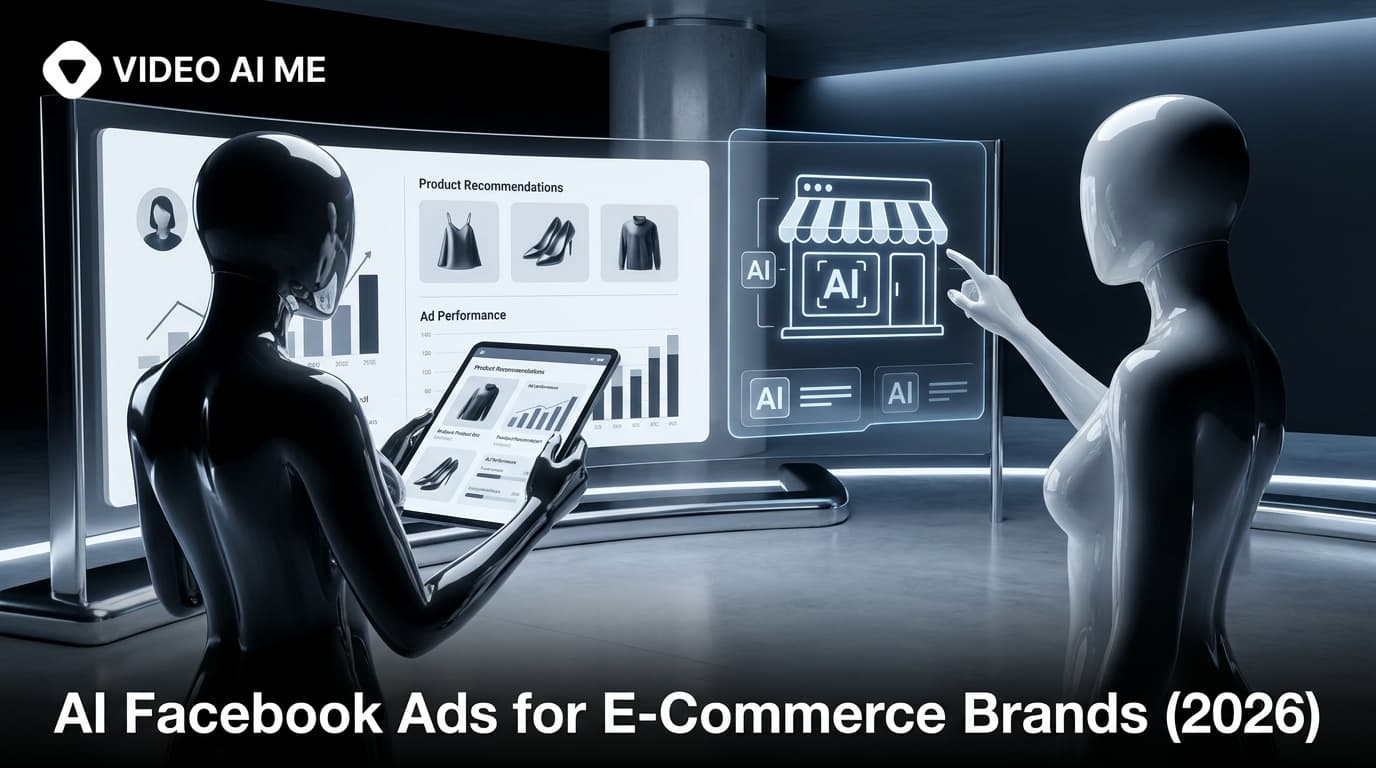
AI Facebook ads are how DTC brands keep Meta auctions alive in 2026
Your CPM jumped 40 percent this week. Your hero ad from a month ago is dragging the account down because nothing newer is hitting threshold. The creator you booked in March is finally shipping next Tuesday. You stare at the Meta dashboard knowing you are about to torch another $5k waiting for fresh creative. This is the trap.
Meta still drives the most paid revenue for most DTC brands. Creative fatigue is the cost. A single ad lasts 7 to 10 days before performance decays. To stay in auction, most accounts need 15 to 30 new variants per active SKU per week. That cadence breaks every human UGC pipeline and breaks most $50k-per-month creative budgets too.
AI Facebook ads close the gap with a workflow that ships 5 ad variants in an afternoon. This guide is how DTC operators actually run them: creative formats, hook patterns, audience setup, and the metrics that separate a real winner from noise. Built for stores spending $10k to $500k a month across Meta and Instagram.
Why AI Facebook ads matter for DTC in 2026
Meta ad revenue is still the largest digital channel by spend. Statista reports Meta ad revenue past $140 billion in 2024, with DTC e-commerce as one of the largest vertical contributors. HubSpot research puts paid video as the highest engagement creative format for DTC accounts.
Three creative realities define Meta in 2026:
- Volume requirement: 15 to 30 variants per SKU per week to keep auctions hot
- Creator economics: human UGC at $150 to $500 per ad blocks volume
- Multilingual launches: international stores need every ad in every language
AI Facebook ads solve all three.
The creative formats that work on Meta in 2026
Feed video, square 1 by 1, 15 to 30 seconds
Still the workhorse. Best for direct response.
Reels and Stories, vertical 9 by 16, 15 to 30 seconds
Higher CPMs but stronger hook rates. Best for cold prospecting.
Catalog plus video collection ads
A short AI UGC video at the top with product catalog below. Best for retargeting.
Advantage plus campaigns
Meta's automated creative campaigns reward volume. 10 plus variants per ad set wins.
The hooks that work for DTC on Meta
From the playbooks we see across DTC accounts:
- Peer testimonial: 'I tried 5 of these before this one worked'
- Curiosity: 'This is what no one tells you about [category]'
- Specific number: '40,000 people switched to this last month'
- POV format: 'POV: you finally found a [product] that lasts'
- Direct callout: 'If you sell [thing], you need to see this'
Lead with the hook in the first 2 seconds. Show product in the first 5.
How to ship AI Facebook ads end to end
Step 1: Audit your best performer
Pull the top 3 ads from the last 30 days. Note hook structure, length, and format.
Step 2: Write 5 new hook variants
Use the patterns above. Keep total script at 60 to 90 words.
Step 3: Render 5 ads with 5 different actors
Match actor to buyer demographic in the AI actors library.
Step 4: Add product B-roll
3 to 5 product photos minimum. Live product video at the start of the ad if you have it.
Step 5: Ship as one ABO ad set
5 ads, 1 broad audience, $50 daily budget. 48 hour learning window.
Step 6: Read the metrics
- Hook rate (3 sec views / impressions): 30 percent plus
- CTR (link): 1.5 percent plus on cold
- CPM: account benchmark dependent
- ROAS: 1.5x on cold, 3x plus on warm
Step 7: Kill below threshold, scale winners
Kill at 48 hours, scale at 72.
Prompt example: 20-second Reels fashion try-on UGC for a Shopify apparel brand
Style: modern UGC handheld, bedroom afternoon light, smartphone capture, slight bokeh, lived-in wardrobe
Scene: A woman in her late 20s in a cream knit sweater stands beside a full-length mirror in a sunlit bedroom. A second sweater hangs over a chair behind her, color tag still on. A small unbranded boutique bag sits on the floor beside the chair. A messy bed and a folded throw are slightly out of focus in the background.
Cinematography: Camera shot: chest-up handheld, slight low angle from waist, subject offset slightly camera-left Lens: 28mm equivalent smartphone, f/1.8, soft bokeh on wardrobe behind Lighting: window light from camera-right, warm afternoon balance, colors anchored in cream, dusty rose, warm wood, navy denim, warm skin Mood: relaxed, confident, weekend energy
Actions:
- She tugs the hem of the sweater down once and turns slightly to show the side fit
- She points at the color tag still attached and gives a small smirk
- She steps closer to the lens and adjusts the sleeve
Dialogue:
- Woman: "Three sweaters from this brand. Zero pilling, all winter. That is the whole pitch."
Background sound: Quiet bedroom ambience, soft fabric rustle
Load this into the AI Facebook ad generator at 9:16 for Reels and 1:1 for feed in the same render session, then re-render with a buyer-matched actor for each Meta ad set.
Real e-commerce use cases
1. Personalized goods brand, 2x ROAS lift
Deejo, the personalized knife brand, added AI UGC to Meta creative rotation and reported a 2x return on ad spend lift with about 50 percent faster production. Full breakdown in the Deejo AI UGC case study.
2. Beauty brand at $200k monthly Meta spend
A beauty DTC at $200k monthly Meta spend went from 4 to 8 ads a month with human UGC to 25 plus weekly with AI UGC. Cost per acquisition fell 22 percent over 60 days. The team kept human UGC for 2 hero ads per quarter and ran AI for everything else.
3. Pet brand launching in 4 EU markets
A pet supplement brand expanded from US to UK, Germany, France, and Spain. Voice cloning let them ship the same ad in 4 languages from a single script. Per-market launch cost dropped from $4,800 to under $200.
Personas based on common DTC patterns. Test against your own funnel before scaling.
The best AI tools for Meta ads in 2026
1. VIDEOAI.ME
Most complete DTC fit. UGC actors, voice cloning, multilingual, product URL upload.
- Paid: Starter $29, Pro $99, Premium $199
- Try the AI Facebook ad generator or the AI ad video generator
2. Arcads
Direct-response focus. Higher pricing.
3. Creatify
Product URL workflow. Limited multilingual support.
4. HeyGen
Spokesperson focus. Less UGC native.
5. Synthesia
B2B leaning. Useful for explainer ads.
AI Facebook ads vs human UGC for Meta
| Factor | Human UGC | AI Facebook Ad |
|---|---|---|
| Cost per ad | $150 to $500 | $1 to $5 |
| Time to first ad | 5 to 10 days | 10 minutes |
| Variants per concept | 1 | 5 plus |
| Languages | new shoot per market | one render per market |
| Refresh cadence | weeks | days |
| Mid-funnel testimonial | strong | weaker |
| Cold hook testing | strong | strong |
Audience setup that works with AI UGC volume
The audience side of the equation matters as much as the creative. The setups that pair well with AI UGC volume:
- Broad cold prospecting. With 5 to 10 creative variants per ad set, broad audiences out-perform tight interest stacks in 2026. The algorithm needs creative diversity to find pockets, and AI gives it that.
- Lookalike on purchasers (last 90 days). 1 percent for narrow lift, 3 percent when you have enough purchasers. Add 2 to 3 fresh AI variants weekly.
- Custom audience exclusions. Always exclude past 30 day purchasers from cold. Always exclude email subscribers from cold prospecting.
- Retargeting tiered by recency. 14 day video viewers get one creative set, 90 day add-to-cart abandoners get another. AI volume lets you build a custom creative library per tier instead of recycling one ad.
What kills AI Facebook ads
- Studio framing on cold prospecting
- No product B-roll in the first 5 seconds
- Long monologues past 30 seconds for cold
- Generic stock voice without founder clone
- Same actor across every ad in an ad set
What scales AI Facebook ads
- Founder voice clone over multiple actors
- Weekly hook refresh from new reviews
- Multilingual layer from one master script
- Documented swipe file of winners with archetype tagging
- Format coverage of 9:16 and 1:1 from one render session
Advantage+ Shopping Campaigns: AI UGC fit
Meta Advantage+ Shopping Campaigns reward creative volume more than any other campaign type. The setup that consistently lifts ROAS for DTC brands:
- Upload 10 to 15 creative variants per campaign at launch, not 3. Volume gives the algorithm room to find the winner.
- Mix formats inside one campaign: vertical 9:16 for Reels and Stories, square 1:1 for feed.
- Include at least 2 founder-voice ads in the rotation. Founder voice on multiple actors consistently outperforms generic voice on the same actors.
- Refresh 30 percent of the creative every week. Do not replace the whole set, because winners build delivery weight.
- Pair AI UGC with a clean static product image variant. The image often wins on retargeting while video wins cold.
Instagram-specific rules for AI ads
Instagram and Facebook share an Ads Manager but the delivery patterns differ:
- Reels favor vertical 9:16 with sharp first-second hooks. Anything wider than 4:5 dies in Reels delivery.
- Stories prefer 9:16 with the safe zone clear of bottom 20 percent UI overlay. Place captions in the middle band.
- Feed accepts 1:1 and 4:5. 4:5 takes up more screen real estate but converts slightly worse on hook rate.
- Explore favors faster cuts. Add a second beat change at the 3 second mark.
- Branded Content tag is required if you boost a creator post that uses an AI version of that creator.
A single AI UGC ad rendered for one Meta surface usually does not work across all 4. Render at 9:16 and 1:1 in the same session to cover delivery.
Meta-specific compliance for AI ads in 2026
- Synthetic content of real people. Requires Meta's AI-generated content disclosure inside Ads Manager. Stock-based AI actors and fictional characters do not require the tag.
- Health and supplement. Meta still rejects ads making medical or weight-loss claims. AI does not change policy. Avoid before-and-after.
- Political content. Stricter rules and pre-clearance required. Most DTC brands are unaffected.
- Trademark and IP. Do not generate ads showing competitor logos or product packaging.
- Branded Content tagging. If a real creator licensed their likeness to your AI actor, tag the content correctly. Required by Meta and most state laws.
Keep a 1 page internal compliance memo in the swipe file. Reference it before every batch render. Most rejections on Meta come from claims and imagery, not from AI generation itself, so a quick policy pass on the script saves you a 48 hour appeal cycle.
Next steps
If you spend on Meta and your creative team is the bottleneck, run 5 AI ads against your best human UGC for $50. Most DTC brands find at least one winner inside the first batch.
Want to see one running on your store? Drop your Shopify product URL into the AI Facebook ad generator, the AI ad video generator, or the AI UGC generator and render a sample in under 10 minutes. Related reading:
Frequently Asked Questions
Share
AI Summary

Paul Grisel
Paul Grisel is the founder of VIDEOAI.ME, dedicated to empowering creators and entrepreneurs with innovative AI-powered video solutions.
@grsl_frReady to Create Professional AI Videos?
Join thousands of entrepreneurs and creators who use VIDEO AI ME to produce stunning videos in minutes, not hours.
- Create professional videos in under 5 minutes
- No video skills experience required, No camera needed
- Hyper-realistic actors that look and sound like real people
Get your first video in minutes
Related Articles

A Same Day Workflow for AI Video Ad Creative
A full day plan that takes an offer from brief to launched creative, built around fast drafting, one round of judgement, and finishing only what survives.
How to Draft a Video Ad in Minutes With AI
A repeatable routine for going from a product page to six testable video ad drafts in one sitting, using a fast model and single variable rewrites.
How Many Video Ad Variations Should You Test?
How many creatives a test actually needs, how different they have to be, and why the right number is set by what you can afford to produce.