
Explainer Video Production Cost in 2026: Agency, Freelancer, DIY and AI
Explainer video production costs $1,000 to $25,000 per finished minute from freelancers and studios in 2026, or a $29 to $99 monthly plan if you generate it yourself with AI. Here is the math for each route.
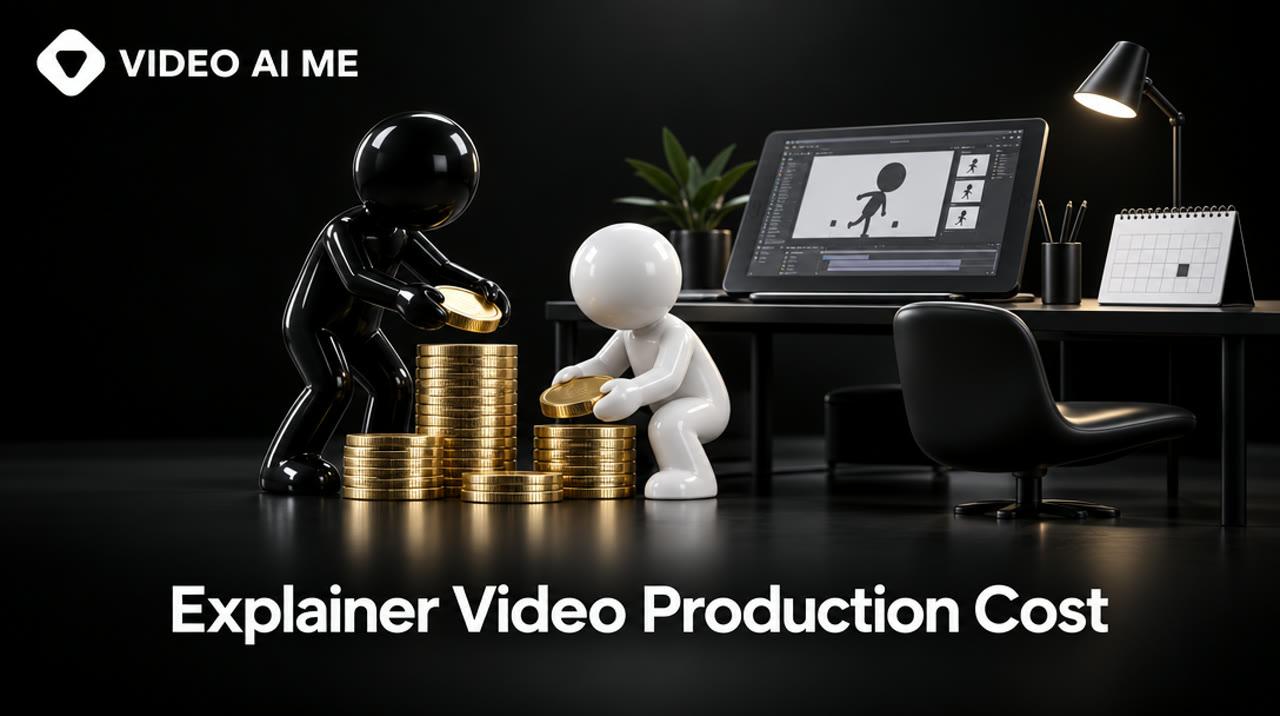
Explainer video production cost in 2026 runs from a few dollars of AI generation budget to $25,000 or more per finished minute at an established studio. Most small businesses pay a freelancer $1,000 to $5,000 per minute or a mid-tier agency a few thousand for 30 seconds. The route you pick matters more than the length.
How much does explainer video production cost in 2026?
It depends on who makes it. A template or AI tool costs under $1,000 per finished minute, a freelancer $1,000 to $5,000, a small studio $5,000 to $8,000 and an established studio $8,000 to $25,000, according to the Yum Yum Videos animation pricing study, last reviewed in July 2026.
Those are per-minute prices for professional business animation. Broadcast-level work sits above all of them: the same study lists $25,000 to $150,000 or more per minute.
The chart below shows the low and high end of each tier. The takeaway: the gap between tiers is wider than the gap inside any one tier, so choosing the tier is the real budget decision.
Low and high end of each production tier for professional business animation.
View the data as a table
| Tier | Low end | High end |
|---|---|---|
| Template or AI | $0 | $1,000 |
| Freelancer | $1,000 | $5,000 |
| Small studio | $5,000 | $8,000 |
| Established studio | $8,000 | $25,000 |
Source: Yum Yum Videos, animation cost per minute market study, pricing reviewed July 2026
A second data point comes from the buyer's side. Squideo sent one real brief for a 30-second animated explainer to more than 100 agencies in the UK, US, Europe and Canada and got 45 answers. In its 2026 pricing breakdown, the average starting price was £2,960, the most common entry band was £2,000 to £5,000, and quotes ranged from £296 to more than £20,000. Squideo also found that US agencies priced 15 to 30% above UK agencies at a similar tier.
Both sources are production companies with something to sell, so treat the figures as the market's own asking prices, not as an independent audit. They agree with each other, which is the useful part.
Why there is no single price
An explainer is a stack of separate jobs: script, storyboard, illustration or footage, animation, voiceover, music and sound, revisions. Each one can be done by a specialist, by you, or by software. The quote you get is the sum of who does which job.
What are the four ways to produce an explainer video?
There are four routes: a full-service agency or studio, a freelancer, do-it-yourself animation software, and an AI video generator. They differ in price, in how long you wait and in how much of the thinking you do yourself.
| Route | Typical price | Typical timeline | What you supply | Best for |
|---|---|---|---|---|
| Agency or studio | $5,000 to $25,000 per finished minute (Yum Yum Videos, July 2026) | Six to nine weeks per minute (same source) | A brief and feedback | A flagship homepage film, a funding round, a regulated product |
| Freelancer | $1,000 to $5,000 per finished minute (same source) | Varies by person and workload | Script direction, feedback, project management | One good video on a fixed budget |
| DIY software | Subscription: Vyond Starter is $99 a month or $699 a year per user | Your own hours | Script, design choices, all the animation work | Teams that make training and internal videos every month |
| AI video generator | Subscription plus usage: from $29 a month on VIDEO AI ME | An afternoon to a few days of your time | Script, prompts, review of every clip | Ads, social explainers, fast tests, many versions |
The Vyond prices come from the Vyond pricing page on the day we checked: Starter at $99 per user per month or $699 billed annually, Professional at $199 per month or $1,199 billed annually. Other DIY tools use the same model, a seat price that does not change with how many videos you make.
For a deeper side-by-side of hiring a company against generating the video yourself, see explainer video company vs AI.
What drives the price up or down?
Five things move an explainer quote: animation complexity, who writes the script, the revision policy, the length, and where the supplier is based.
Squideo's analysis of 45 agency quotes found the same pattern. Price differences tracked creative depth, animation complexity, script development, revision policy and geography.
Animation style
Style is the biggest lever. Yum Yum Videos lists per-minute ranges of $5,000 to $25,000 for 2D animation, $7,000 to $18,000 for motion graphics, $6,000 to $12,000 for whiteboard and $15,000 to $40,000 or more for 3D. Custom characters and 3D cost more because every second is drawn or modeled by hand.
Script and strategy
A script you write yourself is the cheapest script. An agency-led messaging workshop is the most expensive one. If you already know your one-sentence pitch, your audience's main objection and your call to action, you can remove a large part of the quote before you ask for it.
Revisions
Limited revision rounds lower the entry price and move the risk to you. Ask what one extra round costs before you sign, because the answer varies by supplier and it is rarely on the pricing page.
Length
A 30-second video is not half the price of a 60-second one. The fixed work (brief, concept, style frames, voice casting) is the same. Cut the script before you cut the supplier.
What does an agency quote usually leave out?
Most quotes cover one video in one language and one aspect ratio. The costs that arrive later are versions: cutdowns, vertical formats, translations and updates when your product changes.
Check these before you compare two quotes:
- Cutdowns. A 60-second homepage film is the wrong length for a paid social placement. Ask whether 15-second and 6-second cuts are included.
- Aspect ratios. A 16:9 film needs a 9:16 version for TikTok, Reels and Shorts. Reframing animation is real work.
- Languages. A new voiceover is cheap. Re-timing animation to a longer German or French script is not.
- Updates. Pricing changes, the interface changes, the offer changes. Ask what a 10-second edit costs in six months.
- Source files. If you do not get the project files, every future change goes back to the same supplier.
- Usage rights. Confirm the license covers paid advertising, not only your website.
This is where the per-minute price misleads. A business that needs one film a year should think in price per minute. A business that runs ads needs many versions a month, and should think in price per version.
How much does an AI explainer video cost to produce?
On VIDEO AI ME, 60 seconds of raw footage on the default model costs 480 credits, which is $4.80, inside a plan that starts at $29 a month. The honest total is higher than that once you count retakes, and still far below a freelancer's day rate.
The arithmetic is simple because 1 credit is 1 cent of generation budget. The default model, MiniMax H3 Max at 768p, costs 8 credits per second. Sixty seconds is 60 x 8 = 480 credits. Other models charge more or less per second, and the chart shows what 60 seconds costs on each. The takeaway: model choice changes the bill by a factor of 48, so draft on a cheap model and spend on the final takes.
Per-second rate at 720p (768p for MiniMax H3 Max) multiplied by 60 seconds. 100 credits = $1.
View the data as a table
| Model | Cost for 60 seconds |
|---|---|
| Boreal | $0.6 |
| Kling 2.6 Pro | $4.2 |
| MiniMax H3 Max | $4.8 |
| FLUX 3 Max | $10.2 |
| Sora 2 Pro | $18 |
| Seedance 2.5 | $28.8 |
Source: VIDEO AI ME pricing, updated 2026-10-24
A worked budget for a 60-second explainer
Nobody uses every first take. Plan for three takes per shot, which is a planning assumption and not a measured average.
- Eight shots of about 8 seconds each on the default model: 8 x 64 = 512 credits.
- Three takes per shot: 512 x 3 = 1,536 credits, or $15.36.
- The Starter plan includes 1,400 credits for $29 a month, so this project needs either tighter retakes or the Pro plan at $99 a month with 5,600 credits.
- Voiceover and captions are produced in the same workspace, so there is no separate voice actor invoice.
So a realistic first explainer costs one month of a $29 or $99 plan plus your own afternoon. Starter covers up to 175 seconds of default-model video a month, Pro up to 700 seconds and Premium up to 1,500 seconds. Premium models use credits faster. Full plan details are on the pricing page.
The clip below was generated on VIDEO AI ME with MiniMax H3 Max from the prompt shown. It is 8 seconds long and cost 64 credits, or $0.64.
Notice that the voiceover line and the picture were produced in one 64-credit run, with no separate voice session.
MiniMax H3 Max · 8s · 16:9
See the prompt that made this video
Time-lapse of an animator's desk: a hand sketches storyboard frames on a drawing tablet while daylight moves across the room, coffee cups appearing one after another. A dry male voiceover says: "Weeks of production, or one afternoon." Cinematic commercial look, shallow depth of field, smooth camera move, no text on screen, no logos.
Prompts you can copy
Write one prompt per shot. Name the subject, the action, the camera move, the spoken line and what must stay off screen.
Time-lapse of an animator's desk: a hand sketches storyboard frames on a drawing tablet while daylight moves across the room, coffee cups appearing one after another. A dry male voiceover says: "Weeks of production, or one afternoon." Cinematic commercial look, shallow depth of field, smooth camera move, no text on screen, no logos.
- Video
- MiniMax H3 Max
- 8s
- 16:9
This is the exact prompt behind the example clip. Keep the spoken line under 12 words so it fits 8 seconds.
A small business owner sits at a kitchen table late at night, surrounded by paper invoices and a laptop, rubbing her eyes. Slow push in. A calm female voiceover says: "Chasing invoices should not be your second job." Warm practical lighting, shallow depth of field, no text on screen, no logos.
- Video
- MiniMax H3 Max
- 8s
- 16:9
Swap the scene and the line for your customer's problem. Follow it with a solution shot and a call-to-action shot, then merge the three.
A full walkthrough of the steps is in how to make an explainer video with AI.
What the AI route cannot do
Be clear about the limits before you cancel the agency call.
- It does not animate your exact interface or a consistent custom mascot frame by frame. For a precise product walkthrough, a screen recording or a motion designer is the right tool.
- Captions are the only on-screen text in the editor. Logos, labels and infographic text are added after export in another tool.
- Each aspect ratio is a separate run and a separate charge.
- Generation takes minutes per clip, and some takes will be unusable. Budget for retakes.
- You are the creative director. Nobody will challenge a weak script for you.
When is an agency worth the money?
An agency is worth it when the video has one job, a long life and a high cost of being wrong. That means a homepage film, a launch, an investor piece or anything a legal team has to approve.
Pay for an agency or a strong freelancer when:
- The message is not settled, and you need someone to find it.
- The product is abstract, and it needs designed diagrams and exact on-screen text.
- The brand has a visual identity that must be matched precisely.
- One video will carry a large budget for a year or more.
Use the AI or DIY route when:
- You need many versions: different hooks, audiences, languages and lengths.
- The video is an ad, and you expect to replace it within weeks.
- You are testing which message works before you commission the expensive film.
The two are not rivals. A common sequence is to test five messages as cheap generated explainers, find the one that earns attention, then brief an agency on that message. If you are still deciding what kind of video you need, start with what an explainer video is, and if you would like software to do the animation, compare the options in animated explainer video makers.
Why do agencies pay so much for explainer video clicks?
Because one signed client is worth thousands of dollars. Advertisers bid $74.21 per click for "explainer video production" and $64.27 for "animated explainer video production" on Google in the United States, according to DataForSEO's Google Ads data pulled on 2026-11-10.
The chart puts those bids next to related searches. The takeaway: the closer a search is to hiring a production team, the higher the bid, and searches for a tool you operate yourself cost about a third as much.
Average Google Ads cost per click in the United States, by search term.
View the data as a table
| Search term | Google Ads CPC |
|---|---|
| explainer video production | $74.21 |
| animated explainer video production | $64.27 |
| explainer video agency | $56.48 |
| explainer video company | $41.86 |
| explainer video maker | $23.28 |
| explainer video | $20.86 |
Source: DataForSEO, Google Ads data for the United States, pulled 2026-11-10
This matters to you as a buyer for one reason. The sales cost of winning your project is built into the quote. A supplier that pays $74 a click and closes a small share of those clicks has to recover that spend somewhere. It is one reason entry prices rarely drop below a few thousand dollars, and one reason referrals and direct outreach to freelancers can get you a better price for the same work. The same logic applies to ad production in general, covered in what a video ads agency costs.
How to set your explainer video budget
Set the budget from the job the video does, not from the average price. Three questions get you there in ten minutes.
- How long will this video live? A year or more on the homepage justifies studio money. A three-week ad does not.
- How many versions do you need? One version points to a freelancer or an agency. Ten versions point to software or AI.
- Is the message proven? If not, spend $29 to $99 testing messages before you spend thousands producing one of them.
A sensible split for a small team with $5,000: put most of it into one well-made core film from a freelancer, and keep a monthly AI plan for the cutdowns, vertical versions and message tests that the core film does not cover.
To see what generated explainers look like before you decide, browse the explainer video examples. Business accounts can get one demo video during signup with no card, and paid plans start at $29 a month on the pricing page.
Frequently Asked Questions
Share
AI Summary

Ready to Create Professional AI Videos?
Join thousands of entrepreneurs and creators who use VIDEO AI ME to produce stunning videos in minutes, not hours.
- Create professional videos in under 5 minutes
- No video skills experience required, No camera needed
- Hyper-realistic actors that look and sound like real people
Get your first video in minutes
Related Articles
AI Product Video Generator: Turn One Photo Into Ad-Ready Video
An AI product video generator animates a product photo into short ad footage. One good photo and about $0.64 of generation budget makes an 8-second clip, and ten variations cost $6.40.

AI Influencer Marketing: How Brands Use Virtual Creators, Costs and Risks
AI influencer marketing uses a virtual creator to promote products the way a human influencer would. It costs from $29 a month to produce, and FTC, platform and EU disclosure rules all apply.
Real Estate Video Marketing: 9 Video Types That Win Listings
Real estate video marketing works when each video has one job. These nine types cover trust, listings and leads, and only the walkthrough and the client testimonial need a real shoot.