
MiniMax H3 for Agencies: Concepting and Volume
Where a fast video model actually fits in agency work: concepting in front of a client, filling a variant matrix, and the client conversations worth having first.
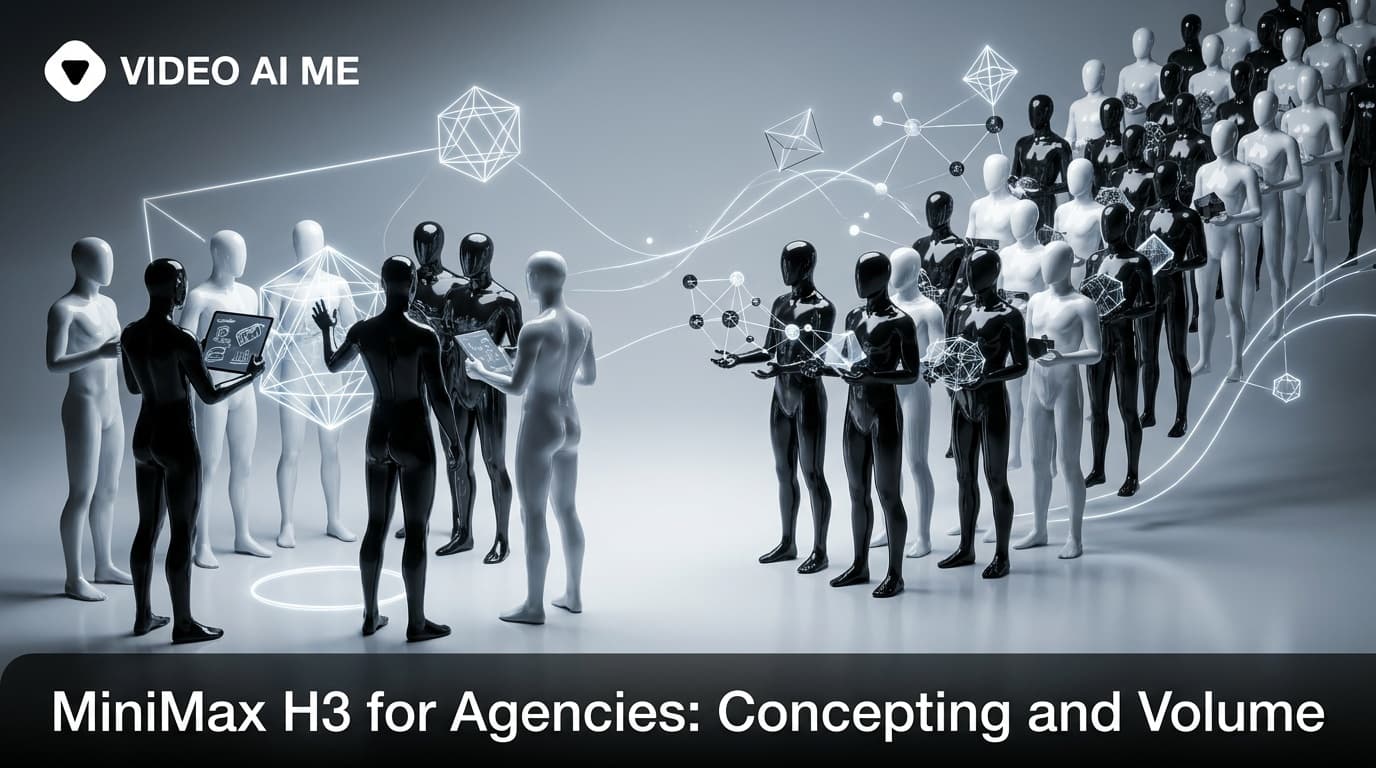
For agencies, a fast video model is useful in two specific places: concepting, where you need something a client can react to rather than a description they have to imagine, and volume, where an approved hero needs twenty variants nobody wants to spend a production day on.
It is not a replacement for production. It is a replacement for the waiting between an idea and a reaction.
Where does it actually help?
Concepting in the room. The gap between pitching three directions verbally and showing three rough clips is enormous. Clients respond to what they can see, and a five second draft of each direction turns an abstract debate into a concrete choice. Directions that sounded exciting in a deck often die instantly on screen, which saves everyone a month.
Variant production. Once a hero concept is approved, campaigns need the long tail: different hooks, different audiences, different placements, localised versions. This work is necessary and it was never a good use of a shoot day. Producing it on a fast model frees your production budget for the assets that deserve it.
Testing before committing. Running cheap creative tests before a shoot tells you which angle to build the expensive asset around. That reverses the usual order, where you produce first and learn afterwards.
Pitch work. Speculative creative for a new business pitch has never justified real production spend, which is why pitches lean on mood boards. Rough moving versions of your ideas are more persuasive than stills.
Where does it not help?
Worth being clear, because overselling this internally damages trust.
Hero brand films, where a client is paying for craft and a viewer will watch closely on a large screen. Anything requiring precise on screen typography, since lettering is unreliable across every model in this class. Anything where a specific real person's likeness is required. And anything where the client's brand guidelines demand a level of control that generation does not offer.
The useful internal position is that this is a tool for the first eighty percent of assets by count and none of the assets by prestige.
How should you handle the client conversation?
Early and directly. Two reasons.
First, trust. A client who discovers later that creative was generated, having not been told, will treat it as something you hid. A client told up front usually cares much less than you expect, particularly when the reason is that they get more variants and faster tests for the same fee.
Second, compliance. Platform rules on synthetic media and on ads featuring generated people change regularly and vary by region. Check the current guidance from Meta and TikTok for Business, and our FTC disclosure guide covers the broader picture. Some clients in regulated categories will have their own rules that are stricter than the platforms'.
Have the conversation before the first asset, not after the first question.
How does it change scoping and pricing?
This is the part agencies underestimate, so it is worth thinking about deliberately.
If your pricing is anchored to asset count, it gets squeezed, because producing the tenth variant is no longer meaningfully harder than producing the first. Clients will work that out.
If your pricing is anchored to strategy, testing and results, it holds up better, and arguably improves. You can now offer a genuine creative testing programme rather than a production schedule, and testing programmes are worth more to a client with real media spend than another batch of assets.
The agencies that struggle with this shift are the ones selling production hours. The ones that do well are selling judgement about what to make, and using cheap production to test that judgement more often.
What does a client workflow look like?
- Concept round. Three directions, one five second draft each, low resolution. Show the client. Kill two.
- Hook test. Five hooks within the surviving direction, identical production style, only the line changing. Run them as a real test with the client's media budget.
- Hero production. Build the winning angle properly, on whichever model or production route suits the deliverable.
- Variant matrix. Generate the long tail around the approved hero, keeping look consistent with reference images.
- Report. Which promise won and why, which is the output the client actually values.
Step two is where the value is, and it is only possible because steps one and four became cheap. The reasoning is in why iteration speed decides your ad creative.
How do you keep a look consistent across a client campaign?
Attach two to four reference images and the model carries the person and product through a batch, which is covered in how to use reference images. Fix your production style in a template prompt and change only the line, so the set looks like one campaign.
For a spokesperson who must be identical across every asset a client ships, the actor tools are more reliable than raw reference images. Know that before you promise a client a recurring face.
How do you brief a team to work this way?
The tooling is the easy part. Getting a creative team to change how they work is where this succeeds or stalls.
Separate concepting from crafting, explicitly. The most common failure is a creative treating a concept draft as a portfolio piece and spending a day on it. Make it clear that concept round output is disposable by design, generated at low resolution and short length, and judged only on whether the idea reads.
Make the template the deliverable. For variant work, the valuable artefact is not the clip, it is the prompt template with the variable fields marked. Once a template exists, a junior can produce the matrix and a senior reviews rather than builds.
Keep a house prompt library. Framing, lighting and sound lines that match each client's look, written once and reused. This is the agency equivalent of a lighting setup, and it is what makes output consistent across different people on the team.
Review muted, on a phone. Not on a colour accurate monitor in a dark room. The review conditions should match the viewing conditions or you will approve things that fail in a feed.
Decide what never gets generated. Write the list down: hero films, anything with precise typography, anything featuring a real named person. A clear boundary protects the work that deserves protecting and stops the tool creeping into places it does not belong.
What about the commercial terms?
Every paid plan carries a full commercial license, client work included, with no watermarks on the output. That matters for agency use because it means the assets you deliver are genuinely the client's to run.
Plans run from $29 a month with 1,400 credits through to $199 with 12,000, with annual billing available. Current detail is on the pricing page. For an agency running several client accounts, the higher tiers are usually the right starting point simply because variant work adds up.
Frequently Asked Questions
Where does a fast video model fit in agency work?
Concepting and volume. Showing a client three directions instead of describing them, and producing the variant matrix once a hero is approved.
Should we tell clients that creative is AI generated?
Yes, and early. Disclosure protects the relationship and platform rules on synthetic media vary by region, so the conversation has to happen anyway.
Does this replace our production partners?
No. It replaces the gap between an idea and something a client can react to, and it absorbs low value variant work that was never good use of a production day.
How does this change scoping and pricing?
Volume stops being the expensive part, so pricing anchored to asset count gets squeezed. Pricing anchored to strategy and testing holds up better.
Can we keep a consistent look across a client campaign?
Reference images carry a person and product through a batch. For a spokesperson who must be identical across everything, the actor tools are more reliable.
What should not be produced this way?
Hero brand films, anything needing precise on screen typography, and any asset where a viewer will watch closely on a large screen.
Try it on one account
Pick a client with real media spend and run one concept round this way before the next production cycle. Showing three directions instead of describing them changes the meeting, and that is the fastest way to find out whether this belongs in your process. The drafting routine is in how to draft a video ad in minutes.
Frequently Asked Questions
Share
AI Summary

Paul Grisel
Paul Grisel is the founder of VIDEOAI.ME, dedicated to empowering creators and entrepreneurs with innovative AI-powered video solutions.
@grsl_frReady to Create Professional AI Videos?
Join thousands of entrepreneurs and creators who use VIDEO AI ME to produce stunning videos in minutes, not hours.
- Create professional videos in under 5 minutes
- No video skills experience required, No camera needed
- Hyper-realistic actors that look and sound like real people
Get your first video in minutes
Related Articles

We Made a Super Bowl-Style Ad With Seedance 2.5
A 15 second mock luxury spot built in one Seedance 2.5 generation: six beats with timings and prompts, the real credit cost, and the creative logic behind it.
Seedance 2.0 for Marketing Agencies: 10x More Creatives Per Client
Seedance 2.0 agencies playbook: ship 10 times more creative variants per client per week without growing the team or the shoot budget.
FLUX 3 Max Cinematic Video: 21:9 Brand Films at 1080p
How to shoot a cinematic brand film with FLUX 3 Max: 21:9 at 1080p, 20 second single takes, camera language, sound design, copy-paste prompts and a cost table per shot.