
Seedance 2.0 Negative Prompts: What to Tell the Model NOT to Do
How to write Seedance 2.0 negative prompts that strip out music, logos, captions, and stock library leaks. Real examples and the universal closing line.
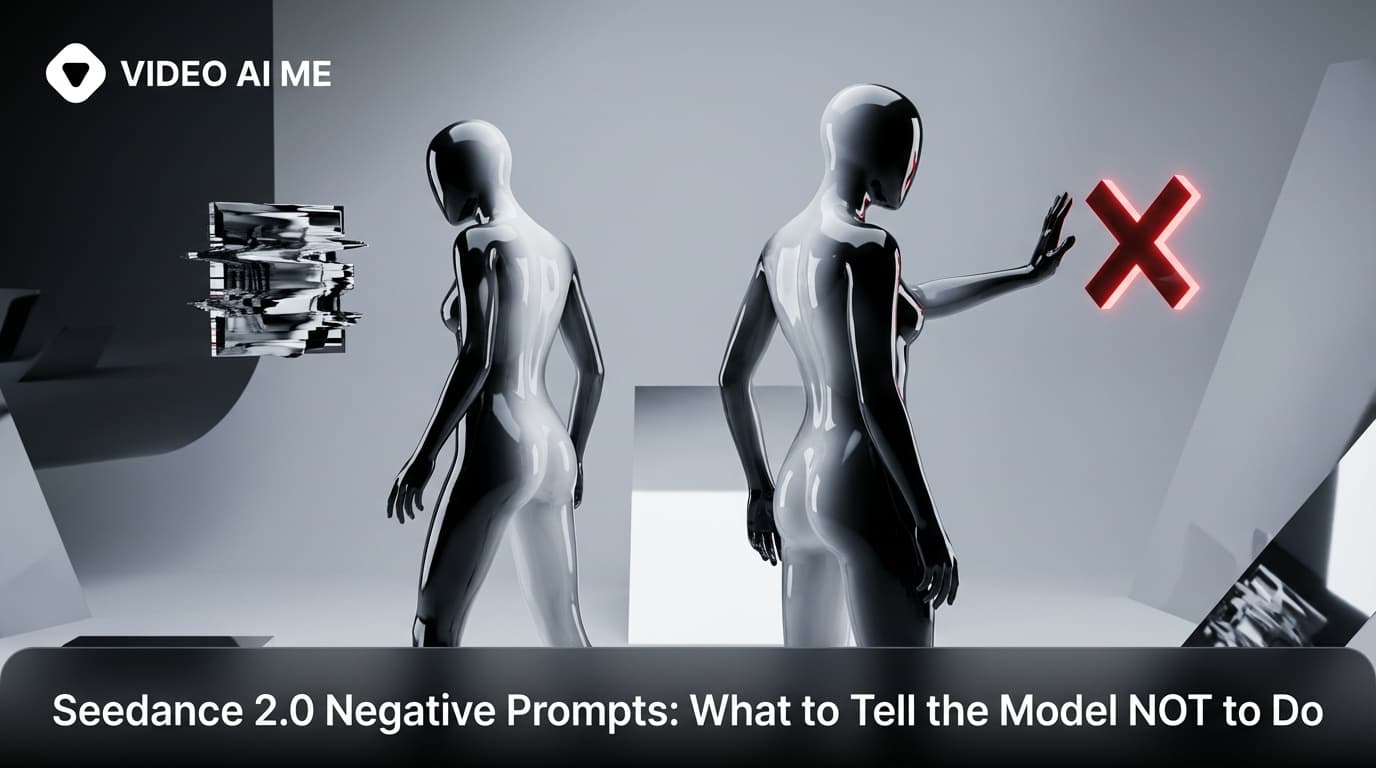
Why your AI clip has stock music you never asked for
Seedance 2.0 negative prompts are the difference between a clean ad and a clip with random library piano playing under your dialogue. You wrote a perfect prompt, hit generate, played the clip, and instantly there was background music you never requested. You did not ask for music. You did not want music. The model added it anyway.
This happens because Seedance 2.0 trained on millions of clips and a huge percentage of those clips had music baked in. When you do not tell the model what to leave out, it defaults to the most common pattern it has seen. The same thing happens with on screen captions, brand logos, watermarks, and stock voiceover tracks. They sneak in because they were in the training distribution.
The fix is the negative prompt: a short closing line that tells Seedance 2.0 explicitly what NOT to render. Every one of our four reference prompts (Adidas, Emma, Fortnite, VIDEO AI ME) ends with the same negative line. This guide gives you the universal closer plus five negative stack patterns for products, dialogue, neon noir, testimonials, and clean overlays.
The principle: end with what you do not want
Seedance 2.0 negative prompts work best as a single closing line that begins with a dash and lists each forbidden element by name. The universal nine word closer is "- No music, No logo, no text on screen." It strips library audio, auto generated brand marks, and baked in captions in one pass and works as the default closer for almost every UGC prompt.
The standard universal negative for UGC ads is the line below. It removes default watermarks, captions, and library music that would otherwise leak into the frame.
- No music, No logo, no text on screen.
Three negatives, one closing dash, total of nine words. This is the most useful nine words you can add to a UGC prompt and we end every Seedance 2.0 reference video with this exact line. Look back at the Adidas, Emma, Fortnite, and VIDEO AI ME prompts. All four use it verbatim.
Why these three. No music kills the default stock library audio. No logo prevents Seedance 2.0 from inventing a brand mark or sticker (this happens often when you mention products by name). No text on screen strips out the auto generated captions, lower thirds, and chyron style overlays the model has seen in training and assumes you want.
The order matters less than the presence of all three. The leading dash is also a stylistic choice that helps the model parse the negative section as separate from the positive description. You can use a colon or a comma if you prefer, but the dash is what we use across every Seedance 2.0 prompt at VIDEO AI ME.
Negatives also work for visual elements you do not want in the frame. No people in the background. No cars. No phones visible. No watermark. Each one is a small instruction the model treats as a hard boundary. Stack the ones you need.
Reference 1: The universal UGC negative
All four of our reference prompts end with the same line. Look at the Adidas prompt as the example.
UGC creator, energetic Black man in his twenties standing in a concrete skatepark at golden hour, holding a brand new pair of white and neon green sneakers. He lifts them close to the camera lens, rotates them slowly saying: "Bro look at these. Feel that material." He drops them on the ground, slides his foot in, stomps twice, then jogs three steps and stops. He turns back to camera: "Insane comfort." Filmed with iPhone, warm sunset backlight, slight lens flare, handheld. - No music, No logo, no text on screen.
Why this works: the full positive prompt is 90 words. The negative line is 9 words. That ratio is healthy. The negatives sit at the end where the model parses them right before it commits to the render. Without that line, this clip would likely come back with a soft piano track and a generated brand watermark stamped on the sneaker.
If you want to feel the difference yourself, paste this into VIDEO AI ME once with the negative line and once without. The two clips will look like they came from different products.
Pattern 2: Visual element negatives for clean product shots
For product hero shots you usually want a clean frame with nothing distracting. Add visual negatives.
Product hero shot, ceramic coffee mug on a slate stone slab in a minimalist studio. Slow dolly in from a wide shot to a medium close up, shallow focus on the mug rim, soft window key light from the left, palette of slate gray, warm cream, espresso brown. Filmed in 720p. - No music, no logo, no text on screen, no people in the background, no other objects on the slab, no watermark.
Why this works: six negatives. The first three are the universal trio. The next three are scene specific. No people in the background prevents Seedance 2.0 from inventing a barista or a customer in the corner. No other objects on the slab prevents the model from adding a spoon or a sugar packet next to the mug. No watermark covers any auto generated brand stamps the model might add to the mug itself.
Pattern 3: Audio negatives for dialogue clips
When you have dialogue in your prompt, the worst thing is for the model to also add background music that fights the line. Stack audio negatives.
UGC creator, woman in her thirties sitting at a kitchen table with a coffee, looks up at the camera and says: "Honestly this is the only one I have stuck with for more than a week." Filmed with iPhone, soft daylight from a window, handheld, palette of cream, beige, espresso brown. - No music, no background music, no library audio, no voiceover narration, no logo, no text on screen.
Why this works: the audio negatives are stacked. No music. No background music. No library audio. No voiceover narration. Saying it four ways might feel redundant but it is not. Each phrase catches a slightly different audio default. Music is general. Background music targets the soft underscore. Library audio targets the stock track patterns. Voiceover narration prevents Seedance 2.0 from adding a second voice on top of your dialogue.
Pattern 4: Caption and overlay negatives for clean frames
Seedance 2.0 sometimes adds captions, subtitles, brand logos, and lower thirds because those things appeared in its training data. Strip them all.
Wide shot of a woman in a yellow raincoat walking across a wet city street at night, hot pink neon sign behind her, slow tracking shot from the side. Filmed with iPhone, neon noir lighting, palette of magenta, cyan, deep blue, wet black asphalt. - No music, no logo, no text on screen, no captions, no subtitles, no brand watermark, no lower third graphic.
Why this works: seven negatives. The trio plus four more text and overlay specific cues. If your clip is destined for an ad account where you will add your own captions in post, you need to strip every kind of text the model might bake in. This is the cleanest way to get a frame with nothing pre rendered on top.
Once you have one clean clip, open VIDEO AI ME and run the prompt again with a different city and palette. Save both as variants.
Pattern 5: Background element negatives for testimonials
For testimonial style clips you want focus on the speaker, not on a busy background. Use scene negatives.
UGC creator close up, woman in her thirties on a couch in a softly lit living room at night, single warm table lamp on her right, looks at camera and says: "Day forty seven and I am genuinely sleeping through the night." Filmed with iPhone, handheld, palette of warm amber, cream, walnut brown. - No music, no logo, no text on screen, no other people in the frame, no pets, no TV in the background, no cluttered background.
Why this works: the last four negatives clean up the background. No other people. No pets. No TV. No cluttered background. Without these, Seedance 2.0 will sometimes add a second person on the couch, a dog at her feet, or a glowing TV behind her, all of which pull focus from the testimonial. Naming the things you do NOT want is faster than describing every empty corner of the room.
For more prompting techniques and the full Seedance 2.0 series, browse the VIDEO AI ME blog and check the features page.
Common negative prompt mistakes
- Skipping the negative line entirely. Defaults will leak in. Always close with at least the universal trio.
- Putting negatives at the start of the prompt. They work better at the end where the model parses them last.
- Writing too many negatives. Stick to three to six. More than that and the model spends budget rejecting things instead of rendering the positive.
- Saying the same thing twice. No music, no music, no music does not stack. Use different phrasings (no music, no background music, no library audio).
- Forgetting visual negatives. Audio is not the only thing the model defaults to. Brand logos, captions, and background clutter are just as common.
- Using vague negatives like nothing weird. Be specific. No watermark, no captions, no other people, no cars.
How to apply this on VIDEO AI ME
Negative prompts work in every Seedance 2.0 generation on VIDEO AI ME. Paste any prompt that ends with a negative line and the model will respect it. We bake the universal UGC closing line into our default templates so you do not have to remember it every time. For a specialized negative stack (audio heavy for dialogue, visual heavy for product shots) save the closer as a snippet and append it to new prompts. The voice cloning, 300+ AI actor library, and 70+ language support all run on top of the same prompt structure, so the negatives carry through.
Wrapping up
Negative prompts are the unsung hero of clean Seedance 2.0 generations. The universal nine word closer (- No music, No logo, no text on screen) handles 90% of cases. Stack additional negatives for product, dialogue, neon, and testimonial scenes. Try Seedance 2.0 free on VIDEO AI ME and stop letting the model decide what your clips should and should not contain.
More Seedance 2.0 prompts to study
The four reference videos used throughout this guide (a multi shot street interview, a skatepark product UGC, an unboxing narrative with a timelapse, and a high energy gamer reaction) live as a full copyable library on Seedance 2.0 Prompt Templates: Copy Paste and Ship. Bookmark it and remix any of the four when you need a starting point.
Related Seedance 2.0 guides on VIDEO AI ME
If you want to go deeper, these guides pair well with this one:
- Unboxing Videos With Seedance 2.0: The Emma Mattress Pattern
- Seedance 2.0 AI Testimonial Videos That Do Not Look Fake
- Seedance 2.0 Street Interview Videos: The VIDEO AI ME Format
- Seedance 2.0 for E commerce: Product Videos That Sell
You can also browse the full VIDEO AI ME blog for more AI video tutorials, or jump straight into the product and try Seedance 2.0 free on VIDEO AI ME with no credit card.
Frequently Asked Questions
Share
AI Summary
Paul Grisel
Paul Grisel is the founder of VIDEOAI.ME, dedicated to empowering creators and entrepreneurs with innovative AI-powered video solutions.
@grsl_frReady to Create Professional AI Videos?
Join thousands of entrepreneurs and creators who use VIDEO AI ME to produce stunning videos in minutes, not hours.
- Create professional videos in under 5 minutes
- No video skills experience required, No camera needed
- Hyper-realistic actors that look and sound like real people
Get your first video in minutes
Related Articles

How to Run MiniMax H3 Without a GPU
MiniMax H3 has public weights, so people try to self host it. Here is what that actually costs in hardware and time, and the browser route if you just want the clips.
Writing Sound and Dialogue in MiniMax H3 Prompts
Audio is generated with the picture, so it is yours to direct. How to write dialogue, ambience and silence, and how much speech actually fits in a short clip.
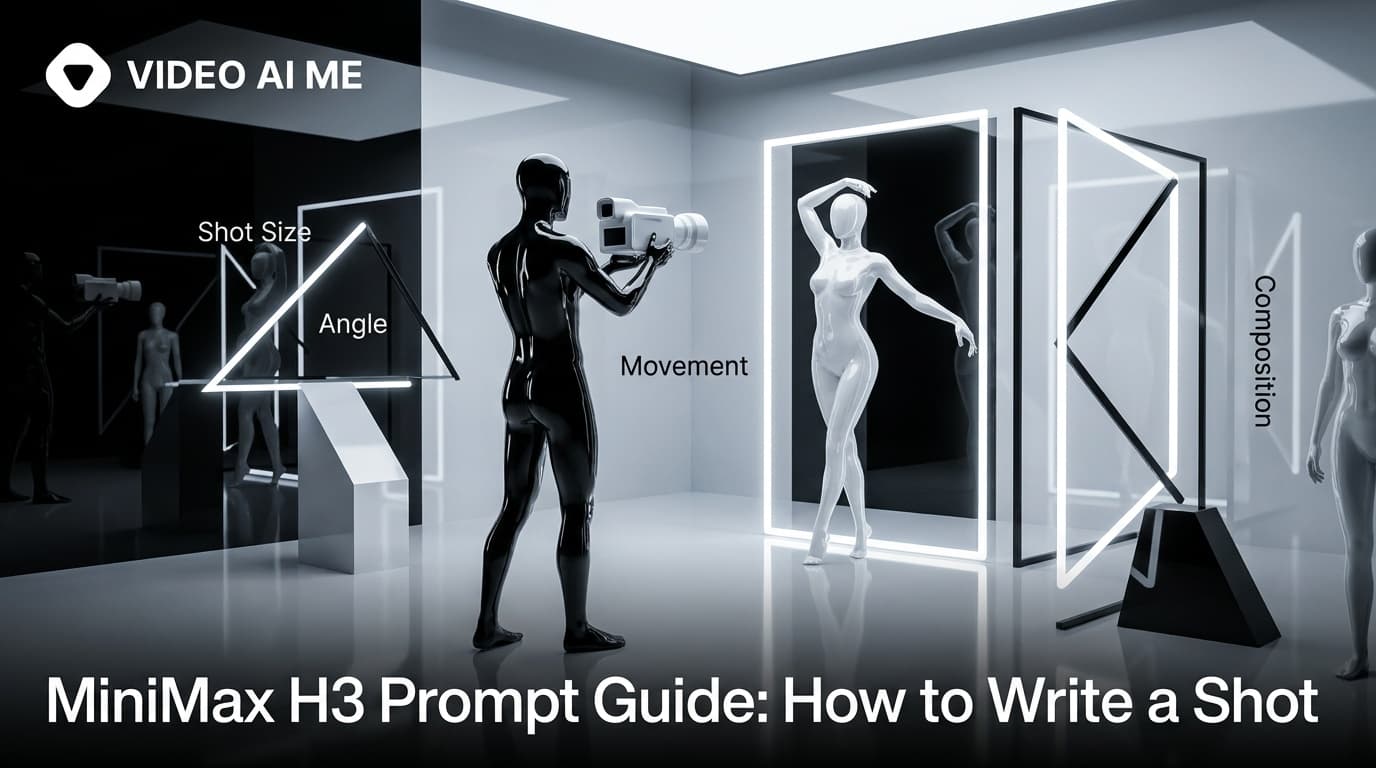
MiniMax H3 Prompt Guide: How to Write a Shot
The five part structure that gets usable clips out of MiniMax H3, why keyword lists fail, and how to write the sound as deliberately as the picture.