
What Is the AI Korean Baseball Trend? The 2026 Fan Cam Phenomenon Explained
The AI Korean baseball trend swept social media in May 2026, putting strangers in fake KBO crowd shots that look exactly like live broadcast footage.
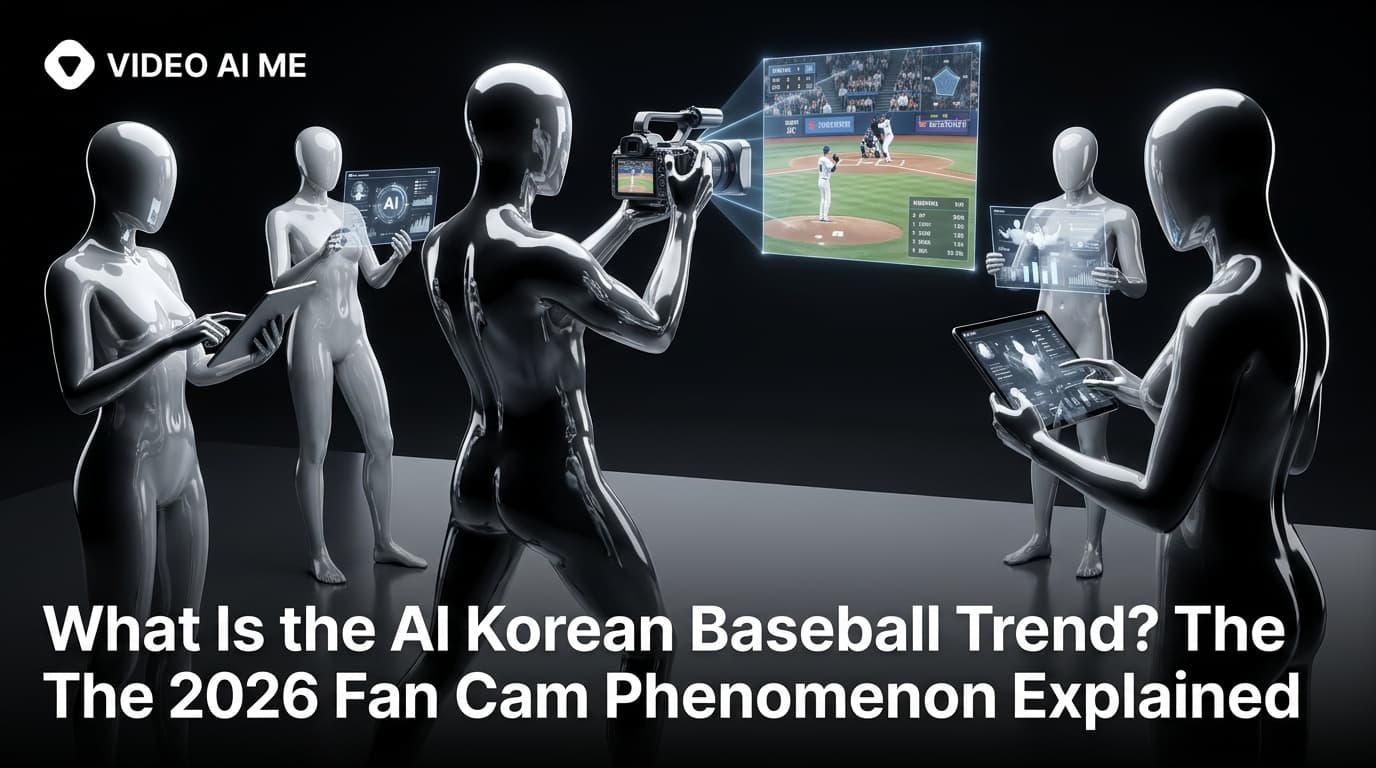
The AI Korean Baseball Trend in One Sentence
The AI Korean baseball trend is the viral 2026 format where ordinary people use generative AI to fake a Korean baseball broadcast catching them in the crowd. The output is a 5-second clip that looks exactly like a real KBO live feed accidentally panned across a beautiful spectator in the stands.
If you have scrolled Instagram, TikTok or X in May 2026, you have seen one. The aesthetic is unmistakable: white off-shoulder top, jeans, glowing skin, scoreboard graphics in the corner, the slight motion blur of a real broadcast camera. The only thing missing is the actual stadium.
This post walks through what the trend is, how it started, who is making it, and where it is going next.
How the Trend Looks and Feels
A typical AI Korean baseball trend video is short. Around five seconds. It opens on a young person in a stadium seat, captured from a slight downward angle as if a real broadcast camera in the press box just panned across them. The subject is either watching the game with quiet intensity, sighing in mock frustration, or laughing with friends. The KBO scoreboard graphics float over the bottom of the frame.
The trick is that none of it is real. Not the stadium. Not the scoreboard. Sometimes not even the person.
This is the same fan cam aesthetic Korean broadcasters have leaned on for years. The "beauty cut" tradition in KBO broadcasts deliberately panned to attractive spectators during downtime. Generative AI took that visual language and turned it into a meme template that any phone owner can run in a few minutes.
The Stadium Goddess Moment
No single clip launched the AI Korean baseball trend, but one made it impossible to ignore. In early May 2026 a 5-second video of a woman in a white off-shoulder top watching a Hanwha Eagles vs Doosan Bears game racked up roughly 8 million views, with the original X post hitting close to 15 million. Commentators dubbed her the Stadium Goddess.
Then baseball nerds checked the scoreboard.
The overlay listed Kim Seo-hyun pitching against Jo In-sung. Jo retired in 2017 and never played for Doosan. Banner text and smartphone shapes elsewhere in the frame were warped in the small ways AI still gives itself away. The clip was synthetic. The Stadium Goddess did not exist. Korean media wrote it up, and the trend became a story about itself.
The Korea Times framed the moment as a turning point: AI video has become so good that logical data errors, not visual artifacts, are now the main way to spot a fake. That single observation propelled the AI Korean baseball trend from a niche Korean meme into a global format that anyone could try.
Who Is Making These Videos
The early creators were Korean. The breakout creators were not.
Instagram user @somdattaaa posted one of the first viral non-Korean entries on May 10, 2026 and pulled roughly 159,000 likes in two days. A day later @thisenola hit around 358,000 likes on a single clip. @akita_hooligan went viral by putting a dog in the seat. By the second week of May, the format had jumped to basketball, F1, soccer and concert footage, with creators like @ssilanursss, @mineeva_n1 and @armanevalois pushing variations.
Know Your Meme catalogued the format as the KBO TV / Korean AI Courtside Trend on May 12, 2026. By then the genie was out. Reels For You pages in the United States started recommending the trend to users who had never watched a baseball game in their lives.
For more on the timeline, see our day-by-day breakdown.
How the Trend Is Made
Most creators chain two or three tools. The default stack looks like this:
- ChatGPT or Gemini for the still image. The prompt asks for a candid KBO broadcast screenshot with imperfect lighting, slight motion blur, compression noise and a natural crowd composition. The negative prompt explicitly rejects influencer polish and enlarged eyes.
- Kling AI, Sora or Veo 3 for the motion. The still image becomes the first frame. A short prompt adds a sigh, a smile, a cheer or a glance to camera.
- CapCut or similar for the final 9:16 crop and caption overlay.
It works. It also takes time, juggles three account logins, hits separate paywalls and rarely outputs the dual 16:9 and 9:16 cuts that creators actually need to publish across TikTok, Reels and YouTube horizontal in one session.
That is where VIDEO AI ME comes in. You build an AI actor that speaks any language, then generate clips in 16:9 and 9:16 from one workflow. No chaining, no tab juggling, no separate exports per platform. If you want to repeat the AI Korean baseball trend look without rebuilding your stack from scratch every time, try a free generation on VIDEO AI ME and see how the pipeline feels in practice.
Why This Trend, Why Now
The AI Korean baseball trend did not appear in a vacuum. Three forces lined up in May 2026.
KBO had its biggest season ever. Streaming partner Tving reported viewership up roughly 30 percent year over year, with women in their 20s overtaking male viewers for the first time. Stadium attendance hit sellouts on opening day. Baseball was already cultural infrastructure when the meme arrived.
At the same time, generative video tools crossed a quality threshold. Kling and Sora updates earlier in 2026 made short broadcast-style clips look broadcast-real. The Stadium Goddess clip would not have been credible a year earlier.
Finally, the desire was there. Korean broadcast culture has trained millions of viewers to associate the broadcast camera spotlight with social validation. AI gave them a way to grant themselves that spotlight on demand.
We break down why women aged 20-30 drove the trend in a separate post.
Platforms Where the Trend Lives
The trend touched almost every major platform, but the centers of gravity were clear.
Instagram Reels is where the global breakout happened. The 9:16 format and the For You page algorithm rewarded the candid broadcast aesthetic. @somdattaaa and @thisenola both hit six-figure likes there.
TikTok picked the trend up second and remixed it fastest, with creators stacking the AI clip against real KBO footage and dropping audio overlays.
X (Twitter) is where the Stadium Goddess clip first detonated and where the AI exposure also happened. The platform's combination of fast share velocity and crowdsourced fact-checking made it the perfect host.
YouTube Shorts caught the trail end as creators repurposed their best 9:16 clips for the horizontal-friendly Shorts feed.
This is exactly the kind of multi-platform play where a 16:9 plus 9:16 dual export workflow earns its keep. Single workflow, four publishing destinations.
The Controversies Around the Trend
Not everyone is delighted by the AI Korean baseball trend. The Korea Times and Seoul Economic Daily both ran skeptical pieces. Critics raised three concerns.
First, consent. Some creators generated clips of real public figures in stadium seats they never visited. Korean media reported on at least one celebrity, Maeng Seung-ji, becoming the center of an AI-generated controversy after a fake clip suggested unsportsmanlike behavior. The clip was synthetic.
Second, labeling. South Korea's AI Basic Act, in force since January 2026, requires AI-generated media to carry disclosure labels. The law applies to companies, not individuals, which leaves user-generated content in a regulatory gap.
Third, beauty standards. The format almost exclusively features conventionally attractive young women, which several Korean commentators argued reinforces narrow beauty norms rather than challenging them. We cover this debate in the ethics breakdown.
Beyond the Trend: Building Something That Lasts
Here is the part most creators miss. One viral AI Korean baseball clip is a moment. A repeatable workflow that outputs your AI actor across every platform every week is a business.
The creators who will look back on May 2026 as a turning point are not the ones who posted a single Stadium Goddess remix. They are the ones who used the trend as a stepping stone into a personal brand engine. Same AI actor, new format every week, consistent voice, consistent face, dual-format output for every platform their audience uses. That is the play. The AI Korean baseball trend is the hook. Your brand is the hand on the rod.
What the Trend Means for Creators
If you create content for a living or a side hustle, the AI Korean baseball trend is a useful preview of where the next twelve months go. Expect more meme formats built around faking the affordances of professional production. Expect platform algorithms to keep rewarding video that looks like it has been caught rather than made. Expect dual-format publishing to stop being optional.
The tools to participate are widely available. The skill is no longer technical, it is editorial: knowing what hook lands, what aesthetic feels real, what story your AI actor should tell next week. The faster you can iterate, the faster you learn.
Try the Format Without the Tool Stack
If you want to ride the AI Korean baseball trend without juggling four tools, an AI actor workflow built for repeat output is the shortcut. Pick a face, write a 15-second beat sheet, generate in 16:9 and 9:16, post across TikTok, Reels and Shorts the same hour.
Try VIDEO AI ME for free and see if it fits how you want to work. The trend will fade. Your AI actor will not.
Frequently Asked Questions
Share
AI Summary

Paul Grisel
Paul Grisel is the founder of VIDEOAI.ME, dedicated to empowering creators and entrepreneurs with innovative AI-powered video solutions.
@grsl_frReady to Create Professional AI Videos?
Join thousands of entrepreneurs and creators who use VIDEO AI ME to produce stunning videos in minutes, not hours.
- Create professional videos in under 5 minutes
- No video skills experience required, No camera needed
- Hyper-realistic actors that look and sound like real people
Get your first video in minutes
Related Articles
MiniMax H3 UGC Prompt Templates for Ad Creative
Reusable UGC prompt templates with the variables marked, so you can produce a whole batch of creator style ads by swapping four fields.
Seedance 2.5 UGC Prompt Templates for Ads
Six fill in the blank UGC prompt templates for Seedance 2.5, each with a fully filled worked example, plus how to direct dialogue when the audio is generated.
How to Make AI UGC Videos With Seedance 2.5
A five step playbook for creator style UGC clips with Seedance 2.5: casting, prompts that carry the spoken hook, reference images for batches, and the credit math.