
FLUX 3 Max vs Happy Horse 1.1: Cost, Length, Use Cases
Happy Horse 1.1 costs less per second at 720p and 1080p. FLUX 3 Max runs to 20 seconds. Here is the cost per usable clip math and a test to settle it on your brief.
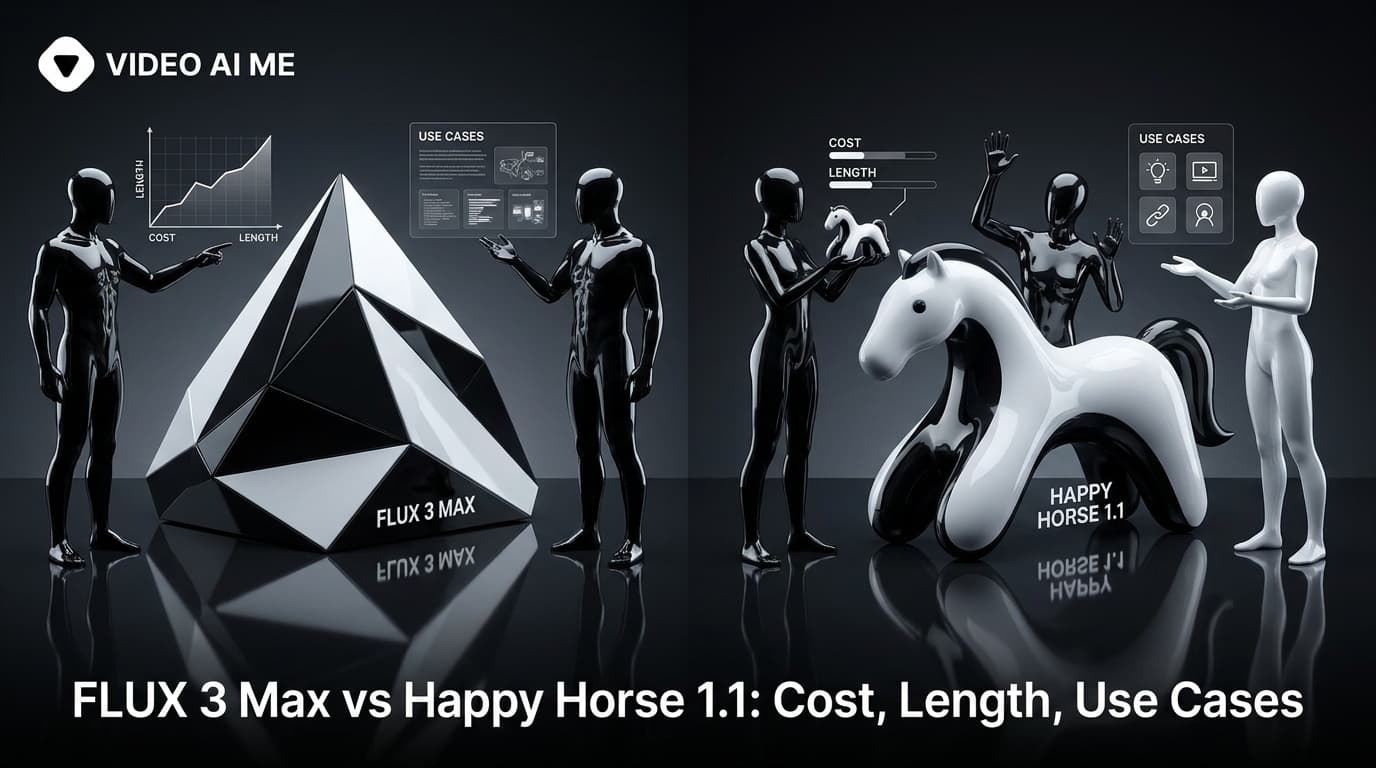
FLUX 3 Max vs Happy Horse comes down to length versus price. On VIDEO AI ME, Happy Horse 1.1 costs less at both shared tiers, 14 credits per second at 720p and 18 at 1080p, for clips of 3 to 15 seconds. FLUX 3 Max costs 17 and 29 and runs to 20 seconds. Both generate sound.
The two models overlap more than most pairs in the picker. Both do text to video and image to video, both render 720p and 1080p, and both return clips with generated audio. That makes the choice sharper, not harder: on paper Happy Horse 1.1 is the cheaper option at every resolution both offer, and FLUX 3 Max has to earn its place on length and on the developers' claims. Here is how to tell which applies to your brief.
FLUX 3 Max vs Happy Horse: how do the specs compare?
| Spec on VIDEO AI ME | FLUX 3 Max | Happy Horse 1.1 |
|---|---|---|
| Maker | Black Forest Labs | Alibaba |
| Modes | Text to video, image to video (your image is the start frame) | Text to video, image to video |
| Clip length | 5 to 20s | 3 to 15s |
| Resolutions | 720p, 1080p | 720p, 1080p |
| Audio | Generated in the same pass, always on | Generated |
| Credits per second | 17 at 720p, 29 at 1080p | 14 at 720p, 18 at 1080p |
The spec rows that differ are length and price. Happy Horse 1.1 reaches shorter, down to 3 seconds, and costs less per second. FLUX 3 Max reaches longer, up to 20 seconds in a single generation.
On FLUX 3 Max, the editor offers 5, 8, 10, 12, 15 and 20 second durations and aspect ratios of auto, 9:16, 16:9, 1:1, 4:3, 3:4 and 21:9. Auto renders 16:9 for text to video and follows your image for image to video. The guide to FLUX 3 Max durations and aspect ratios goes through each one.
Which is cheaper, FLUX 3 Max or Happy Horse 1.1?
Happy Horse 1.1, at both resolutions. At 720p it costs 14 credits per second against 17 credits per second for FLUX 3 Max. At 1080p the gap widens: 18 against 29. One credit is one cent of generation cost.
| Clip length | Happy Horse 1.1 720p | Happy Horse 1.1 1080p | FLUX 3 Max 720p | FLUX 3 Max 1080p |
|---|---|---|---|---|
| 3s | 42 credits | 54 credits | Not offered | Not offered |
| 5s | 70 credits | 90 credits | 85 credits | 145 credits |
| 8s | 112 credits | 144 credits | 136 credits | 232 credits |
| 10s | 140 credits | 180 credits | 170 credits | 290 credits |
| 12s | 168 credits | 216 credits | 204 credits | 348 credits |
| 15s | 210 credits | 270 credits | 255 credits | 435 credits |
| 20s | Not offered | Not offered | 340 credits | 580 credits |
One number stands out. Happy Horse 1.1 at 1080p, at 18 credits per second, costs only one credit per second more than FLUX 3 Max at 720p. If 1080p matters and the clip fits inside 15 seconds, that is a real argument for Happy Horse 1.1.
In ten second clips at 1080p, a Starter plan's 1,400 credits cover 7 on Happy Horse 1.1 and 4 on FLUX 3 Max. A Pro plan's 5,600 credits cover 31 and 19. A Premium plan's 12,000 credits cover 66 and 41. The VIDEO AI ME pricing page lists the plans, and the FLUX 3 Max pricing breakdown covers every duration.
How do you work out cost per usable clip?
A per-second rate is the price of a take, not the price of a clip you would run. If a brief needs two takes before you get one you would ship, the real cost doubles. That is the only way FLUX 3 Max can come out cheaper than Happy Horse 1.1, so it is worth doing the arithmetic.
Take a ten second clip at 1080p. One FLUX 3 Max take costs 290 credits. One Happy Horse 1.1 take costs 180. FLUX 3 Max only wins on cost if Happy Horse 1.1 needs about 1.6 takes or more for every take FLUX 3 Max needs to land the same brief. At 720p the break-even is tighter, about 1.2 takes, because the rates are closer: 170 against 140.
Nobody can tell you from a spec sheet which side of that line your brief falls on. It depends on your product, your prompt and how strict your standard is. The test below is how you find out, and it is the only number that should settle the decision.
What do its developers claim for FLUX 3 Max?
FLUX 3 Max is a post-trained variant of Black Forest Labs' FLUX 3 Video, which its developers describe as tuned for stronger prompt adherence and better visual quality, and optimized for lower latency. These are the developers' claims, and the reroll arithmetic above is where they would show up in your budget if they hold.
FLUX 3 Max also reasons about your prompt and expands it before rendering, so a short prompt still produces a full shot. Anything you leave open gets filled in, so write down every detail that matters: the product colour, the action, the exact line.
When should you pick Happy Horse 1.1 over FLUX 3 Max?
Happy Horse 1.1 has the stronger case on paper for a lot of everyday ad work.
When the clip is 15 seconds or less and budget is the constraint. At every shared duration and resolution, it is the cheaper take. For a high volume of short clips, that adds up across a month.
When you want 1080p at close to 720p money. At 18 credits per second, 1080p Happy Horse 1.1 costs one credit per second more than 720p FLUX 3 Max.
When the clip is very short. Happy Horse 1.1 goes down to 3 seconds. A hook test, a reaction beat or a cutaway often needs only a few seconds, and you do not have to pay for five. YouTube Help lists bumper ads at between 5 and 6 seconds, and a 5 second clip from either model fits that format.
When you are drafting concepts. Cheaper takes at 720p mean more angles tested for the same spend, before you decide which concept deserves a final render.
The Happy Horse review covers the model on its own terms.
When should you pick FLUX 3 Max over Happy Horse 1.1?
When the beat needs 16 to 20 seconds. Happy Horse 1.1 stops at 15. FLUX 3 Max generates up to 20 seconds in one pass, which is room for a spoken hook, a product moment and a reaction without cutting.
When your test shows fewer rerolls on your brief. If FLUX 3 Max lands your product, action and line in fewer takes, the arithmetic above can flip the cost comparison. That is the practical meaning of the developers' prompt adherence claim.
When you want one model for every length up to 20 seconds. Keeping every cut of a campaign, from the 5 second cutdown to the 20 second version, on one model means one prompt style and one set of test results to manage.
How do you test FLUX 3 Max against Happy Horse 1.1 yourself?
Keep everything identical except the model, and count takes, not just impressions.
- Choose a real brief inside both models' range: 10 seconds, 9:16, text to video.
- Write one prompt in four parts, in this order: subject and action, camera, light and look, then sound.
- Render it on both at 720p, three takes each. That is 510 credits on FLUX 3 Max and 420 on Happy Horse 1.1.
- For each take, mark it usable or not on the same four checks. Is the product right? Is the action what you wrote? Is the line spoken word for word? Does the sound match the action?
- Divide each model's spend by its usable takes. That is your cost per usable clip, and it is the number to compare.
A prompt for the test:
A man in his forties laces up a pair of grey trail shoes on a wooden porch step, stands, and bounces once on his toes. Handheld, low angle, slow tilt up from the shoes to his face. Early morning light from the right, cool natural grade. He says, "Right, let's see what these can do." Birdsong, the creak of the porch boards, the tap of the laces, no music.
Ten seconds holds about 20 to 25 spoken words, so keep the line short. Test at 720p, then deliver at 1080p once you know which model wins; the guide to FLUX 3 Max at 1080p vs 720p explains that step.
On both models, watch the generated speech and lip sync before a clip goes live. And keep on-screen text and logos out of the prompt: small text and exact logos inside generated frames are unreliable on every video model, so add them after export, in your own editing tool.
What are the limits of FLUX 3 Max to plan around?
| Limit | FLUX 3 Max on VIDEO AI ME | What to do |
|---|---|---|
| Longest single clip | 20 seconds | Split longer pieces into scenes, join them in the editor |
| Shortest clip | 5 seconds | Use Happy Horse 1.1 for 3 or 4 second clips |
| Reference input | One image, as the start frame | Use Seedance 2.5 or MiniMax H3 Max for several references |
| Your own audio track | Not accepted | Boreal takes an uploaded track |
| Generated audio | Always on | Replace the track with your own audio afterwards |
FLUX 3 Max vs Happy Horse: which should you choose?
- 15 seconds or less, lowest cost per take: Happy Horse 1.1.
- 1080p on a tight budget: Happy Horse 1.1, at 18 credits per second.
- Clips of 3 or 4 seconds: Happy Horse 1.1.
- 16 to 20 seconds in one generation: FLUX 3 Max.
- Anything else: run the three-take test and compare cost per usable clip.
Both are in the same picker, so you can split a campaign between them. For vertical placements, check the current creative specs on TikTok for Business and Meta for Business before you lock durations.
Frequently Asked Questions
Is FLUX 3 Max better than Happy Horse?
Neither wins on every line. On VIDEO AI ME, Happy Horse 1.1 costs less per second at 720p and 1080p and goes down to 3 seconds. FLUX 3 Max runs up to 20 seconds. Run the same prompt on both and compare cost per usable clip.
What is Happy Horse 1.1?
Happy Horse 1.1 is a video model from Alibaba. On VIDEO AI ME it does text to video and image to video, renders 720p or 1080p, generates clips of 3 to 15 seconds with sound, and costs 14 credits per second at 720p and 18 at 1080p.
Which is cheaper, FLUX 3 Max or Happy Horse 1.1?
Happy Horse 1.1. It costs 14 credits per second at 720p against 17 credits per second for FLUX 3 Max, and 18 at 1080p against 29. A 10 second 1080p clip is 180 credits on Happy Horse 1.1 and 290 on FLUX 3 Max.
How long can Happy Horse videos be?
On VIDEO AI ME, Happy Horse 1.1 generates clips of 3 to 15 seconds. FLUX 3 Max generates 5 to 20 seconds in one pass. For anything longer on either model, generate separate scenes and join them in the editor.
Do FLUX 3 Max and Happy Horse both generate audio?
Yes. Both return clips with generated sound. On FLUX 3 Max audio is always on and covers ambience, effects, music and any spoken lines you write into the prompt. To replace it, swap in your own audio afterwards.
Which is better for short video ads?
For clips of 15 seconds or less, Happy Horse 1.1 is the cheaper take at both resolutions, and it goes down to 3 seconds for hooks and cutaways. For clips of 16 to 20 seconds, FLUX 3 Max is the one of the two that covers them in one generation.
Frequently Asked Questions
Share
AI Summary

Paul Grisel
Paul Grisel is the founder of VIDEOAI.ME, dedicated to empowering creators and entrepreneurs with innovative AI-powered video solutions.
@grsl_frReady to Create Professional AI Videos?
Join thousands of entrepreneurs and creators who use VIDEO AI ME to produce stunning videos in minutes, not hours.
- Create professional videos in under 5 minutes
- No video skills experience required, No camera needed
- Hyper-realistic actors that look and sound like real people
Get your first video in minutes
Related Articles
FLUX 3 Max Cinematic Video: 21:9 Brand Films at 1080p
How to shoot a cinematic brand film with FLUX 3 Max: 21:9 at 1080p, 20 second single takes, camera language, sound design, copy-paste prompts and a cost table per shot.
FLUX 3 Max Meta Ads: A Creative Testing Workflow
How to feed a Meta creative test with distinct FLUX 3 Max variants: credit budgets per asset, 720p drafts, 1080p winners, placement ratios and one-variable prompts.

FLUX 3 Max for Agencies: Client Volume and Cost per Ad
How agencies can price, draft and deliver client video with FLUX 3 Max: cost per deliverable, the 720p draft and 1080p final workflow, and keeping a batch on brand.