
Kling AI Pricing Guide 2026: Every Tier, Every Route, Every Cost Explained
The complete Kling AI pricing breakdown for 2026. Direct app pricing, fal.ai API costs, VIDEOAI.ME subscription plans, and the math for teams at every volume level.
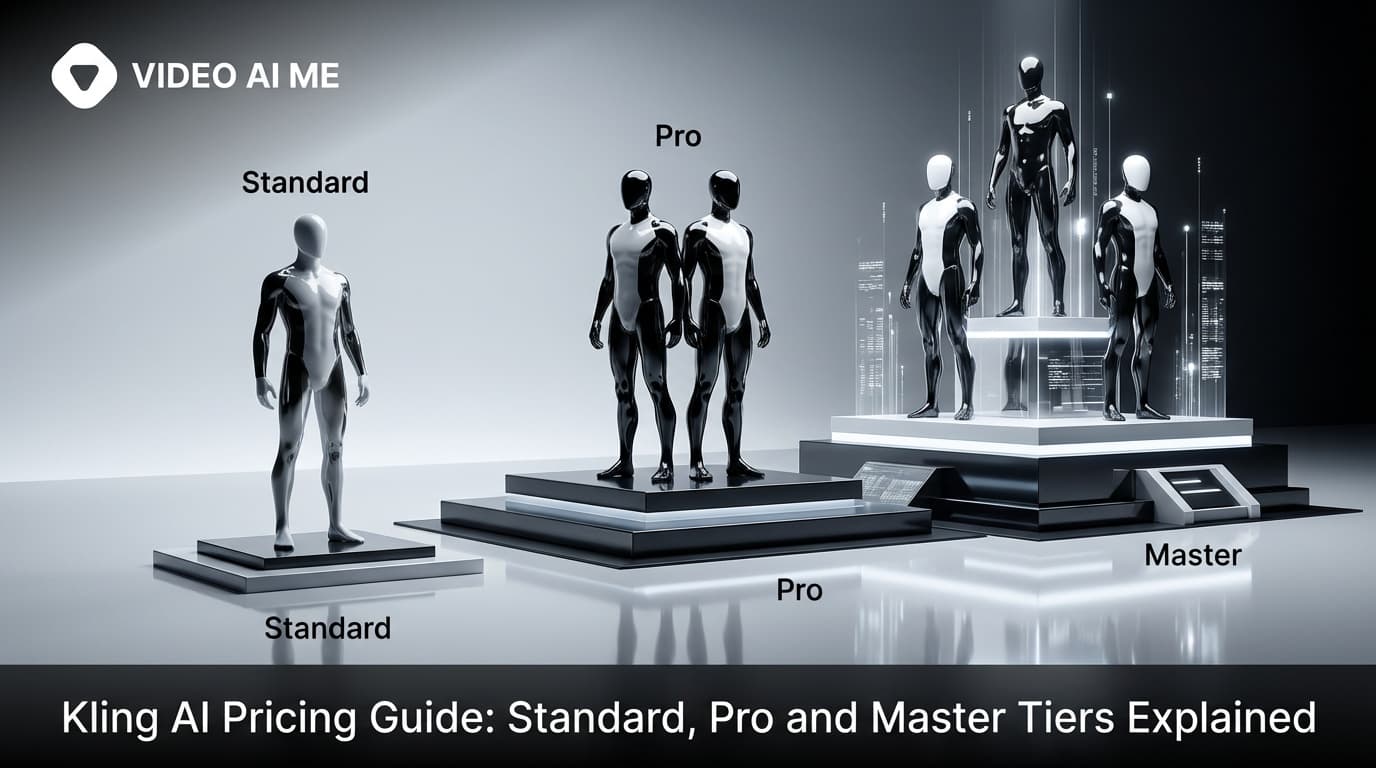
Kling AI Pricing Is Confusing. This Guide Fixes That.
Kling AI pricing varies by version, tier, and access route. Most pricing pages are vague. This guide gives you the actual numbers based on real production billing data from 2026.
The Three-Tier Quality Structure
Kling AI exposes three quality tiers across its model versions:
- Standard. Fastest generation, lowest cost, lower quality. Best for b-roll and exploration.
- Pro. Production-grade quality. The default for ad creative and professional work.
- Master. Highest quality. Best for hero shots and premium creative.
The two most-shipped versions in 2026 are Kling 2.6 Pro and Kling 3.0.
Complete Cost-Per-Second Table (fal.ai API)
These are approximate prices on fal.ai as of early 2026.
| Version + Tier | Cost/Second | 5s Clip | 10s Clip | 15s Clip |
|---|---|---|---|---|
| Kling 1.6 Standard | ~$0.04 | $0.20 | $0.40 | $0.60 |
| Kling 2.1 Standard | ~$0.05 | $0.25 | $0.50 | $0.75 |
| Kling 2.6 Pro (no audio) | ~$0.07 | $0.35 | $0.70 | $1.05 |
| Kling 2.6 Pro (with audio) | ~$0.14 | $0.70 | $1.40 | $2.10 |
| Kling 3.0 (multi-shot + audio) | ~$0.20 | $1.00 | $2.00 | $3.00 |
| Kling Master | ~$0.30 | $1.50 | $3.00 | $4.50 |
Key insight: Kling 2.6 Pro without audio is the sweet spot for high-volume production. Kling 3.0 is worth the premium for multi-shot sequences and content that needs native dialogue.
The Three Access Routes and Their Costs
Route 1: Direct on klingai.com
The global Kling app offers tiered subscription plans:
| Plan | Monthly Cost | Credits | Best For |
|---|---|---|---|
| Free | $0 | ~10-20 generations | Testing |
| Basic | ~$10 | ~100 generations | Hobbyists |
| Standard | ~$30 | ~300 generations | Individual creators |
| Pro | ~$60-100 | ~600-1000 generations | Small teams |
Credits vary by generation length and quality tier. Higher tiers consume more credits per generation. These plans are best for individual creators who want a first-party experience.
Route 2: fal.ai API (Pay-Per-Generation)
fal.ai charges per generation with no monthly minimum. You pay exactly what you use.
Advantages:
- No monthly commitment
- Access to multiple Kling versions in one API
- Programmatic access for custom pipelines
- Only pay for what you generate
Disadvantages:
- Requires technical setup (API keys, code)
- No built-in workflow tools
- No custom AI actor pipeline
- Costs can be unpredictable at variable volumes
Best for: Developers building custom pipelines, teams with variable volume, technical users.
Route 3: VIDEOAI.ME Managed Subscription
VIDEOAI.ME provides Kling access through flat monthly plans with managed workflow tools.
| Plan | Monthly Cost | Includes |
|---|---|---|
| Pro | $99/month | Kling generations, custom AI actors, prompt scaffolding, queue management |
| Premium | $199/month | Higher volume, priority queue, all features |
Advantages:
- Predictable monthly cost
- Custom AI actors included
- Prompt scaffolding and templates
- Queue management and retry handling
- No API code required
- Commercial license included
Disadvantages:
- Monthly commitment
- Less flexibility than raw API for custom pipelines
Best for: Marketing teams, agencies, D2C brands, creators shipping at consistent volume.
Cost Math for Real Production Volumes
Solo Creator (10 clips/week)
| Route | Weekly Cost | Monthly Cost |
|---|---|---|
| fal.ai (Kling 2.6 Pro, 5s, no audio) | $3.50 | $14 |
| fal.ai (Kling 3.0, 5s) | $10 | $40 |
| klingai.com Basic plan | N/A | $10 |
| VIDEOAI.ME Pro | N/A | $99 |
Verdict: At 10 clips/week, fal.ai pay-per-clip or klingai.com direct is cheaper. VIDEOAI.ME makes sense if you value the workflow tools and custom AI actors.
Small Team (50 clips/week)
| Route | Weekly Cost | Monthly Cost |
|---|---|---|
| fal.ai (Kling 2.6 Pro, 5s, no audio) | $17.50 | $70 |
| fal.ai (Kling 3.0, 5s) | $50 | $200 |
| klingai.com Pro plan | N/A | $60-100 |
| VIDEOAI.ME Pro | N/A | $99 |
Verdict: At 50 clips/week, VIDEOAI.ME's $99 plan is competitive with fal.ai and adds workflow value. The break-even point is around 30-50 clips per month.
Performance Team (200 clips/week)
| Route | Weekly Cost | Monthly Cost |
|---|---|---|
| fal.ai (Kling 2.6 Pro, 5s, no audio) | $70 | $280 |
| fal.ai (Kling 3.0, 5s) | $200 | $800 |
| VIDEOAI.ME Premium | N/A | $199 |
Verdict: At 200 clips/week, VIDEOAI.ME's flat pricing provides significant savings over per-clip API costs. The workflow tools pay for themselves in time saved alone.
Agency (500+ clips/week)
| Route | Weekly Cost | Monthly Cost |
|---|---|---|
| fal.ai (Kling 2.6 Pro, 5s, no audio) | $175 | $700 |
| fal.ai (Kling 3.0, 5s) | $500 | $2,000 |
| VIDEOAI.ME (custom plan) | N/A | Contact for volume pricing |
Verdict: At agency volume, a managed subscription with volume pricing is the most cost-effective and operationally efficient option.
Kling vs Competitors: Cost Comparison
| Tool | Cost/Second | 50 clips/week (5s each, monthly) | 200 clips/week (5s each, monthly) |
|---|---|---|---|
| Kling 2.6 Pro (no audio) | $0.07 | $70 | $280 |
| Kling 3.0 | $0.20 | $200 | $800 |
| Runway Gen-4 Standard | $0.10 | $100 | $400 |
| Runway Gen-4 Pro | $0.20 | $200 | $800 |
| Pika Standard | $0.08-0.12 | $80-120 | $320-480 |
| Veo 3 Standard | $0.15-0.20 | $150-200 | $600-800 |
| Hailuo Standard | $0.05-0.08 | $50-80 | $200-320 |
| Wan 2.2 Standard | $0.04-0.06 | $40-60 | $160-240 |
Kling 2.6 Pro offers the best cost-to-production-quality ratio. For pure cost minimization, Wan 2.2 is cheapest but lacks multi-shot, audio, and ecosystem maturity.
The Hidden Costs Nobody Talks About
Raw per-second pricing does not tell the full story. Here are the hidden costs that affect your real cost per usable clip:
1. Reroll rate. If your first-take success rate is 70%, every clip really costs 1.4x the per-second price. Kling's image-to-video has a higher first-take success rate for talking heads than most competitors.
2. Audio production time. Models without native audio (Runway, Pika, Luma) require separate audio production. This costs time and potentially money for voice-over services. Kling 3.0's native audio eliminates this step.
3. Multi-shot editing. Models without multi-shot generation require you to generate shots individually and edit them together. This costs editor time and often produces inconsistent results that require additional rerolls. Kling 3.0's multi-shot saves this entire step.
4. Queue management time. On direct API access, you manage retries, timeouts, and queue monitoring yourself. Managed platforms like VIDEOAI.ME handle this automatically.
Which Pricing Route is Right for You?
- Under 20 clips/month: Free tier on klingai.com or fal.ai pay-as-you-go.
- 20-100 clips/month: VIDEOAI.ME Pro ($99/month) or fal.ai pay-as-you-go.
- 100-500 clips/month: VIDEOAI.ME Premium ($199/month).
- 500+ clips/month: Contact VIDEOAI.ME for volume pricing.
The break-even point where VIDEOAI.ME becomes cheaper than direct API usage is typically around 30-50 clips per month, factoring in the workflow tools and time savings.
The ROI Calculation Nobody Does
Most teams evaluate AI video pricing in isolation. But the real ROI comparison is AI video versus the alternative, which is typically human-created content.
For a D2C brand shipping 50 UGC-style ads per month:
| Option | Monthly Cost | Time Investment | Consistency |
|---|---|---|---|
| Human UGC creators (50 videos) | $10,000-25,000 | 2-4 weeks lead time | Variable |
| Kling AI via fal.ai | $70-200 | Same-day turnaround | High with reference images |
| Kling AI via VIDEOAI.ME | $99-199 | Same-day turnaround | High with custom actors |
The cost difference is not subtle. AI video generation at $100-200/month produces the same volume of content that would cost $10,000-25,000/month from human creators. Even accounting for lower per-clip quality on some generations, the economics are overwhelming.
The math gets even more compelling when you consider that AI-generated ad variants can be produced in hours instead of weeks, allowing you to test more creative concepts and find winners faster.
Common Pricing Mistakes
1. Choosing the cheapest per-second option without considering ecosystem costs. The cheapest per-second model (Wan 2.2 at $0.04/sec) lacks multi-shot, audio, and Western ecosystem support. The time you spend managing those gaps can cost more than the per-second savings.
2. Paying for a tier you do not need. If you are shipping b-roll and simple product shots, Kling 2.6 Pro at $0.07/sec is sufficient. Do not pay for Kling 3.0 at $0.20/sec unless you need multi-shot or native audio.
3. Not accounting for reroll costs. If your first-take success rate is 70%, every clip really costs 1.4x the listed price. Better prompts and image-to-video conditioning improve first-take rates and reduce effective cost.
For more context see Kling AI free vs paid, Kling AI complete guide, and best AI video generators 2026.
Match Your Plan to Your Volume
Do not overpay for a plan you do not use. Do not underpay and lose time managing API complexity. Pick the route that matches your current volume and upgrade when you grow.
Try VIDEOAI.ME free and find the right Kling plan for your team.
Frequently Asked Questions
Share
AI Summary

Paul Grisel
Paul Grisel is the founder of VIDEOAI.ME, dedicated to empowering creators and entrepreneurs with innovative AI-powered video solutions.
@grsl_frReady to Create Professional AI Videos?
Join thousands of entrepreneurs and creators who use VIDEO AI ME to produce stunning videos in minutes, not hours.
- Create professional videos in under 5 minutes
- No video skills experience required, No camera needed
- Hyper-realistic actors that look and sound like real people
Get your first video in minutes
Related Articles

A Same Day Workflow for AI Video Ad Creative
A full day plan that takes an offer from brief to launched creative, built around fast drafting, one round of judgement, and finishing only what survives.
How to Draft a Video Ad in Minutes With AI
A repeatable routine for going from a product page to six testable video ad drafts in one sitting, using a fast model and single variable rewrites.

How Many Video Ad Variations Should You Test?
How many creatives a test actually needs, how different they have to be, and why the right number is set by what you can afford to produce.