
AI Video for Webinar Promotion and Event Marketing
Video ads dramatically outperform static images for webinar and event promotion. Learn how freelance marketers and agencies use AI video to create speaker intros, countdown teasers, and registration-driving ads across Facebook, Instagram, and LinkedIn - at scale for multiple clients.
The Registration Gap: Why Most Webinars Underperform
Every freelance marketer and agency professional has seen it happen. A client has a great webinar planned - compelling topic, qualified speaker, valuable content. The landing page is built. The email sequence is loaded. Everything is ready.
Then the registrations trickle in. The webinar that should have attracted 500 attendees gets 87. The client is disappointed. The marketer scrambles to boost promotion in the final days, but it is too late to build real momentum.
The gap between a webinar's potential and its actual attendance almost always traces back to the same problem: the promotion was not compelling enough to drive action. Specifically, the promotional content failed to communicate the value of attending in a format that stops people mid-scroll and motivates them to register.
Static image ads - the default for most webinar campaigns - suffer from a fundamental limitation. A single image with a speaker headshot, event title, date, and a "Register Now" button does not give the viewer enough information or emotional reason to act. They scroll past.
Video changes this. A 15-30 second video showing the speaker, previewing the topic, and communicating the value of attending gives the viewer everything they need to make a decision. It feels personal, credible, and worth their time.
But producing video ads for webinar promotion has historically been expensive and logistically painful - especially for freelance marketers managing multiple client webinars simultaneously. AI video removes both barriers.
Why Video Outperforms Static Ads for Event Promotion
The evidence for video's superiority in event promotion is broad and consistent. According to HubSpot's marketing research, video ads achieve higher click-through rates and lower cost per action than image ads across most campaign objectives.
For webinar promotion specifically, video ads work better for three reasons:
Trust through presence. When a viewer sees the speaker talking about the webinar topic - even in a 15-second clip - they form an impression of the speaker's credibility, energy, and expertise. This trust is what converts a passive scroll into an active registration. A static image of the speaker's headshot does not create the same effect.
Information density. A 20-second video can communicate the topic, the speaker's credentials, two to three key takeaways, the date and time, and a call to action. Accomplishing the same information transfer with a static image requires so much text that the design becomes cluttered and the viewer does not read it.
Emotional engagement. Video triggers emotional responses that static images cannot. The urgency in a speaker's voice, the excitement about a topic, the promise of exclusive insights - these emotional signals drive action. Webinar registration is an emotional decision dressed up as a rational one, and video speaks to the emotional side.
The Webinar Promotion Timeline
Effective webinar promotion is not a single blast. It is a staged campaign that builds awareness, creates interest, and drives urgency over 2-3 weeks. Each stage benefits from different types of video content.
Phase 1: Awareness (3-2 Weeks Before)
Goal: Make the target audience aware the webinar exists and pique their interest in the topic.
Speaker Introduction Video (30-45 seconds): This is the most important single video in the entire campaign. It introduces the speaker, establishes their credibility, and previews the topic. The format is simple: the speaker (or AI avatar) talks directly to camera, briefly explains who they are, what the webinar covers, and why it matters to the viewer.
A strong speaker intro video follows this structure:
- Hook: "If you have been struggling with [problem], this is for you."
- Credibility: "I have spent [timeframe] working on [relevant experience]."
- Promise: "In this free webinar, I am going to show you [specific takeaways]."
- Call to action: "Register now - link in the description."
Topic Teaser Video (15-30 seconds): A shorter, punchier video that focuses on the most compelling aspect of the webinar content. Think of it as a movie trailer for the webinar. It should make the viewer think, "I need to know more about this."
During the awareness phase, these videos run as broad-targeted ads to reach the intended audience. On Facebook and Instagram, they also serve as organic posts from the host's page. On LinkedIn, they work as sponsored content targeting relevant professional demographics.
Phase 2: Engagement (2-1 Weeks Before)
Goal: Retarget people who engaged with Phase 1 content and deepen their interest.
Content Preview Video (30-60 seconds): A deeper dive into one specific insight or framework that will be covered in the webinar. This gives viewers a taste of the actual content quality, building confidence that the webinar will be worth their time.
Social Proof Video (15-30 seconds): If the speaker or organizer has run previous webinars, testimonial-style content from past attendees is extremely effective. "I attended the last session and implemented [specific tactic] - it increased our conversion rate within two weeks." Even without real testimonials, a video highlighting attendance numbers, ratings, or outcomes from previous events provides social proof.
During the engagement phase, ads retarget people who watched the Phase 1 videos or visited the registration page without converting. This warm audience is much more likely to register than a cold audience.
Phase 3: Urgency (Final Week and Day-Of)
Goal: Create urgency that converts interested viewers into registered attendees.
Countdown Video (15-20 seconds): Short, direct videos with countdown messaging. "This webinar is happening in 3 days - have you registered yet?" and "Tomorrow is the day - last chance to grab your spot." These are simple but effective at converting people who intended to register but procrastinated.
Last-Chance Video (15 seconds): A day-of or night-before video with the strongest urgency messaging. "Starting in a few hours. We already have 300 people registered. Do not miss this."
Replay Promotion Video (30 seconds): After the webinar, a video promoting the replay to anyone who did not attend. This extends the campaign's value and captures registrations from people who were interested but could not attend live.
Creating Urgency Without Being Pushy
Urgency is the most powerful driver of webinar registrations, but it has to feel genuine rather than manipulative. Here are approaches that work:
Limited availability framing. If the webinar platform has a capacity limit, mention it. "We have 500 spots and 340 are taken" is factual urgency that motivates action.
Time-sensitivity. The webinar has a fixed date and time. That is inherent urgency. "This Wednesday at 2 PM - it is happening whether or not you are there" communicates that the opportunity is fleeting.
Exclusive content promise. "I am sharing a framework I have never published anywhere else" gives viewers a reason they cannot just wait for the content to appear elsewhere.
Social momentum. Showing registration numbers climbing creates social proof and FOMO simultaneously. "Over 400 people have already registered" signals that the viewer might be missing out on something the rest of their industry considers important.
AI video makes it easy to produce urgency-stage content rapidly because the videos are short (15-20 seconds), follow simple templates, and need to be generated quickly as the event approaches. A freelance marketer can generate countdown videos for three different clients in a single sitting.
Platform Strategies for Webinar Promotion
Facebook and Instagram
Facebook and Instagram remain the workhorses of webinar promotion, especially for B2C and coaching-style webinars. The platforms offer strong targeting, proven ad formats, and cost-effective registration costs.
Ad format: Use in-feed video ads (not Stories-only placement) for the awareness phase, then add Stories, Reels, and retargeting placements in later phases. The video should work with sound off (use captions) and sound on.
Targeting: Start with interest-based and lookalike audiences in Phase 1. Build retargeting audiences from video viewers (people who watched 50%+ of your awareness videos) for Phase 2 and 3.
Facebook Events: Create a Facebook Event for the webinar and boost it with video content. Events add another touchpoint - people who mark themselves as "Interested" receive reminders as the date approaches.
For more on building effective Facebook and Instagram ad campaigns with AI video, our guide on AI video for Facebook and Meta ads covers the platform-specific tactics in depth.
LinkedIn is the premium platform for B2B webinar promotion. If your webinar targets professionals, executives, or industry-specific audiences, LinkedIn's targeting capabilities are unmatched.
Ad format: Sponsored Content with video performs best. LinkedIn also offers Event ads specifically designed for webinar promotion.
Targeting: Target by job title, company size, industry, seniority level, and skills. This precision means every dollar spent reaches people who are genuinely relevant to the webinar topic.
Cost consideration: LinkedIn ads cost more per click and per registration than Facebook or Instagram. However, the quality of registrants - measured by job title, purchasing authority, and engagement - is typically much higher. For high-value B2B webinars, the higher cost per registration still delivers strong ROI.
Organic strategy: Post the speaker introduction video natively on the speaker's personal LinkedIn profile. Personal posts on LinkedIn consistently outperform company page posts in reach and engagement. When the speaker shares the webinar promotion personally, it carries more credibility than a brand page post.
YouTube
YouTube pre-roll and in-stream ads are effective for webinar promotion because they reach people already in a learning mindset - watching educational content related to your webinar topic.
Ad format: Skippable in-stream ads (the viewer can skip after 5 seconds) work best. Your first 5 seconds must be compelling enough that viewers choose to keep watching rather than skip.
Targeting: Target by topic (people watching content related to your webinar subject) and by custom intent audiences (people who have searched for relevant terms on Google).
Retargeting: YouTube allows you to retarget people who watched your awareness-stage videos, creating a powerful multi-touch campaign on a single platform.
Scaling Webinar Promotion as a Freelance Marketer
For freelance marketers and agency professionals who manage webinar campaigns for multiple clients, AI video solves what has traditionally been the biggest bottleneck: creative production.
Consider a realistic scenario. A freelance marketer manages advertising and webinar funnels for four clients simultaneously. Each client runs one webinar per month. A proper promotion campaign requires 5-8 video assets per webinar.
That is 20-32 promotional videos per month. Through traditional production - coordinating filming with each client, editing, formatting for each platform - this workload would require either a production team or a significantly reduced client roster.
With AI video, the workflow becomes:
- Brief call with client (15-20 minutes): Understand the webinar topic, speaker background, target audience, and key selling points.
- Script writing (30-45 minutes per client): Write all 5-8 video scripts following the phase-based framework above.
- Video generation (15-20 minutes per client): Generate all videos, review for quality and accuracy.
- Campaign setup (time varies): Build the campaigns on each platform with the generated video assets.
Total creative production time per client: roughly 1-1.5 hours. For four clients, that is 4-6 hours of creative work that would have taken 20-30 hours through traditional methods.
This efficiency is what allows freelance marketers to scale their client roster without sacrificing campaign quality. For more on how marketing agencies scale content production with AI, the principles translate directly to webinar promotion workflows.
Writing Scripts That Drive Registrations
The script is the most important element of any webinar promotional video. Beautiful visuals with a weak script will not drive registrations. Here is what works:
The Problem-Promise-Proof Structure
The most effective webinar promo scripts follow a three-part structure:
Problem: Identify the pain point or challenge the audience faces. "If you are spending hours on [task] but not seeing [result], you are not alone."
Promise: State what the webinar will deliver. "In this free 60-minute session, you will learn the exact [framework/strategy/method] that [achieves specific outcome]."
Proof: Provide a reason to believe the promise. "[Speaker name] has [relevant credential or accomplishment] and is sharing the approach that [specific result]."
This structure works because it mirrors the viewer's decision-making process: Do I have this problem? Would this solution help? Can I trust this person to deliver?
Script Length by Video Type
- Speaker introduction (30-45 seconds): 80-120 words
- Topic teaser (15-30 seconds): 40-75 words
- Content preview (30-60 seconds): 80-150 words
- Countdown/urgency (15-20 seconds): 30-50 words
- Replay promotion (30 seconds): 60-80 words
Keep scripts tight. Every word should earn its place. Viewers decide within seconds whether to keep watching, so front-load the most compelling information.
Multilingual Webinar Promotion
For marketers serving international markets, AI video enables multilingual webinar promotion that was previously cost-prohibitive. A webinar targeting the French market can be promoted with French-language video ads generated from translated scripts. A webinar for Spanish-speaking audiences gets native-language promotional content.
This is particularly valuable for turnkey webinar services where the marketer handles the entire funnel. Instead of limiting promotion to English-language audiences or relying on subtitles (which perform poorly in ads), the marketer can produce native-language video content for each target market.
For the complete workflow on producing multilingual AI video content, our dedicated guide covers translation considerations, cultural adaptation, and quality assurance steps.
Measuring What Matters
Webinar promotion campaigns should be measured on specific metrics that trace from ad performance to business outcomes:
- Cost per registration: The primary efficiency metric. Video ads typically deliver 20-40% lower cost per registration than static image ads.
- Registration-to-attendance rate: Typically 30-50% for most webinars. Strong reminder sequences (including video reminders) push this higher.
- Video view rate: What percentage of people who see the ad watch at least 50%? This indicates creative quality and audience relevance.
- Click-through rate: The percentage who click through to the registration page. Strong scripts and clear calls to action drive this.
- Replay views: Post-event replay promotion can capture 15-30% additional registrations from people who missed the live event.
Tracking these metrics across the campaign timeline reveals which video types perform best for your specific audience, allowing you to refine the approach for future webinar campaigns.
The Post-Webinar Content Opportunity
Many marketers treat the webinar as the end of the campaign. In reality, it is the beginning of the next one.
After the live event, several content opportunities arise:
Replay promotion videos target everyone who registered but did not attend, plus new audiences who were not in the original campaign. A 30-second video highlighting key moments from the webinar drives replay registrations.
Highlight clips extract the most valuable 60-90 second segments from the webinar and publish them as organic social content. These serve double duty: they promote the replay and they demonstrate the speaker's expertise for future events.
Testimonial collection from attendees provides social proof for the next webinar promotion. "What was your biggest takeaway?" responses become the foundation for social proof videos in the next campaign.
AI video can be used to produce the replay promotion and formatted highlight clips efficiently, extending the campaign's lifespan and maximizing the return on the original webinar investment.
For understanding how AI video fits into broader content marketing strategies for agencies, our cost comparison guide provides context on the economics of AI-generated versus traditionally produced promotional content.
Build Your Webinar Promotion Engine
Webinars remain one of the highest-converting lead generation channels available. The bottleneck has never been demand - it has been the ability to promote effectively with compelling video content at the pace and volume modern advertising requires.
AI video removes that bottleneck. Whether you are a freelance marketer running webinar campaigns for multiple clients, a business owner promoting your own live events, or an agency managing a portfolio of client webinars, the production burden is eliminated.
Write the scripts. Generate the videos. Launch the campaigns. Measure the results. Iterate.
Start creating your webinar promotional videos with VIDEOAI.ME. Turn every upcoming webinar into a fully promoted event with professional video ads across every platform - in minutes, not days.
For the latest data on webinar performance benchmarks and promotional best practices, ON24's Webinar Benchmarks Report provides annual data on registration rates, attendance rates, and engagement metrics across industries.
Frequently Asked Questions
Share
AI Summary

Paul Grisel
Paul Grisel is the founder of VIDEOAI.ME, dedicated to empowering creators and entrepreneurs with innovative AI-powered video solutions.
@grsl_frReady to Create Professional AI Videos?
Join thousands of entrepreneurs and creators who use VIDEO AI ME to produce stunning videos in minutes, not hours.
- Create professional videos in under 5 minutes
- No video skills experience required, No camera needed
- Hyper-realistic actors that look and sound like real people
Get your first video in minutes
Related Articles
A Same Day Workflow for AI Video Ad Creative
A full day plan that takes an offer from brief to launched creative, built around fast drafting, one round of judgement, and finishing only what survives.
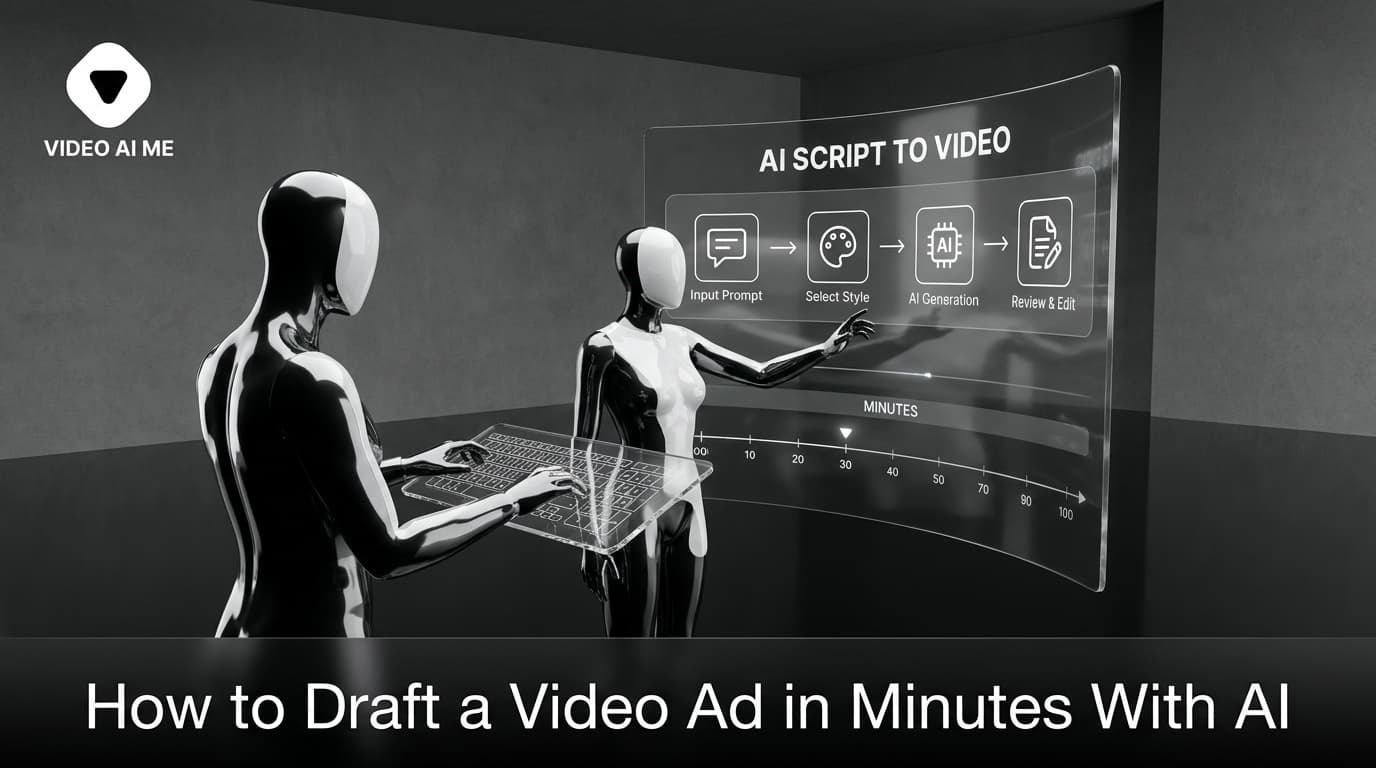
How to Draft a Video Ad in Minutes With AI
A repeatable routine for going from a product page to six testable video ad drafts in one sitting, using a fast model and single variable rewrites.
How Many Video Ad Variations Should You Test?
How many creatives a test actually needs, how different they have to be, and why the right number is set by what you can afford to produce.